Israel Is Using Starvation as a Weapon of War in Gaza and the World Has Failed to Stop It

Spread the love

Original article by RAMZY BAROUD republished from Common Dreams under Creative Commons (CC BY-NC-ND 3.0). 
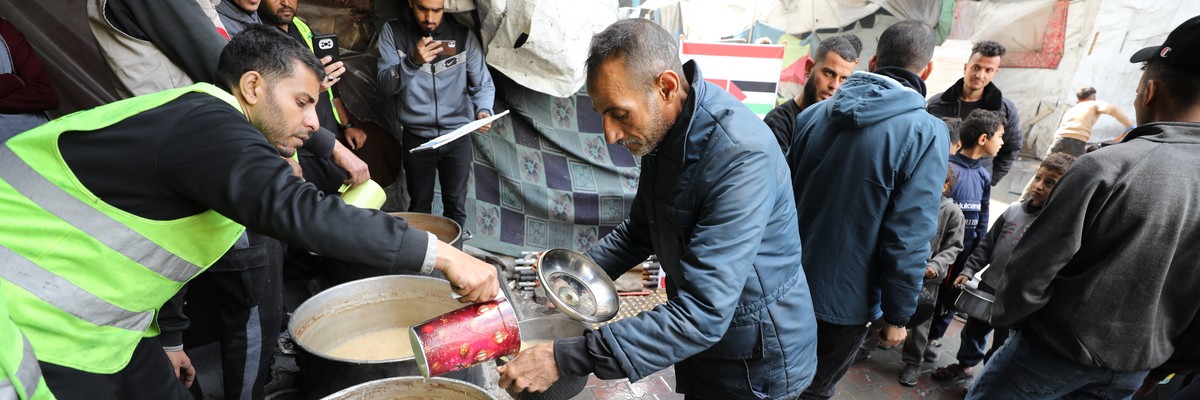
Relief workers distribute food in Gaza City, Gaza on March 14, 2024. (Photo: Dawoud Abo Alkas/Anadolu via Getty Images)

Providing aid to Gaza and ensuring the reconstruction of the strip must not be a political item for negotiations. It is a basic human right that must be honored under any circumstance.

Humanitarian aid should never be politicized though, quite often, the very survival of nations is used as political bargaining chips.

Sadly, Gaza remains a prime example. Even before the current war, the Gaza Strip suffered under a 17-year hermetic blockade, which has rendered the impoverished area virtually “unlivable.”

That very term, “unlivable” was used by the then-United Nations Special Rapporteur for the Situation of Palestine, Michael Lynk, in 2018.

Scenes and images of thousands of starving Palestinians chasing after boxes of aid parachuted into Gaza will remain etched in the collective memory of humanity as an example of our failed morality.

As of mid-December of last year, “nearly 70% of Gaza’s 439,000 homes and about half of its buildings have been damaged or destroyed,” The Wall Street Journal reported, citing experts who conducted a thorough analysis of satellite data.

As tragic as the situation was in December, now it is far worse.

Sixty-seven percent of Gaza’s water, sanitation facilities, and infrastructure have been destroyed or damaged, according to a statement by the United Nations Agency for Palestinian Refugees, UNRWA, on June 19, leading to the spreading of infectious diseases, which has ravaged the beleaguered population for months.

The spread of disease is also linked to the accumulation of garbage everywhere in Gaza. Earlier, the refugees agency reported that “as of June 9, over 330,000 tons of waste have accumulated in or near populated areas across Gaza, posing catastrophic environmental (and) health risks.”

The situation was already disastrous. Indeed, three years before the war, the Global Institute for Water, Environment, and Health (GIWEH) said, in a joint statement with the Euro-Mediterranean Human Rights Monitor, that 97% of Gaza water was undrinkable and unfit for human consumption.

Yet, so far, any conversation on allowing aid to Gaza, or the rebuilding of Gaza after the war, has been placed largely within political contexts.

By shutting down all border crossings, including the Egypt-Gaza Rafah Crossing—which, on June 17, was set ablaze—Israel has politicized food, fuel, and medicine as tools in its war in the strip.

This is not a mere inference, but the actual statement made by Israeli Minister of Defense Yoav Gallant, who on October 9 declared that he had ordered a “complete siege” and that “there will be no electricity, no food, no fuel, no water” entering Gaza.

The timing of the statement, which has indeed been put into action from the first day of the war, suggests that Israel did not apply the strategy as a last resort. It was one of the most important pieces in the war stratagem, which remains in effect to this day.

Instead of pressuring Israel, Washington tried to obtain its own political leverage, also by politicizing aid. On March 2, the U.S. Air Force started airdropping aid into northern Gaza. A far more conducive and less humiliating option for Palestinians, however, would have been direct U.S. pressure on Israel to allow access to aid trucks arriving through Rafah, Karem Abu Salem Crossing, or any other.

Scenes and images of thousands of starving Palestinians chasing after boxes of aid parachuted into Gaza will remain etched in the collective memory of humanity as an example of our failed morality.

News reports spoke of people who were killed under the weight of the dropped “aid,” much of which had fallen in the Mediterranean, never to be retrieved.

Even the Gaza pier, constructed by the U.S. military on the Gaza shore in May, did little to alleviate the situation. It merely transported 137 aid trucks, according to the U.S.’ own estimation, enough to cover Gaza’s need for food for a few hours only.

During the years of siege, an average of 500 trucks arriving daily in Gaza has kept the 2.3 million population of the strip alive, though malnourished.

To deal with the outcome of the war, and to stave off current starvation, especially in the north, the number of aid trucks would have to be much higher. Yet, whole days would pass without a single truck making its way to the suffering population. This is unacceptable.

Not only did the international community fail at ending the war, it has also failed in delinking humanitarian aid from political and military objectives.

The problem with politicizing aid is that innocent civilians become a bargaining chip for politicians and military men. This goes against the very foundation of international humanitarian law.

According to the International Committee of the Red Cross, citing the Hague Regulations, “international humanitarian law is the branch of international law that seeks to impose limits on the destruction and suffering caused by armed conflict.” In Gaza, no such “limits” have been “imposed” by anyone.

Providing aid to Gaza and ensuring the reconstruction of the strip must not be a political item for negotiations. It is a basic human right that must be honored under any circumstance.

Meaningful pressure must be placed on Israel to end the Gaza siege, and urgent plans must be drafted, starting today, by representatives of U.N. humanitarian institutions, the Arab League, and Palestinian and Gaza authorities to be the entities responsible for delivering aid to Gaza.

Humanitarian aid to Gaza must not be used as political leverage, or a tool in a cruel war, whose primary victims are millions of Palestinian civilians.

Original article by RAMZY BAROUD republished from Common Dreams under Creative Commons (CC BY-NC-ND 3.0). 

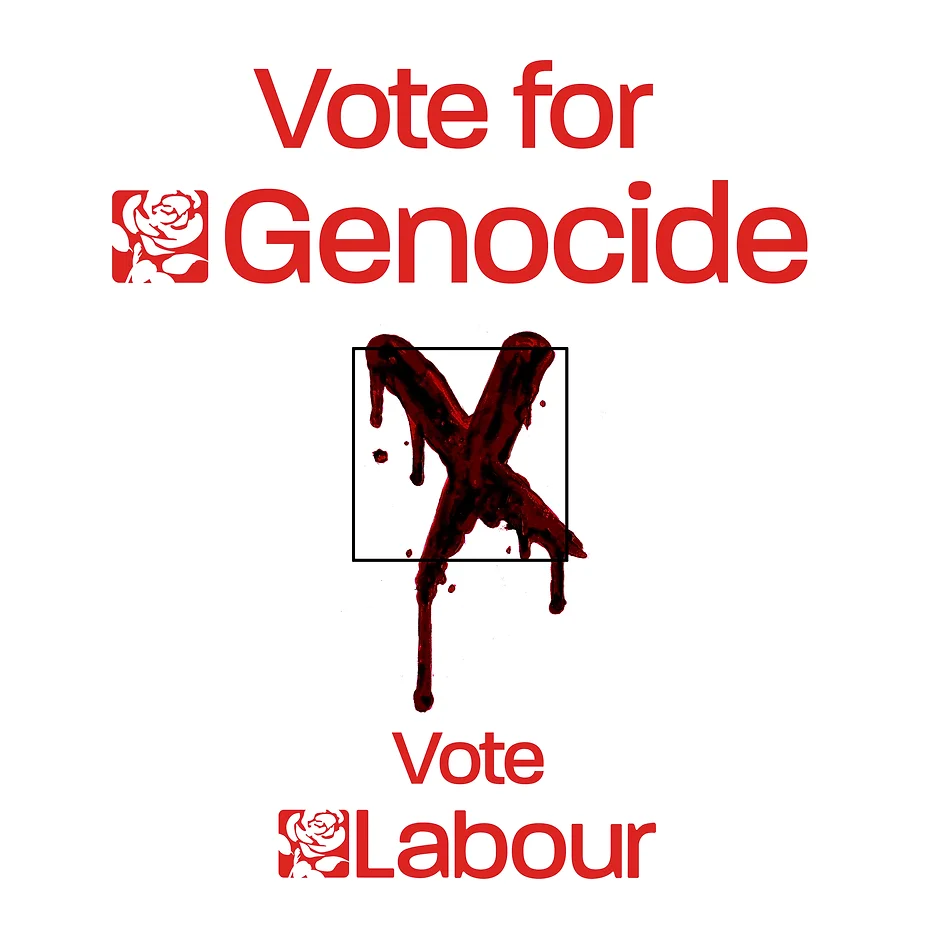
Vote For Genocide Vote Labour.

Zionist Keir Starmes is quoted "I support Zionism without qualification." He's asked whether that means that he supports Zionism under all circumstances, whatever Zionists do.
Zionist Keir Starmes is quoted “I support Zionism without qualification.” He’s asked whether that means that he supports Zionism under all circumstances, whatever Zionists do.
Continue ReadingIsrael Is Using Starvation as a Weapon of War in Gaza and the World Has Failed to Stop It

The Gaza Project Exposes Israel’s ‘Chilling Pattern’ of Killing Journalists

Spread the love

Original article by BRETT WILKINS republished from Common Dreams under a CC licence.

Forbidden Stories and its Gaza Project partners investigated Israel’s killing of journalists in Gaza and elsewhere.
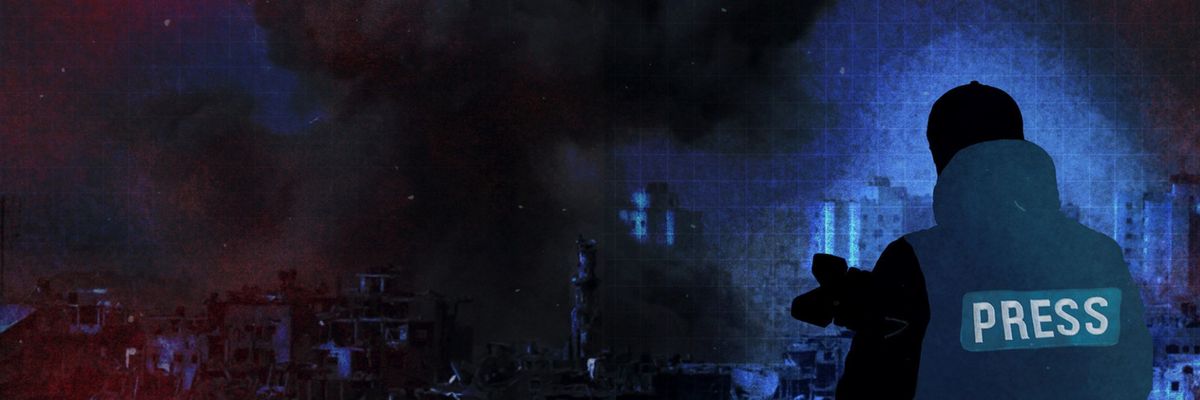
 (Illustration: Forbidden Stories/The Gaza Project)

“This is one of the most flagrant attacks on press freedom that I can remember,” said one campaigner. “The impact on press freedom in Gaza, in the region, and the rest of the world is something we cannot accept.”

With more than 100 media professionals—nearly all of them Palestinian—killed in Gaza since October, a group of 50 reporters from 13 international organizations this week shared the results of a new investigative journalism initiative aimed at exposing the deadly toll Israel’s onslaught has taken on those reporting it to the world.

The Gaza Project—led by the Paris-based nonprofit Forbidden Stories—”analyzed nearly 100 cases of journalists and media workers killed in Gaza, as well as other cases in which members of the press have been allegedly targeted, threatened, or injured since October 7,” when Hamas-led attacks on Israel left more than 1,100 people dead and over 240 others kidnapped.

“Faced with what is being reported as the record number of journalists killed, Forbidden Stories, whose mission is to pursue the work of journalists who are killed because of their work, set out to investigate the targeting of journalists,” the group said

“For four months, Forbidden Stories and its partners investigated the circumstances of their killings, as well as those who have been targeted, threatened, and injured in the West Bank and Gaza,” it added. “These investigations point to a chilling pattern and suggest some journalists may have been targeted even though they were identifiable as press.”

Gaza Project member Committee to Protect Journalists (CPJ) has condemned what it called an “apparent pattern of targeting journalists and their families,” noting cases in which media workers were killed while wearing press insignia and after being threatened by Israeli officials.

“This is one of the most flagrant attacks on press freedom that I can remember,” CPJ program director Carlos Martínez de la Serna said of the ongoing war. “The impact on press freedom in Gaza, in the region, and the rest of the world is something we cannot accept.”

Basel Khair Al-Din, a Palestinian journalist in Gaza who believes he was targeted by a drone strike while wearing a press vest, said, “Whereas this press vest was supposed to identify and protect us, according to international laws, international conventions, and the Geneva Conventions, it is now a threat to us.”

“It’s this vest that almost got us killed, as has happened to so many of our fellow journalists and media workers,” he added.

Groups like Human Rights Watch (HRW) and Amnesty International have called for official investigations into Israeli killing of journalists including an October 13 attack that killed 37-year-old Lebanese Reuters videographer Issam Abdallah and wounded half a dozen other journalists who were covering cross-border clashes between Israeli troops and Hezbollah fighters in southern Lebanon.

Dylan Collins, an American deputy editor at Al Jazeera English, was wounded while administering first aid to Christina Assi, an Italian Agence-France Presse journalist whose legs were blown off in the attack.

Reuters determined that an Israeli tank crew “fired two shells in quick succession” at the journalists, who HRW said were “clearly identifiable as members of the media, and had been stationary for at least 75 minutes.” HRW “found no evidence of a military target near the journalists’ location.”

Amnesty International, meanwhile, asserted that the Israel Defense Forces (IDF) strike was “likely a direct attack on civilians that must be investigated as a war crime.”

Asa Kasher, the lead author of the IDF’s Code of Ethics, told Forbidden Stories that “no member of the press should have been killed under normal circumstances of hostilities in Gaza.”

“It shouldn’t happen, even a single one,” he added. “It’s illegal. It’s unethical. The person who does it should be brought to court.”

Israel’s alleged deliberate targeting of journalists is part of the evidence presented in a South Africa-led genocide case against Israel being reviewed by the International Court of Justice in The Hague.

Separately, the chief prosecutor at the International Criminal Court (ICC), also located in the Dutch city, is seeking arrest warrants for Israeli Prime Minister Benjamin Netanyahu, Israeli Defense Minister Yoav Gallant, and three Hamas leaders for alleged war crimes and crimes against humanity including extermination and forced starvation in the case of the Israelis and extermination, rape, and torture in the case of Hamas.

The international press freedom group Reporters Without Borders last month filed a third ICC complaint alleging “war crimes against journalists in Gaza.”

According to Palestinian and international officials, at least 37,718 Palestinians—mostly women and children—have been killed during Israel’s 264-day assault on Gaza, which has also left more than 86,300 people wounded and 11,000 others missing and feared dead and buried beneath the rubble of hundreds of thousands of homes and other bombed-out buildings.

Around 90% of Gaza’s 2.3 million people have also been forcibly displaced, and the Israeli siege on Gaza has caused widespread—and deadly—starvation and what the head of the United Nations food agency called a “full-blown famine” in northern parts of the strip.

Original article by BRETT WILKINS republished from Common Dreams under a CC licence.

Zionist Keir Starmes is quoted "I support Zionism without qualification." He's asked whether that means that he supports Zionism under all circumstances, whatever Zionists do.
Zionist Keir Starmes is quoted “I support Zionism without qualification.” He’s asked whether that means that he supports Zionism under all circumstances, whatever Zionists do.

Continue ReadingThe Gaza Project Exposes Israel’s ‘Chilling Pattern’ of Killing Journalists

UN to Warn Half a Million Gazans Facing ‘Catastrophic’ Food Insecurity

Spread the love

Original article by BRETT WILKINS republished from Common Dreams under Creative Commons (CC BY-NC-ND 3.0).

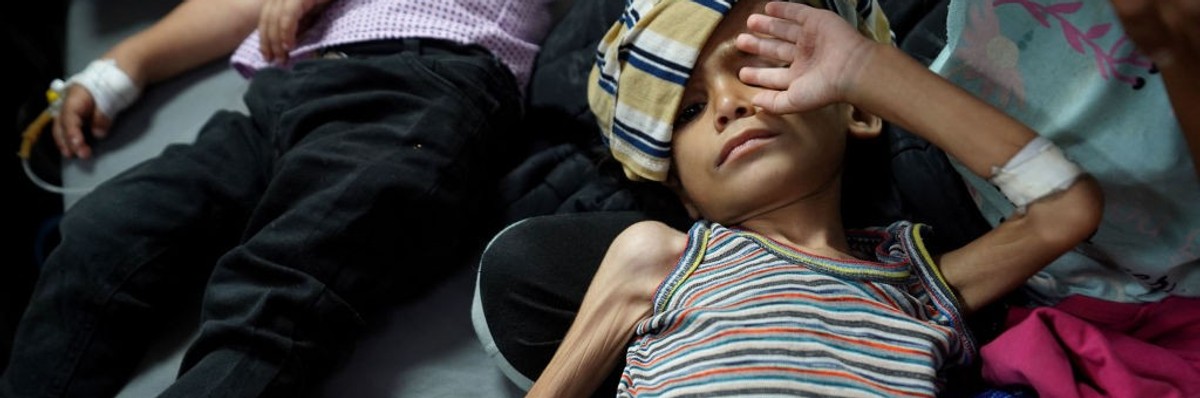
Children receive malnourishment treatment at Al-Aqsa Martyrs Hospital in Deir al-Balah in the central Gaza Strip on May 30, 2024, amid Israel’s ongoing assault on the besieged enclave. (Photo: Bashar Taleb/AFP via Getty Images)

“The international community must apply relentless pressure to achieve a cease-fire and ensure sustained humanitarian access now,” said one advocate.

More than 1 in 5 people in the Gaza Strip are “facing catastrophic levels of food insecurity” amid Israel’s relentless assault and siege against the Palestinian territory, according to a draft report set to be published Tuesday by the United Nations’ hunger monitoring system.

The latest Integrated Food Security Phase Classification (IPC) Acute Food Insecurity Special Snapshot—which was previewed by various news agencies—says that more than 495,000 Gazans—who already face “an extreme lack of food, starvation, and exhaustion”—are expected to suffer the highest level of starvation over the coming months.

The draft report states that while a sharp increase in food aid in northern Gaza in March and April can be credited with “likely averting a famine,” the situation is “deteriorating again following renewed hostilities.”

“A high risk of famine persists across the whole of the Gaza Strip as long as conflict continues and humanitarian access is restricted,” IPC noted.

The IPC draft report also says more than half of all Gaza households had to sell or swap clothing in order to obtain food, and that the majority of Gazan families often “do not have any food to eat in the house, and over 20% go entire days and nights without eating.”

“The population cannot endure these hardships any longer.”

Kate Phillips-Barrasso, vice president of global policy and advocacy at Mercy Corps, an Oregon-based humanitarian NGO, told The Guardian that “people are enduring subhuman conditions resorting to desperate measures like boiling weeds, eating animal feed, and exchanging clothes for money to stave off hunger and keep their children alive.”

“The humanitarian situation is deteriorating rapidly, and the specter of famine continues to hang over Gaza,” she added. “The international community must apply relentless pressure to achieve a cease-fire and ensure sustained humanitarian access now. The population cannot endure these hardships any longer.”

Although the IPC stopped short of the rare step of declaring a famine in Gaza, it warned that “the recent trajectory is negative and highly unstable.”

“Should this continue, the improvements seen in April could be rapidly reversed,” the agency added.

The IPC’s famine review panel previously said there is not enough data to make a determination on whether there is a famine in Gaza since research was being blocked by “conflict and humanitarian access constraints.”

The Geneva-based group Euro-Mediterranean Human Rights Monitor said Monday that “the Famine Review Committee’s inability to declare the current food situation in the Gaza Strip to be a famine does not negate the existence of famine in the strip, as pockets of famine are forming and spreading among different age groups, particularly children, and there is a noticeable increase in deaths from hunger, malnutrition, and related diseases.”

“The committee’s failure to declare the existence of a famine is solely related to its inability to provide certain technical information because of illegal Israeli restrictions and policies that aim to conceal evidence related to the crimes it commits and prevent criminal investigations into them by independent U.N. and international committees, particularly by preventing these committees from entering the strip,” the group added.

U.N. World Food Program Executive Director Cindy McCain said last month that “full-blown famine” had taken hold in Gaza and was spreading south. According to Gaza officials, at least 40 people—mostly children—have died from malnutrition and dehydration during the 262-day Israeli onslaught. Almost all of the victims are from northern Gaza.

Israel began bombing, and later invaded, Gaza after Hamas-led attacks left more than 1,100 Israelis and others dead and over 240 others kidnapped on October 7. At least some of the victims were killed by Israeli forces in so-called “friendly fire” incidents, according to Israeli and international media reports.

Since then, Israeli forces have killed at least 37,626 Palestinians—most of them women and children—in Gaza, while wounding over 86,000 others, according to Palestinian and international agencies. At least 11,000 people, including over 4,000 children, are missing and presumed dead and buried beneath the rubble of hundreds of thousands of bombed-out homes and other buildings.

Michael Fakhri, the United Nations special rapporteur on the right to food and a law professor at the University of Oregon, said in late February that Israel is committing genocide by intentionally starving Gazans. Israel’s siege—and Israeli attacks on humanitarian aid shipments, workers, and recipients—are being reviewed by the International Court of Justice as part of a South Africa-led genocide case backed by over 30 countries and regional blocs.

Original article by BRETT WILKINS republished from Common Dreams under Creative Commons (CC BY-NC-ND 3.0).

Over 20,000 Children Missing in Gaza, With ‘Unknown Number’ in Mass Graves: Report

‘Visible Signs of Wasting’: Heat, Forced Malnutrition Strangle People of Gaza

Biden Continues to Cement a Bloody and Immoral Legacy in Gaza

Continue ReadingUN to Warn Half a Million Gazans Facing ‘Catastrophic’ Food Insecurity

‘Historic, But So, So Late’: Israel Added to UN’s Child-Killing ‘List of Shame’

Spread the love

Original article by BRETT WILKINS republished from Common Dreams under Creative Commons (CC BY-NC-ND 3.0). 

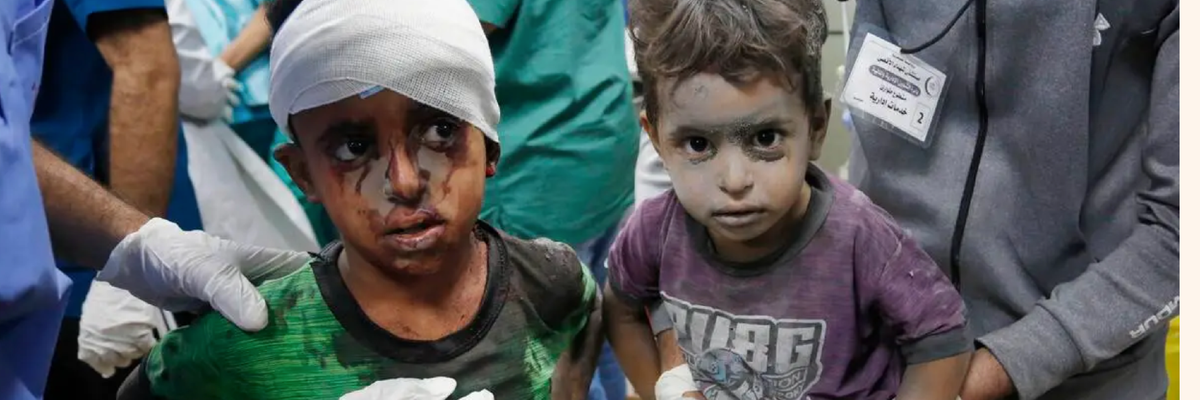
Palestinian children injured in Israeli attacks on Al-Maghazi refugee camp are brought to al-Aqsa Martyrs Hospital in Deir Al-Balah, Gaza on November 5, 2023.  (Photo: Ashraf Amra/Anadolu Agency)

“It took a genocide that killed 15,000 children and maimed and scarred thousands more but the U.N. has finally and rightly added Israel to its List of Shame,” said one Palestinian observer.

United Nations Secretary-General António Guterres informed Israel on Friday that, for the first time, it is being added to the so-called “List of Shame” of countries that kill and injure children during wars and other armed conflicts, a decision that infuriated Israeli officials but was welcomed by human rights defenders as long overdue.

The Secretary-General Office’s annual Children and Armed Conflict report—which is likely to be released publicly later this month—has included countries and militant groups such as Afghanistan, al-Qaeda, Boko Haram, Iraq, Islamic State, Myanmar, Russia, Somalia, Syria, and Yemen. This is believed to be the first time the list has included a nation hailed by Western governments as a democracy.

“It took a genocide that killed 15,000 children and maimed and scarred thousands more but the U.N. has finally and rightly added Israel to its List of Shame,” Palestinian political analyst Nour Odeh said on social media. “Arms embargo NOW!”

Meanwhile, Israeli Prime Minister Benjamin Netanyahu said that “the U.N. has put itself on the blacklist of history today when it joined the supporters of the Hamas murderers.”

“The IDF is the most moral army in the world and no delusional decision by the U.N. will change that,” added the prime minister, who International Criminal Court Prosecutor Karim Khan is seeking to arrest along with Israeli Defense Minister Yoav Gallant for alleged crimes including extermination.

This year’s 2024 List of Shame will also include Hamas, which led the October 7 attack that left more than 1,100 Israelis and others dead, including 38 children. Around 30 minors were also kidnapped by Hamas, all of whom are believed to have been freed. Khan wants to arrest three leaders of Hamas, whose members are accused of extermination, rape, and other crimes.

In retaliation, Israel launched an assault and siege on theGaza Strip—now on its 244th day—killing more than 36,700 Palestinians including at least 15,000 minors, according to Palestinian and international agencies. Some children have allegedly been sexually abused and executed by Israeli troops.

More children were killed in Gaza in the first four months of the war than in four years of conflict worldwide, in what Philippe Lazzarini, who heads the U.N. agency for Palestinian refugees, called a “war on children… their childhood, and their future.”

There are also tens of thousands of children among the more than 83,000 Palestinians wounded by Israeli bombs and bullets in Gaza. Hundreds of thousands of children have been forcibly displaced by Israel’s bombardment and invasion, but there’s no safe place for them to go.

The Israeli blockade of Gaza and obliteration of its healthcare infrastructure have exacerbated what the U.N.’s top food official has called a “full-blown famine” in the north and widespread starvation throughout the strip. Dozens of children have starved to death.

Israel’s conduct in the war is under investigation by the International Court of Justice in The Hague in a genocide case brought by South Africa and supported by more than 30 other nations and regional blocs.

The U.N. Children’s Fund (UNICEF) calls Gaza the most dangerous place in the world for children. The perils are not only physical; the annihilation of Gaza has also wrought tremendous psychological damage upon its children, many of whom have survived multiple Israeli campaigns.

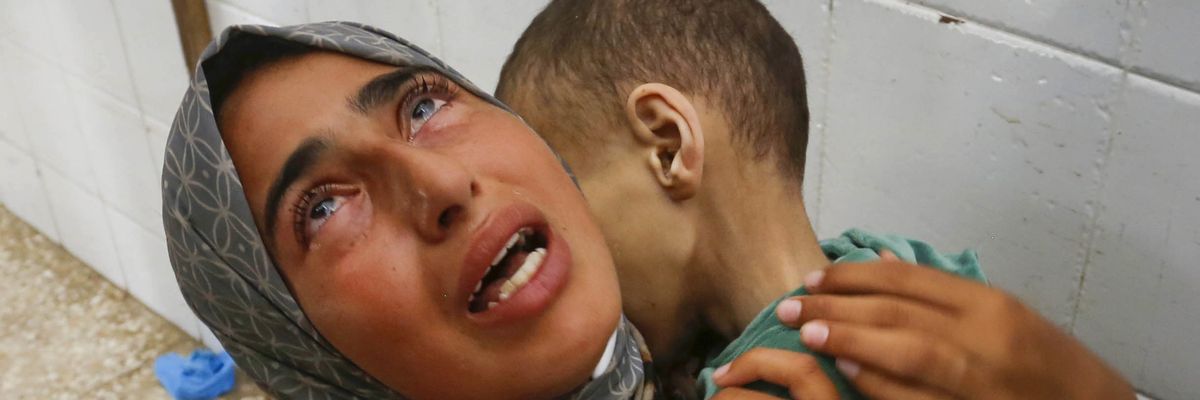
According to UNICEF, more than 17,000 Gazan children are now orphans, with some having lost their entire families to Israeli attacks. International medical workers have coined a new acronym for these children: WCNSF, or, wounded child, no surviving family.

Between 2000 and the start of the Gaza war, Israeli forces killed more than 2,300 children throughout Palestineaccording to Defense for Children International-Palestine. Prior to the current war, the highest number of Palestinian children killed in one year was 546 in 2014, when Israel carried out its Operation Protective Edge invasion of Gaza.

Despite all this killing, Israel was perennially given a pass from the List of Shame.

“Including Israel in the List of Shame is an urgent necessity to put an end to its severe and horrific violations and to protect the rights of Palestinian children. It is also crucial for maintaining the integrity and credibility of U.N. mechanisms, which are at risk of erosion due to double standards,” said Radhya Al-Mutawakel, who heads the Yemen-based group Mwatana for Human Rights.

Al-Mutawakel asserted that blacklisting Israel sends “a clear message that the U.N. stands firmly for the protection of children’s rights worldwide and will not tolerate violations against them” and also conveys “that the U.N. deals uniformly with all parties involved in grave violations against children, regardless of the perpetrators’ identities or the children’s backgrounds.”

Numerous Palestine advocates said Israel’s inclusion on the list of shame underscores the urgency of halting shipments of weapons used to kill Palestinian children.

“Israel is a terrorist nation,” said British union leader Howard Beckett. “Arms embargo. Sanctions. Hague.”

Original article by BRETT WILKINS republished from Common Dreams under Creative Commons (CC BY-NC-ND 3.0). 

Continue Reading‘Historic, But So, So Late’: Israel Added to UN’s Child-Killing ‘List of Shame’

Biden Claims Israel Isn’t Starving Gazans. Rights Groups Say ‘It Is Clear as Day’

Spread the love

Original article by JAKE JOHNSON republished from Common Dreams under Creative Commons (CC BY-NC-ND 3.0).

Palestinians wait in line to receive food distributed by charitable organizations amid Israeli attacks in Deir Al-Balah, Gaza on May 28, 2024. (Photo: Hassan Jedi/Anadolu via Getty Images)

“The fact that Israel is using starvation as a weapon of war in Gaza is not in contention,” said a Human Rights Watch researcher.

U.S. President Joe Biden said in an interview published Tuesday that he does not believe the Israeli government is using starvation as a weapon of warfare in Gaza, contradicting the findings of leading human rights organizations that have documented Israel’s deliberate obstruction of food aid as Palestinians die of malnutrition.

“No, I don’t think that,” Biden said in response to TIME magazine’s Washington bureau chief Massimo Calabresi and editor-in-chief Sam Jacobs, who noted some have “alleged that Israel is intentionally using starvation of civilians as a method of warfare.”

The president, who has approved more than 100 arms sales to Israel during its eight-month assault on the Gaza Strip, acknowledged that Israel’s military has “engaged in activity that is inappropriate” and that “Palestinians have suffered greatly.”

But he stopped well short of the conclusions reached by Oxfam InternationalHuman Rights Watch (HRW), and the International Criminal Court, which recently applied for arrest warrants against Israeli Prime Minister Benjamin Netanyahu and Defense Minister Yoav Gallant for their role in the “starvation of civilians as a method of warfare” and other war crimes.

The U.S. Agency for International Development has also determined that Israel has unlawfully impeded the delivery of humanitarian assistance to Gaza, leading to a “deterioration of food security and nutrition in Gaza [that] is unprecedented in modern history.”

“The fact that Israel is using starvation as a weapon of war in Gaza is not in contention. It is clear as day,” Hiba Zayadin, a researcher at HRW, wrote in response to Biden’s TIME interview, pointing to her group’s December report that found the Israeli military was “deliberately blocking the delivery of water, food, and fuel, while willfully impeding humanitarian assistance, apparently razing agricultural areas, and depriving the civilian population of objects indispensable to their survival.”

“The evidence is even stronger today,” Zayadin added, citing HRW’s April report that focused specifically on the Israeli military’s starvation of Gaza children. Dozens of Palestinian kids, some just months old, have died of malnutrition since October, a figure that is almost certain to grow as Israel’s bombing campaign and ground offensive in Rafah continue.

The World Food Program said Wednesday that unless Israel’s assault on Gaza ends and desperately needed humanitarian aid is allowed to flow, more than a million people in the occupied enclave “are expected to face death and starvation… by mid-July.”

Humanitarian groups and experts—including an outspoken former U.S. State Department official—have argued that by continuing to arm Israel and provide it with diplomatic cover on the world stage, the Biden administration is complicit in Gaza’s increasingly dire hunger crisis.

“This is not just turning a blind eye to the man-made starvation of an entire population, it is direct complicity,” Josh Paul, who resigned from the State Department in October over the administration’s support for Israel’s assault on Gaza, told The Independent last month.

In a speech on the floor of the U.S. Senate earlier this week, Sen. Bernie Sanders (I-Vt.) displayed photos of emaciated children as he explained his decision to boycott Netanyahu’s upcoming speech to Congress.

“Blocking humanitarian aid and creating the conditions for famine is not only an act of extreme cruelty—using starvation as an act of war—but it is a violation of both American and international law,” Sanders added. “It is a war crime.”

Original article by JAKE JOHNSON republished from Common Dreams under Creative Commons (CC BY-NC-ND 3.0).

Continue ReadingBiden Claims Israel Isn’t Starving Gazans. Rights Groups Say ‘It Is Clear as Day’