Biden Claims Israel Isn’t Starving Gazans. Rights Groups Say ‘It Is Clear as Day’

Spread the love

Original article by JAKE JOHNSON republished from Common Dreams under Creative Commons (CC BY-NC-ND 3.0).
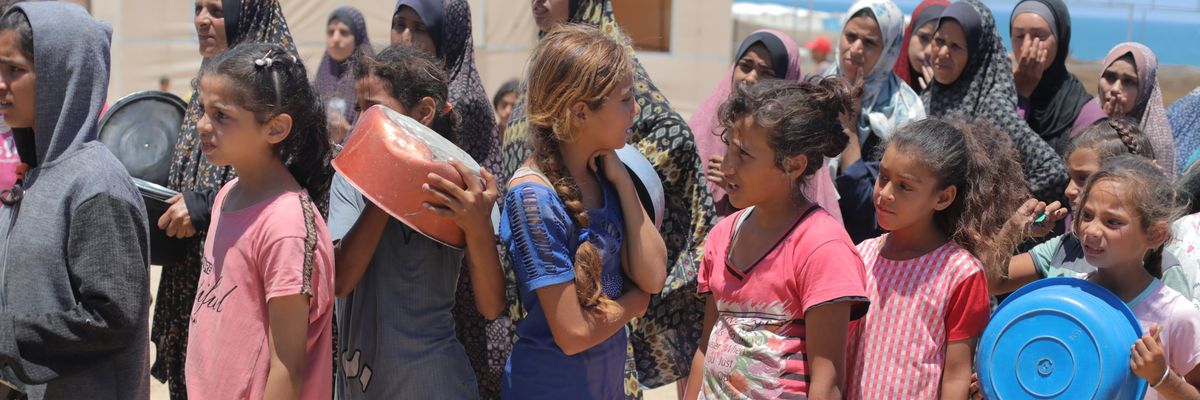
Palestinians wait in line to receive food distributed by charitable organizations amid Israeli attacks in Deir Al-Balah, Gaza on May 28, 2024. (Photo: Hassan Jedi/Anadolu via Getty Images)

“The fact that Israel is using starvation as a weapon of war in Gaza is not in contention,” said a Human Rights Watch researcher.

U.S. President Joe Biden said in an interview published Tuesday that he does not believe the Israeli government is using starvation as a weapon of warfare in Gaza, contradicting the findings of leading human rights organizations that have documented Israel’s deliberate obstruction of food aid as Palestinians die of malnutrition.

“No, I don’t think that,” Biden said in response to TIME magazine’s Washington bureau chief Massimo Calabresi and editor-in-chief Sam Jacobs, who noted some have “alleged that Israel is intentionally using starvation of civilians as a method of warfare.”

The president, who has approved more than 100 arms sales to Israel during its eight-month assault on the Gaza Strip, acknowledged that Israel’s military has “engaged in activity that is inappropriate” and that “Palestinians have suffered greatly.”

But he stopped well short of the conclusions reached by Oxfam InternationalHuman Rights Watch (HRW), and the International Criminal Court, which recently applied for arrest warrants against Israeli Prime Minister Benjamin Netanyahu and Defense Minister Yoav Gallant for their role in the “starvation of civilians as a method of warfare” and other war crimes.

The U.S. Agency for International Development has also determined that Israel has unlawfully impeded the delivery of humanitarian assistance to Gaza, leading to a “deterioration of food security and nutrition in Gaza [that] is unprecedented in modern history.”

“The fact that Israel is using starvation as a weapon of war in Gaza is not in contention. It is clear as day,” Hiba Zayadin, a researcher at HRW, wrote in response to Biden’s TIME interview, pointing to her group’s December report that found the Israeli military was “deliberately blocking the delivery of water, food, and fuel, while willfully impeding humanitarian assistance, apparently razing agricultural areas, and depriving the civilian population of objects indispensable to their survival.”

“The evidence is even stronger today,” Zayadin added, citing HRW’s April report that focused specifically on the Israeli military’s starvation of Gaza children. Dozens of Palestinian kids, some just months old, have died of malnutrition since October, a figure that is almost certain to grow as Israel’s bombing campaign and ground offensive in Rafah continue.

The World Food Program said Wednesday that unless Israel’s assault on Gaza ends and desperately needed humanitarian aid is allowed to flow, more than a million people in the occupied enclave “are expected to face death and starvation… by mid-July.”

Humanitarian groups and experts—including an outspoken former U.S. State Department official—have argued that by continuing to arm Israel and provide it with diplomatic cover on the world stage, the Biden administration is complicit in Gaza’s increasingly dire hunger crisis.

“This is not just turning a blind eye to the man-made starvation of an entire population, it is direct complicity,” Josh Paul, who resigned from the State Department in October over the administration’s support for Israel’s assault on Gaza, told The Independent last month.

In a speech on the floor of the U.S. Senate earlier this week, Sen. Bernie Sanders (I-Vt.) displayed photos of emaciated children as he explained his decision to boycott Netanyahu’s upcoming speech to Congress.

“Blocking humanitarian aid and creating the conditions for famine is not only an act of extreme cruelty—using starvation as an act of war—but it is a violation of both American and international law,” Sanders added. “It is a war crime.”

Original article by JAKE JOHNSON republished from Common Dreams under Creative Commons (CC BY-NC-ND 3.0).

Continue ReadingBiden Claims Israel Isn’t Starving Gazans. Rights Groups Say ‘It Is Clear as Day’

ANDREW FEINSTEIN: WHY I AM STANDING AGAINST KEIR STARMER

Spread the love

https://www.declassifieduk.org/andrew-feinstein-why-i-am-standing-against-keir-starmer/

Zionist Keir Starmer supports Israel's Gaza genocide.
Zionist Keir Starmer supports Israel’s Gaza genocide. He needs to hold his seat to become prime minister.

Labour’s leader thinks he can get away with supporting genocide in Gaza. It’s time to teach him a lesson in his own backyard.

Our democracy is in crisis. The two main parties are virtually indistinguishable in their offers of permanent austerity, forever wars and environmental degradation. 

Keir Starmer, the MP for Holborn and St. Pancras where my family and I have lived for around 22 years, is emblematic of this crisis. His politics are mendacious, unprincipled and in the interests of his billionaire donors rather than the constituents he was elected to serve.

I have seen real leadership in action: I was privileged to serve under Nelson Mandela as an MP in South Africa. His leadership was selfless, principled, accountable, transparent and honest. Everything that Keir Starmer is not.

His almost immediate abandonment of many of the ten progressive pledges on which he was elected to lead the Labour Party is a clear sign he cannot be trusted. 

Starmer has now gone a step too far by refusing to support an unqualified ceasefire and a halt to arms sales to Israel amid the greatest human tragedy since World War Two: the genocide being committed in Gaza. 

How is it possible that a former human rights lawyer, who must see the horrific images that we all view on our screens every day, has not even commented on the highest court in the world’s interim ruling that Israel is likely committing genocide and ethnic cleansing? 

Article continues at https://www.declassifieduk.org/andrew-feinstein-why-i-am-standing-against-keir-starmer/

Continue ReadingANDREW FEINSTEIN: WHY I AM STANDING AGAINST KEIR STARMER

UN Food Chief Says Northern Gaza Suffering ‘Full-Blown Famine’

Spread the love

Original article by BRETT WILKINS republished from Common Dreams under Creative Commons (CC BY-NC-ND 3.0). 

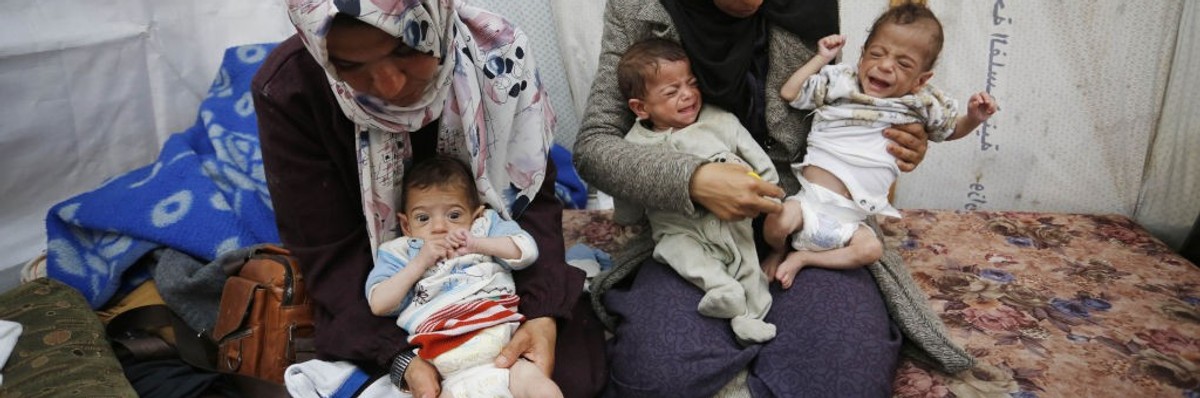
The infant triplets of Palestinian mother Nuzha Awad face the threat of dying from malnutrition and lack of medical care due to constant Israeli attacks and blockades as they take shelter in Nuseirat camp in Deir al Balah, Gaza on March 25, 2024. (Photo: Ashraf Amra/Anadolu via Getty Images)

“And it’s moving its way south,” she warned.

United Nations World Food Program Executive Director Cindy McCain said Friday that Palestinians in the northern Gaza Strip are experiencing “full-blown famine” after nearly seven months of Israeli bombardment and invasion—and that deadly malnutrition is “moving its way south” through the embattled enclave.

While U.N. agencies have warned since March that famine was imminent in Gaza, McCain’s remarks—which came during an interview with Kristen Welker that is scheduled to air on Sunday’s edition of NBC News‘ “Meet the Press”—make her the most high-profile international official to date to publicly acknowledge a state of famine in parts of the Palestinian territory.

“It’s horror,” said McCain, who is American. “There is famine—full-blown famine—in the north, and it’s moving its way south.”

McCain’s remarks come as hundreds of thousands of Gazans are on the brink of starvation. Dozens of Palestinians—the vast majority of them children and infants—have already died of malnutrition and dehydration in northern Gaza.

According to Palestinian and international officials, Israel’s 211-day assault on Gaza—which many experts including Israelis call genocidal—has killed or maimed more than 123,000 Palestinians since the Hamas-led October 7 attacks, including an estimated 11,000 people who are believed to be dead and buried beneath the ruins of the hundreds of thousands of destroyed or damaged homes and other buildings.

In addition to not allowing adequate humanitarian aid into Gaza, Israeli forces have also repeatedly attacked both aid workers and desperate civilians trying to access the lifesaving provisions.

“What we are asking for and what we continually ask for is a cease-fire and the ability to have unfettered access, to get in safe through the various ports and gate crossings,” McCain said during the interview.

On Saturday, Hamas spokesperson Osman Hamdan said there have been “some forward steps” toward a cease-fire agreement during negotiations in Egypt. Egyptian mediators proposed a six-week cessation of hostilities, the release of an unspecified number of Israeli and international hostages, and a partial withdrawal of Israeli forces from Gaza.

However, one Israeli official told ABC News on condition of anonymity Saturday that “Israel will under no circumstances agree to the end of the war as part of an agreement to release our abductees.”

The negotiations come as Israeli forces prepare for an expected ground invasion of Rafah, Gaza’s southernmost city, where more than a million refugees forcibly displaced from other parts of the strip are sheltering alongside around 280,000 local residents. On Friday, the U.N.’s humanitarian agency warned that an Israeli ground invasion of Rafah would put hundreds of thousands of Palestinians “at imminent risk of death.”

Original article by BRETT WILKINS republished from Common Dreams under Creative Commons (CC BY-NC-ND 3.0). 

Continue ReadingUN Food Chief Says Northern Gaza Suffering ‘Full-Blown Famine’

Gaza war: ‘no evidence’ of Hamas infiltration of UN aid agency, says report – but US and UK dither on funding while famine takes hold

Spread the love
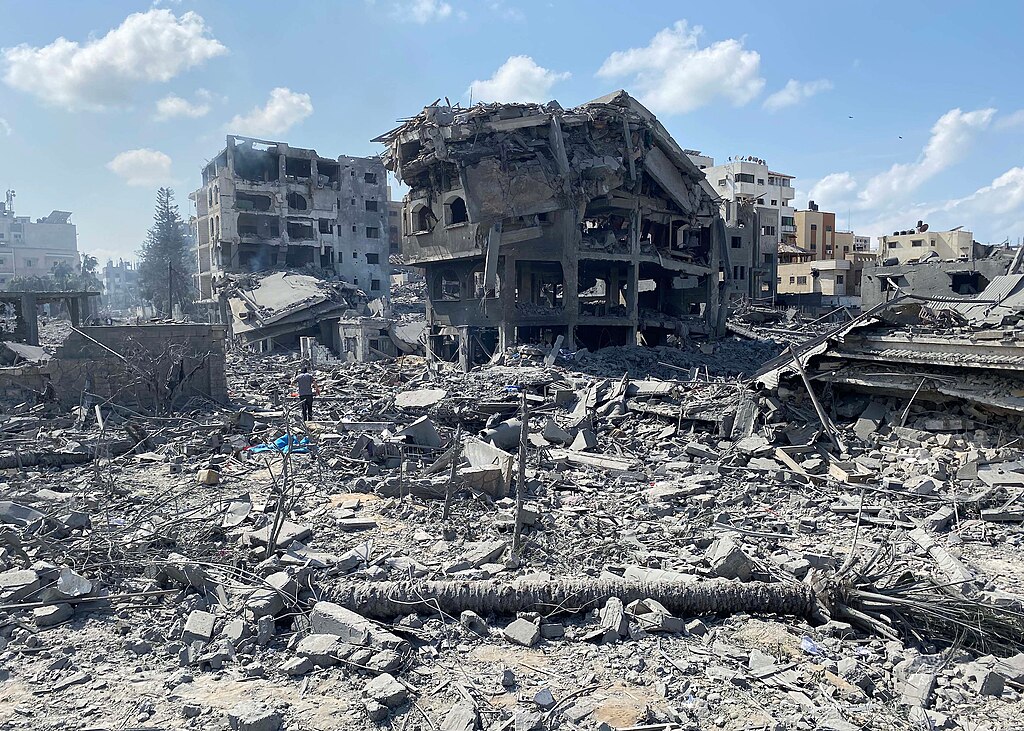
Palestinians inspect the damage following an Israeli airstrike on the El-Remal aera in Gaza City on October 9, 2023. Israel continued to battle Hamas fighters on October 10 and massed tens of thousands of troops and heavy armour around the Gaza Strip after vowing a massive blow over the Palestinian militants' surprise attack. Photo by Naaman Omar apaimages. licensed under the Creative Commons Attribution-Share Alike 3.0 Unported license.
Palestinians inspect the damage following an Israeli airstrike on the El-Remal aera in Gaza City on October 9, 2023. Israel continued to battle Hamas fighters on October 10 and massed tens of thousands of troops and heavy armour around the Gaza Strip after vowing a massive blow over the Palestinian militants’ surprise attack. Photo by Naaman Omar apaimages. licensed under the Creative Commons Attribution-Share Alike 3.0 Unported license.

Anne Irfan, UCL

Germany has become the latest country to resume its funding to Unrwa, the United Nations agency that provides essential relief services to nearly 6 million Palestinian refugees. The decision came after an independent review found no evidence to support Israel’s claim that the agency has been infiltrated by Hamas.

Germany is the agency’s second-biggest funder – and the move is especially striking in view of its extremely close political alignment with Israel, which is now coming under increasing strain.

All eyes are now on the US, the agency’s largest supporter, to see if it will reinstate the US$350 million (£280 million) it typically provides each year. Meanwhile in the UK, MPs have written to foreign minister David Cameron, demanding that funding is restored “without delay”.

Reaction from the Israeli government has been hostile. In a statement, Israel’s foreign ministry spokesman said that “this is not what a true and comprehensive investigation looks like”, adding “it is impossible to say where Unrwa ends and Hamas begins”. The Israeli government did not provide any further detail or evidence for this claim.

Israel alleged in January that 12 of Unrwa’s 13,000 employees in Gaza had participated in the October 7 attacks. Shortly afterwards, the government went on to claim that hundreds of Unrwa employees are members of Hamas or Islamic Jihad, in breach of the UN’s neutrality principles.

In response, Unrwa commissioner-general Philippe Lazzarini immediately fired nine of the accused 12 (of the other three, two are dead and one is missing). Meanwhile, the UN secretary-general, António Guterres, ordered an independent review into Unrwa’s neutrality practices.

That review was chaired by former French foreign minister Catherine Colonna and carried out by staff of Nordic research bodies – the Swedish-based Raoul Wallenberg Institute of Human Rights and Humanitarian Law, the Norwegian Chr. Michelsen Institute and the Danish Institute for Human Rights.

The report makes good reading for Unrwa. Colonna and her team described its work as an “indispensable lifeline” for Palestinians and noted the agency’s robust neutrality framework.

Crucially, they also found that Israel has provided no evidence for its allegations that a significant number of Unrwa employees belong to militant groups.

Donor response

In response to the original Israeli allegations, 16 governments paused or suspended funding to the agency. This threw Unrwa’s work into an escalating crisis. With the agency having already suffered from a serious financial deficit for many years, management warned that it could run out of money entirely in a matter of weeks.

The withdrawal of core funds heightened the humanitarian catastrophe in Gaza, where Unrwa provides essential services to 87% of the population, including food assistance to 1 million Palestinians. The UN special rapporteur on the right to food advised that the defunding made famine in Gaza inevitable.

Not long afterwards, a group of aid organisations confirmed that human-made famine has now taken hold.

With the Colonna report finding no evidence to support the allegations, serious questions are now raised about the speed with which so many states withdrew their funding. Many governments had already reinstated funding for Unrwa after Colonna’s interim report was released last month. These included Australia, Japan, Finland, Iceland,
Sweden and Canada.

Since the final report’s publication, EU humanitarian chief Janez Lenarcic has called on others to follow suit. But there are so far no signs that the US – Unrwa’s biggest donor for decades – will.

Congress recently passed a budget banning any financing of Unrwa for the next 12 months. This means there is little possibility of a policy reversal, even if the Biden administration was amenable to it. By the time that budget expires in March 2025, the next US presidential election may have returned the White House to Trump – who completely defunded the agency during his previous presidency.

The UK government has also so far resisted calls to reinstate funding to Unrwa, meaning there may be a limit to the Colonna report’s impact on this front.

Israel’s stance

The accusations levelled against Unrwa in January follow years of Israeli attacks on the agency. The prime minister, Benjamin Netanyahu, first called for Unrwa to be disbanded back in 2017 and has repeated his demand regularly since then.

Observing this, several observers, including Omar Shakir, the Israel-Palestine director at Human Rights Watch, have concluded that the Israeli discourse on Unrwa is really driven by the political objective of undermining Palestinian refugee rights.

They may now point to further evidence of this in the Colonna report, which notes that although Unrwa has provided Israel with its staff lists annually since 2011, the government had never previously raised any concerns.

The report also throws further doubt on Netanyahu’s post-war plan for Gaza, which proposes that Unrwa be shut down and replaced by other international aid groups. It is unclear how this would work in practice, as Israel has provided no specifics.

What’s more, Colonna and her team found that Unrwa actually has “a more developed approach to neutrality than other similar UN or NGO entities” – raising questions about whether neutrality is really the issue here.

Amid the political discussions, it is crucial not to lose sight of what is at stake. A man-made famine is threatening lives across the Gaza Strip. More than 2 million Palestinians are struggling to survive after Israeli attacks have killed more than 34,000 people over the past six months.

With Unrwa providing a critical lifeline, any decision about its funding has serious repercussions – with the most vulnerable people in Gaza paying the ultimate price.The Conversation

Anne Irfan, Lecturer in Interdisciplinary Race, Gender and Postcolonial Studies, UCL

This article is republished from The Conversation under a Creative Commons license. Read the original article.

Continue ReadingGaza war: ‘no evidence’ of Hamas infiltration of UN aid agency, says report – but US and UK dither on funding while famine takes hold

‘It’s death there’: babies and children hit hardest as famine tightens hold on Gaza

Spread the love

https://www.theguardian.com/world/2024/apr/15/babies-children-gaza-famine

Estimated 27 children killed by famine, with fears many more will suffer lifelong effects, despite Israel’s promise of more aid

Even if the war in Gaza ended tomorrow, for some of the Palestinian territory’s children, it would not help. Hunger and malnutrition have already claimed an estimated 27 young lives, and for many more, it may be too late to reverse the excruciating toll that starvation takes on small, growing bodies.

Nuzha Awad’s triplets, Malek, Khader and Moustafa, born two months before the war began when Hamas attacked Israel on 7 October, did not stop crying as she spoke to the Guardian. She fled Gaza City when food and formula for her babies began to run out; in their new home, a makeshift tent in the central town of Deir al-Balah, she is still desperately afraid for their futures.

“At this age a child should weigh 8 kilos. They weigh 2 kilos … They don’t have thighs yet. At this stage they are supposed to be crawling and preparing to walk. And now you can see the state they’re in,” she said.

“Are these the arms of an eight-month-old child? … It’s death there, death, death. Death in the literal meaning of the word.”

UN-backed food insecurity experts assessed in mid-March that famine n Gaza could set in between later that month and mid-May. Last week, Samantha Power, the head of the US humanitarian and development agency, USAid, became the first American official to confirm publicly that in some areas, famine had already taken hold.

https://www.theguardian.com/world/2024/apr/15/babies-children-gaza-famine

Continue Reading‘It’s death there’: babies and children hit hardest as famine tightens hold on Gaza