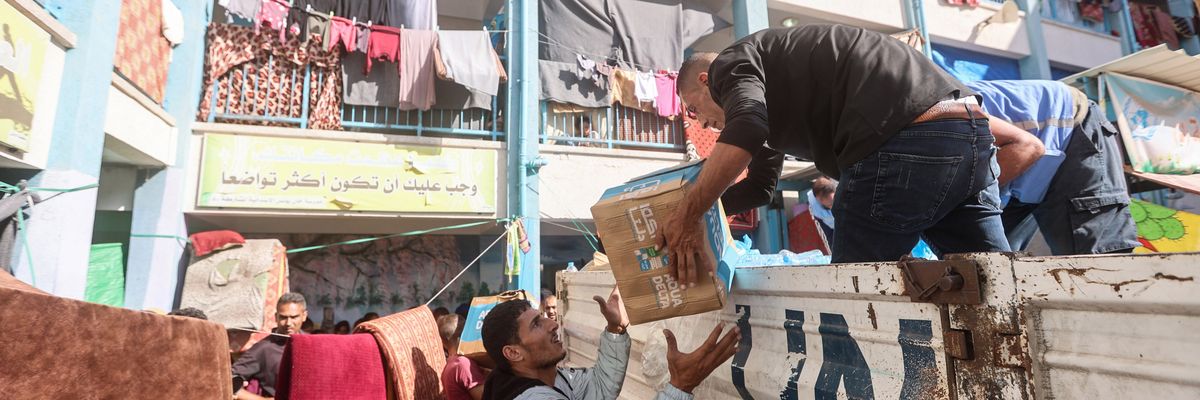
United Nations workers and volunteers unload aid from a truck at a school housing displaced Palestinians on the 29th day of fighting between Israel and the armed Palestinian factions in Khan Yunis on November 8, 2023. (Photo: Ahmed Zakot/SOPA Images/LightRocket via Getty Images)
“By preventing UNRWA to fulfill its mandate in Gaza, the clock will tick faster toward famine and many more will die of hunger, dehydration, and lack of shelter,” UNRWA’s commissioner-general said.
Israel will no longer permit the United Nations Relief and Works Agency for Palestine Refugees in the Near East to drive convoys bearing food aid into northern Gaza, even as the area is on the brink of famine.
Israeli officials informed the U.N. of the new restrictions on Sunday, prompting outrage and dire warnings from U.N. officials and other human rights advocates.
“By preventing UNRWA to fulfill its mandate in Gaza, the clock will tick faster toward famine and many more will die of hunger, dehydration, and lack of shelter,” UNRWA Commissioner-General Philippe Lazzarini posted on social media. “This cannot happen, it would only stain our collective humanity.”
“I have urged Israel to lift all impediments on aid to Gaza. Now this—MORE impediments.”
In his response, Lazzarini said that UNRWA was the largest organization operating in Gaza with the greatest capability to distribute aid.
“This is outrageous and makes it intentional to obstruct lifesaving assistance during a man-made famine,” Lazzarini said. “These restrictions must be lifted.”
The news comes as medical workers and international aid organizations have sounded the alarm about famine in Gaza. At least 23 children in northern Gaza have already died from starvation or dehydration, and one-third of children under two years old suffer from acute malnutrition, according to the United Nations’ International Children’s Emergency Fund. A new Integrated Food Security Phase Classification report published on March 18 found that famine was “imminent” in Gaza’s northern governorates and likely to begin “anytime” between the report’s publication and May. In the northern governorates, where around 300,000 live, almost two-thirds of households endured at least 10 days and nights when they did not eat at all in the last 30 days.
“Blocking UNRWA from delivering food is in fact denying starving people the ability to survive,” World Health Organization Director-General Tedros Adhanom Ghebreyesus said on social media. “This decision must be urgently reversed. The levels of hunger are acute. All efforts to deliver food should not only be permitted but there should be an immediate acceleration of food deliveries.”
U.N. Under-Secretary-General for Humanitarian Affairs and Emergency Relief Coordinator Martin Griffiths also called for Israel’s decision to be “revoked.”
“I have urged Israel to lift all impediments on aid to Gaza. Now this—MORE impediments,” Griffiths posted on social media, calling UNRWA the “beating heart of the humanitarian response in Gaza.”
UNRWA Communications Director Juliette Touma told BBC World on Monday that a quarter of a million people in the north rely on UNRWA food aid, yet the agency has not been able to deliver to them in two months. An attempt on February 5 had to turn back after the Israeli Navy fired on an aid convoy even as it traveled along a pre-approved route.
Touma told BBC World that more than 1 million people in Gaza now live in UNRWA shelters.
“They lost everything, and they need everything,” Touma said.
Touma added that the most important commodity people in Gaza need is food, but they also need “safety, and they need protection, above all, and a cease-fire, which is very, very much overdue.”
The U.N. Security Council finally succeeded in passing a resolution on Monday calling for an immediate cease-fire in Gaza and the release of all hostages as the U.S. abstained from the vote.
Outside the U.N., former Human Rights Watch executive director Kenneth Roth said on social media that the food aid decision showed Israeli Prime Minister Benjamin Netanyahu’s “starvation strategy at work,” as well as his “vendetta against Palestinian refugees.”
CEO of Medical Aid for Palestinians Melanie Ward also decried Israel’s decision to permanently block UNRWA convoys from the north.
“This would be a death sentence for thousands,” Ward said on social media. “They cannot be allowed to do this.”
Over 100 Palestinians were killed and hundreds more wounded on February 29, when Israeli snipers opened fire on people approaching a convoy of trucks carrying desperately needed supplies of flour. The attack was quickly dubbed the flour massacre.
Corporate media reporting was contentious and confused, mired in accusations and conflicting details that filled the news hole, even as media downplayed the grave conditions in Gaza created by Israel’s engineered famine. With headlines layered in verbal opacity, the massacre prompted yet another egregious moment in media’s facilitation of Israel’s continuing genocide in Gaza.
Linguistic gymnastics
This New York Times headline (2/29/24) was described as “a haiku to avoid saying Israel massacres Palestinians that they’re deliberately starving in Gaza.”
On the day of the massacre, the New York Times (2/29/24) published this contrivance:
“As Hungry Gazans Crowd a Convoy, a Crush of Bodies, Israeli Gunshots and a Deadly Toll”
It was met with ridicule as it slid across online platforms. Assal Rad (Twitter, 3/1/24), author and research director at the Iranian American Council, called the piece of work “a haiku to avoid saying Israel massacres Palestinians that they’re deliberately starving in Gaza.”
Another Times headline (2/29/24) read, “Deaths of Gazans Hungry for Food Prompt Fresh Calls for Ceasefire.” Nima Shirazi, co-host of the podcast Citations Needed (Twitter, 3/1/24), noted that “the New York Times just can’t bring itself to write clear headlines when Israeli war crimes are involved.” Shirazi offered this revision: “Israel Slaughters Starving People as It Continues Committing Genocide.”
Professor Jason Hickel (Twitter, 2/29/24), along with Mint Press‘s Alan MacLeod (2/29/24), flagged the use of the neologism “food aid–related deaths” when it turned up in a Guardian headline (2/29/24): “Biden Says Gaza Food Aid–Related Deaths Complicate Ceasefire Talks.” MacLeod noted, “Virtually the entire Western media pretend they don’t know who just carried out a massacre of 100+ starving civilians.”
Linguistic gymnastics—a longstanding plague pervading Western media coverage of Palestine (FAIR.org, 8/22/23)—were so popular in news headlines and reporting that Caitlin Johnstone (Consortium News, 3/1/24) compiled a list of them, adding “chaotic incident” (CNN, 2/29/24) and “chaotic aid delivery turns deadly” (Washington Post, 2/29/24) to those already mentioned.
Sana Saeed, media critic for Al Jazeera, decoded the latter kind of construction for AJ+ (3/29/24), arguing that such passive language has been used “consistently to sanitize the violence that a powerful state is unleashing against civilian populations.”
As the genocide enters its sixth month, media analysts, investigative reporters and social media users have become adept at recognizing pro-Israeli contortions and patterns of language that justify Israel’s war on Gaza. This has become an essential aspect in exposing Israel’s genocide.
‘Anarchy rules in Gaza’
Economist (2/29/24): “As with many events in the war between Israel and Hamas, the facts are destined to remain fiercely contested.”
The Economist (2/29/24), under the headline, “A New Tragedy Shows Anarchy Rules in Gaza: A Shooting and Stampede Kill 122 and Injure Hundreds,” went into the worst pro-Israel spin, with reporting that seemed to blame Palestinians for their own murders. Parroting Israeli press directives, the piece claimed Palestinians were killed by “trampling” each other in their own “stampede.”
The piece was written in literary prose: “Death descended on a coastal road in Gaza,” the reporter (not present at the scene) wrote. Then “catastrophe befell an aid convoy,” as if it merely happened upon bad luck.
Then the writer made a prediction: “As with many events in the war between Israel and Hamas, the facts are destined to remain fiercely contested.” That’s likely to come true, especially when major media outlets abdicate their responsibility for evaluating claims.
Timeline of changing denials
Even in special “Verify” mode, the BBC (3/1/24) can’t bring itself to say in a headline who it was that killed Gazans.
Many other writers and journalists have documented the string of vacillating Israeli statements that help explain the contorted reporting. Al Jazeera reporter Willem Marx (Twitter, 3/1/24) traced a timeline of how the Israeli military changed its story over the course of the day.
The IDF began by claiming there had been trampling and pushing that led to injuries around the aid truck. Then, hungry Palestinians had “threatened their soldiers,” or “appeared in a threatening manner,” so the IDF shot at them. Later that day, Israeli officials claimed there were two separate incidents, one that involved trampling and the other that led to shooting. By the end of the day, they alleged only to have provided support to a humanitarian convoy, and that no shots were fired at all by the military.
When the BBC (3/1/24) verified that a video released by the Israeli military exhibited four unexplained breaks in the footage and was therefore invalid, the outlet still used the passive voice, referring in the headline to “Gazans Killed Around Aid Convoy.” One sentence of the detailed, confused article quoted Palestinian journalist Mahmoud Awadeyah: “Israelis purposefully fired at the men…. They were trying to get near the trucks that had the flour.” Earlier, however, Awadeyah was problematized when identified “as a journalist for Al Mayadeen, a Lebanon-based news station whose broadcasts are sympathetic to groups fighting Israel.”
Independent and international media
“Israel’s use of food as a weapon of war reaches new heights,” Mondoweiss (3/4/24) reported.
If we compare corporate outlets to independent media, in which reporting was based on ground sources, humanitarian actors and aid workers, we find very different content.
Al Jazeera reporter Ismail al-Ghoul (2/29/24), who was at the scene of the massacre, said that “after opening fire, Israeli tanks advanced and ran over many of the dead and injured bodies. It is a massacre, on top of the starvation threatening citizens in Gaza.”
EuroMed staff (2/29/24) on the scene confirmed that the Israeli military had fired on starving Palestinians. EuroMed’s findings were summarized in a videotape by Palestinian news agency Quds News Network and posted by the Palestine Information Center (3/4/24).
Mondoweiss (3/4/24) reported details of the massacre from eyewitness accounts. One survivor recounted how an Israeli checkpoint “split the crowd in two,” preventing those who had entered the checkpoint from passing back to the northern side. Then Israeli soldiers opened fire on the crowd. International observers visited the injured survivors at al-Shifa’ Hospital, “confirming that the majority of wounds from the hundreds of injured people were due to live ammunition.”
In context of famine
Middle East Eye (2/29/24) put IDF claims in the context of a Gaza “on the brink of famine as a result of the Israeli blockade.”
Reporting in the alternative press also placed the massacre within the context of the rapidly increasing famine in Gaza.
The headline for the Electronic Intifada (2/29/24) read, “Palestinians Seeking Food Aid Killed as Israel Starves Gaza.” The outlet said an “engineered famine has taken hold in Gaza, with people resorting to eating wild plants with little nutritional value and animal feed to survive.”
Middle East Eye’s reporting (2/29/24) included the dire condition Palestinians are currently facing: “Much of Gaza’s population is on the brink of famine as a result of the Israeli blockade, according to the UN and other humanitarian organizations.”
The day of the massacre, Democracy Now! (2/29/24) opened its broadcast with a clear statement and the relevant context: “Israel Kills 104 Palestinians Waiting for Food Aid as UN Expert Accuses Israel of Starving Gaza.” Its first guest, UN special rapporteur on the right to food Michael Fakhri, said, “Every single person in Gaza is hungry.” He accused Israel of the war crime of intentional starvation. He emphasized that famine in the modern context is a human-made catastrophe:
At this point I’m running out of words to be able to describe the horror of what’s happening and how vile the actions have been by Israel against the Palestinian civilians.
Common Dreams (3/3/24) reported on Israel’s obstruction of aid convoys, and cited UNICEF on the deaths of children who
died of starvation and dehydration at a hospital in northern Gaza as Israeli forces continue to obstruct and attack aid convoys, fueling desperation across the territory…. People are hungry, exhausted and traumatized. Many are clinging to life.
It concluded, “These tragic and horrific deaths are man-made, predictable and entirely preventable.”
In the days before the massacre, numerous outlets had been documenting the growing famine looming over Gaza. This is the material independent media made use of for contextualizing the massacre.
The New York Times, on the other hand, put the massacre into an entirely different context. A piece (3/2/24) headlined “Disastrous Convey Was Part of New Israeli Effort for More Aid in Gaza,” cited as confirmation “Western diplomats, who spoke on condition of anonymity.” It said that international aid groups “suspended operations” because of “rising lawlessness,” as well as Israel’s refusal to “greenlight aid trucks.” It blamed starving Gazans by claiming that aid convoys had been looted either by “civilians fearing starvation” or by “organized gangs.”
‘How is this not a bigger story?’
“How is this not a bigger story?” one observer asked of this Al Jazeera report (3/6/24).
As Common Dreams and Mondoweiss reported, the flour massacre was not the first time the IDF killed starving Palestinians, and it would not be the last. As Mondoweiss (3/4/24) put it: “In less than a week, Israel has committed several massacres against the hungry. On Sunday, March 3, Israel bombed an aid convoy, killing seven people.”
Quds News Network (3/2/24) reported that Israel targeted hungry civilians again at Al Rasheed Street in northern Gaza while they were waiting for humanitarian aid. And Quds (3/4/24) reposted Al Jazeera footage that captured the moments when Israel’s military opened fire at other hungry Gazans, this time at the Al Kuwait roundabout, as they looked for food aid.
Al Jazeera (3/6/24) continues to document the murders of Palestinians desperate for aid as they come under Israeli fire. On a longer videotape, a spokesperson for Human Rights Watch says these attacks violate ICJ orders:
The idea that these people are being killed as they scavenge for meager rations of food is just appalling, and is a reminder why there must be international immediate action to prevent further mass atrocities.
Following the Al Jazeera report, Assal Rad (Twitter, 3/6/24) expressed dismay:
Israeli attacks on Palestinians waiting for or attempting to get aid have repeatedly happened this week, yet there has been no media coverage since the massacre that killed over 100 people. Israel is attacking civilians it’s deliberately starving. How is this not a bigger story?
Normalizing starvation and massacres
The Floutist (11/16/23) addresses “the perversion of language that the defense of Israel’s violence requires.”
So just to be clear: Much like how Israel normalized attacking and destroying hospitals, and it was accepted by the international community, Israel is now normalizing shooting and killing the people it is starving as they seek food.
Media have failed to inform the US public on the horrific conditions experienced by starving civilians in Gaza. They blamed Palestinians for their own deaths, covering for the Israeli military as it carried out a massacre. They further dehumanized Palestinians by characterizing starving people as an unruly mob who trampled one another.
To paraphrase Patrick Lawrence (Floutist, 11/16/23) on the distortion of language in defense of Israel’s violence against Palestinians: It corrupts our public discourse, our public space, and altogether our ability to think clearly. This corruption is as vital as US bombs to the Israeli genocide against Palestine: Without these verbal distortions that justify, distract, deny and consume corporate information spaces, the genocide could not be carried out.
FAIR’s work is sustained by our generous contributors, who allow us to remain independent. Donate today to be a part of this important mission.
U.S. Rep. Alexandria Ocasio-Cortez (D-N.Y.) pleads for a suspension of U.S. military aid to Israel during a March 22, 2024 speech on the floor of the House of Representatives in Washington, D.C. (Photo: Rep. Alexandria Ocasio-Cortez/YouTube screen grab)
“The time is now to force compliance with U.S. law and the standards of humanity.”
Progressive Congresswoman Alexandria Ocasio-Cortez took to the House floor Friday to demand a suspension of U.S. military aid to Israel as it wages a genocidal war on Gaza and deliberately starves Palestinians to death in the besieged enclave.
“As we speak, in this moment, 1.1 million innocents in Gaza are at famine’s door. A famine that is being intentionally precipitated through the blocking of food and global humanitarian assistance by leaders in the Israeli government,” Ocasio-Cortez (D-N.Y.) said during her speech. “This is a mass starvation of people, engineered and orchestrated following the killing of another 30,000, 70% of whom were women and children.”
“If you want to know what an unfolding genocide looks like, open your eyes,” she continued. “It looks like the forced famine of 1.1 million innocents. It looks like thousands of children eating grass as their bodies consume themselves, while trucks of food are slowed and halted just miles away. It looks like good and decent people who do nothing. Or too little. Too late.”
“As we speak, in this moment, 1.1 million innocents in Gaza are at famine’s door.”
Noting that much of the death and devastation in Gaza was “accomplished with U.S. resources and weapons,” the congresswoman pointed out that “it is against United States law to provide weapons to forces who block United States humanitarian assistance.”
“That is exactly what is happening right now,” she said. “So much so that the president himself stated, during the State of the Union, that the United States must and will be building its own port to let aid through. It will be too late.”
“The time is now to force compliance with U.S. law and the standards of humanity,” the lawmaker asserted. “And fulfill our obligations to the American people to suspend the transfer of U.S. weapons to the Israeli government in order to stop and prevent further atrocity.”
There is no world in which the forced famine of 1.1 million people cannot be considered genocide. And that is exactly what we are watching unfold in Gaza now.
We must enforce U.S. laws and halt weapons transfers to the Israeli government to stop an atrocity in the making. pic.twitter.com/N40Jk3yKc7
— Rep. Alexandria Ocasio-Cortez (@RepAOC) March 22, 2024
Ocasio-Cortez related that “a decent man” once said: “‘Preventing genocide is an achievable goal, a goal that requires a level of government organization and engagement that matches in its intensity the brutality and efficiency required to carry out mass killing. Too often, these efforts have come too late, after the best and least costly opportunities to prevent them have been missed.’”
“The man who said that was then-Vice President and now President Joseph Biden,” she revealed. “And he was right.”
Ocasio-Cortez was referring to a 2011 speech during which Biden told an audience at the United States Holocaust Memorial Museum that “when a state engages in atrocity, it forfeits its sovereignty.”
This, as U.S. troops were committing atrocities while violating the sovereignty of Afghanistan, Iraq, Libya, Pakistan, Yemen, and Somalia as the Obama administration continued and expanded the so-called War on Terror launched after 9/11 by then-President George W. Bush.
“This is not just about Israel or Gaza. This is about us,” Ocasio-Cortez added. “The world will never be the same. And we will never be the same. And we must write our story in this moment, of what it means and who we are as Americans. And our story must be not that we were good men who did nothing. But that we were a committed democracy that did something.”
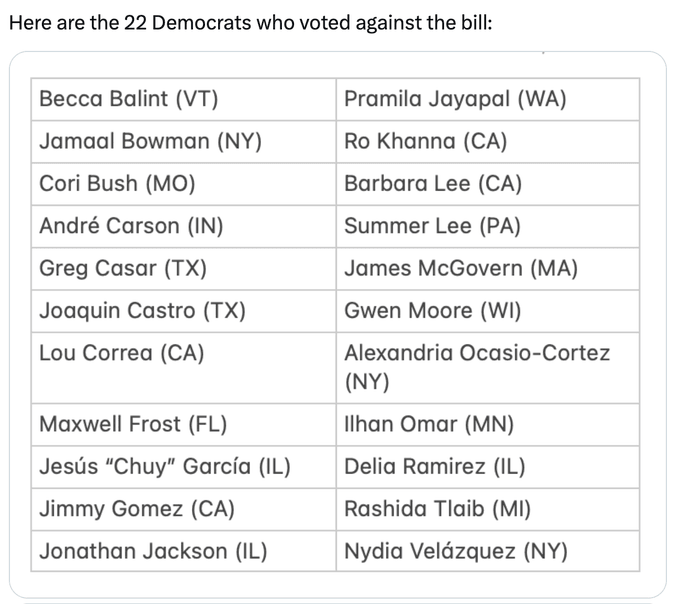
Ocasio-Cortez’s plea came as her House colleagues voted 286-134 on Friday to extend U.S. sanctions on the United Nations Relief and Works Agency for Palestine Refugees in the Near East (UNRWA) until March 2025, while authorizing another $3.8 billion in military aid to Israel. Ocasio-Cortez was one of just 22 House Democrats to vote against the measure, which also authorizes more than $1 trillion in spending on U.S. militarization.
Responding to unfounded Israeli claims—reportedly resulting from torture—that 12 of UNRWA’s more than 13,000 workers in Gaza took part in the October 7 attacks on Israel, the U.S. and more than a dozen other countries suspended funding for the lifesaving agency, even as famine loomed amid Israel’s relentless bombardment and siege. Numerous nations have since reinstated financing for UNRWA, most recently Finland on Friday.
The Biden administration—which is seeking an additional $14.3 billion in military aid for Israel—continues to support the country’s war on Gaza even as evidence mounts that the key ally is violating an International Court of Justice order to avoid genocidal acts. However, the administration has ramped up its criticism of Israeli war crimes, with Biden imploring the Israel Defense Forces to stop its “indiscriminate bombing” of civilians and Secretary of State Antony Blinken this week asserting that “children should not be dying of malnutrition in Gaza.”
“It’s time for the president to bring real leverage to bear, in accordance with existing U.S. law, and suspend military assistance to Israel.”
But they are dying, and critics say U.S. humanitarian airdrops and construction of an aid port are essentially meaningless as long as Washington also continues to back Israel’s genocidal onslaught. And now the world is watching as Israeli Prime Minister Benjamin Netanyahu and members of his far-right government vow to invade Rafah, where around 1.5 million Palestinians—the vast majority of them refugees forcibly expelled from other parts of Gaza—are sheltering.
“The Biden administration has rightly been sounding the alarm about the threatened Israeli incursion into Rafah, and the looming famine resulting from Israel’s indiscriminate war on Gaza,” said Matt Duss, executive vice president of the Center for International Policy. “But the devastating last five months have shown the limits of the power of words.”
“It’s time for the president to bring real leverage to bear, in accordance with existing U.S. law, and suspend military assistance to Israel,” Duss added. “We applaud Congresswoman Ocasio-Cortez’s courageous call today for President Biden to do that.”
High Representative of the European Union for Foreign Affairs and Security Policy Josep Borrell attends a press conference on October 2, 2023 in Kyiv, Ukraine. (Photo: Eduard Kryzhanivskyi/Global Images Ukraine via Getty Images)
“This famine is not a natural disaster. It is not a flaw. It is not an earthquake. It is entirely man-made,” said Josep Borrell, the E.U.’s foreign affairs chief.
The European Union’s top foreign affairs official on Monday said that after more than five months of Israel’s blocking of humanitarian aid and bombardment of Gaza, the U.S.-backed government has pushed the enclave into famine.
Josep Borrell, the E.U.’s high representative for foreign affairs and security policy, demanded that Western governments clearly state the reason that at least two of Gaza’s five governorates have now been identified by the Integrated Food Security Phase Classification global initiative (IPC) as experiencing famine “with reasonable evidence.”
“In Gaza we are no longer on the brink of famine; we are in a state of famine, affecting thousands of people,” Borrell said in Brussels at a meeting on humanitarian aid for the besieged enclave. “This is unacceptable. Starvation is used as a weapon of war.”
“By whom? Let’s dare to say by whom. By the one that prevents humanitarian support entering into Gaza,” he said, adding that “Israel is provoking famine.”
EU foreign policy chief Josep Borrell: "In Gaza we are no longer on the brink of famine. We are in a state of famine. It is not a flood. It is not an earthquake. It is entirely man made. By whom? Lets dare to say it, by whom? … Israel is provoking famine" pic.twitter.com/FztKdE7MRZ
Borrell’s remarks signify that the E.U. has now accepted that “that Israel is starving Gaza,” said journalist Owen Jones, with “straightforward genocidal intent.”
The IPC, which was established in 2004 by the United Nations and international humanitarian groups, said Monday that since the analysis it conducted in December—in which it warned of famine by May if a cessation of hostilities did not take place—the conditions needed to prevent such a catastrophe have not been met.
Famine in Gaza’s northern governorates is now projected to take hold between mid-March and May, the IPC said.
“According to the most likely scenario, both North Gaza and Gaza Governorates are classified in IPC Phase 5 (famine) with reasonable evidence, with 70% (around 210,000 people) of the population in IPC Phase 5 (catastrophe),” said the initiative.
The group uses the famine classification when at least one of three conditions has been observed:
At least 20% of households have an extreme lack of food;
At least 30% of children suffer from acute malnutrition; and
At least two adults or four children for every 10,000 people die daily from starvation or from disease linked to malnutrition.
At least 27 children in Gaza have now died of malnutrition in recent weeks, according to local authorities, as Israel has attacked civilians seeking humanitarian aid numerous times and has blocked deliveries.
The E.U. said Monday that just 100 tonnes of aid per day are reaching Gaza, compared with 500 tonnes that entered the enclave daily before Israel’s current bombardment.
The entire population of 2.2 million people is now facing high levels of “acute food insecurity,” according to the IPC.
Dr. Hussam Abu Safiya, head of the pediatric department at Kamal Adwan Hospital in northern Gaza, told Medical Aid for Palestinians (MAP) that the facility is seeing the daily effects of Israel’s blocking of aid.
“Amid the famine in the north, there are many cases of elderly people and especially children showing symptoms of dehydration and malnutrition,” said the doctor. “Twenty-five to 30 children are admitted to the hospital on a daily basis, with half of them suffering from dehydration and malnutrition. One child, two months old, died today because of dehydration and malnutrition. Other children are on the same trajectory unless the situation is addressed soon.”
Meanwhile, he said, medical workers themselves are “suffering from physical weakness and extreme exhaustion” as they try to treat people injured in relentless bombings and gunfire.
“As a medical team managing the hospital, we have not been able to secure even one meal,” said Abu Safiya. “Our staff are worn out working 24/7 without food.”
Borrell pointed to recent comments by German Chancellor Olaf Scholz to Israeli Prime Minister Benjamin Netanyahu, in which Scholz warned: “We cannot stand by and watch Palestinians starve.”
“This famine is not a natural disaster. It is not a flaw. It is not an earthquake. It is entirely man-made,” said Borrell. “Chancellor Scholz is saying Europeans cannot sit and watch Palestinian starving, when on the other side of the border there is food for months accumulated in stocks, while on the other side of the road there are people dying of hunger.”
Rose Caldwell, CEO of children’s rights group Plan International, added that the “entirely man-made catastrophe should be a source of shame for the international community.”
“After months of unimaginable trauma and indiscriminate bombing, the children of Gaza are now facing the horror of starvation and the threat of imminent famine,” said Caldwell. “There can be no excuses: preventing access for humanitarian aid is a clear violation of international humanitarian law. The starvation of civilians as a method of warfare is illegal and immoral.”
The IPC has classified only two other humanitarian crises as famines: one in Somalia, which killed 490,000 people in 2011, and one in South Sudan, which killed 80,000 people in 2017.
At least 31,726 Palestinians have been killed by the Israel Defense Forces since it began its bombardment.
“Before the war, Gaza was the greatest open air prison,” said Borrell. “Today it is the greatest open air graveyard.”
Melanie Ward, CEO of MAP, noted that the organization warned in January that its physicians were seeing evidence of severe malnutrition in children.
“World leaders have fiddled at the edges rather than take decisive action which addresses the cause of this starvation,” said Ward. “Now world leaders must insist that Israel immediately opens all land crossings into Gaza, particularly the Karni and Erez crossings, and allows safe and unfettered access for aid and aid workers.”
“Children in Gaza are being starved at the fastest rate the world has ever known,” she added, “and their survival depends on more food, fuel, and water entering Gaza immediately, as well as a lasting cease-fire.”
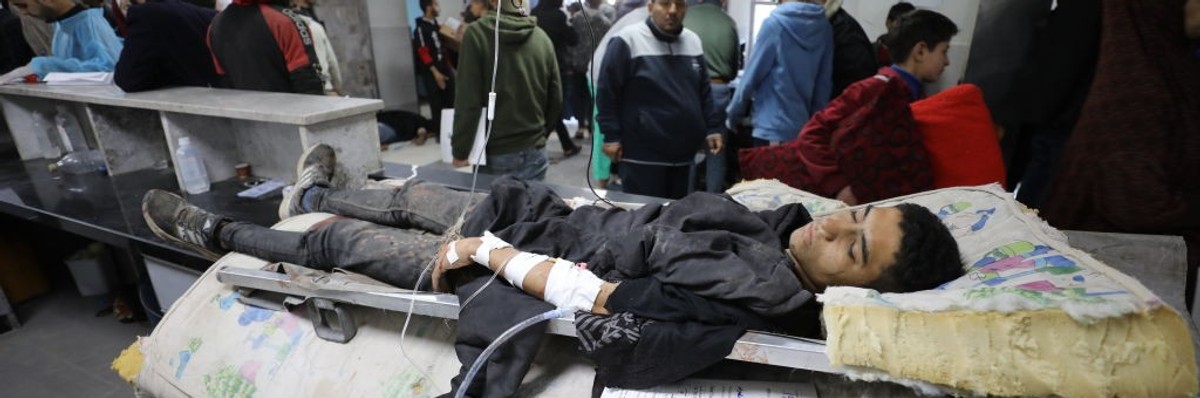
Injured Palestinians receive medical treatment in al-Shifa Hospital in Gaza City after Israeli forces open fire on starving people waiting for humanitarian aid trucks on February 29, 2024. (Photo: Dawoud Abo Alkas/Anadolu via Getty Images
A preliminary investigation by Euro-Mediterranean Human Rights Monitor affirmed that bullets that killed and wounded hundreds of Palestinians waiting for food aid are the same type fired by Israeli troops’ guns.
Bullet wounds caused by the same type of large-caliber ammunition used in several Israel Defense Forces rifles and machine guns undercut Israeli officials’ dubious claim that most victims of last week’s “Flour Massacre” near Gaza City died in a stampede, one human rights monitor said Wednesday.
Gaza officials said at least 118 Palestinians were killed and 760 others injured when Israeli troops shot and shelled a large crowd of starving people waiting for food distribution in the al-Nabulsi Roundabout area south of Gaza City on February 29. Israeli officials said many or most of the victims were trampled as the large crowd of people starving due to Israel’s siege and blockade of Gaza desperately rushed aid trucks.
However, Dr. Mohammed Salha, the acting director of Al-Awda Hospital, told reporters last Friday that more than 80% of Flour Massacre victims treated at the facility suffered gunshot wounds. A United Nations team that visited al-Shifa Hospital in Gaza City found “a large number of gunshot wounds” among the 200 or so patients being treated there.
On Wednesday, the Geneva-based Euro-Mediterranean Human Rights Monitor, which is investigating the massacre, said that many victims suffered injuries from 5.56×45 mm NATO bullets, which are used in various guns carried by Israel Defense Forces (IDF) troops including M4 and Tavor assault rifles and IWI Negev light machine guns.
“A sample of 200 dead and injured victims revealed that they were indeed hit by this type of bullet, and that the bullets were discovered and examined at the massacre site along with shrapnel found in the bodies of the wounded and dead,” the group said.
Israel imports some of its 5.56 mm rounds from the United Kingdom, where Palestine advocates are calling for an investigation and the suspension of arms exports to the country.
This investigation from @EuroMedHR is startling: the UK Govt must investigate claims that UK-exported 5.56x45mm NATO bullets were used in Israel's Flour Massacre. Given what we know already, continuing to license arms exports to Israel is unconscionable⬇️https://t.co/hTNeqBenfU
Numerous Flour Massacre survivors have described how Israeli troops opened fire on them while they attempted to secure food for their starving families.
“We had been waiting for hours when we finally spotted the trucks. At that very moment, the Israeli occupation opened fire at us with gunfire and artillery shelling,” Hajj Mahmoud Daghmash toldThe Palestine Chronicle earlier this week. “Fear filled all our hearts, and people started running everywhere. We didn’t know where to hide. The screams of the wounded, women, and children were heard everywhere.”
“The occupation killed us twice,” Daghmas added. “Once when it shelled our homes, and then again by starving us.”
A group of U.N. special rapporteurs on Tuesday condemned the massacre and Israel’s policy of deliberately starving Gazans to death and attacking humanitarian aid and those delivering and receiving it.
“Israel has been intentionally starving the Palestinian people in Gaza since October 8. Now it is targeting civilians seeking humanitarian aid and humanitarian convoys,” the U.N. experts said. “Israel must end its campaign of starvation and targeting of civilians.”
On January 26, the International Court of Justice in The Hague found that Israel is “plausibly” committing genocide in Gaza and ordered the Israeli government to prevent genocidal acts. However, the U.N. experts asserted that “Israel is not respecting its international legal obligations, is not complying with the provisional measures of the International Court of Justice, and is committing atrocity crimes.”
“Israel systematically denies and restricts the entry of humanitarian aid into Gaza by intercepting deliveries at checkpoints, bombing humanitarian convoys, and shooting at civilians seeking humanitarian assistance,” they said.
IDF troops have also stood by as extremist Israeli civilians block roads at border crossings to prevent aid from entering Gaza. At one encampment, organizers erected a children’s bouncy castle and served cotton candy, popcorn, and slushies.
Starvation and dehydration deaths have added a ghastly new dimension to a war in which at least 30,717 Palestinians—mostly women and children—have been killed and more than 72,000 others maimed by Israeli bombs and bullets, according to Gaza officials and international human rights groups.
“Fifteen children have already died of malnutrition at Kamal Adwan Hospital in Gaza City, and there are fears that the figures could be higher in other hospitals,” the U.N. Office of the High Commissioner for Human Rights said on Tuesday. “As the risk of famine continues to rise, all children under five—335,000—are at high risk of severe malnutrition, with serious negative impact on their development and their right to health. At least 90% of children under five are affected by one or more infectious diseases, and 70% have diarrhea.”
It’s not just small children anymore. The Gaza Health Ministry said Wednesday that a 15-year-old died at al-Shifa Hospital and a 72-year-old man died at Kamal Adwan Hospital from malnutrition and dehydration.
“Famine in northern Gaza has reached fatal levels, especially for children, pregnant women, and patients with chronic diseases,” ministry spokesperson Ashraf al-Qudra said. “Thousands of people are at risk of dying of starvation.”
Israeli assaults on humanitarian aid convoys and starving Palestinians have continued, including a Sunday attack that killed and wounded scores of people at the Kuwait Roundabout south of Gaza City.
Breaking | According to the spokesperson for the Gaza Health Ministry, Israeli forces have perpetrated another devastating massacre at the Kuwaiti Roundabout in Gaza today. This has led to the killing of dozens of starving Gazans awaiting aid convoys. pic.twitter.com/BkaBEUMdud
Airdrops of food and humanitarian aid by Jordan and the United States—which also supplies Israel with the bombs being dropped on Gazans—have been decried as wholly insufficient to address the crisis.
“I don’t think the airdropping of food in the Gaza Strip should be the answer today,” Philippe Lazzarini, who heads the U.N. agency for Palestinian refugees, said late last week. “The real answer is: Open the crossing and bring convoys and bring meaningful assistance into the Gaza Strip.”