Labour Ignores Coal Mine-Shaped Elephant in the Room

Spread the love

Original article by Tommy Greene republished from DeSmog
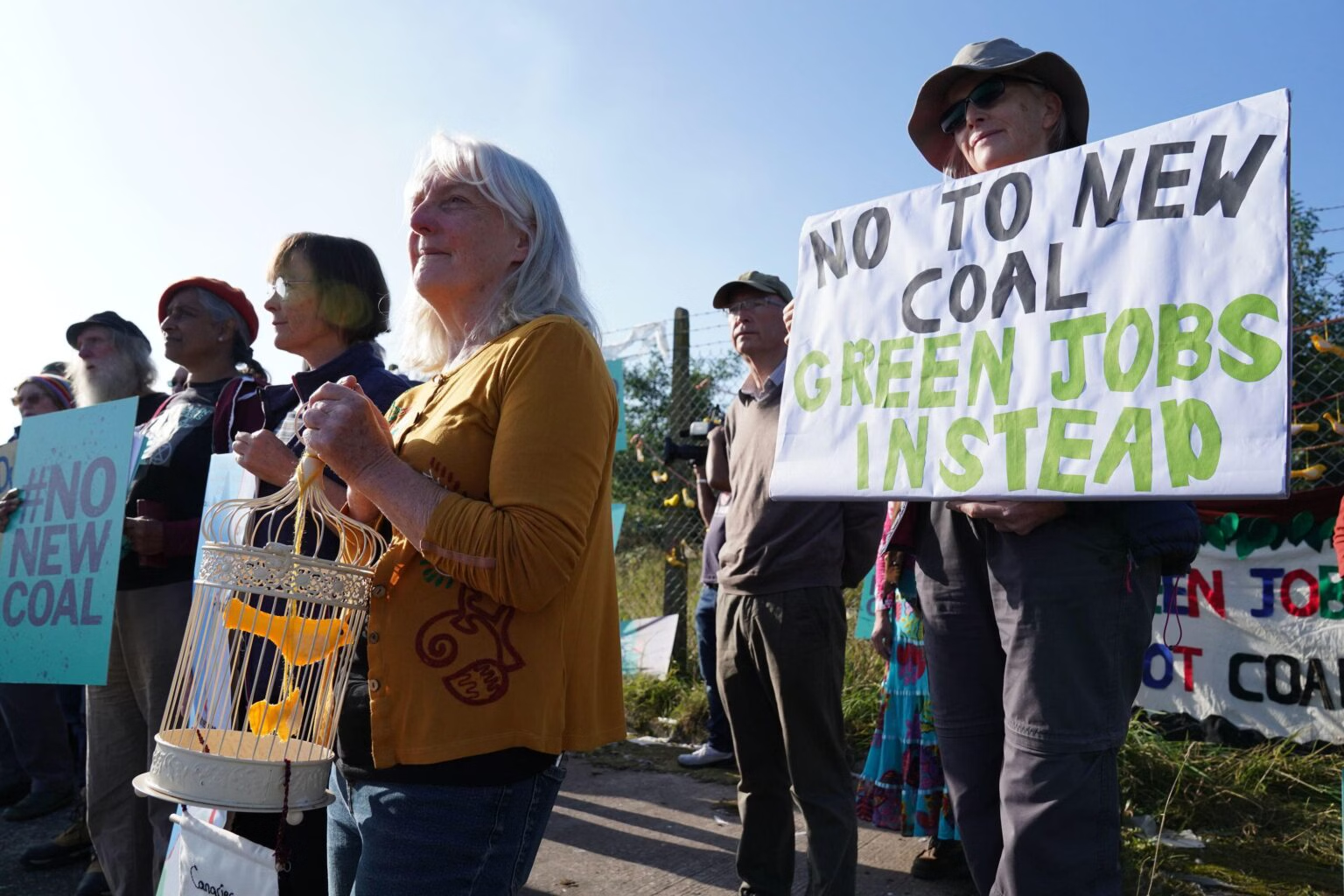
Demonstrators outside the proposed Woodhouse Colliery, south of Whitehaven, September 2021. Credit: PA Images / Alamy Stock Photo

Questions over compensation and employment could make it politically difficult for Labour to scrap the Whitehaven project, experts told DeSmog.

Labour has been urged to clarify its stance on the UK’s first deep coal mine in more than 30 years – as it fights an election campaign that has put clean energy at the fore.

The proposed mine in Whitehaven, Cumbria, would extract 2.8 million tonnes of coking coal a year from under the Irish sea to produce steel, emitting an estimated 220 millions tonnes of greenhouse gases over its lifetime.

The mine has become a political flashpoint in discussions over the UK’s commitment to reach net zero by 2050. In 2021, the International Energy Agency concluded that any new fossil fuel extraction was incompatible with global decarbonisation targets.

Ahead of a widely predicted victory at the 4 July election, Labour’s lack of clarity on the polluting mine poses awkward questions for a party that has based its manifesto on making Britain “a clean energy superpower”.

In the new manifesto, launched last week, Labour says it will not revoke existing oil and gas licences, but will also not grant any new licences. The party has explicitly ruled out issuing licences for new coal mines and says it will ban fracking for good.

The Woodhouse Colliery was granted planning permission by then Conservative levelling up secretary Michael Gove in December 2022, but has been plagued by controversy over its environmental impact and beset by legal delays.

So far, Labour has failed to address whether it would seek to overturn planning permission for the project, and has not responded to DeSmog’s requests for clarification.

In contrast, the party’s parliamentary candidate for the new Workington and Whitehaven constituency, where the mine would be built, has been vocal in his opposition.

Speaking to his local newspaper the News & Star last week, prospective MP Josh MacAlister said the mine was “a risky bet for new jobs”. “The easiest thing in the world would be to tell you the mine will solve our problems – but it won’t,” he said.

DeSmog understands that MacAlister has also addressed the issue at a number of local meetings, including to a mining heritage group in Whitehaven. 

According to a source, he told dozens of residents in November that the area was better off without the mine. However, he reportedly stopped short of clarifying whether he would oppose the national party if it backed the scheme’s development.

When approached by DeSmog for comment, MacAlister’s team referred DeSmog to his views expressed in the News & Star, adding that they were “consistent with what he has said since being selected”.

projection released by YouGov on 5 June shows that MacAlister is expected to win the seat in a landslide, with a predicted 53 percent of the vote to the Conservatives’ 25 percent.

Rebecca Willis, professor in energy and climate governance at the University of Lancaster, told DeSmog that “the mine has huge symbolic importance” both domestically and in terms of climate diplomacy.

“You can’t be a leading climate nation and provide consent for new coal mines,” she said. “Those two things are fundamentally incompatible.”

‘Non-Committal’

Despite Labour’s silence, MacAlister’s position appears to align with that of Ed Miliband, the party’s shadow climate change secretary.

Shortly after the mine was approved, Miliband co-authored an opinion piece for the News & Star with Cumberland’s council leader Mark Fryer. In the article, they argued that the mine would be “obsolete by the 2030s and 2040s at the latest, because of changes to the global steel industry which is rapidly moving towards clean steel production”.

Miliband reiterated this message at a March 2023 Cumberland Economic Summit event in west Cumbria.

Since then, the national Labour party has revealed little on its position.

Karl Conor, a former Labour councillor for Copeland, told DeSmog that given the controversies surrounding the scheme and the interest of the local community, MacAlister and Labour will be unable “to get through the campaign without having to nail their colours to the mast”.

In contrast to MacAlister, prospective Conservative MP Andrew Johnson has strongly backed the mine, telling the News & Star: “It offers the best prospect in years to create new jobs, attract significant investment into West Cumbria and help to deliver the upgrade to the coastal railway.

“If elected I will work tireless[ly] to fight for the mine to open and those jobs delivered”.

Claims by West Cumbria Mining that the project will create around 500 jobs have been strongly disputed.

Campaign group South Lakes Action on Climate Change (SLACC) group, which is bringing a legal challenge against the decision to greenlight the scheme, said that “no methodology” had been provided by the mining firm to support these claims.

A source in the new joint Cumberland authority told DeSmog they thought the local Conservative party would “try to make it [the local election campaign] about the mine”. 

“In the same way they made the Uxbridge by-election all about ULEZ [London’s Ultra Low Emission Zone], Sadiq Khan’s flagship policy, the Tories’ electoral strategy will be to make it about the mine,” they said. “… If I was in their position, it’s what I’d be doing.”

Compensation Conundrum

Any new administration looking to block the Cumbria coal mine may be hit with a compensation claim that runs into the tens of millions, according to a well-placed legal expert. 

Matthew McFeeley, a lawyer with Richard Buxton Solicitors, has been advising SLACC on its legal challenge. He told DeSmog that much will depend on the judicial review, which is scheduled to be heard on 16 July, less than a fortnight after the general election.

“If the court were to find that the planning permission had been unlawfully granted, then it would all have to go back to the secretary of state for a new decision,” McFeeley said.

In this scenario, he explained, a Labour administration could argue that the climate and environmental impacts of the project are too great, and refuse to grant permission.  

If campaigners can successfully argue the mine’s planning permission is unlawful, the company behind the coaling scheme – West Cumbria Mining (WCM) – would not be able to issue any kind of compensation claim.

However, if the next government decided to revoke planning permission without a legal ruling, the taxpayer would be legally obliged to pay compensation, McFeeley said. The amount would depend on an assessment of how much WCM stood to lose from the permission being revoked.

The legal challenge is one of a number of hurdles WCM has to jump over before it can begin work at the site. McFeeley also indicated that the compensation claim could run into the tens of millions, or higher.  “They’re investing their money at risk at this point,” he said.

WCM vacated its offices in west Cumbria on the eve of the 2021 public inquiry after the Singapore-based EMR Capital, one of the mine’s major financial backers, oversaw a “cost-saving” programme. The company has until the end of 2025 to get shovels in the ground.

Other hurdles also stand in the way of the mine’s construction – including approval of marine licences, habitat monitoring and a risk assessment.

Despite the many issues associated with the mine, Professor Willis, of the University of Lancaster, said that scrapping the plans may still prove awkward for an incoming government.

“There’s a timing issue for Labour here,” she said. “They’ve promised a lot in terms of green industrial policy through Great British Energy [Labour’s proposed state-owned energy company] and publicly-backed investment in green industries. But that will take a while to get going.

“So, at least over the next year, you’ll have the situation where they’ll be saying no to the mine but they’re not saying yes to anything else in the area. That’s quite difficult politically.

“Until the community actually sees a physical project with attached jobs being offered to them, they’re going to be pretty cynical about it.”

West Cumbria Mining did not respond to DeSmog’s request for comment.

Original article by Tommy Greene republished from DeSmog

Continue ReadingLabour Ignores Coal Mine-Shaped Elephant in the Room

Climate Groups Call for Rich to Pay More as International Meetings Begin

Spread the love

Original article by EDWARD CARVER republished from Common Dreams under Creative Commons (CC BY-NC-ND 3.0). 

Delegates from around the world meet at an annual climate change conference in Bonn, Germany, on June 3, 2024, in preparation for the COP29 conference in November in Azerbaijan. (Photo: Christoph Driessen/Getty Images)

“We have to put the social justice element upfront,” an architect of the 2015 Paris agreement said as the world’s climate delegates gathered in Germany.

Advocates on Tuesday issued strong calls to action on climate finance for developing countries and an international agency released a report on the need to ramp up renewable energy production as the Bonn Climate Change Conference continued in Germany and G7 nations prepared to meet in Italy next week.

At the conference in Bonn, Friends of the Earth International pushed for more rich-country financing to pay for the rising costs of climate impacts in the Global South, while Laurence Tubiana, head of the European Climate Foundation and an architect of the 2015 Paris agreement, called for the global rich to pay their share through taxes and consumption levies.

Meanwhile, two organizations warned that countries aren’t on track to meet targets they set just last year. Oil Change International (OCI) published a briefing showing that G7 nations are expanding oil and gas commitments that undermine goals set at the United Nations Climate Change Conference (COP28) meeting in Dubai, and the International Energy Agency (IEA) issued a report showing that the world’s nations are not on track to meet their Dubai pledge to triple renewable energy production by 2030.

“The world is on fire because of decades of inaction by rich countries on reducing emissions, and their failure to pay the climate finance they owe to developing countries to transition to renewable energy systems for all, and to pay for rising costs for loss and damage and adaptation,” Sara Shaw, Friends of the Earth International program coordinator, said in a statement. “What is on the table to date is scales of magnitude away from what it needed. This year must be a year of breakthrough on climate finance.”

Climate representatives are meeting in Bonn this week and next to prepare for COP29 in November in Azerbaijan, where a key agenda item is expected to be financing for a green transition in the Global South. COP negotiations are conducted under the aegis of the United Nations Framework Convention on Climate Change (UNFCCC). At COP21 in 2015, nations signed the Paris agreement, a treaty that sought to limit global warming to less than 2°C above preindustrial levels.

Tubiana, an architect of that deal, said Tuesday that tackling climate change requires centering global justice in order to avoid conflict and gain public acceptance of climate measures.

“We have to put the social justice element upfront,” Tubiana, a French economist and diplomat, told The Guardian.

Tubiana said that raising the funds required for low-income nations will require holding both rich nations and people to account, via taxes and consumption levies, given that inequities exist not just between nations but also within them.

“This inequality is true not only between developed countries and developing ones, but within each country—the 1% of rich Chinese, or the 1% of very rich Indians, or the U.S. citizen—they have a lifestyle which is very, very similar, in terms of overconsumption,” she said.

The world’s richest and most powerful nations are not taking responsibility for climate action as they should, the new OCI briefing argues.

“Some G7 countries are massively expanding fossil fuel production at home, while others are investing in more fossil fuel infrastructure abroad,” the briefing states. “Both are catastrophic failures of leadership.”

OCI cites the United States, Italy, and Japan as particularly bad climate actors. The U.S. is the largest oil and gas producer in the world and has plans for massive expansions of the industry, despite President Joe Biden’s climate promises, the briefing notes. Italy has announced plans to double natural gas production. And both the U.S. and Japan have financed billions of dollars worth of oil and gas production in other countries just since the end of 2022, the document states, citing earlier OCI findings.

The IEA also spelled out unfulfilled commitments, while detailing progress that has been made on the energy transition. The agency looked at the domestic policies and targets of 150 countries to see how far along they were toward reaching the international target of tripling renewable power generation by 2030. It found that once added together, the nations’ domestic plans would get them about 70% of the way toward the 11,000 gigawatts of additional capacity required to meet the goal.

“There is a gap, but the gap is bridgeable,” Heymi Bahar, a senior energy analyst at the IEA and co-author of the report, toldThe Guardian.

Governments have not in most cases written these domestic plans into their Nationally Determined Contributions (NDCs) under the Paris agreement. The IEA report says that countries need to “bring their NDCs in line with their current domestic ambitions” and scale those ambitions up further still, to get from 70% to 100%. Moreover, they must follow through with their promises and achieve the targets they’ve set.

“This report makes clear that the tripling target is ambitious but achievable—though only if governments quickly turn promises into plans of action,” Fatih Birol, the IEA’s executive director, said in a statement.

The world added about 560 gigawatts of renewable capacity in 2023, a record increase, more than half of which came from China, according to the IEA. About half of planned capacity increases are in solar, with a quarter from wind power, the IEA report states.

Original article by EDWARD CARVER republished from Common Dreams under Creative Commons (CC BY-NC-ND 3.0). 

Continue ReadingClimate Groups Call for Rich to Pay More as International Meetings Begin

The World’s Largest Funder of Fossil Fuel Expansion

Spread the love

Original article by ALEC CONNON republished from Common Dreams under Creative Commons (CC BY-NC-ND 3.0). 

Environmental activist protest outside CitiBank Headquarters in New York City on April 25, 2023, calling for an end to fossil fuel financing.
 (Photo by Leonardo Munoz / AFP via Getty Images)

Here’s why we will be using our bodies to shut down Citibank’s global headquarters over and over again, this summer.

This summer, along with dozens of others, I’ll be helping to run the Summer of Heat on Wall Street, a campaign of sustained nonviolent civil disobedience against the banks, investors, and insurance companies financing fossil fuel expansion.

As we have written about here already, our plan is simple: using our bodies, we will continually blockade the New York headquarters of the Wall Street giants bankrolling coal, oil, and gas expansion; week after week, we will disrupt the companies disrupting our climate and our planet.

We’re targeting several companies―including the insurance company, Chubb, and the private equity group, KKR―but our number one target will be Citigroup. Here’s why.

Since the adoption of the Paris Agreement in 2015, Citi has provided $204.46 billion in financing to the company’s most rapidly developing new coal, oil, and gas fields. Remarkably, Citi has provided more money to those oil and gas companies than even JPMorgan Chase―the bank that climate activists like to call the “Doomsday Bank.”

To be clear, I’m talking here only about the financing Citi has provided for companies developing new oil and gas reserves, not merely investing in infrastructure to keep the oil pumping from existing reserves. When we take into account financing to all fossil fuel companies, Citi has provided a little shy of $400 billion to coal, oil, and gas companies since 2015. But focusing on expansion is important.

Numerous climate experts, from the International Energy Agency to the Intergovernmental Panel on Climate Change, have made it clear that to stave off the worst of climate catastrophe, there must be no investment in new fossil fuel expansion. But last year alone, Citibank provided $14.6 billion to the companies most rapidly expanding their coal, oil, and gas operations.

Citibank’s financing of fossil fuel expansion not only drives climate chaos, it also results in environmental racism. To give just one example, 70% of the air pollution generated by ExxonMobil is dumped on communities of color, contributing to the higher levels of heart disease, strokes, cancer, and other illnesses that are widely associated with living near oil and gas infrastructure.

Citibank’s top fossil fuel client is ExxonMobil. Yet when asked by Congress if she knew what environmental racism was, Citi CEO Jane Fraser replied: “Only vaguely.”

Not content with merely financing fossil fuels, Citi also works to block climate action both from its own investors and the U.S. government.

CEO Jane Fraser is chair of a group called the Financial Services Forum and a board member of the Bank Policy Institute, groups that have fought tooth and nail to weaken climate-financial regulation advanced by the Biden Administration. Citi also donates to several high-profile politicians who work against action on climate, including Congressman Andy Barr who has led the charge in a series of fossil fuel-backed, right-wing attacks designed to prevent the financial industry from taking action on climate.

For the past three years, Citi has faced a shareholder resolution from investors calling for a report on how the bank ensures that the oil, gas, and mining companies it finances respect Indigenous rights and sovereignty. Yet, in spite of Ms. Fraser’s previous claims in 2020 that Citi was committed to being ”an anti-racist institution,” Citi has fought the resolution each year, urging investors to vote against it, even as they remain one of the world’s largest funders of oil and gas in the Amazon rainforest.

Besides its role in the climate crisis and environmental racism, there are plenty other reasons to be angry at Citibank, too. In the early 20th century, Citi actively lobbied the US government to invade and occupy Haiti, which it promptly did, resulting in decades of bloodshed and misery for Haitians. A century later, Citi did as much as any bank to cause the financial crisis of 2008, which led to nearly 3.8 million Americans losing their homes; no bank received a larger bailout from the government than Citi.

And then there’s the fact that Citi is the foreign bank with the largest presence in Israel and a major financier of weapons manufacturers that are currently providing Israel with fighter jets and missiles being used to massacre Palestinians.

All of this is why Citibank is our number one target this summer.

To kick off the campaign, we will disrupt and shut down Citibank’s headquarters in Manhattan every day, all week long. We start on Monday, June 10th. We hope that you join us.

Original article by ALEC CONNON republished from Common Dreams under Creative Commons (CC BY-NC-ND 3.0). 

‘Just The Beginning’: 50+ Arrested For Blockading Citigroup Bank Over Climate Crimes ›

Continue ReadingThe World’s Largest Funder of Fossil Fuel Expansion

US Leads Charge as Surge of Oil and Gas Projects Threaten Hope for Livable Planet

Spread the love

Original article by JULIA CONLEY republished from Common Dreams under Creative Commons (CC BY-NC-ND 3.0). 

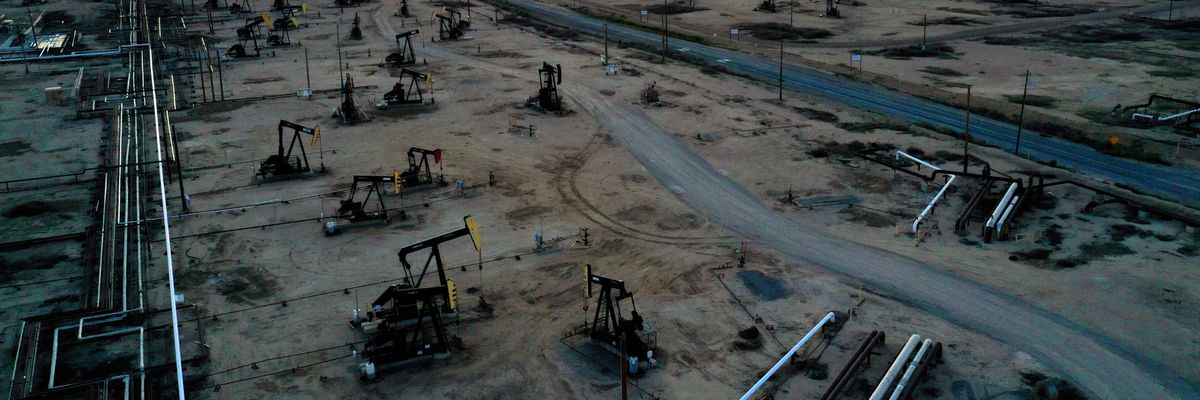
There are over 1,100 oil-producing wells in the McKittrick oil field, just north of the town of McKittrick, California.
 (Photo: Carolyn Cole/Los Angeles Times via Getty Images)

“The science is clear: No new oil and gas fields, or the planet gets pushed past what it can handle,” said one analyst.

Fossil fuel-producing countries late last year pledged to “transition away from fossil fuels,” but a report on new energy projects shows that with the United States leading the way in continuing to extract oil and gas, governments’ true views on renewable energy is closer to a statement by a Saudi oil executive Amin Nasser earlier this month.

“We should abandon the fantasy of phasing out oil and gas,” the CEO of Saudi Aramco, the world’s largest oil company, said at an energy conference in Houston.

new report published Wednesday by Global Energy Monitor (GEM) suggests the U.S. in particular has abandoned any plans to adhere to warnings from climate scientists and the International Energy Agency (IEA), which said in 2021 that new oil and gas infrastructure has no place on a pathway to limiting planetary heating to 1.5°C.

Despite the stark warning, last year at least 20 oil and gas fields worldwide reached “final investment decision,” the point at which companies decide to move ahead with construction and development. Those approvals paved the way for the extraction of 8 billion barrels of oil equivalent (boe).

By the end of the decade, companies aim to sanction nearly four times that amount, producing 31.2 billion boe from 64 oil and gas fields.

The U.S. led the way in approving new oil and gas projects over the past two years, GEM’s analysis found.

An analysis by Carbon Brief of GEM’s findings shows that burning all the oil and gas from newly discovered fields and approved projects would emit at least 14.1 billion tonnes of carbon dioxide.

“This is equivalent to more than one-third of the CO2 emissions from global energy use in 2022, or all the emissions from burning oil that year,” said Carbon Brief.

GEM noted in its analysis that oil companies and the policymakers who continue to support their planet-heating activities have come up with numerous “extraction justifications” even as the IEA has been clear that new fossil fuel projects are incompatible with avoiding catastrophic planetary heating.

The report notes that U.S. Sen. Lisa Murkowski (R-Alaska) “supported ConocoPhillips’ Willow oil field, arguing that the Alaskan oil and gas industry has a ‘better environmental track record,’ and not approving the project ‘impoverish[es] Alaska Natives and blame[s] them for changes in the climate that they did not cause.'”

Carbon Brief reported that oil executives have claimed they are powerless to stop extracting fossil fuels since demand for oil and gas exists for people’s energy needs, with ExxonMobil CEO Darren Woods telling Fortune last month that members of the public “aren’t willing to spend the money” on renewable energy sources.

A poll by Pew Research Center last year found 67% of Americans supported the development of alternative energy sources. Another recent survey by Eligo Energy showed that 65% of U.S. consumers were willing to pay more for renewable energy.

“Oil and gas producers have given all kinds of reasons for continuing to discover and develop new fields, but none of these hold water,” said Scott Zimmerman, project manager for the Global Oil and Gas Extraction Tracker at GEM. “The science is clear: No new oil and gas fields, or the planet gets pushed past what it can handle.”

Climate scientist and writer Bill McGuire summarized the viewpoint of oil and gas executives and pro-fossil fuel lawmakers: “Climate emergency? What climate emergency?”

The continued development of new oil and gas fields, he added, amounts to “pure insanity.”

Original article by JULIA CONLEY republished from Common Dreams under Creative Commons (CC BY-NC-ND 3.0). 

Continue ReadingUS Leads Charge as Surge of Oil and Gas Projects Threaten Hope for Livable Planet

Planet-Warming CO2 Emissions Surged to Record High in 2023: IEA

Spread the love

Original article by THOR BENSON republished from Common Dreams under Creative Commons (CC BY-NC-ND 3.0).

A sign reading “Stop, extreme heat danger” is seen in Death Valley National Park in California. (Photo: Patrick T. Fallon/AFP via Getty Images)

“The clean energy transition has undergone a series of stress tests in the last five years—and it has demonstrated its resilience,” said IEA Executive Director Fatih Birol.

Carbon emissions reached a record high in 2023, but the increased adoption of renewable energy is helping slow the pace, according to the International Energy Agency.

The IEA said in a new report that global CO2 emissions “increased by 410 million tonnes, or 1.1%, in 2023—compared with a rise of 490 million tonnes the year before—taking them to a record level of 37.4 billion tonnes.”

But the agency found that carbon emissions “rose less strongly in 2023 than the year before even as total energy demand growth accelerated… with continued expansion of solar PV, wind, nuclear power, and electric cars helping the world avoid greater use of fossil fuels.”

The report notes that “exceptional droughts” decreased the amount of hydropower that could be produced last year. Demand for coal fell to “levels not seen since the early 1900s.” It says CO2 emissions would have been three times larger had renewable energy not been utilized to generate electricity.

An IEA report from September found that rapid adoption of clean energy technologies could keep the world from surpassing the 1.5°C warming target. The Energy Information Administration forecast in December that 2024 could become the first year that wind and solar power generate more electricity than coal in the U.S.

The world will need to adopt a lot more renewable energy to address the climate crisis. Last month was most likely the warmest February on record, and records like that are being set every year. The more countries burn fossil fuels, the higher the temperatures will go.

“The clean energy transition has undergone a series of stress tests in the last five years—and it has demonstrated its resilience,” said IEA executive director Fatih Birol. “A pandemic, an energy crisis and geopolitical instability all had the potential to derail efforts to build cleaner and more secure energy systems. Instead, we’ve seen the opposite in many economies.”

Original article by THOR BENSON republished from Common Dreams under Creative Commons (CC BY-NC-ND 3.0).

Imperiling Climate Goals, Global Resource Extraction Set to Surge 60% by 2060

‘Frightening’: Greenland Losing 33 Million Tons of Ice Per Hour Due to Climate Crisis

2023 Destroys Global Heat Record as Fossil Fuel Emissions Boil the Planet

Continue ReadingPlanet-Warming CO2 Emissions Surged to Record High in 2023: IEA