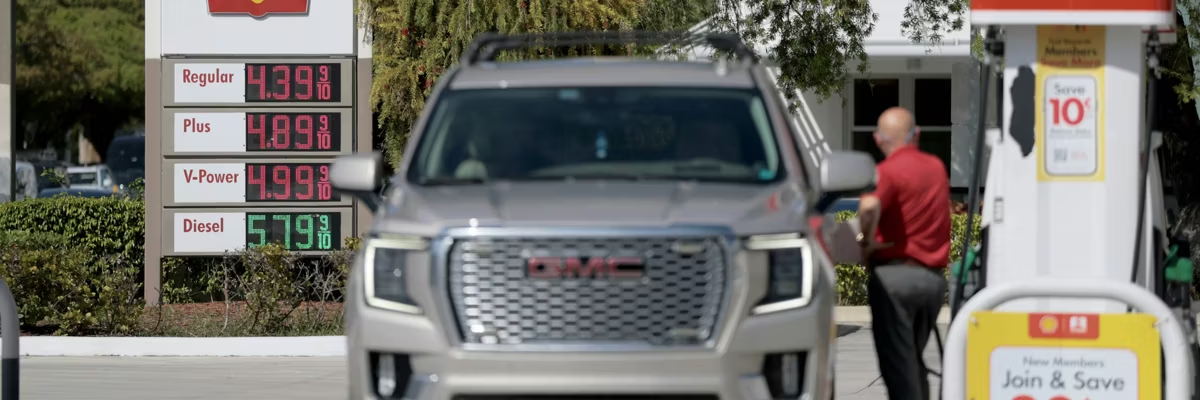
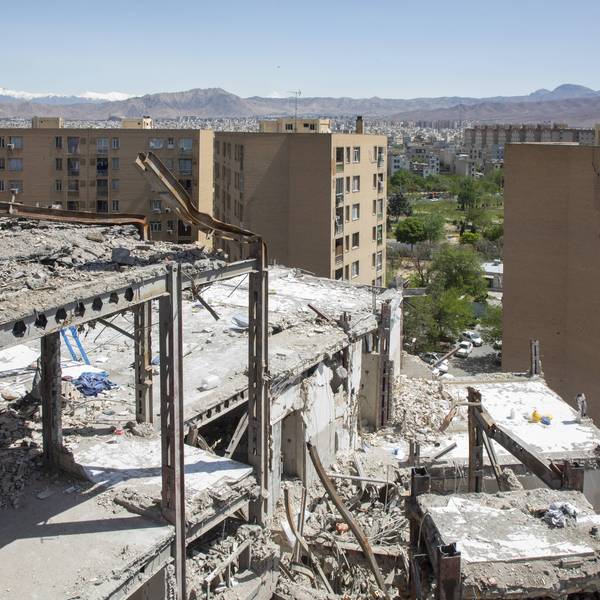
Fuel prices are displayed on a sign as a customer fills their vehicle at a gas station on April 13, 2026 in Miami, Florida. (Photo by Joe Raedle/Getty Images)
“We are living on borrowed time,” said one economist about global oil prices.
With no end in sight to the Strait of Hormuz crisis caused by President Donald Trump’s illegal war with Iran, the head of the International Energy Agency warned Monday that global energy supplies are running dangerously low.
IEA executive director Faith Birol told reporters in Paris that the world only has weeks’ worth of oil reserves left, raising the likelihood that energy prices will soar even higher in the near future.
Birol said that oil inventories are “declining rapidly” and added that there was “a perception gap in the markets between the physical markets and the financial markets,” as the price of oil in futures markets has not yet risen to a level that accurately reflects the coming supply crunch.
In his remarks to the press, given on the sidelines of a G7 gathering taking place this week in France,Birol warned that it’s only a matter of time before the supply shortage of fertilizer, which was also caused by the Iran War, leads to a surge in food prices that “might give a big push to inflation numbers.”
The Financial Times reported on Sunday that energy markets are approaching a “tipping point” where prices could see another upward surge that would throw the global economy into a recession.
Paul Diggle, chief economist at fund manager Aberdeen, told The Financial Times that he has been modeling the economic impact of oil hitting $180 per barrel, which he said would set off a global inflation crisis.
“We are taking that outcome very seriously,” Diggle said. “We are living on borrowed time.”
Oil prices briefly fell last month after the US and Iran announced a ceasefire agreement. However, the Strait of Hormuz has remained closed throughout that period, and Trump is reportedly preparing to restart attacks on Iran in the near future if no deal to reopen the strait is reached.
In a Sunday Truth Social post, Trump again threatened Iran with destruction unless it agrees to his demands.
“For Iran, the Clock is Ticking, and they better get moving, FAST, or there won’t be anything left of them,” the president wrote. “TIME IS OF THE ESSENCE!”
Orcas discuss how Trump was re-elected and him being an obviously insane, xenophobic Fascist.Climate science denier Donald Trump confirms that he knows nothing about democracy and that more liquid gold is being secured according to his policy of global privateering.Keir Starmer explains that UK is actively supporting Israel’s genocidal expansion and repeats his previous quotation that he supports Zionism “without qualification”. Keir Starmer said “I said it loud and clear – and meant it – that I support Zionism without qualification.” here: https://www.jewishnews.co.uk/keir-starmer-interview-i-will-work-to-eradicate-antisemitism-from-day-one/
This work by Middle East Monitor is licensed under a Creative Commons Attribution-NonCommercial-ShareAlike 4.0 International License.
Power outages re-emerged in the Iraqi cities of Erbil, Duhok and Sulaymaniyah following the outbreak of war between the United States and Israel against Iran on March 11, 2026. [Fariq Faraj Mahmood – Anadolu Agency]
The conflict involving Iran has triggered the most severe energy security crisis the world has ever seen, warned a top international energy official, Anadolu reports.
Speaking to The Financial Times on Friday, International Energy Agency Executive Director Fatih Birol said the conflict represents “the greatest global energy security threat in history.”
Birol, a Turkish economist and energy expert, pointed out that the current conflict has cut off twice the volume of gas that Europe lost from Russia in 2022, after the start of the Ukraine war.
The Strait of Hormuz has effectively been blocked by Iranian threats to target vessels, halting “vital arteries” of the global economy, he said.
Birol warned that markets and politicians are still underestimating the depth of the crisis, saying: “People understand that this is a major challenge, but I am not sure that the depth and the consequences of the situation are well understood.”
Even if the conflict ends and the strait is reopened, restarting damaged or shuttered oil and gas fields will take significant time, he said: “It will be six months for some (sites) to be operational, others much longer.”
In response to strait’s closure, last week the IEA announced the release of 400 million barrels of oil and refined products from emergency reserves, about 20% of its total stockpiles.
Birol said additional supply discussions are underway with major producers including Canada, Mexico, Brazil, and Norway, though he stressed these measures cannot fully offset the loss of Middle Eastern output.
“The single most important action is the resumption of transits through the Strait of Hormuz,” he said.
Birol also urged European governments not to ease restrictions on Russian gas imports, warning against renewed dependence on Moscow despite the current crisis.
Russia’s Nord Stream pipelines remains inoperable, and its reputation as a reliable supplier has been severely damaged, he said.
Looking ahead, Birol said the crisis could reshape global energy policy, echoing the lasting impact of the 1973 and 1979 oil shocks.
He predicted increased investment in renewable energy, a revival of nuclear power, and accelerated adoption of electric vehicles, alongside a possible return to coal use instead of gas.
Regional hostilities in the Middle East have escalated since Israel and the US launched a joint offensive on Iran on Feb. 28, killing more than 1,300 people, including then-Supreme Leader Ali Khamenei.
Iran has retaliated with drone and missile attacks across the region and has effectively closed to most ships the Strait of Hormuz, a key oil transit route that normally handles about 20 million barrels per day and roughly 20% of global liquefied natural gas trade.
This work by Middle East Monitor is licensed under a Creative Commons Attribution-NonCommercial-ShareAlike 4.0 International License.
Climate science denier Donald Trump confirms that he knows nothing about democracy and that more liquid gold is being secured according to his policy of global privateering.Donald Trump calls for help from NATO allies in securing the Straight of Hormuz despite saying only 9 days ago that they don’t need people to join wars after they’ve already won.Donald Trump warns against following the https://onaquietday.org blog, says that it’s easy atm, she only needs to report war crimes supporting Israel’s genocidal expansion.
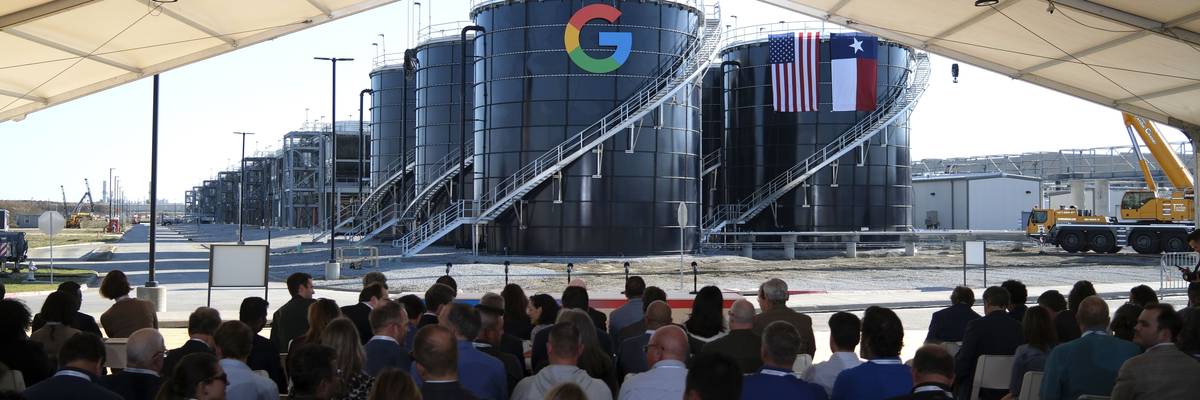
Attendees await the arrival of Texas Gov. Greg Abbott and Alphabet and Google CEO Sundar Pichai at the Google Midlothian Data Center on November 14, 2025 in Midlothian, Texas. (Photo by Ron Jenkins/Getty Images)
“Tech companies are using vagueness about what happens within energy-hogging data centers to greenwash a planet-wrecking expansion.”
A report released on Tuesday says that the tech industry is blowing hot air with its claims that generative artificial intelligence will be beneficial for the climate.
The report, titled “The AI Climate Hoax,” was commissioned by a broad consortium of environmental advocacy organizations and authored by climate and energy analyst Ketan Joshi.
In total, it analyzes more than 150 statements made by both big tech companies and organizations such as the International Energy Agency about the supposed benefits of generative AI.
The report finds that 74% of such claims made by these institutions are unproven, with 36% not bothering to cite any evidence whatsoever.
One key finding in the report is that many claims about the purported benefits of the technology conflate traditional AI systems with more recent generative AI systems, which require massive amounts of energy and are spurring demand for the construction of power-and-water-devouring data centers across the US.
“Even if these benefits are real,” the report writes of traditional AI systems, “they are unrelated to—and dwarfed by—the massive expansion of energy use from the generative AI industry,” which is projected to to consume 13 times as much energy as traditional AI by the year 2030.
Even the more supportable claims about the benefits of traditional AI deserve serious scrutiny, the report notes, since “they tend to rely on weaker forms of evidence, such as corporate websites, rather than published academic research,” which was only cited in 26% of claims made about AI benefits.
The report also knocks big tech companies for using assorted strategies to conceal the true extent of their energy use, including buying renewable energy certificates even while relying on fossil fuels to power their operations, and vowing to implement highly implausible solutions to mitigate the climate impact of data centers, including carbon capture technologies and even building orbital data centers in space.
Commenting on the report, study author Joshi said its findings seem to show “tech companies are using vagueness about what happens within energy-hogging data centers to greenwash a planet-wrecking expansion.”
“The promises of planet-saving tech remain hollow, while AI data centers breathe life into coal and gas every day,” Joshi added. “These claims of climate benefit are unjustified and overhyped, and could cover up irreversible damage being done to communities and society.”
Jill McArdle, international corporate campaigner at study sponsor Beyond Fossil Fuels, said the study shows “there is simply no evidence that AI will help the climate more than it will harm it,” and accused Big Tech companies of “writing themselves a blank cheque to pollute on the empty promise of future salvation.”
AI data centers have become a major controversy throughout the US in recent months, as their massive energy needs have pushed up utility bills and put a strain on communities’ water supplies.
A study published in the journalNature Sustainability last year found that data centers could soon consume as much water as 10 million Americans and emit as much carbon dioxide as 10 million cars, or roughly the same amount of consumption as the entire state of New York.
Revealed: Only a third of national climate pledges support ‘transition away from fossil fuels’
Only around a third of the latest country climate pledges submitted to the UN express support for the “transition away from fossil fuels”, according to Carbon Brief analysis.
Several countries even have used their 2035 climate plans to commit to increasing the production or use of fossil fuels, predominately gas, the analysis finds.
The first global stocktake of progress to tackle climate change, agreed at the COP28 climate summit in Dubai in 2023, calls on all countries to contribute to “transitioning away from fossil fuels”.
Countries were meant to explain how they are implementing the outcomes of the global stocktake, including their contribution to transitioning away from fossil fuels, in their latest climate plans.
However, just 23 of the 63 plans submitted to the UN so far express support for “transitioning away from fossil fuels”, or the “phase out” or “phase down” of their use.
In addition, six countries, including Russia, Nigeria and Morocco, use their climate plans to commit to boosting gas production.
Some two-thirds of countries have not yet announced or submitted their pledges, missing not only the UN deadline of 10 February, but also an extension to September.
How to address the lack of sufficient action from countries with their latest plans is billed to be one of the major issues up for debate at the COP30 climate summit in Brazil next month.
Taking stock
In 2015, countries forged the Paris Agreement, the landmark deal to keep temperature rise “well-below” 2C, with “aspirations” to limit global warming to 1.5C of warming by the end of this century.
At the time, countries’ initial pledges were not enough to put the world on track to meet the temperature targets, so they built a “ratchet mechanism” into the Paris Agreement, requiring them to keep increasing their ambition in the following years.
As part of this, countries agreed to submit new, more ambitious plans every five years detailing what they are doing to take action on climate change and adapt to its impacts. These are called “nationally determined contributions” (NDCs).
The Paris Agreement also stated that, following on from these plans, “global stocktakes” should be conducted to assess collective progress in meeting the temperature goal.
The first global stocktake concluded at the COP28 climate summit in Dubai in 2023, with countries agreeing to a new document setting out how they will respond to a lack of sufficient action to meet the Paris goals.
The two-week talks saw fierce debate about how fossil fuels – the main driver of human-caused climate change – should be referred to in this text.
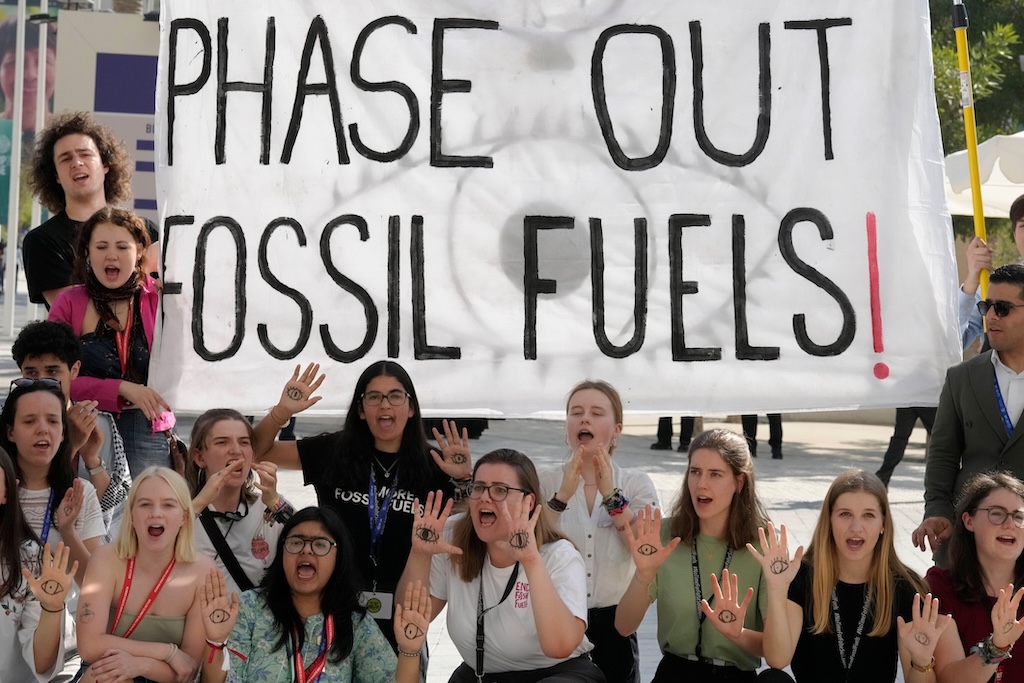
Activists demonstrating at the 2023 COP28 climate summit in Dubai Credit: Associated Press.
In the end, the stocktake “calls on” all countries to “contribute to” a list of global goals, including “transitioning away from fossil fuels…accelerating action in this critical decade” towards net-zero by 2050.
It was the first time that countries formally acknowledged the need to transition away from fossil fuels in almost 30 years of international climate negotiations.
However, many countries were disappointed that the text did not contain a firmer commitment to phase out all fossil fuels, or even just those with “unabated” emissions.
After Dubai, countries were expected to come up with new NDCs for 2035 that explained how they responded to the priorities set out in the stocktake.
The deadline for submitting the “3.0” NDCs was 10 February 2025, which 95% of countries missed.
On 24 September, the UN convened a climate summit in New York at the sidelines of the UN general assembly in the hope of encouraging more countries to come forward with new NDCs.
China stole the show at the event, announcing a pledge – although not yet formally submitted to the UN – to cut greenhouse gas emissions to 7-10% below peak levels by 2035. Several other countries announced new plans, including Russia, Turkey and Bangladesh.
Following the summit, around one-third of countries have announced or submitted their 2035 NDCs.
Fossil-fuel focus
For the analysis, Carbon Brief reviewed each of the NDCs submitted to the UN to determine whether they express support for “transitioning away” from fossil fuels or for phasing them out or “down”.
Countries were considered to have expressed support if they explicitly mentioned the terms “transition” or “phase out/down” in relation to “fossil fuels” when speaking about their own actions to address climate change.
Some countries spoke in general terms about “reducing” or “replacing” fossil fuels, but did not explicitly reference the need to transition away from or phase them down or out. Others spoke about transitioning to a clean or renewable-based economy, but did not explicitly mention fossil fuels.
For the purposes of this analysis, all of these countries were considered to have not expressed support for the need to transition away from fossil fuels.
In addition, some countries mentioned in their NDCs that the global stocktake calls for a transition away from fossil fuels, but did not say that transitioning away from fossil fuels would be part of their own actions to address climate change.
These countries were also considered to have not expressed support for the need to transition away from fossil fuels.
Overall, the results show that only one-third of countries express support for the need to transition away from fossil fuels in their NDCs.
Countries used varying language when speaking about the need to transition away from fossil fuels.
Some directly acknowledged that transitioning away from fossil fuels was a key conclusion of the global stocktake and committed to doing this within their own borders.
This includes the UK, Brazil, Canada, Australia, Singapore, Lebanon and Niue. For example, the UK’s NDC states:
“At home and in line with the outcomes of the GST [global stocktake], the UK is committed to transitioning away from fossil fuels to achieve net-zero by 2050.”
Other countries chose to commit to “phasing out” fossil fuels instead of “transitioning away”.
This includes Iceland and Vanuatu. Similarly, Colombia’s NDC says:
“NDC 3.0 reaffirms that the phasing out of fossil fuels is not only a climate imperative, but also an opportunity to strengthen energy sovereignty [and] democratise the benefits of the transition.”
(Colombia and Vanuatu were two of the countries that were disappointed not to see a commitment to phase out fossil fuels included within the global stocktake text.)
Barbados, an island nation known for its strong commitment to climate action, committed in its NDC to “achieve a fossil fuel-free economy” by 2040. In addition, Chile pledged to contribute to the “elimination of fossil fuels”.
In the analysis, these pledges were considered to be support for transitioning away from fossil fuels, despite not using the terms “transition” or “phase out”.
The table below shows the language used by each of the 21 countries that expressed support for transitioning away from fossil fuels, according to the analysis.
Country
Expression of support for ‘transitioning away from fossil fuels’ in NDC
United Kingdom
“At home and in line with the outcomes of the GST, the UK is committed to transitioning away from fossil fuels to achieve net-zero by 2050.”
Brazil
“Brazil will respond to the call to contribute to global efforts under paragraph 28 of decision 1/CMA.5, through the policies and national efforts below, including those under the National Climate Plan. In addition, Brazil would welcome the launching of international work for the definition of schedules for transitioning away from fossil fuels in energy systems, in a just, orderly and equitable manner, with developed countries taking the lead, on the basis of the best available science, reflecting equity and the principle of common but differentiated responsibilities and respective capabilities in the light of different national circumstances and in the context of sustainable development and efforts to eradicate poverty, as per paragraph 6 of decision 1/ CMA.5.”
Canada
“Canada also remains committed to implementing the mitigation outcomes of the Global Stocktake (GST), agreed at COP28…This includes…transitioning away from fossil fuels in energy systems.”
Lebanon
“Guided by the UAE Consensus reached at COP28, which calls on all Parties to transition away from fossil fuels and strengthen support for adaptation, this NDC reflects Lebanon’s commitment to scaling ambition while addressing national vulnerabilities.”
Iceland
“Iceland’s NDC takes note of the outcome of the global stocktake, according to Decision 1/CMA.5. Specifically, Iceland’s NDC seeks to represent the need for deep, rapid and sustained reductions in greenhouse gas emissions in line with 1.5°C pathways by contributing to the phase-out of fossil fuels across sectors and the strategic, fair and ambitious implementation of carbon capture, utilisation and storage, according to para. 28.”
Barbados
“In 2020, the Government of Barbados set the aspirational goal to achieve a fossil fuel-free economy and to reduce GHG emissions across all sectors to as close to zero as possible by 2030. In light of the significant challenges faced by the country, the aspirational goal is currently expected to be reached around 2040.”
Chile
“In 2023, within the framework of the 28th Conference of the Parties to the UNFCCC (COP) in Dubai, the report on the First Global Stocktake, designed within the framework of the Paris Agreement to assess the global response to the climate crisis, was presented…Among its main conclusions, the agreement to move towards the elimination of fossil fuels in energy systems…stands out. All these conclusions are addressed in this NDC, demonstrating Chile’s commitment to climate ambition.”
Vanuatu
“Moving beyond our current net-zero status, this NDC recommits Vanuatu to rapidly phasing out fossil fuels, deeply decarbonising and transitioning completely to a circular economy.”
Pakistan
“Natural gas and furnace oil are set to decline, with net reductions of 2,147 MW and 430 MW respectively, as per IGCEP 2025-2035, signaling a gradual phase down of fossil fuels in Pakistan’s capacity mix.”
Colombia
“NDC 3.0 reaffirms that the phasing out of fossil fuels is not only a climate imperative, but also an opportunity to strengthen energy sovereignty, democratize the benefits of the transition, and consolidate Colombia as a Power of Life.”
Niue
Niue understands the need to transition from fossil fuel-based electricity generation to renewable energy to reduce the GHG emissions footprint and ensure energy security.”
Singapore
“Singapore is contributing to the first global stocktake’s call to triple global renewable energy capacity and double the global average annual rate of energy efficiency improvements by 2030. We are also supporting efforts to transition away from fossil fuels in energy systems and phase out inefficient fossil fuel subsidies.”
Australia
“The global stocktake recognised the global direction of travel in its consensus call to transition away from fossil fuels in energy systems and to phase-down unabated coal-fired power. In Australia, our transition is underway.”
United Arab Emirates
“The GST Outcome at COP28, together with the broader UAE Consensus and the work under the Troika, has provided a strong impetus for the UAE NDC 3.0. The outcome of the first GST notably emphasizes the need to transition away from fossil fuels in energy systems in a just, orderly and equitable manner, urging parties to adopt ambitious, economy-wide emission reduction targets.”
Japan
“The items listed in decision 1/CMA.5 have been incorporated to the greatest extent possible into the Plan for Global Warming Countermeasures, which is a comprehensive implementation plan for achieving Japan’s NDC.”
Bolivia
“The persistent dependence on fossil fuels, both for electricity generation and transportation, not only contributes to national greenhouse gas emissions, but also exposes the country to volatility in international oil and gas prices, highlighting the urgency of a fair, sovereign, and resilient energy transition toward renewable sources.”
Nicaragua
“The transition to an energy matrix less dependent on fossil fuels is a fundamental priority of the government.”
Marshall Islands
“This NDC also demonstrates our drive, our achievements, and the challenges we face. In particular, we detail our domestic actions to contribute to the collective commitments made following the global stocktake, including the tripling of renewable energy, doubling of energy efficiency and removal of fossil fuel subsidies, all in pursuit of accelerating the transition away from fossil fuels this decade.”
Cambodia
“This transition will be implemented in two key phases: 70% renewable energy by 2030, followed by a further increase to 72% by 2035, ensuring a gradual yet decisive shift away from fossil fuel dependency in the power sector.”
Bangladesh
“Transitioning away from fossil fuels in energy systems, in a just, orderly and equitable manner [is] central to Bangladesh’s contribution to the global response to climate change. The NDC 3.0 commitments are designed not only to reduce Greenhouse Gas (GHG) emissions but also to accelerate the just energy transition, promote zero- and low-emission technologies, and enhance climate resilience.”
Tuvalu
“We are steadfast in our transition to 100% renewable energy.”
Sri Lanka
“With abundant solar, wind, and hydropower resources, Sri Lanka has a clear opportunity and expressed ambitious commitments to move towards total electricity generation based on renewable sources, to transition away from fossil fuels toward cleaner, decentralised energy systems.”
Nepal
Nepal’s NDC is “informed” by Decision 1/CMA.5 Outcome of the first GST, “such as 1.5C decarbonisation pathway…just transition away from fossil fuels in energy systems.”
Separately, the thinktank E3G has examined how countries speak about their policies for reducing fossil fuels in their NDCs.
It found that more than two-thirds of countries include “explicit references to displacing fossil fuels in their electricity mix”.
However, E3G also noted that “specific language on winding down the production of coal, oil, and fossil gas is lacking in almost all NDCs”.
‘Transitional fuel’
Carbon Brief also examined each of the submitted NDCs to see how countries speak about new fossil-fuel production and use within their borders.
Six of the 64 nations – around 10% – used their NDCs to pledge to increase fossil-fuel production or use, predominately gas, claiming this could contribute to their efforts to lower emissions.
In its NDC, the world’s fourth biggest emitter, Russia, says it “emphasises the importance of implementing a just transition to low-emission development models using all available solutions”, including “gas as a transition fuel and technologies for reducing emissions in coal-fired power generation”.
During negotiations on the stocktake text in 2023, Russia had pushed successfully to include a controversial paragraph that says “transitional fuels can play a role in facilitating the energy transition while ensuring energy security”, Climate Home News reported.
The publication noted that, after this text was agreed, Antigua and Barbuda negotiator Diann Black-Layne called it a “dangerous loophole”, adding that gas is also a fossil fuel that “we need to transition away from”.
Several African nations, including Nigeria, Morocco, Mauritius and Zimbabwe, also pledged to boost the production or use of gas as part of their “climate” actions.
Nigeria, Africa’s second biggest emitter, says that the country “relies heavily on the oil and gas industry” and that the sector will be “called upon to further grow while adopting sustainability measures”. It continues:
“Natural gas use will be boosted, serving as a key transition fuel in Nigeria’s move towards increased adoption of renewable energy for meeting its net-zero emissions target.”
The world’s energy watchdog, the International Energy Agency, recently reemphasised that there would be no need for any new fossil-fuel production, if the world cuts emissions in line with limiting global warming to 1.5C.
It comes after the world’s top court this year concluded that new fossil-fuel production, consumption, the granting of exploration licences or the provision of subsidies “may constitute an internationally wrongful act”, leaving the states involved vulnerable to legal action.
COP30 calls
After nearly all nations missed the deadline for submitting NDCs in February, UN climate chief Simon Stiell asked laggard countries to do so by the end of September.
This will allow their plans to be included in a new report synthesising the level of progress contained within the latest NDCs, which is due to be published on 24 October. (Less than a third of nations met Stiell’s request.)
The report will come just before COP30, which will take place from 10-21 November in the rainforest Brazilian city of Belém.
Whether and how to respond to the insufficient progress contained within these NDCs, including whether to call for increased ambition in line with the outcomes of the first global stocktake, are among the key issues up for debate at the summit.
The Brazilian presidency is pushing for a formal COP decision on any “disappoint[ment]” over NDCs falling short, collectively, of what is needed to avoid dangerous global warming.
However, other countries would need to agree to this proposal at the summit.
Orcas comment on killer apes destroying the planet by continuing to burn fossil fuels.Orcas discuss Donald Trump and the killer apes’ concept of democracy. Front Orca warns that Trump is crashing his country’s economy and that everything he does he does for the fantastically wealthy.
Fossil fuel lobbyists attended almost every government meeting about a temporary windfall tax on North Sea oil and gas companies’ ‘extraordinary profits’. Photograph: Nature Picture Library/Alamy
Lobbyists attended 48% more meetings than Tories, as Labour accused of giving them ‘backstage pass’
Government ministers met representatives from the fossil fuel industry more than 500 times during their first year in power – equivalent to twice every working day, according to research.
The analysis found that fossil fuel lobbyists were present at 48% more ministerial meetings during Labour’s first year in power than under the Conservatives in 2023.
The government defended the meetings, saying ministers held meetings with a wide range of representatives from “the energy industry, unions and civil society to drive forward our clean energy superpower mission”.
The findings have raised concern among critics about the extent of the fossil fuel industry’s influence over government at a time when ministers are trying to lower bills and transition to a more sustainable energy system.
A report from the International Energy Agency in 2023 found that fossil fuel companies still had “minimal” engagement with the global clean energy transition, contributing just 1% of clean energy investment globally.
Nigel Farage urges you to ignore facts and reality and be a climate science denier like him and his Deputy Richard Tice. He says that Reform UK has received £Millions and £Millions from the fossil fuel industry to promote climate denial and destroy the planet.Donald Trump urges you to be a Climate Science denier like him. He says that he makes millions and millions for destroying the planet, Burn, Baby, Burn and Flood, Baby, Flood.Orcas comment on killer apes destroying the planet by continuing to burn fossil fuels.