One recent Wednesday, while most scientists around the world were carrying out their research, we stepped away from our day jobs to engage in a more direct form of communication.
Along with more than 20 others from Scientists for Extinction Rebellion and assisted in our efforts by Doctors for Extinction Rebellion, we pasted scientific papers to the UK government’s Department of Business, Energy and Industrial Strategy (BEIS). A group of us glued ourselves to the building, and nine scientists were arrested.
This kind of action may seem extreme for a scientist, but these are no ordinary times. As most members of the UK public now recognise, addressing the climate crisis requires drastic changes across society. In 2019, the UK parliament itself declared a climate emergency – and in an emergency, one must take urgent action.
Seemingly endless academic papers and reports highlight the need for the immediate and rapid decarbonisation of the global economy if we are to avert climate change so serious that it risks the collapse of human civilisation. The International Energy Agency, a respected policy advisory body to countries around the world, warned in 2021 that “if governments are serious about the climate crisis, there can be no new investments in oil, gas and coal, from now – from this year”.
Prime Minister Boris Johnson has stated that “it is time for us to listen to the warnings of the scientists” on the climate emergency. But despite this, the UK government is choosing not to wind down the fossil fuel industry, but instead to expand it.
The government recently published its energy security strategy. However, rather than focusing on home insulation, energy efficiency and onshore wind as most experts suggest, the strategy promotes the expansion of oil and gas production.
Such measures do very little to address the pressing issues of rising fuel bills or heavy imports of Russian oil and coal. And as a self-proclaimed leader in global climate action, the UK’s doubling down on fossil fuels also sends a dangerous message to the rest of the world.
Evidence alone is easily ignored
In a choice between fossil fuels and a liveable planet, the government has chosen oil and gas. For scientists who have dedicated their lives to research, this is hard to take. Many of us do our work in the belief that, if we provide scientific information to decision-makers, they will use it to make wise decisions in the public interest.
Yet the global response to the climate crisis, despite decades of increasingly dire warnings, shows this to be naive. The reason is as simple as it is obvious: governments don’t respond to science on these matters, but to the corporate interests that invest so heavily in political donations and lobbying.
Scientists must face a difficult truth that doesn’t come easily to those of us who are most comfortable working diligently on experiments and journal articles: evidence alone, even if expertly communicated, is very easily ignored by those that do not wish to hear it.
If we are to help bring about the transition away from fossil fuels that the world so urgently needs, we are going to have to become much harder to ignore. This does not mean disregarding the evidence or abandoning our integrity: quite the opposite. We must treat the scientific warnings on the climate crisis with the seriousness that they deserve.
Become hard to ignore
History suggests that one of the most powerful ways to become hard to ignore – and one of the few options available to those who do not have deep pockets or the ear of politicians – may be through nonviolent civil disobedience, the refusal to obey certain laws in order to bring public and media attention to an unjust situation.
From universal suffrage to civil rights for people of colour and action on the Aids pandemic, many of the most progressive social changes of the 20th century were brought about in this way. Many would likely agree that such actions are morally justified in a planetary emergency.
The recent blossoming of environmental civil disobedience movements around the world, led by Extinction Rebellion and the Greta Thunberg-inspired youth strikes, has been hugely influential in changing the global conversation on climate. These movements have been linked to an unprecedented surge of public concern and awareness about the climate crisis.
The scientists arrested on that Wednesday included an expert in energy policy, an air pollution specialist, three ecologists and two psychologists, across all career stages from junior researchers to established professors. Some work on the planetary crisis itself, others on our societal responses to it, but none of us took our actions lightly.
Civil disobedience doesn’t always need a particular target to be effective, because the main objective is to ring the alarm by generating media and wider public attention. Extinction Rebellion protests, for example, has targeted fossil fuel infrastructure, media and finance institutions and airports used by private jets, in addition to the general disruption caused by roadblocks.
But we went to BEIS because, as the government department responsible for climate change, it should be leading the transition away from fossil fuels. Instead, through enabling and promoting new fossil fuel extraction, it is doing the opposite.
Recent acts of law-breaking by scientists may seem radical, but the world’s most senior diplomat disagrees. On the release of the IPCC’s latest report, the UN Secretary General António Guterres said: “Climate activists are sometimes depicted as dangerous radicals. But the truly dangerous radicals are the countries that are increasing the production of fossil fuels.”
He could not have said it more clearly: while we scientists may have been breaking the law, it is the government that’s placing us all in danger.
In May 2021, the International Energy Agency (IEA) sent shockwaves through the fossil fuel industry and its allies in government by concluding that no new coal mines or oil and gas fields should be developed if the world is to hold global warming to 1.5 degrees Celsius (°C), the limit agreed by governments to preserve a livable climate. The IEA’s logic was clear: Already-developed extraction projects – those actively producing fossil fuels or under construction – contain enough oil, gas, and coal to fulfill declining levels of demand aligned with limiting warming to 1.5°C. Developing more fields and mines would come with climate and/or economic costs that could be avoided by simply saying “no” to new extraction.
One year later, in May 2022, Oil Change International and a team of researchers [1] published a peer-reviewed study in the journal Environmental Research Letters (ERL) that went a step further than the IEA’s analysis (building on OCI’s path-breaking 2016 study).
We found that developed extraction projects hold not only enough fossil fuels to meet 1.5°C-aligned demand but way too much. Extracting the oil, gas, and coal within already developed fields and mines would push the world well beyond 1.5°C of warming. In fact, our study concluded nearly 40% of developed fossil fuel reserves need to stay in the ground to keep the 1.5°C limit in reach. Thus, in addition to ceasing new oil, gas, and coal development, as per the IEA’s recommendation, governments must also ensure a significant portion of existing extraction sites are shut down and decommissioned prematurely.
Unfortunately, since the IEA and OCI studies were published, governments (with a fewexceptions) and oil and gas companies (with zero known exceptions) have continued approving and investing in new extraction projects, and global fossil fuel emissions hit a new record high in 2022.
In this analysis, I provide an updated estimate of the steep and deep climate hole the fossil fuel industry has dug us into. Because of the lag time between research and final publication (and the difficulty of compiling quality coal mine data), the ERL study was based on estimates of committed carbon-dioxide (CO2) emissions from developed fossil fuel reserves and remaining carbon budgets aligned with global climate goals as of January 1, 2018. Here I update the oil and gas reserves and carbon budget estimates to a baseline of January 1, 2023.
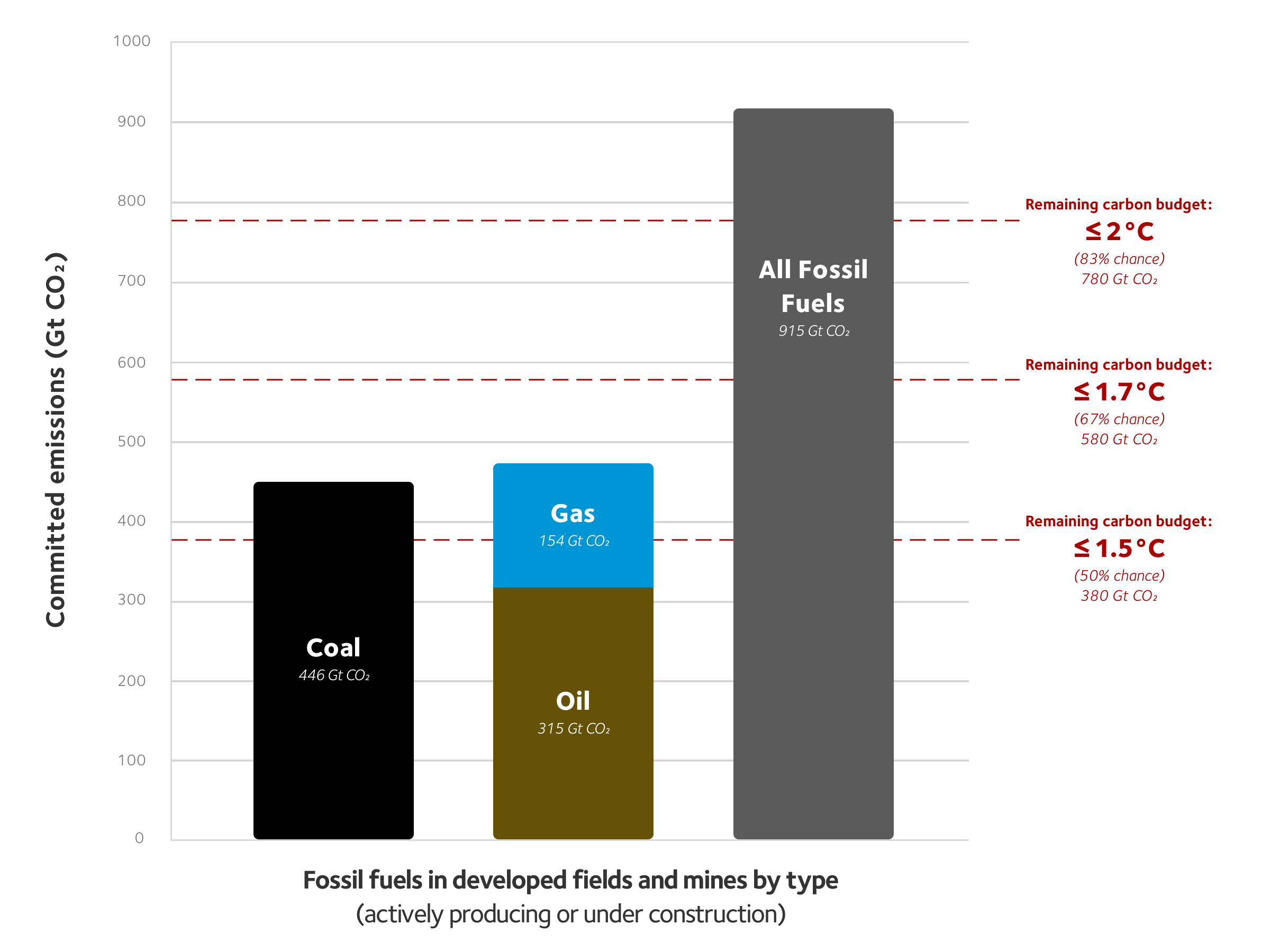
Figure 1: CO2 emissions committed by developed oil and gas fields and coal mines, compared to remaining carbon budgets from the start of 2023
The majority of the fossil fuel reserves within active fields and mines must now stay in the ground. Using updated 2023 data, the proportion of coal, oil, and gas reserves that must remain unextracted to meet the 1.5°C limit has increased from nearly 40% in 2018 to almost 60% in 2023.
As of 2023, developed oil and gas reserves alone, if fully extracted, would cause cumulative carbon emissions nearly 25% greater than the world’s remaining 1.5°C carbon budget. Thus, even in the theoretical scenario where coal mining stops immediately, developed oil and gas reserves alone could push the world beyond 1.5°C.
A significant portion – almost one-fifth (20%) – of oil and gas fields must be shut down, even if no new fields are developed and coal extraction stops tomorrow.
Developed fields and mines contain enough fossil fuel to push the world beyond 2°C, a significantly more dangerous threshold that could make parts of our planet newly uninhabitable.
These findings underscore why governments must show up to the upcoming United Nations-hosted climate summits, the Climate Ambition summit in September in New York and COP28 in December in the UAE, with super-charged commitments to:
Stop licensing and permitting new fossil fuel development, and
Initiate a fast and fair global phase-out of fossil fuels. To be fair, wealthy fossil fuel-producing countries must move fastest to revoke permits for and retire polluting infrastructure while fully funding a just transition to renewable energy.
There have been some rays of light. Core members of the Beyond Oil and Gas Alliance have committed to stop licensing new oil and gas exploration and phase out their oil and gas production on a 1.5°C-aligned timeline. A group of six Pacific Island nations recently issued a call committing to a fossil-free Pacific and demanding “a global, just and equitable phase out of coal, oil and gas.” And, at last year’s United Nations COP27 climate summit, over 80 countries pushed for the summit conclusions to include a call to phase out fossil fuels.
Yet, many of the same countries ostensibly backing the call for a fossil fuel phase-out at COP27 – including the United States, Canada, Australia, the United Kingdom, and Norway – have turned around and hypocritically continued developing more fossil fuels.
When you are in a hole, the first step is to stop digging. It is time for countries to heed the call of United Nations Secretary-General António Guterres and come to New York in September with new and accelerated commitments to phase out fossil fuels backed by concrete policy action. To be credibly 1.5°C aligned, these commitments must include, at minimum, action to end licensing, permitting, or funding of new fossil fuel production – and, for the wealthiest countries, to fund a just global transition to renewable and sustainable energy.
Read on for more of the technical analysis comparing our updated results on developed fossil fuel reserves to those in the ERL study published last May.
If we have not been warned of the dangers of climate change this summer, we never will be. Extreme heat, forest fires and floods have been all over news reports. Yet the oil and gas industry remains largely in denial.
The International Energy Agency (IEA) says steep cuts in oil and gas production are necessary to reach the Paris (COP 21) goal of keeping global warming at 1.5℃. However, only a tiny fraction of the industry, accounting for less than 5% of oil and gas output, has targets aligned with the IEA’s “net zero” requirements.
The current secretary general of production cartel Opec, Haitham al-Ghais, expects global oil demand to rise by about 10% to 110 million barrels a day by 2045, a volume incompatible with the Paris goals. The UK government has just offered a helping hand, granting around 100 new North Sea licences. What are we to make of this mismatch?
The new denialism
Typical of the new breed of climate denialism is a recent report by the Energy Policy Research Foundation (ERPF), a body funded by the US government and various undisclosed corporate interests and foundations. It sees the IEA’s requirements as a “seal of approval … to block investment in oil and gas production by western companies”. The report views meeting the targets as too costly, too harsh on poor countries and too bad for the energy security of the west.
In fact, it is wrong on each account. Many eminent economists and scientists use the concept of the social cost of carbon (SCC), which is defined as the cost to society of releasing an additional tonne of CO₂. Expert estimates from 2019 put this at between US$171 and US$310 (£133 to £241). If we go with, say, US$240 per tonne, the social cost of continued carbon equivalent emissions comes out at almost US$8.5 trillion every year.
A recent study has factored into the calculation climate feedback loops. This is where one problem caused by global warming leads to others, such as melting permafrost unleashing stores of methane.
When the study estimated the economic damage that this could cause, it produced an SCC in excess of US$5,000. That implies annual costs of more like US$170 trillion a year, which makes the US$4 trillion investment into clean energy that the IEA thinks necessary to meet the Paris climate goals look like a drop in the ocean.
It may help to break this down to one barrel of oil. A special IEA report for COP28 estimates that on average, each barrel of oil emits 0.53 tonnes of CO₂ equivalent in greenhouse gas across its life cycle, 20% of which comes from production.
Going back to our average SSC per tonne of US$240, that points to a social cost of US$126 per barrel. With oil currently at US$85 per barrel, the societal damage from producing, transporting, refining and consuming it is far greater – and that’s before including climate feedbacks.
Meanwhile, the arguments by the EPRF and like-minded supporters about energy security are laughable. The history of the oil and gas industry is a history of wars and geopolitical tensions. Transitioning to cleaner fuels can only increase our energy security and reduce the need to police remote autocracies.
The argument that poor countries need to continue burning carbon for development reasons is no better. In its latest report from 2022, the Intergovernmental Panel on Climate Change (IPCC) said climate change would probably see an increase in “losses and damages, strongly concentrated among the poorest vulnerable populations”.
Equally, the World Health Organization estimates that: “Between 2030 and 2050, climate change is expected to cause approximately 250,000 additional deaths per year from malnutrition, malaria, diarrhoea and heat stress.”
How to respond
The denialists offer no alternatives to cutting carbon emissions, and often simply ignore climate change altogether. The recent ERPF report mentions climate change only four times. It is as if heatwaves, forest fires, flooding, rising sea levels and the demise of natural habitat caused by climate inaction were happening on another planet.
We still have time to limit global warming below 1.5℃. It is true that we will need oil and gas for many years, and that there are currently no alternatives for certain sectors such as air travel, shipping and some industries. Nonetheless, there is still much that can be done now to make a substantial difference.
To incentivise the transition to cleaner energy, governments need to end fossil fuel subsidies, which the IMF estimates amounted to US$5.9 trillion in 2020 alone. We also need to put a proper price on carbon – only 40 countries have attempted this so far, and none has it anywhere near the estimated social cost of emitting carbon.
Countries that resist charging their own polluters should face a carbon border adjustment mechanism, which is a tariff that effectively puts the polluter on the same footing as local players. If all the actors in the fossil fuel supply chain had to face the cost of the damage they cause, the need to phase out long-term investments in fossil fuels would become more obvious.
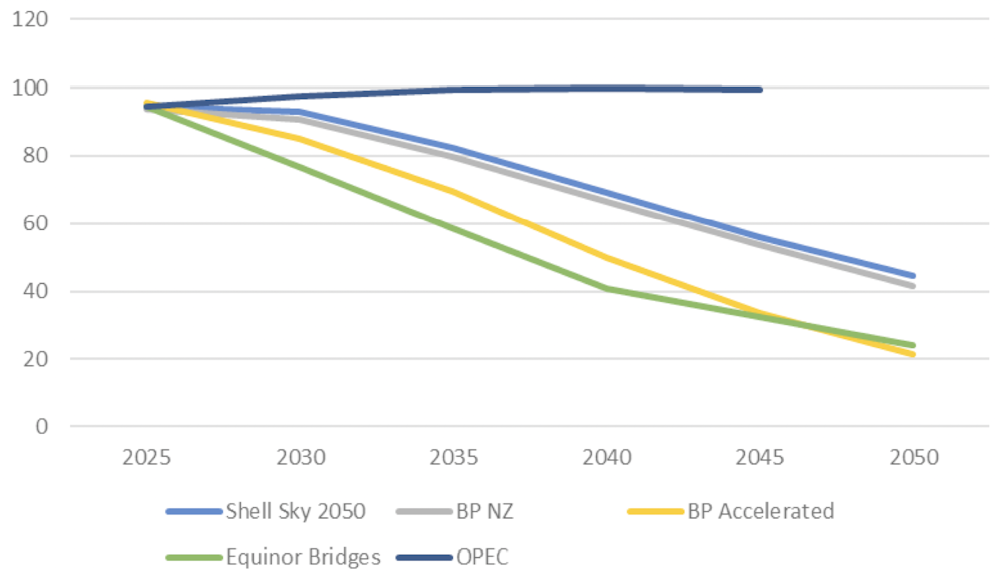
The IEA requirements for “net zero” are just one of the pathways towards meeting the Paris goal of 1.5℃ warming. Others are explored by some of the more credible actors in the petroleum industry, such as Shell, BP and Norway’s Equinor, but all require a substantial decline in oil demand and production by 2050.
Required production cuts
I left the IEA’s scenario off the graph because it published so few datapoints, but it is broadly in line with the others. Meanwhile, the Opec data is for reference and not a net zero scenario. BP, Shell, Equinor and Opec
Instead of criticising efforts to slow climate change and sponsoring ridiculous reports calling for more fossil fuels, the oil industry should eliminate leakages, venting and flaring of methane, and electrify as many processes as possible using renewable power. It should also employ carbon capture, usage and storage technologies over the next ten years – yes this will increase the price of fossil fuels, but that is exactly what we need to make clean sources of energy competitive across the board and speed up the energy transition.
The sooner the industry starts facing up to the realities of climate change, the more chance it has to survive. The companies and even countries that produce fossil fuels will have to face and pay the cost for the damage they cause. Those costs are already massive and will grow. Those that survive will do so only as a provider of clean and sustainable energy.
Don’t have time to read about climate change as much as you’d like?
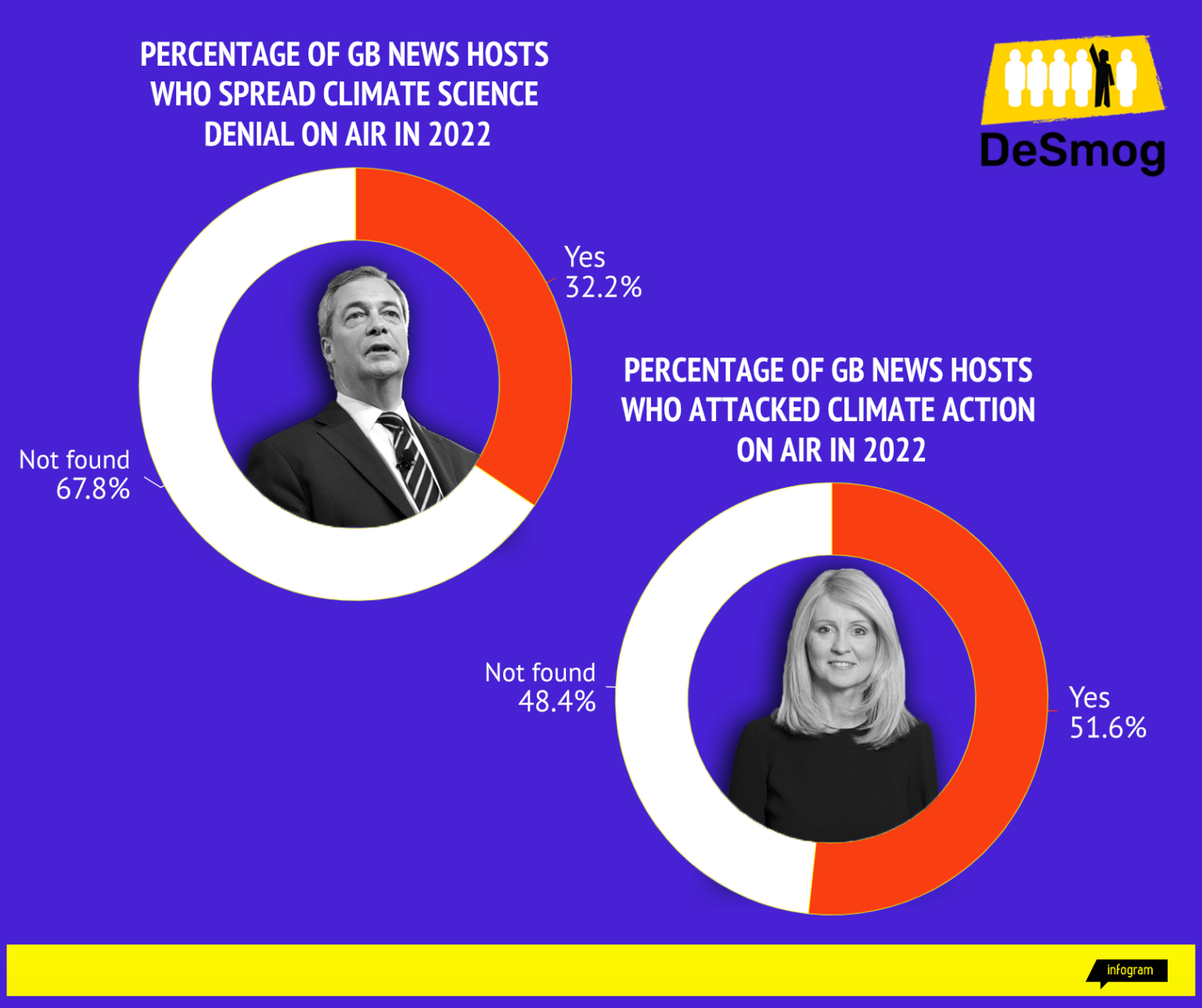
A majority of GB News hosts attacked climate action on the channel in 2022, while one in three spread climate science denial, a DeSmog analysis can reveal.
Opponents of green policies have seized on the energy crisis sparked by Russia’s invasion of Ukraine to denounce the UK’s net zero target and push for new, environmentally-damaging fossil fuel extraction.
Broadcaster GB News has faced criticism for spreading anti-green messages to millions of viewers since its launch in June 2021. GB News CEO Angelos Frangopoulos has previously defended the platform by claiming that it presents “multiple sides of the climate debate”.
However, an in-depth DeSmog analysis of GB News’s output from 2022 reveals a pattern of hostility to climate action, including outright climate science denial.
DeSmog reviewed dozens of YouTube video clips of 31 GB News hosts over a 12 month period. Our analysis found that at least 16 hosts (52 percent) attacked on air the UK’s climate policies, including its net zero target.
Presenters claimed that net zero will cause “death by poverty and starvation”, “poses an existential threat to the free world”, and called for the UK to “drill, baby, drill” for more fossil fuels.
The analysis also showed that ten hosts (32 percent) broadcast views in 2022 that challenged or rejected the scientific consensus on climate change. Presenters dismissed the role of climate change in extreme weather, such as the UK’s record 2022 heatwave, claiming “the polar bears are doing fine” and that “the ice in Antarctica is getting thicker every day”.
The world’s leading climate science group, the UN’s Intergovernmental Panel on Climate Change (IPCC) warned in 2022 that efforts to tackle climate change were being delayed by “rhetoric and misinformation that undermines climate science and disregards risk and urgency”.
The Scottish National Party (SNP) MP John Nicolson – who sits on Parliament’s Culture, Media and Sport (DCMS) select committee – called DeSmog’s analysis “damning” and urged Ofcom to take “urgent” action, while US-based media and climate expert Allison Fisher said that GB News was using “a similar playbook as Fox News”.
At least four GB News hosts have ties to right-wing political parties that are hostile to climate action, while its ranks include well-known anti-green MPs from the Conservative benches. The channel also frequently platforms activists from climate science denial groups such as the Global Warming Policy Foundation (GWPF).
All but two of the hosts who spread climate delay and denial in 2022 are still working at GB News. And, in recent months, GB News has hired two more anti-green MPs as presenters: former Business Secretary Jacob Rees-Mogg, and current Conservative Party Deputy Chair Lee Anderson.
A GB News spokesperson told DeSmog: “GB News embraces a wide range of voices on all major issues such as climate change and policy.” They claimed that DeSmog’s research excluded “other hosts, guests, politicians, and commentators on GB News who have robustly and resoundingly argued different views on climate policy and science”.
Communications regulator Ofcom has repeatedly found GB News to have broken broadcasting rules with false claims about Covid vaccines, and is probing the channel’s use of MPs as hosts. But, until now, GB News’s climate coverage has largely evaded scrutiny.
“GB News prioritises polemicists over journalists,” Nicolson told DeSmog. “Many of GB News’s broadcasts pollute public discourse with right-wing propaganda.
“There is an urgent need for Ofcom now to act. We do not want to go further down the American Fox News route of unchallenged, often scientifically illiterate, culture war propaganda spewing into our homes.”
An Ofcom spokesperson told DeSmog: “In line with freedom of expression, broadcasters are free to broadcast programmes about climate change from a range of different perspectives.
“Under our rules, however, any scientifically unsubstantiated claims must be handled with care and put properly into context – for example, by receiving adequate challenge – to ensure audiences are not misled.”
‘Net Zero Must Die’
In 2022, GB News frequently aired claims about climate policy that run counter to the scientific consensus, DeSmog’s findings show.
Net zero targets were a favourite topic. The UK’s 2050 net zero target is legally binding and backed by the world’s top climate scientists. Rapidly cutting carbon emissions is necessary to limit global warming to 1.5°C and avoid the worst impacts of climate change, including drought, famine, and ill health, according to the IPCC.
Yet, net zero was the subject of attacks from GB News hosts last year, with the presenters often veering into conspiracy theories.
For example on 5 November, host Neil Oliver used his show to attack “net zero [and] the green agenda”, which he claimed was part of “a hellish potpourri of policies guaranteed to condemn hundreds of millions to death by poverty, death by starvation”.
Mark Steynclaimed on an 18 May episode of The Steyn Line that climate policy was part of a conspiracy to bring about “a controlled demolition of the western world” by “sinister globalist[s]”. Steyn parted ways with GB News this year after Ofcom ruled that his false claims about the safety of Covid vaccines had broken its standards over potentially harmful content.
Flagship host Dan Wootton argued on 10 March that the war in Ukraine meant “for now the rush to net zero must die”. He urged the government to “frack, frack, frack” for shale gas. In a 2 November show, Wootton attacked Rishi Sunak for agreeing to attend the “eco doomfest” COP27 climate summit, while a graphic on the screen referred to “the deranged march to net zero”.
Mark Dolan, in a 22 September episode of Mark Dolan Tonight, said: “Blindly pursuing net zero threatens to hasten the decline of the west, and therefore poses an existential threat to the free world.”
In a 9 December show, Dolan praised plans to open a new coal mine in Cumbria, saying the UK should “drill, baby, drill” for coal, oil and gas, and adding: “I think the push for net zero here is another element of liberal progressivism which is infecting the west.”
The International Energy Agency (IEA) has said that any new fossil fuel projects would be incompatible with limiting warming to 1.5°C. Coal emits the most CO2 of any fossil fuel.
In July, star host Nigel Farage – who has a long record of opposing climate action – used his GB News platform to launch a campaign for a Brexit-style referendum on net zero.
On 6 December, GB News host and Reclaim Party leader Laurence Fox argued for scrapping “those woke billions” that “we are spending each year to appease the sun monster with offerings of net zero”.
Fellow host Nana Akua claimed on 16 July that net zero was “a money-spinning, extreme and impossible goal” that “only relates to the zero sum you will have in your bank account by the time they’re done with you.”
GB News hosts also frequently challenged or rejected the scientific consensus on climate change in 2022.
On 16 July, during the UK’s record-breaking summer heatwave, host Calvin Robinson accused the Met Office of “alarmism”, adding: “Man-made climate change, I don’t buy it, because how much of an impact do we really make if we’re talking about carbon levels?”
On her 16 July show, Akua accused the print media of “climate alarmism” over warnings about the heatwave, which she said “really isn’t that bad,” adding of such warnings that “in any case, most of the time, they’re wrong”.
Six days later, Akua said: “If we [humans] only generate 3.5 percent of CO2 and the rest of it is natural, then surely the CO2 is not the reason for the climate changing because it’s such a small proportion?”
A day earlier, host Beverley Turnercalled heatwave warnings “fear mongering” in order to “facilitate state control over your life”. Turner also spread baseless claims warning viewers to “be aware of green issue propaganda which will serve large corporate interests”, which is “part of a plan to register us all to a Biometric ID and a social credit score system that’ll tell you when you can and can’t leave the house for the sake of the planet”.
On 8 August, Farage questioned the link between extreme weather and climate change, saying: “Which is it? Is climate change giving us floods in the [US] midwest or drought in southern England? I’m confused.”
These claims about the heatwave contradict the IPCC, the Met Office, and a study by the World Weather Attribution service that said the heatwave was made “at least 10 times more likely” by human-caused climate change.
In a 22 September segment, Mark Dolan cast doubt on climate science, saying: “When it comes to global warming, my mind is open, but after two and a half years of, in my view anti-scientific Covid policies, and junk modelling in relation to the virus, forgive me for having questions and not slavishly following ‘the science’.”
In a 10 December show, Neil Oliver asserted that “the polar bears are doing fine” and “the ice in Antarctica is getting thicker every day” – claims not supported by the scientific evidence.
Professor J. Timmons Roberts, co-author of an influential paper on the “discourses of climate delay”, told DeSmog that GB News presenters were “casting doubt on the urgency of meaningful action on climate change and the viability of solutions we now have to this urgent problem.
“These are classic discourses of delay, honed by the fossil fuel industry and its allies, building on the decades of experience of the tobacco PR machine,” he said.
“GB News appears to be utilising a similar playbook as Fox News to push climate misinformation and throw sand in the gears of climate action,” said Allison Fisher, Climate and Energy Program Director for the US-based media watchdog Media Matters.
“Attempting to discredit climate science, denying the link between our warming planet and ever-increasing extreme weather, all while keeping up a steady drumbeat of attacks on climate solutions and policies intended to address the climate crisis, are tactics Fox News has used for years to misinform its audiences and delay action on climate change.”
All of the hosts cited in this article have been approached for comment.
Anti-Green Politicians
At least four GB News hosts have ties to political parties with a record of climate science denial: Nigel Farage, former leader of the Brexit Party (now Reform UK) who also heads up the anti-green group Vote Power Not Poverty; Calvin Robinson, who was a Brexit Party parliamentary candidate in 2019 and a former Reclaim Party advisor; Arlene Foster, former leader of the Democratic Unionist Party; and Reclaim Party leader Laurence Fox.
Another host, Philip Davies, was one of five MPs to vote against the Climate Change Act in 2008. Davies, Anderson, and Esther McVey – who is also a GB News presenter – are all members of the anti-climate action Net Zero Scrutiny Group of backbench Conservative MPs.
Owned by the Dubai-based investment firm Legatum Group, GB News reached 2.87 million viewers in December alone, reportedly beating rival station TalkTV in key time slots. Despite this, the broadcaster lost £30 million in its first year on air.
The Legatum Institute think tank, which is run by the Legatum Group, has previously received donations from a foundation linked to the US-based Koch Industries oil dynasty. Three of the five parties with significant control of GB News’s parent company, All Perspectives Limited, are executives at Legatum.
GB News last year appointed a new chair, Alan McCormick, who is a partner at Legatum and previously shared articles online which dismissed the threat from climate change.
Legatum Group did not respond when contacted for comment.
‘Biased Messaging’
GB News not only gives a voice to climate denial and delay via its hosts; it also platforms guests who are hostile to climate science and net zero policies.
Frequent guests include Lois Perry of the climate science denial group CAR26, as well as figures from the GWPF, the UK’s principal climate denial group, which campaigns as Net Zero Watch. On 30 April this year, GB News hosted the GWPF’s head of policy Harry Wilkinson in a segment on net zero.
GB News has also promoted GWPF material under its own banner. In May 2022, GB News published an online story criticising government subsidies for wind farms which, although it was based on a Net Zero Watch analysis, did not reveal the group as its source.
GB News’s online story carried quotes from Conservative MPs Steve Baker and Craig Mackinlay, both of whom are Net Zero Watch allies. These quotes were identical to the statements featured in the Net Zero Watch press release.
The on-air version of the story featured an interview with Andrew Montford, deputy director of Net Zero Watch, while the story was also cited in a new report by the influential Institute for Economic Affairs (IEA) think tank that called for a “phase out” of renewable energy subsidies.
Richard Wilson, board member of the Stop Funding Heat campaign, said GB News was pushing “biased messaging on climate change and net zero.”
Wilson urged advertisers to pull support for the channel, saying: “Any company that cares about climate change, and the future of humanity, should be steering well clear of GB News.”
Fisher at Media Matters added: “At a time when the window to act on global warming is rapidly closing, the last thing the world needs is another Fox News.”
For a full breakdown of GB News’s record on climate, visit its new profile in DeSmog’s climate disinformation database.
Methodology Using online video footage of GB News segments, mainly on YouTube, DeSmog analysed the comments made on air in 2022 by the presenters listed on the GB News website.
We excluded six of these 37 listed hosts – Mark Longhurst, Rosie Wright, Darren McCaffrey, Mark White, Ellie Costello and royal correspondent Cameron Walker – as they were news anchors or reporters who did not regularly express opinions.
DeSmog’s analysis found that, of the 31 GB News hosts, 16 (52 percent) attacked climate action on air, while 10 (32 percent) challenged or rejected basic climate science.
We defined “attacks on climate action” as hosts attacking “net zero” and efforts to cut CO2 emissions, or supporting a major increase in fossil fuel extraction, e.g. overturning the UK’s fracking ban or opening a new coal mine. We excluded specific calls for more North Sea oil and gas extraction because, while this still contradicts the IPCC and IEA, it is a more mainstream position, held for example by the current UK government.
We defined “climate science denial” as hosts rejecting or casting doubt on the role of human-caused CO2 emissions on global warming, and on its role in extreme weather events such as last year’s record heatwave in the UK.
The analysis did not include the regular attacks on climate protesters by GB News, or contestable claims about the UK being a “world leader” on climate action.
In drawing up these definitions DeSmog was guided by the peer-reviewed 2020 “discourses of climate delay” paper published by Cambridge University.
We were not able to review all of GB News’s 2022 output, as not all of it is currently publicly available after live broadcast, so there may be more examples that were not captured in this analysis. We also found that several hosts made delay or denial statements in 2021 or 2023 which fell outside the time frame and so were not included in this analysis. A full dataset is available upon request.
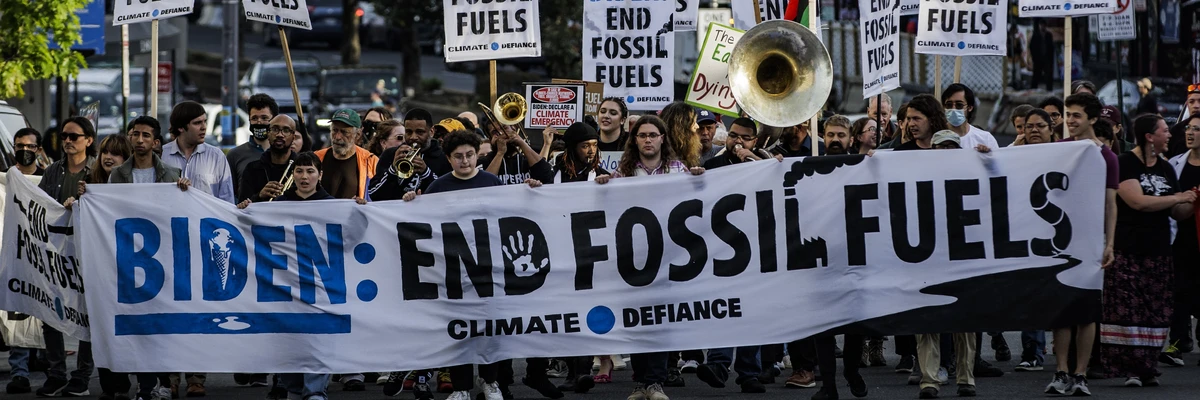
Climate protesters have gathered outside Norwegian oil giant Equinor’s London offices to oppose the company’s plans to develop the Rosebank oil and gas field.
Rosebank, which lies west of the Shetland Islands, is one of the largest such fields in the North Atlantic, capable of producing up to 500 million barrels of oil.
The International Energy Agency has previously said there must be no new investment in oil and gas if the world is to become net zero by 2050, while the Intergovernmental Panel on Climate Change said emissions from existing fossil fuel infrastructure are already set to push global temperatures beyond safe limits.
…
We’re outside London @Equinor HQ demanding they get #EquinorOut of oil & gas ⏩ Their shareholders are meeting in Norway to decide its future today.
They want to open new oil & gas projects in Argentina, Canada, the UK & Brazil.