This work by Middle East Monitor is licensed under a Creative Commons Attribution-NonCommercial-ShareAlike 4.0 International License.
A banner which reads ‘Stop killing children – Stop killing civilians’ is displayed as players of both side’s line up prior to during the UEFA Super Cup 2025 match between Paris Saint-Germain and Tottenham Hotspur at Stadio Friuli on August 13, 2025 in Udine, Italy. [Photo by Chris Ricco – UEFA/UEFA via Getty Images]
Ahead of its Super Cup match between the Paris Saint-Germain and Tottenham clubs, which took place on Tuesday at Stadio Friuli in Udine, Italy, the Union of European Football Association (UEFA) rolled out a banner reading, “Stop killing children. Stop killing civilians,” in a hint of solidarity with the children of Gaza, who have been the victims of Israel’s war on the Strip for more than 21 months.
In conjunction with the stadium gesture, the UEFA reiterated its position through a post on its official X account that read, “From the UEFA Super Cup in Udine, the message is loud and clear. A banner. A call.”
Since 7 October, 2023, US-backed Israel has been committing genocidal crimes in Gaza. In killing, starving, destroying, and displacing Palestinians, Israel has ignored international calls and International Court of Justice rulings that it end its war on the strip.
Israel’s genocide in Gaza has left 61,722 Palestinians killed and 525,000 injured, most of whom were women and children. The Israeli war has also left more than 9000 missing, hundreds of displaced Palestinians, and a famine that has killed 235 persons, including 106 children, so far.
Activists protesting against police infiltrations in Italy. Source: Cambiare Rotta/Facebook
Potere al Popolo is pressing the Meloni government to explain five police infiltration attempts targeting the party’s youth organizations.
Italian left party Potere al Popolo! (Power to the People!) continues to demand full government transparency following revelations that multiple police agents infiltrated the party’s youth groups, Collettivo Autorganizzato Universitario (Self-Organized University Collectives, CAU) and Cambiare Rotta (Changing Course). For approximately eight months, undercover police officers infiltrated or attempted to infiltrate chapters in Naples, Milan, Bologna, and Rome, only to be uncovered through by the party’s internal investigation and independent media outlet Fanpage.
Speaking to Peoples Dispatch, Giuliano Granato, one of Potere al Popolo’s spokespeople, stated that the party is exploring all potential avenues for action, emphasizing that it will not wait passively in the meantime. A key priority is compelling the relevant institutions, including Prime Minister Giorgia Meloni and Interior Minister Matteo Piantedosi, to publicly explain what happened. “They owe the public some answers,” Granato says. “Who ordered this operation? Who planned it? And on what grounds?”
Meloni’s government and institutions, however, are not known for responding transparently to uncomfortable questions. This became evident again after the first case was exposed in May, when official statements ranged from evasive to outright absurd. One explanation offered, Granato recalls, was that the officer who infiltrated the youth group in Naples had done so not as part of an official assignment, but rather because he had “fallen in love with a Potere al Popolo activist.”
“Are we now supposed to believe five officers from the same training course all suddenly fell in love with five of our activists at the same time?”
Another line of defense claimed that while the infiltrations were official operations, they did not target Potere al Popolo as a political party, but only the specific youth collectives. Yet, even if one was to accept the dubious legitimacy of undercover operations in youth organizations on campuses, that explanation raises new questions. As Granato notes, there are many youth collectives across Italy active on similar issues, including Palestine solidarity and housing. “And yet, the only ones where infiltrators were discovered are the ones organically tied to Potere al Popolo.”
A state increasingly intolerant of dissent
Granato also stresses the importance of keeping public attention on the issue. Since the revelations in May, Potere al Popolo! has received solidarity from grassroots networks and trade unions, civil society organizations, and even a few opposition parties that submitted formal inquiries to the government. “In contrast to this, there has been no media uptake of the case,” Granato said. “Apart from Fanpage, only Il Fatto Quotidiano and il manifesto covered it. The rest of the mainstream media landscape? Radio silence. All the big self-declared progressive media ignored it.”
“This is a very grave thing,” he continues, “because these are the same center-left media that now and then raise concerns about Meloni’s authoritarian drift.” By choosing not to cover the infiltrations in Potere al Popolo, Granato suggests, they show that they will only raise issues when it benefits them, ignoring the public interest when it doesn’t.
The tendency is particularly worrying in the current context, Granato says, considering the infiltration of Potere al Popolo is not an isolated case but part of a broader trend. He points to connections to other recent cases, such as the surveillance of Fanpage journalists and of activists from Mediterranea Saving Humans, who have challenged the government’s deadly migration policies through their work. He also mentions the government’s so-called security decree and an ongoing campaign against the right to strike. “If we connect all these little dots, what emerges is a picture of a government and institutions that are less and less tolerant of dissent,” Granato explains.
Yet it is not individual dissent they are afraid of. Instead, what state authorities and institutions fear is collective dissent that organizes people and gives them the tools to change the status quo, Granato says. This fear is one of the reasons why they would want to infiltrate Potere al Popolo, as they recognize it as a political force capable of posing a real threat to the structures they want to protect.
One way to resist this tendency, Granato concludes, is to remain persistent in showing solidarity, including to those who have been infiltrated by the police. “Publicly showing solidarity means publicly showing there’s still a democratic fabric that hasn’t been destroyed, both in Italy and beyond.”
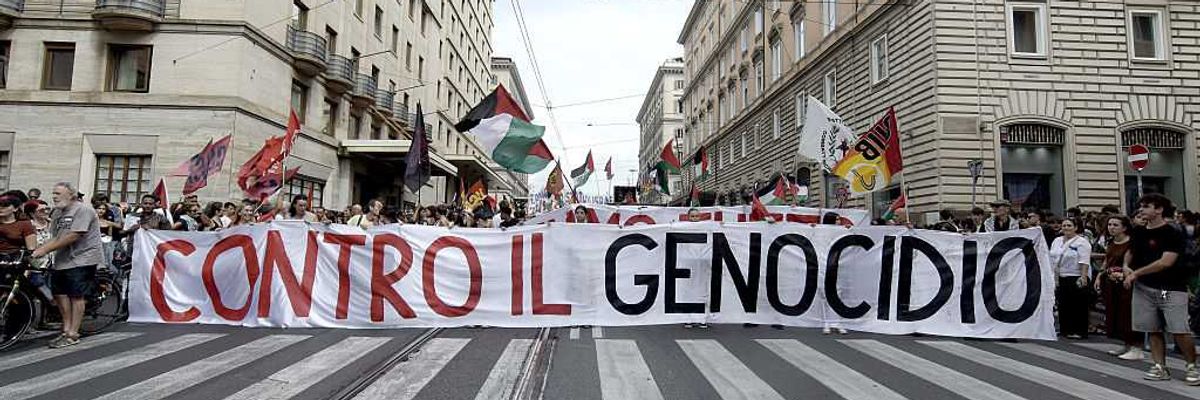
Potere al Popolo activists with banner reading: “Against spies and repression. Let’s stand up to the Meloni government”. Photo: Potere al Popolo
Following the exposure of an undercover operation in its Naples chapter, Potere al Popolo has reported additional cases of police spying in other Italian cities.
After discovering that a young police officer had infiltrated Potere al Popolo (Power to the People) in Naples at the end of May, the party, together with media outlet Fanpage, uncovered four similar cases in Milan, Bologna, and Rome. The officers approached the organization primarily through one of its youth collectives, Cambiare Rotta (Changing Course), between October and November 2024, shortly after graduating from the same police course and just before being assigned to the Central Police Directorate for Crime Prevention, an agency dedicated to investigating terrorism.
During this period, the officers actively participated in demonstrations against the cost of living crisis, in solidarity with Palestine, and in anti-militarization actions. They often presented themselves as out-of-town students with few connections at local universities. Their involvement went deep: some supported election campaigns for official student bodies. At the same time, other activists noticed inconsistencies – none of the identified officers engaged in activities beyond political work, for example, an unusual pattern in youth organizing.
While the infiltration operations in Naples, Milan, and Bologna lasted about eight months, the effort in Rome was short-lived. Activists there quickly grew suspicious of the officer’s background story and the way he tried to approach the organization.
Protestors take the streets to demonstrate against rearmament and NATO. Photo: Potere al Popolo
By late June, all those identified had ceased contact with Potere al Popolo, but one officer was present at a demonstration in Bologna when news of the Naples infiltration broke publicly last month. “The moment there was a public denunciation in that demonstration in Bologna, about the Naples episode, this person disappeared from one day to the next,” said Giuliano Granato of Potere al Popolo. “We haven’t heard from him since.”
A threat to democratic rights and structures
Back in May, the party had denounced the Naples case as a disturbing sign of the government’s authoritarian drift, undermining the democratic character of Italian society and constitutional values. That warning has since prompted several parliamentary parties to demand explanations from Prime Minister Giorgia Meloni’s government – none of which have been provided. With these new revelations, alongside confirmed instances of journalists being spied on, concerns are mounting over the administration’s trajectory.
“It shows us the path of repression this government is taking through, and I quote Giorgia Meloni’s own words, ‘regime methods’,” said Anita Palermo of Potere al Popolo Rome. “We appeal to social and democratic forces, associations, and citizens to mobilize so that political activity in this country can take place in a democratic way, without fear of police infiltration.”
During a press conference on June 27, Granato added that the infiltration and surveillance of political parties, humanitarian organizations working with migrants, and journalists were indicative of the government’s own fear. The fact that they are prepared to launch such operations shows that the government is terrified of dissent, he said.
“But dissent is the salt of democracy,” Granato added, insisting that the experience of Potere al Popolo has far broader relevance. “If the state can plant an undercover officer inside a political party, it can do the same to a union or a newsroom.”
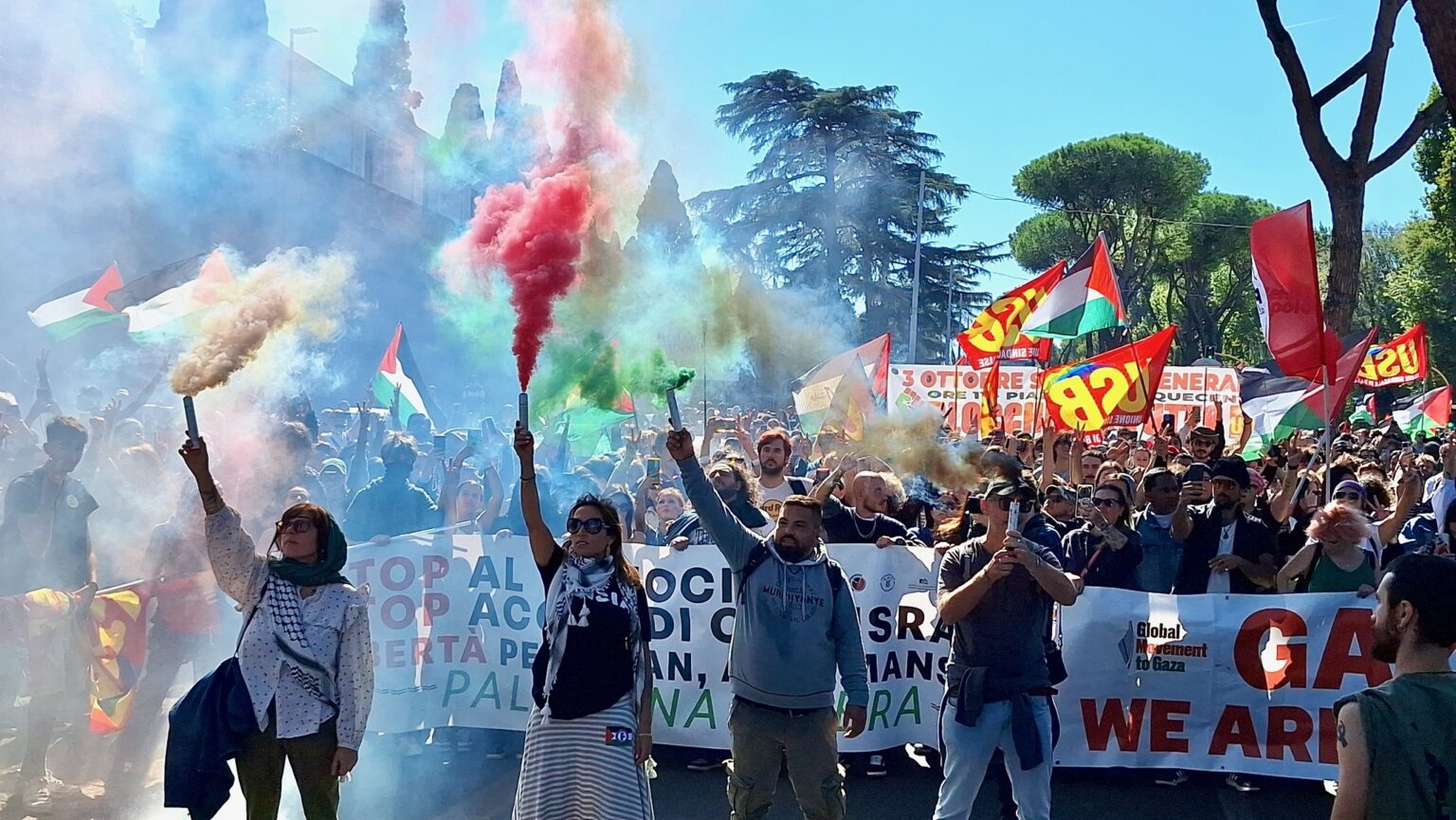
Trade unions and social collectives have condemned the police operations as a clear attack on political and civil rights. Many interpret it as part of the Meloni government’s increasingly repressive stance toward political opposition. This comes at a moment when Potere al Popolo, alongside grassroots unions, is leading a national campaign against war, NATO, and the European Union’s rearmament agenda.
According to the Unione Sindacale di Base (USB), the attack on Potere al Popolo and its affiliated groups is emblematic of the broader political climate. “It’s a snapshot of the cultural and political values of a class that has openly aligned itself with war and rearmament,” the union said.
“And in a climate of war, the first targets are those who oppose it clearly and unequivocally, voices that must be preemptively silenced even when they act with full transparency,” the USB warned. “The ‘war system’ and all its economic and social ramifications … allows no dissent because it demands we all silently enlist in its cause. And that cause crushes democracy, packing away our freedoms in the attic.”
Swedish climate campaigner Greta Thunberg speaks surrounded by other participants in the latest Freedom Flotilla Coalition effort to deliver shipborne aid to Gaza, during a June 1, 2025 press conference in Catania, Italy. (Photo: Fabrizio Villa/Getty Images)
“No matter how dangerous this mission is, it’s nowhere near as dangerous as the silence of the entire world in the face of the live-streamed genocide,” said climate activist Greta Thunberg, who is aboard the Madleen.
A dozen Palestine defenders including climate campaigner Greta Thunberg and a French lawmaker set sail from Sicily on Sunday aboard a boat carrying humanitarian aid for the people of Gaza, many of whom are starving amid Israel’s ongoing U.S.-backed genocidal assault and siege and decadeslong naval blockade of the coastal enclave.
The Freedom Flotilla Coalition (FFC) said it launched the sailboat Madleen—named after Gaza’s first and only known fisherwoman—from Catania, Italy at 4:00 pm local time Sunday “in direct defiance of Israel’s illegal and genocidal blockade.”
“Madleen symbolizes the unyielding spirit of Palestinian resilience and the growing global resistance to Israel’s use of collective punishment and deliberate starvation policies,” FFC said in a statement Sunday. “The ship is carrying urgently needed supplies for the people of Gaza, including baby formula, flour, rice, diapers, women’s sanitary products, water desalination kits, medical supplies, crutches, and children’s prosthetics.”
The international volunteers aboard Madleen include Thunberg, French Member of European Parliament Rima Hassan, German refugee advocate and FFC steering committee member Yasemin Acar, Brazilian FFC steering committee member Thiago Ávila, Al Jazeera reporter Omar Fayad, French doctor Baptiste Andre, French journalist Yanis M’Hamdi, Turkish engineer Şuayb Ordu, and crew members Mark Van Rennes, Reva Seifert Viard, Pascal Maurieras, and Sergio Toribio.
“I am aboard Madleen because silence is not neutrality—it is complicity,” said Hassan, who is banned from entering Israel due to her outspoken support for Palestinian rights. “The Palestinian people in Gaza are being starved and slaughtered, and the world watches. This ship is not just carrying aid, it is carrying a demand: End the blockade. End the genocide.”
Thunberg said that “we are seeing a systematic starvation of 2 million people. The world cannot be silent bystanders, Every single one of us has a moral obligation to do everything we can to fight for a free Palestine.”
The Madleen‘s launch came a month after the Conscience, another FCC aid vessel traveling in international waters off Malta, was attacked twice, presumably by Israeli forces. No one was harmed in what FFC said was a drone strike on the ship. However, the activists were forced to abort their humanitarian mission. Israel has not commented on the incident.
Madleen also set sail nearly 15 years to the day after Israeli forces raided a Gaza Freedom Flotilla convoy carrying humanitarian aid to the besieged people of Gaza. The attack—which also came in international waters—left nine people including Turkish-American teenager Furkan Doğan dead.
FFC said Sunday that the “unarmed and nonviolent” mission “poses no threat” and “sails in full accordance with international law. Any attack or interference will be a deliberate, unlawful assault on civilians.”
Those aboard the Madleen said they were aware of the dangers they faced. Israel has killed numerous Western activists and journalists who document its human rights violations over the years, and just last month Israeli troops opened fire on a group of international diplomats visiting the illegally occupied West Bank two days after three involved countries issued an ultimatum to stop annihilating Gaza.
“We are doing this because, no matter what odds we are against, we have to keep trying,” a tearful Thunberg said during a Sunday press conference. “Because the moment we stop trying is when we lose our humanity.”
“And no matter how dangerous this mission is, it’s nowhere near as dangerous as the silence of the entire world in the face of the live-streamed genocide,” she added.
Activist Greta Thunberg says silence is more dangerous than sailing to Gaza, as she boarded a vessel that will try to break the Israeli blockade of Gaza.
The Gaza Freedom Flotilla had to abandon its last attempt on May 2 when it was bombed. pic.twitter.com/ieecZ8ps0E
Some Israelis and their supporters took to social media to wish harm upon the activists. In the United States, Sen. Lindsey Graham (R-S.C.) alluded to past Israeli attacks on Gaza aid flotillas in a social media post saying, “Hope Greta and her friends can swim!”
Israel strongly refutes allegations that it is committing genocide in Gaza. South Africa has filed, and dozens of nations support, a genocide case against Israel at the International Court of Justice in The Hague.
The International Criminal Court, also located in the Dutch city, has issued arrest warrants for Israeli Prime Minister Benjamin Netanyahu and Yoav Gallant, his former defense minister, for alleged war crimes and crimes against humanity, including extermination and starvation as a weapon of war, in Gaza.
Officials in Gaza say that more than 192,000 Palestinians have been killed or injured since Israel launched its assault and siege following the Hamas-led attack of October 7, 2023, a figure that includes at least 14,000 people who are missing and presumed dead and buried beneath rubble and hundreds of mostly children who have died from acute malnutrition and lack of medical care.
Around 2 million Gazans have also been forcibly displaced, often multiple times, amid Israel’s campaign to starve, conquer, indefinitely occupy, ethnically cleanse, and possibly recolonize the coastal strip.
Each side accuses the other of thwarting cease-fire efforts. On Saturday, U.S. Special Envoy Steve Witkoff rejected what he called Hamas’ “totally unacceptable” proposal for a truce in which 10 living and 18 dead Israeli hostages would be exchanged for an unspecified number of Palestinian prisoners held by Israel.
Former Israeli peace negotiator Daniel Levy toldDemocracy Now! on Monday that a cease-fire proposal mediated by Witkoff is “a bad deal for the Palestinians that will allow Israel to continue its ethnic cleansing of Gaza” and “walks back the commitment for a permanent cease-fire, Israeli withdrawal, and allowing in of humanitarian aid.”
This work by Middle East Monitor is licensed under a Creative Commons Attribution-NonCommercial-ShareAlike 4.0 International License.
Spanish Foreign Minister Jose Manuel Albares speaks to press ahead of the international meeting to discuss ending the war between Israel and Hamas, and advancing toward a two-state solution, in Madrid, Spain on May 25, 2025. [Şenhan Bolelli – Anadolu Agency]
Spain’s foreign minister insisted Sunday that the two-state solution is the only alternative to conflict between Israel and Palestine and is pushing for concrete measures to advance it at an international meeting in Madrid, Anadolu reports.
“What’s the alternative? Kill all the Palestinians? Send them, I don’t know where—to the moon?” Jose Manuel Albares said in a speech ahead of the meeting.
Madrid is hosting a group of 20 countries—foreign representatives from European nations, Muslim countries, and Brazil—as well as international organizations to discuss ending the war, Israel’s siege on Gaza, and advancing toward a two-state solution.
“Gaza is an open wound for humanity… There are no words to describe what is happening in Gaza—but just because there are no words doesn’t mean we will remain silent,” said Albares.
The number of countries in the so-called Madrid Plus Group has doubled, said Albares, with countries like Germany, Italy, France, and Portugal, which did not attend the first meeting, showing up on Sunday.
“There’s a lot of diplomatic muscle here today,” said Albares. “We are different governments coming together, but we all believe in the same principles and are not resigned to accepting violence as the natural way for Israelis and Palestinians to relate.”
He said that “time is running out” for a two-state solution, but the Madrid meeting aims to clarify “concrete steps” to turn the situation around for the sake of both Palestinians and Israelis.
Albares said Spain will push for measures to end the war, including suspending the EU-Israel trade agreement, an EU-wide arms embargo on Israel, sanctioning more individuals linked to the conflict, and “making the two-state solution impossible.”
Spain will propose that the upcoming UN meeting on June 16 be used as a “great movement for the recognition of a Palestinian state,” he added.
“Then, around a year later, we can hold another international meeting with Palestine as a full state with complete rights within the UN,” he said.
This work by Middle East Monitor is licensed under a Creative Commons Attribution-NonCommercial-ShareAlike 4.0 International License.
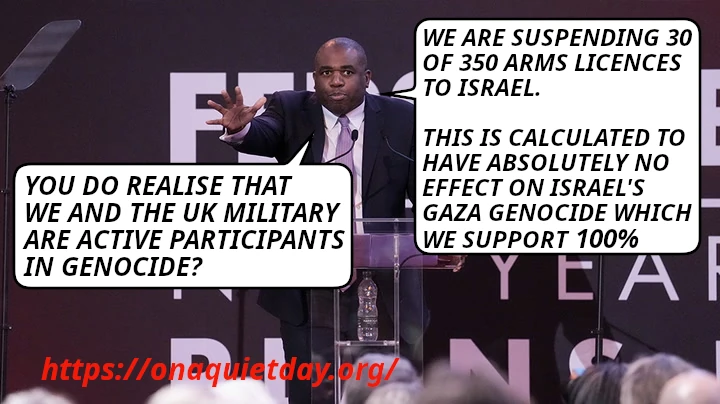
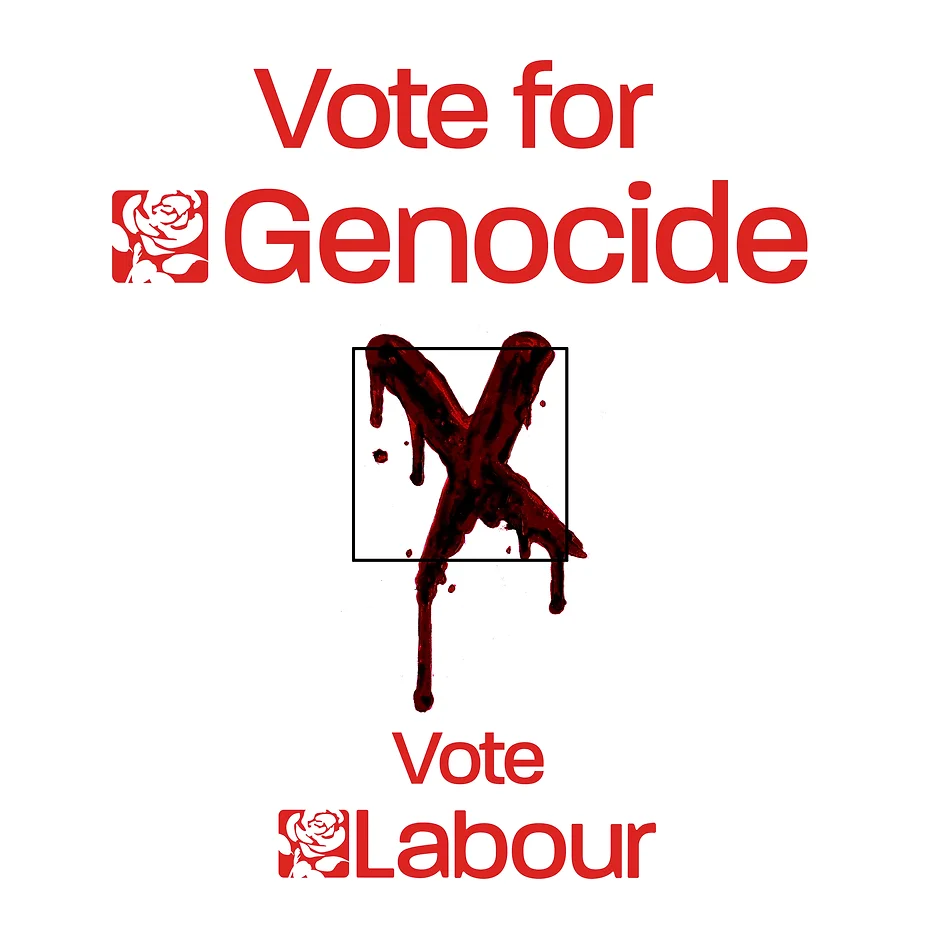
UK Labour Party government ministers Keir Starmer, Angela Rayner and Rachel Reeves explain that they are partners complicit in Israel’s Gaza genocide. The UK has provided Israel with arms, military and air force support. They explain that they don’t do gas chambers but do do forced marches, starvation, destroy hospitals, mass-murders of journalists and healthcare workers.Vote For Genocide Vote Labour.UK Foreign Minister David Lammy confirms that UK government and military are active participants in Israel’s genocides and that the F-35 parts that they suspended from supplying to Israel are instead simply diverted via the United States. He says see https://youtu.be/QILgUHrdWRE