Tag: North Sea

  • AI Was Supposed to Cut Emissions. Instead, Fossil Fuel Companies Are Using It to Find More Oil and Gas.

    Spread the love

    Article by Sarah Hofmann republished from DeSmog.
    Credit: Sarah Hofmann/arbyreed via Flickr (CC-BY-NC-2.0)

    A new study found AI-driven fossil fuel productivity could increase emissions. Here are examples of companies already using AI to boost production.

    When United Nations Secretary-General António Guterres warned world leaders last week in his UN address about the unchecked power of both Big Oil and artificial intelligence, he treated them as two of the defining challenges facing governments.

    The fossil fuel industry is turning to AI to map seabeds, identify new oil reservoirs, assess oil wells’ “abandonment risks”, inspect facilities, and streamline regulatory processes, potentially adding to the emissions of an industry that Guterres said governments must move away from. 

    At the same time, the technology companies providing these AI tools are not generally held accountable for the additional fossil fuel production and emissions their products may enable.

    “The danger is not technology,” Guterres told the UN General Assembly. “The danger is technology without accountability.”

    A DeSmog review of company announcements, industry presentations, and other publicly available information found that, across major fossil fuel companies — Aramco, Chevron, Equinor, ExxonMobil, Shell, TotalEnergies and others — AI is increasingly being integrated into fossil fuel operations, from seismic exploration and drilling to equipment monitoring and field development.

    The examples provide a real-world look at the mechanism behind a recent study published in Nature: that AI can increase emissions not only because of the electricity required to run data centers, but because it can make fossil fuel production more productive and profitable.

    The study found that AI-driven productivity gains in fossil fuel production accounted for most of the modeled increase in global energy-related carbon dioxide emissions. It estimated that AI could increase global energy-related carbon dioxide emissions by between 1.2 and 4.8 percent, with productivity gains in fossil fuel production accounting for most of that increase. 

    In one example of AI gains, Norwegian energy company Equinor re-scanned the Norwegian continental shelf with “new seismic technology and AI,” resulting in 27 new discoveries of oil, Hege Skryseth, the company’s executive vice president, chief technology officer, said during a June presentation for Equinor’s Capital Market Day.

    “By reprocessing the data, the seismic image became much sharper, leading to the discoveries,” Skryseth said. “AI was key here, from automated data interpretation to efficient well planning.”

    AI saved Equinor $130 million last year, according to a January 2026 press release.

    Chevron is also using AI to produce oil that was “previously considered unreachable.” 

    In the oil company’s recently launched podcast — in which racing driver Tanner Foust and Chevron Chief Technology and Engineering Officer Ryder Booth chat from a pickup truck tailgate — Booth said that breakthroughs at Anchor, an oil and gas development, represented the “first time unlocking kind of a new horizon around the world.”

    “AI, it’s attracted to big data and big opportunities, and the oil and gas industry has big data,” Booth said. Last year, Chevron said it had improved drilling and fracking efficiency in the Permian Basin by over 30 percent.

    The value of these productivity gains is significant. A recent McKinsey & Co. report estimated that, for the upstream oil and gas sector, AI can generate $65 billion in profits annually in the short term, which could increase to $230 billion when the technology is deployed at its “full potential.”

    AI-driven efficiency gains have already reduced operational costs by up to 18 percent; and industry executives attribute about 5 percent of their current revenue to “AI-driven initiatives,” according to a 2025 report from IBM, which has multiple partnerships with oil and gas companies.

    ‘Done in seconds and live-streamed’

    At Equinor’s enormous Johan Sverdrup oil field in the North Sea, “data flows up from the ground faster than the oil,” the company’s site states, at the rate of “10,000 Netflix movies a second.”

    The company is also using AI to optimize the placement of subsea equipment and wells.

    “What used to take 2-3 weeks and involved flying hard disks to shore with helicopter for analysis can now be done in seconds and live-streamed,” Equinor said.

    ExxonMobil is also embracing enormous datasets. In 2019, ExxonMobil partnered with Microsoft to use AI in its Permian Basin operations, a move Exxon said would “generate billions of dollars in value” and produce up to an additional “50,000 oil-equivalent barrels a day by 2025.”

    The oil giant also said that gains in efficiency from advanced technologies, including AI, “is a first step” towards letting systems respond to events without human intervention.

    Holly Alpine, a coauthor of the Nature study, said the significance of such partnerships is easy to miss when attention focuses on the emissions produced by powering AI systems.

    “For some reason, tech companies are exempt from accountability for the tech they are creating,” she told DeSmog.

    Alpine and her husband, Will Alpine, another author of the Nature study, previously worked for Microsoft, but left after coming to the conclusion that the company hid how its products were harming the climate. The couple then founded the Enabled Emissions Campaign, a nonprofit that calls attention to tech’s role in fossil fuel production and advocates for better regulations.

    She said that now, oil companies like Exxon pumping 50,000 barrels a day is “actually quite a small deal.” 

    “The deals have only grown in size, and we realized that that was not part of Microsoft’s accountability whatsoever, even though they are the company creating the technology that is making this happen.”

    A recent Reuters article about Exxon’s use of automated drilling in the Permian Basin, which said the company plans to increase production in the region to 2.5 million barrels a day, didn’t mention if Microsoft was still involved with the project; on Exxon’s website, references to Microsoft partnerships still link to the announcement from 2019.

    Microsoft did not confirm whether it’s still partnering with Exxon on those operations, but the tech company is the leading cloud provider for the oil and gas industry, according to Kimberlite Research, followed by Amazon and Google. 

    Data Centers Are Intertwined with AI

    Just two years ago, fossil fuels’ share of the world’s energy supply was projected to decline in coming years. Then, AI data centers began expanding rapidly, and with them, the argument that fossil fuels must scale up, too, for the U.S. to win the “AI arms race.”

    At the same time, the fossil fuel and technology industries are becoming increasingly intertwined. AI data centers require enormous amounts of electricity, and natural gas supplies more than 40 percent of the power used by U.S. data centers, according to the International Energy Agency (IEA).

    “AI’s advance will depend not only on the design labs of Silicon Valley, but also on the gas fields of the Permian Basin,” Mike Wirth, Chevron’s chairman and CEO, said in 2024.

    In the face of power grid constraints, some data centers are turning to natural-gas power plants built onsite, a setup known as “behind-the-meter” generation, like Chevron’s Kilby project with Microsoft. U.S. data centers’ investments in new gas turbines recently surpassed the total investments of every country except the U.S., according to an IEA report. 

    Meanwhile, the oil and gas companies are benefiting both from using AI to increase efficiency, and from supplying the additional energy that its data centers demand.

    AI and Net Zero Aims

    Online, Microsoft promotes AI tools as a way to “accelerate the energy transition,” “reduce emissions,” and “accelerate climate innovation.”

    Instead, AI may be having the opposite effect, prolonging our reliance on fossil fuels and delaying a broader transition to cleaner energy.

    “In the absence of continuous reinvestment, oil and gas production would fall by approximately 8 percent annually,” the Nature paper says, quoting IEA reports, and “technological progress has repeatedly delayed ‘peak oil’ forecasts by unlocking resources previously considered un-viable.”

    Equinor’s website recognizes the growing scarcity of oil reserves, noting that undersea oil and gas discoveries have dramatically declined in recent decades. “Even with planned projects, the (production) trend is downward,” it states. “Gently at first, but more noticeably if we don’t act fast to create new resource opportunities. This will affect value creation across Norway.”

    Chevron’s Booth, meanwhile, says there’s still enough oil, “and technology and innovation will unlock that,” though he also admitted we would need all forms of energy to meet the world’s demand.

    In spite of concerns about future scarcity, wartime windfalls and beneficial policies have recently brought record profits for major oil and gas companies, news reports show.

    After the August Nature article showing that AI helps the fossil fuel industry create more pollution, Johanna Fornberg, a Greenpeace senior research specialist, said in a statement that, while Big Tech continues to promise that AI technologies will benefit humanity and offer climate solutions, “what is hidden from that story is the aggressive support tech companies provide to fossil fuel companies to continue producing oil and gas that harms communities and the climate.”

    Microsoft says it plans to “become carbon negative by 2030,” though the company’s emissions increased by 25 percent last year, driven in part by expanding data centers, according to its 2026 Environmental Sustainability Report.

    Microsoft’s 2025 Responsible AI Transparency Report also said that its enterprise contracts “incorporate our AI Services Code of Conduct, which requires our customers to implement responsible practices (such as human oversight and access controls) and prohibits using our AI services in ways that inflict harm on individuals, organizations, or society, or affects individuals in any way that is otherwise prohibited by law.”

    Alpine said very little action is being taken to regulate the use of AI’s climate impacts. Microsoft announced in 2022 that it would only work in certain capacities with companies with net zero targets, she said, but “they don’t follow any standards for net zero.”

    That principle, which is listed on Microsoft’s website, says the company may provide “technical or engineering resources to develop or co-develop specialized subsurface exploration and extraction services” or provide products at no cost to energy customers with goals to reach net zero Scope 1 and 2 carbon emissions by 2050.

    Exxon and Chevron have both walked back their plans to reach net zero by 2050, saying that necessary advancements in technology and policy that are beyond their control haven’t materialized. Exxon now says it’s on track to achieve net zero across its Permian Basin operations by 2035, while Chevron “continues to have the aspiration” to achieve net zero, but without a timeline.

    Microsoft did not respond to a question about whether the changes to Exxon’s and Chevron’s net zero goals has affected the companies’ agreements. Chevron, Equinor, and Exxon also did not respond to requests for comment.

    Equinor says it intends to become net zero by 2050 “as part of its commitment to do zero harm to people, the environment, and material assets.”

    Article by Sarah Hofmann republished from DeSmog.

    UK Prime Minister Andy Burnham says ignore facts and reality and be a climate science denier like him. He says that he's delayed the go-ahead for Jackdaw and Rosebank North Sea oil and gas extraction until after the Holborn and St. Pancras by-election - don't want democracy interfering with Capitalism.
    UK Prime Minister Andy Burnham says ignore facts and reality and be a climate science denier like him. He says that he’s delayed the go-ahead for Jackdaw and Rosebank North Sea oil and gas extraction until after the Holborn and St. Pancras by-election – don’t want democracy interfering with Capitalism.
    Donald Trump urges you to ignore facts and reality and be a Climate Science denier like him. He says that he makes millions and millions for destroying the planet, Burn, Baby, Burn and Flood, Baby, Flood.
    Donald Trump urges you to ignore facts and reality and be a Climate Science denier like him. He says that he makes millions and millions for destroying the planet, Burn, Baby, Burn and Flood, Baby, Flood.
    Nigel Farage urges you to ignore facts and reality and be a climate science denier like him and his Deputy Richard Tice. He says that Reform UK has received £Millions and £Millions from the fossil fuel industry to promote climate denial and destroy the planet.
    Nigel Farage urges you to ignore facts and reality and be a climate science denier like him and his Deputy Richard Tice. He says that Reform UK has received £Millions and £Millions from the fossil fuel industry to promote climate denial and destroy the planet.
  • Greens turn tables on Labour, asking where they stand on climate action

    Spread the love
    Green Party MP Adrian Ramsay. Wikipedia CC.
    Green Party MP Adrian Ramsay. Wikipedia CC.

    Green MP, Adrian Ramsay, has responded to Ed Miliband’s speech at Labour conference, where he said that parties that deny the dangers posed by the climate crisis are a threat to national security. The foreign secretary went on to ask: “Let us therefore ask each and every party, where do you stand on tackling the climate crisis?

    Adrian Ramsay said “Ed Miliband is right to highlight the threat that climate breakdown poses to our national security – though the government is still to release all the evidence UK intelligence agencies have provided on this.

    “The Foreign Secretary also asked today where each and every party stands on tackling the climate crisis. Good question.

    “The Green Party is unequivocal: no new drilling for oil and gas in the North Sea. No green light for a third runway at Heathrow. And we want to see massive investment in upgrading our homes, cleaning up our energy system, and improving transport to tackle the climate crisis and cut people’s bills.”

    “So we ask Labour: where do you stand on these issues?”

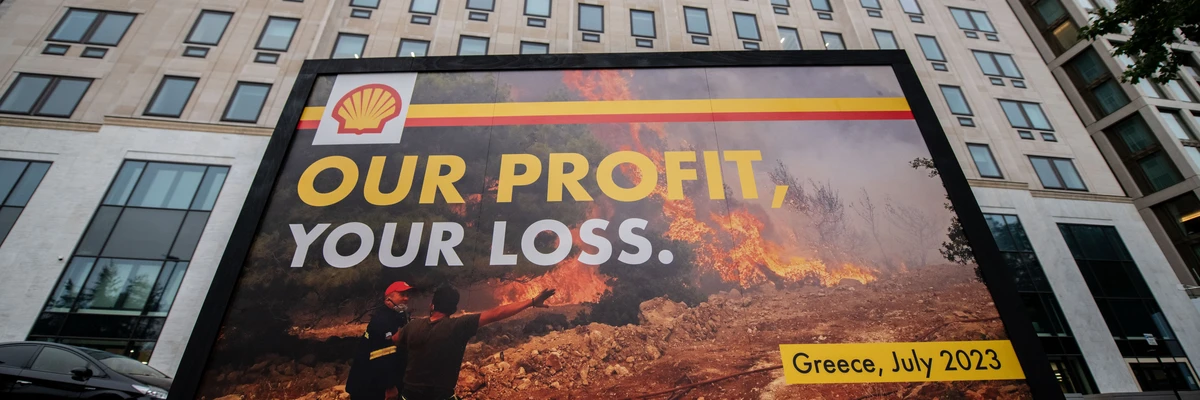
    Greenpeace activists display a billboard during a protest outside Shell headquarters on July 27, 2023 in London.
    Greenpeace activists display a billboard during a protest outside Shell headquarters on July 27, 2023 in London. (Photo: Handout/Chris J. Ratcliffe for Greenpeace via Getty Images)
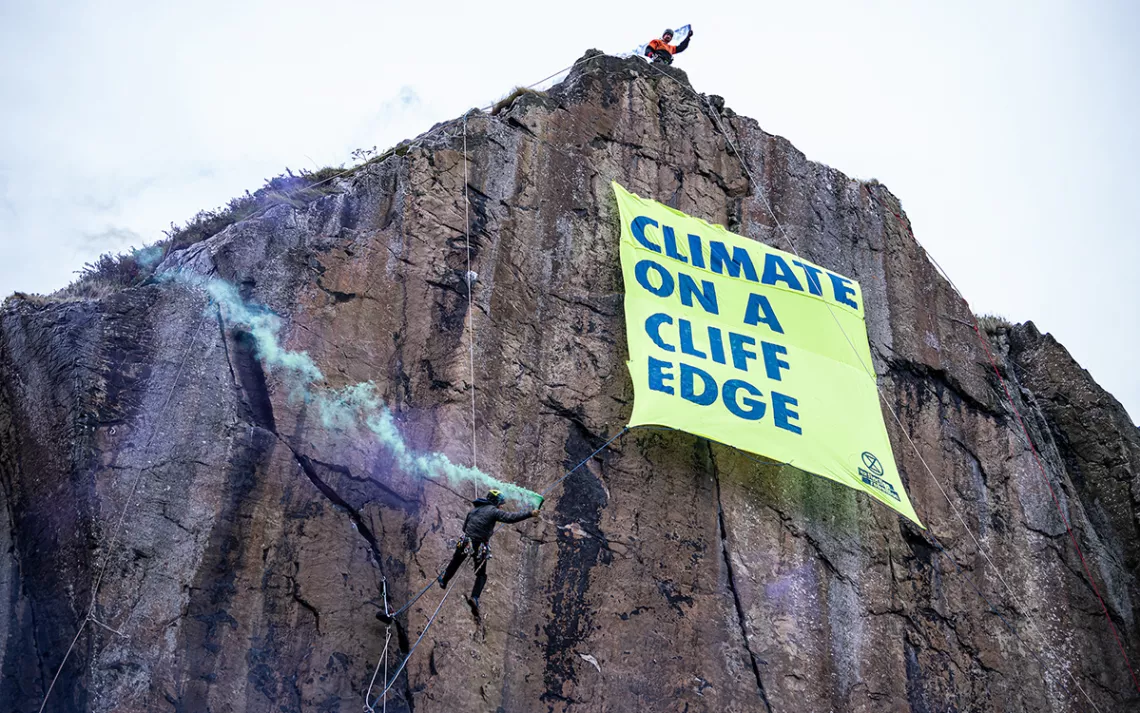
    Experienced climbers scale a rock face near the historic Dumbarton castle in Glasgow, releasing a banner that reads “Climate on a Cliff Edge.” One activist, dressed as a globe, symbolically looms near the edge, while another plays the bagpipes on the shores below. | Photo courtesy of Extinction Rebellion and Mark Richards
    Experienced climbers scale a rock face near the historic Dumbarton castle in Glasgow, releasing a banner that reads “Climate on a Cliff Edge.” One activist, dressed as a globe, symbolically looms near the edge, while another plays the bagpipes on the shores below. | Photo courtesy of Extinction Rebellion and Mark Richards

  • Greens warn government: Greenlighting Jackdaw would be act of climate vandalism

    Spread the love

    This morning the Green Party leadership, Green MPs and Green peers co-signed a letter to the Secretary of State for Energy Security and Net Zero, Miatta Fahnbulleh, to urge her not to approve the Jackdaw gas field in the North Sea, citing the fact that it will not reduce energy prices, protect jobs, or give the UK energy sovereignty.

    Orcas comment on killer apes destroying the planet by continuing to burn fossil fuels.
    Orcas comment on killer apes destroying the planet by continuing to burn fossil fuels.

    The full text of the letter is as follows:

    Dear Miatta,

    Do not approve Jackdaw gas field in the North Sea. 

    We are writing in response to alarming reports that you intend to give the go ahead to the Jackdaw gas field as soon as next week. As Green MPs and peers we cannot sit back and watch you proceed unchallenged with this act of climate vandalism.

    Approving new drilling at Jackdaw will not take a penny off energy costs nor protect jobs. As you said last month, “if you care about affordability, North Sea does not solve that problem for you”, with UK bill-payers still facing the highest energy prices in three years this winter, as a result of our continued exposure to volatile global gas markets. Further, jobs in the North Sea have been in decline for two decades. Jackdaw would only create 27 direct full-time jobs, with the platform unstaffed for most of its operating life and much of the construction already having taken place in Norway. It is completely dishonest of your government to use the legitimate concerns of job security and the cost of living to falsely justify more fossil fuel extraction. 

    Approving Jackdaw will not give the UK energy sovereignty. Even under the most optimistic scenarios Jackdaw is projected to contribute just 2% of UK gas demand over its lifetime (Uplift, 2026). We know that the only way to achieve energy sovereignty is to get the UK off fossil fuels as fast as possible, by significantly scaling up renewable energy and electrification.

    Approving new oil and gas will add fuel to the fire of the climate emergency. Last week, the UN Environment Programme warned that “immediate and sustained cuts to greenhouse gas emissions” were crucial to avoid the worst impacts of climate breakdown. Approving more fossil fuels, at a time when the UK has just experienced record-breaking and deathly heatwaves and wildfires, is a complete dereliction of responsibility. 

    Approving Jackdaw will line the pockets of shareholders. The operating company, Adura, a joint venture between Shell and Equinor, has been criticised for potentially allowing Shell to write off £1.3 billion in UK tax (Global Witness, 2025). Shell has also faced criticism that it paid little or no tax in this country over several years despite huge global profits. Instead of new drilling, we need to ensure that the existing tax instruments, like the windfall tax, actually bring in the revenue that was promised, and end the subsidies that multinational oil and gas companies have received at UK taxpayers’ expense.

    We are therefore urging you to be straight with the public – and instead focus on measures that would actually bring down bills and create secure jobs, like scaling up cheaper home-grown renewables, rolling out a fully-funded national home insulation programme, fully decoupling the price of electricity from gas, and ending rampant profiteering by energy companies.

    Your government promised change, not continuity. Approving Jackdaw, after the hottest summer on record, isn’t doing things differently. The new Prime Minister must not repeat Keir Starmer’s mistake of treating climate and nature as second order. Change starts with ruling out all new oil and gas.

    Yours sincerely,

    Carla Denyer MP
    Dr Ellie Chowns MP
    Adrian Ramsay MP
    Hannah Spencer MP
    Siân Berry MP
    Zack Polanski, Leader of the Green Party 
    Mothin Ali, Deputy Leader of the Green Party 
    Rachel Millward, Deputy Leader of the Green Party 
    Anthony Slaughter, Wales Green Party Leader
    Baroness Bennett of Manor Castle
    Baroness Jones of Moulsecoomb

    Greenpeace activists display a billboard during a protest outside Shell headquarters on July 27, 2023 in London.
    Greenpeace activists display a billboard during a protest outside Shell headquarters on July 27, 2023 in London. (Photo: Handout/Chris J. Ratcliffe for Greenpeace via Getty Images)
  • Jackdaw gasfield set to be approved by ministers this month, sources say

    Spread the love

    https://www.theguardian.com/environment/2026/sep/04/jackdaw-gasfield-set-to-be-approved-by-ministers-this-month-sources-say

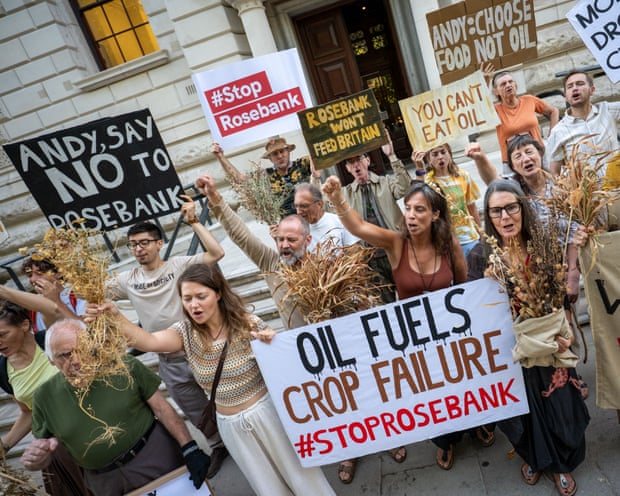
    Climate activists protesting against the new fields. Consultations on Jackdaw and Rosebank closed last month. Photograph: Murdo MacLeod/The Guardian

    Ministers are poised to approve a controversial new gasfield in the North Sea later this month, according to government sources, and are also likely to approve a major oilfield later this year.

    Miatta Fahnbulleh, the energy secretary, will give her recommendation to approve the Jackdaw field off the coast of Aberdeen as soon as next week, according to people close to the decision, with the formal approval following as soon as a week after.

    She is also likely to approve the Rosebank mega-oilfield in the coming months, though officials are looking for ways to make sure the proceeds from that project go towards clean energy projects, as happens in Norway.

    Both projects have become emblematic of the government’s commitment to the North Sea, with green campaigners calling for them to be abandoned while the US president, Donald Trump, urges the prime minister to open them up.

    A spokesperson for the energy department said: “The North Sea remains a vital national asset, supporting jobs, growth and the UK’s energy security. We are clear that oil and gas will continue to play an important role in our energy system for decades to come, alongside transitioning to clean power to protect jobs and tackle the climate crisis.”

    …

    The original article continues at https://www.theguardian.com/environment/2026/sep/04/jackdaw-gasfield-set-to-be-approved-by-ministers-this-month-sources-say

    Greenpeace activists display a billboard during a protest outside Shell headquarters on July 27, 2023 in London.
    Greenpeace activists display a billboard during a protest outside Shell headquarters on July 27, 2023 in London. (Photo: Handout/Chris J. Ratcliffe for Greenpeace via Getty Images)
    Experienced climbers scale a rock face near the historic Dumbarton castle in Glasgow, releasing a banner that reads “Climate on a Cliff Edge.” One activist, dressed as a globe, symbolically looms near the edge, while another plays the bagpipes on the shores below. | Photo courtesy of Extinction Rebellion and Mark Richards
    Experienced climbers scale a rock face near the historic Dumbarton castle in Glasgow, releasing a banner that reads “Climate on a Cliff Edge.” One activist, dressed as a globe, symbolically looms near the edge, while another plays the bagpipes on the shores below. | Photo courtesy of Extinction Rebellion and Mark Richards
    Nigel Farage urges you to ignore facts and reality and be a climate science denier like him and his Deputy Richard Tice. He says that Reform UK has received £Millions and £Millions from the fossil fuel industry to promote climate denial and destroy the planet.
    Nigel Farage urges you to ignore facts and reality and be a climate science denier like him and his Deputy Richard Tice. He says that Reform UK has received £Millions and £Millions from the fossil fuel industry to promote climate denial and destroy the planet.

    dizzy: Nigel Farage and his Reform 2025 limited company pretending to be a political party are in the news today – their conference is on and there are concerns over dodgy donations yet again. Andy Burnham could take his place in this image … “We ignore the many examples of extreme weather made worse by climate change …”

  • Climate damage would obliterate any economic benefits of new North Sea fields, analysis shows

    Spread the love

    https://www.theguardian.com/environment/2026/aug/25/climate-damage-economy-north-sea-oil-gas-fields-rosebank-jackdaw

    The argument that approving Rosebank and Jackdaw would cut bills and improve energy security is a ‘delusion’, say experts. Photograph: James Willoughby/SOPA Images/Shutterstock

    Exclusive: Economic harm of CO2 pollution from Rosebank and Jackdaw forecast to far outweigh any boost to UK

    The climate damage caused by developing the Rosebank and Jackdaw oil and gas fields under consideration by the UK government would destroy their economic benefits many times over, according to an analysis.

    It estimates the economic damage caused by the carbon pollution from the oil and gas produced would be between £119bn and £336bn in the coming decades, compared with the £28.7bn in value to the UK estimated by Adura, the fossil fuel company promoting the new fields.

    The assessment applies peer-reviewed research on how rising temperatures harm economies to the production estimates for the fields from the company. The figures are likely to be underestimates, as they do not include losses from amplified extreme weather, sea level rise or climate deaths. The analysis has been submitted to the Rosebank consultation and to an academic journal.

    …

    The argument that approving Rosebank and Jackdaw would reduce UK bills and improve energy security is a “delusion”, according to energy experts, as they are internationally traded commodities. Proponents of new drilling argue it would boost the UK economy, but the new analysis indicates this would be outweighed by long-term economic damage.

    “The numbers presented here show there’s going to be a very strong destruction of [economic] value above and beyond what Rosebank and Jackdaw could generate for the UK,” said Luke Hatton, at Imperial College London, who conducted the analysis. “The alternative is to really double down on clean energy technologies.” The UK’s net zero sector has grown three times faster than the overall UK economy in recent years.

    …

    https://www.theguardian.com/environment/2026/aug/25/climate-damage-economy-north-sea-oil-gas-fields-rosebank-jackdaw

    Experienced climbers scale a rock face near the historic Dumbarton castle in Glasgow, releasing a banner that reads “Climate on a Cliff Edge.” One activist, dressed as a globe, symbolically looms near the edge, while another plays the bagpipes on the shores below. | Photo courtesy of Extinction Rebellion and Mark Richards
    Experienced climbers scale a rock face near the historic Dumbarton castle in Glasgow, releasing a banner that reads “Climate on a Cliff Edge.” One activist, dressed as a globe, symbolically looms near the edge, while another plays the bagpipes on the shores below. | Photo courtesy of Extinction Rebellion and Mark Richards
    Greenpeace activists display a billboard during a protest outside Shell headquarters on July 27, 2023 in London.
    Greenpeace activists display a billboard during a protest outside Shell headquarters on July 27, 2023 in London. (Photo: Handout/Chris J. Ratcliffe for Greenpeace via Getty Images)