Rishi Sunak facing renewed pressure over plans to ‘max out’ North Sea oil

Spread the love
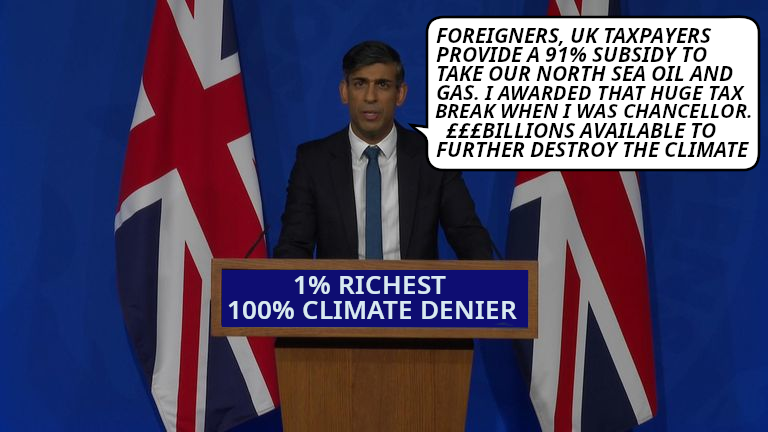
Rishi Sunak offers huge fossil fuel subsidies to develop fossil fuel extraction in UK.

www.theguardian.com/environment/2024/jan/21/rishi-sunak-facing-renewed-pressure-over-plans-to-max-out-north-sea-oil

Dithering on renewable energy and insulation will leave people in Britain ‘colder and poorer’, campaigners warn

Rishi Sunak is facing further attacks on his plans to expand oil and gas exploration in the North Sea this week. The Offshore Petroleum Licensing Bill – to be debated in the Commons on Monday – has already triggered widespread protests, including the resignation of Chris Skidmore, a former Conservative energy minister.

The bill aims to boost fossil fuel extraction by establishing a new system under which licences for North Sea oil and gas projects will be awarded annually.

Green groups and analysts are lining up to criticise it. UpLift, which campaigns for green energy, pointed out that the bill, which the government says will “max out” the UK’s reserves, will actually result in only a 2% rise in North Sea gas output. “The remaining 98% of gas demand will come from existing North Sea fields,” its analysis finds.

“Sunak, like his predecessor Liz Truss, is obsessing over oil and gas, but dithering on renewables and insulation which will boost UK energy security and lower bills,” said Tessa Khan, executive director of UpLift. “And it’s making people in this country colder and poorer.”

www.theguardian.com/environment/2024/jan/21/rishi-sunak-facing-renewed-pressure-over-plans-to-max-out-north-sea-oil

Image of InBedWithBigOil by Not Here To Be Liked + Hex Prints from Just Stop Oil's You May Find Yourself... art auction. Featuring Rishi Sunak, Fossil Fuels and Rupert Murdoch.
Image of InBedWithBigOil by Not Here To Be Liked + Hex Prints from Just Stop Oil’s You May Find Yourself… art auction. Featuring Rishi Sunak, Fossil Fuels and Rupert Murdoch.
Continue ReadingRishi Sunak facing renewed pressure over plans to ‘max out’ North Sea oil

$8.6 Million Shell Lawsuit Threatens Greenpeace’s Ability to Protest

Spread the love

Original article by OLIVIA ROSANE republished from Common Dreams under Creative Commons (CC BY-NC-ND 3.0). 

Four Greenpeace activists are pictured on a Shell vessel in the Atlantic Ocean on January 31, 2023.

“I will stand up in court and fight this; and if Shell refuses to stop drilling, I refuse to stop fighting for climate justice,” one activist named in the suit said.

Oil giant Shell is menacing Greenpeace International and Greenpeace U.K. with a lawsuit that represents “one of the biggest legal threats against the Greenpeace network’s ability to campaign in its more than 50-year history,” the environmental group revealed Thursday.

The lawsuit comes in response to a protest in January in which activists boarded one of the Shell’s oil platforms while it was en rote to a North Sea oil field. Shell has given Greenpeace a choice between facing a full $8.6 million in damages or settling for a reduced charge of $1.4 million and a promise never to protest on Shell infrastructure again.

“Shell is trying to silence my legitimate demands: that it must stop its senseless and greedy pursuit of fossil fuels and take accountability for the destruction it is wreaking upon the world,” Yeb Saño, executive director of Greenpeace Southeast Asia, said in a statement.

Saño, who is one of the activists named in the suit, attempted to board the platform and then met it in port in Norway to protest its arrival.

“I will stand up in court and fight this; and if Shell refuses to stop drilling, I refuse to stop fighting for climate justice,” Saño continued.

The protest that triggered the suit lasted from January 31 to February 12. Four Greenpeace activists used ropes to haul themselves onto the vessel while it was moving at full speed off the Canary Islands, Reuters reported. They stayed occupying the platform until it reached Norway. The platform was set to be used in the Penguins oil and gas field in the North Sea, which has not yet started production.

“He’s trying to crush Greenpeace’s ability to campaign, and in doing so, seeking to silence legitimate demands for climate justice and payment for loss and damage.”

The platform, the Penguins floating production storage and offloading unit, was the first new vessel that Shell had sent to the northern part of the North Sea in 30 years, Greenpeace said. While the protest was ongoing, Shell announced record 2022 profits of almost $40 billion. Greenpeace wanted Shell to stop extracting new oil and gas and to pay into a loss and damage fund to help vulnerable countries respond to the climate crisis. The activists carried signs reading, “Stop drilling—start paying,” The Guardian reported.

Saño said he had a personal reason to object to Shell’s business model.

“I have lived through the devastation caused by Shell and companies like them,” he said in a statement. “Ten years ago I spoke at COP global climate talks while my brother was still missing in the fallout from Super Typhoon Haiyan. Incredibly, he survived, but he helped carry the bodies of 78 innocent people who tragically did not.”

During the occupation itself, Shell and platform builder Fluor promised to seek more than $120,000 in damages. However, in a document seen by Reuters, Shell is now demanding $2.1 million in damages related to shipping delays, security, and legal costs, and Fluor is seeking $6.5 million. The suit was filed in London’s High Court.

“The right to protest is fundamental, and we respect it absolutely. But it must be done safely and lawfully,” a Shell spokesperson said in a statement reported by The Guardian. “Shell and its contractors are entitled to recover the significant costs of responding to Greenpeace’s dangerous actions.”

While Shell has offered to reduce the damages if Greenpeace stops protesting its infrastructure, Greenpeace answered that it would only agree if Shell promised to obey a Dutch court order to cut its emissions by 45% of 2019 levels by 2030.

Greenpeace said that negotiations between it and Shell had wrapped up and the organization had been waiting for details, or “particulars,” from Shell since November 1.

Areeba Hamid, co-executive director of Greenpeace U.K., said the lawsuit reflected the climate-polluting direction of Shell under new CEO Wael Sawan, who took the reins in early 2023. Under his leadership, Hamid said, “Shell’s abandoned any pretence of good intentions, and is brazenly embracing a sinister strategy that’s not just risky for shareholders, but completely devastating for people on the frontlines of the climate crisis. Sawan’s ditching green policies, sacking former colleagues from his renewables division, and he’s gaslit the world by claiming a retreat from fossil fuels would be ‘dangerous.'”

“Now he’s trying to crush Greenpeace’s ability to campaign, and in doing so, seeking to silence legitimate demands for climate justice and payment for loss and damage,” Hamid continued. “We need this case to be thrown out and for Shell to be regulated by the government because it’s clear Sawan is hell-bent on profit, regardless of human cost.”

Original article by OLIVIA ROSANE republished from Common Dreams under Creative Commons (CC BY-NC-ND 3.0). 

Greenpeace image, sign reads CHOOSE OCEANS, NOT OIL

Continue Reading$8.6 Million Shell Lawsuit Threatens Greenpeace’s Ability to Protest

Offering oil and gas licences every year distracts from the challenge of winding down UK North Sea

Spread the love
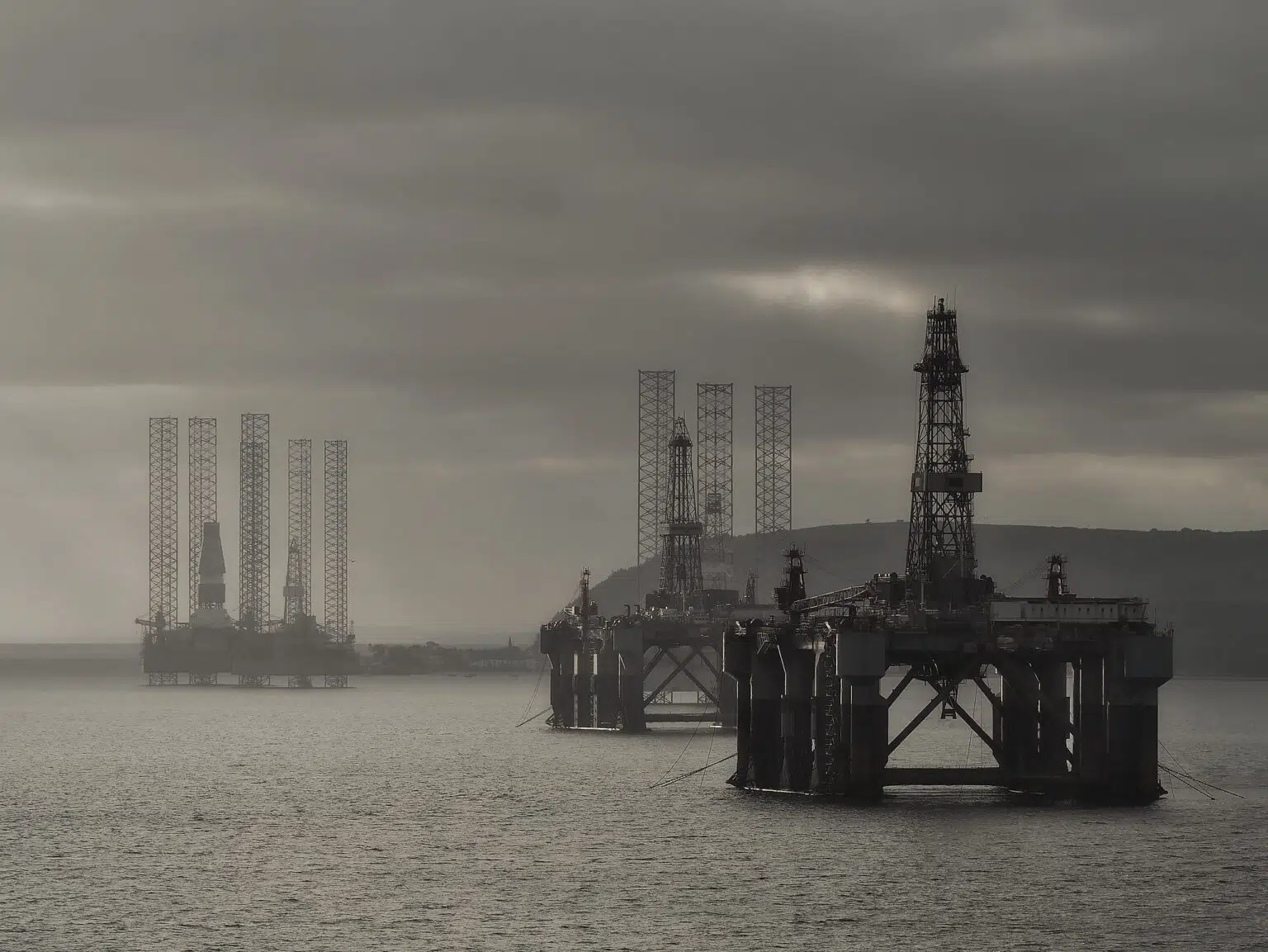
North Sea oil rigs in Cromarty Firth, Scotland. Credit: joiseyshowaa (CC BY-SA 2.0)

Gavin Bridge, Durham University and Gisa Weszkalnys, London School of Economics and Political Science

New areas for oil and gas development on the UK’s North Sea continental shelf are to be made available through annual licensing rounds subject to net zero tests. These proposals by the UK government, outlined in the 2023 king’s speech to parliament, fly in the face of recommendations by the Climate Change Committee – the government’s own independent advisers.

The move should not be summarily dismissed as “political posturing” ahead of a general election, however. It may cause significant damage, not least because it distracts from critical questions surrounding how the UK will transition to low carbon energy.

Licences, under the 1998 Petroleum Act, are how the UK government grants companies exclusive rights “to search and bore for, and get, petroleum”. Companies are invited to bid for access to areas on the UK continental shelf which are pre-selected by the regulator (in consultation with industry).

The first such licensing round was held in 1964. Regular rounds have been held since – the 33rd and most recent licensing round opened in October 2022. Despite the government’s announcement that year that over 100 new licences would be issued, only 27 have been awarded at the time of writing. The government claims annual licensing rounds will encourage oil and gas production in UK waters.

A drilling flare in the North Sea.
The government plans to introduce a bill aimed at granting new oil and gas drilling licences in the North Sea.
Henk Honing/Shutterstock

Wrong answer, wrong question

The licensing system in place has arguably done the job of allocating access to the UK’s oil and gas. What’s questionable is whether, considering the climate emergency, annual licensing rounds will revive interest in what has long been a declining basin.

Handing out licences on its own is insufficient to attract investment. There is growing recognition among financial analysts of the risks of stranded assets in oil and gas. Shell’s withdrawal from the Cambo oil field northwest of Shetland in 2021 showed licence holders are willing to withhold their final investment decision if deemed economic or politically expedient.

The government’s focus on new licences is a red herring, as the bulk of remaining resources are in areas that are already licensed. It will be regulatory approval of field development plans, via a process known as consents, that will allow these existing licences to actually start producing oil or gas.

The recent decision to approve Rosebank (an oil field first licensed in 2001) is a case in point.

Annual licensing rounds will not ensure the UK’s energy security either. Recent licensing rounds have yielded relatively small volumes of gas that do not substantially add to UK reserves. Any oil and gas developed as a consequence of new licences is unlikely to come to market quickly and will be sold at international market prices. Producing oil and gas domestically has not insulated the UK from high prices.

The energy secretary, Claire Coutinho, has acknowledged that UK production “wouldn’t necessarily bring energy bills down”. The Skidmore Review of the UK’s net zero plans and the Climate Change Committee have made clear that the most effective method of helping households afford energy is to “cut fossil fuel consumption … improving energy efficiency, shifting to a renewables-based power system and electrifying end uses in transport, industry and heating”.

New licensing rounds are unlikely to restore offshore oil and gas jobs that have been steadily lost over the years, and which may no longer be seen as a desirable prospect by workers.

Workers in orange overalls and yellow hard hats stand with their backs to the camera.
Offshore workers need training and support to transition to green jobs.
Kichigin/Shutterstock

The government’s claim that two new “tests” will ensure the compatibility of new licences with the government’s net zero goal, too, does not bear scrutiny.

The first, whether oil and gas imports are projected to be larger than domestic production, is a very weak test as it captures the UK’s default position and will lock in dependence on fossil fuels rather than accelerate the transition.

The second, “that the carbon emissions associated with the production of UK gas [must be] lower than the equivalent emissions from imported liquefied natural gas (LNG)”, ignores the emissions associated with burning gas (known as scope 3 under the international accounting protocol for greenhouse gases).

These scope 3 emissions account for 65%-85% of the total emissions and are often omitted from statements about the lower carbon content of UK gas. Instead of comparing the carbon footprint of UK gas with imported LNG, pipeline gas from Norway would be a more appropriate (and lower-carbon) comparison.

In any case, the UK oil and gas industry’s targets for decarbonisation set out in the North Sea transition deal signed in 2021 have been criticised by the Climate Change Committee as insufficiently ambitious.

A large LNG tanker with 4 LNG tanks sailing along the sea.
The government plan proposes the carbon emissions of producing UK gas be compared with those of imported LNG.
The Mariner 4291/Shutterstock

The prominence of oil and gas licensing in the government’s legislative plans is striking. Fossil fuel licensing is a potent political symbol, and not only for campaigners who have worked for years to get licensing onto the agenda. Sunak and Starmer are now harnessing that symbolism for political ends.

A fixation on new licensing, however, is a distraction. It offers comfort in the possibility of conserving oil and gas production through developing new fields, rather than grasping the challenge of a rapid transition.

It leaves untouched the pressing issue of how to phase down oil and gas production from existing licences in a just and equitable way. It deflects from the enormous challenge of decommissioning offshore infrastructures, and the questions that need to be asked about what the North Sea is for and how it can sustain our collective future.


Imagine weekly climate newsletter

Don’t have time to read about climate change as much as you’d like?

Get a weekly roundup in your inbox instead. Every Wednesday, The Conversation’s environment editor writes Imagine, a short email that goes a little deeper into just one climate issue. Join the 20,000+ readers who’ve subscribed so far.The Conversation


Gavin Bridge, Professor of Geography and Fellow of the Durham Energy Institute, Durham University and Gisa Weszkalnys, Associate Professor of Anthropology, London School of Economics and Political Science

This article is republished from The Conversation under a Creative Commons license. Read the original article.

Continue ReadingOffering oil and gas licences every year distracts from the challenge of winding down UK North Sea

Greenpeace loses legal challenge to UK’s new North Sea oil and gas licences

Spread the love
Greenpeace image, sign reads CHOOSE OCEANS, NOT OIL

https://www.reuters.com/world/uk/greenpeace-loses-legal-challenge-uks-new-north-sea-oil-gas-licenses-2023-10-19/

LONDON, Oct 19 (Reuters) – Britain’s decision to authorise new licences for oil and gas exploration in the North Sea was lawful, London’s High Court ruled on Thursday, dismissing a legal challenge by Greenpeace.

The environmental campaign group had argued Britain’s failure to assess the greenhouse gases produced by consuming oil and gas – so-called end-use or downstream emissions – rendered its offshore energy plan unlawful.

But lawyers representing Britain’s Department for Energy Security and Net Zero said at a hearing in July that ministers were not required to assess end-use emissions, though they nonetheless considered them.

Judge David Holgate rejected Greenpeace’s case on Thursday, saying in a written ruling that the decision not to assess end-use emissions was not irrational.

Greenpeace said it planned to appeal the ruling.

Continue ReadingGreenpeace loses legal challenge to UK’s new North Sea oil and gas licences

‘Deeply Troubling’ Lack of UK North Sea Oil and Gas Monitoring

Spread the love

Original article by Andrew Kersley republished from DeSmog.

A North Sea oil rig. Credit: Gary Bembridge / FlickrCC BY 2.0

Fossil fuel giants are largely left to submit their own extraction and emissions data, a freedom of information request shows.

The main regulator of North Sea oil and gas doesn’t conduct physical inspections to ensure companies operating in the region are following the rules, DeSmog can reveal.

The revelations, labelled “deeply troubling” by campaigners, come as the government and the regulator, the North Sea Transition Authority (NSTA), have announced plans to approve drilling at a new oil field, Rosebank, that could produce 69,000 barrels of oil and 44 million cubic feet of gas a day.

DeSmog filed a freedom of information request (FOI) to the NSTA asking the regulator how it ensured companies stayed within the oil and gas extraction maximums outlined in their licences. These rules govern, among other things, how much oil and gas companies are allowed to extract, and the amount of emissions they can produce in the process.

In its response, the NSTA told DeSmog that a company “must notify” the NSTA if a production limit is breached in the North Sea, but that the NSTA itself “does not undertake offshore inspections to ensure compliance with production consents”.

When asked how, given the lack of inspections, the regulator would ensure that companies are being accurate when they self-report the emissions being produced, the regulator said it hosted “an annual consents exercise” (seemingly a single meeting) during which they remind operators of “their obligations and how to ensure they remain in regulatory compliance”.

The findings suggest that operators in the North Sea are left to largely self-regulate – declaring themselves when they break the legal rules governing their operations.

According to Violation Tracker UK, the NSTA has issued just two fines worth £100,000 since 2021 related to companies exceeding the oil and gas extraction limits in their licence.

“This FOI reveals deeply troubling findings about the lack of proper regulation of North Sea oil and gas extraction,” said Matthew Lawrence, the director of the Common Wealth think tank.

Daniel Jones, a researcher at the campaign and research group Uplift, added that The NSTA has never acted like a regulator in the normal sense, preferring to steer and encourage the industry into behaving responsibly, rather than mandating that companies reduce their environmental impact.

“It’s only very recently, in 2021, that the NSTA introduced any mechanisms at all to tackle the huge emissions from producing oil and gas, which account for 4 percent of all UK emissions, and even these require companies to do very little”.

‘Light Touch Regulation’

The NSTA, formerly the Oil and Gas Authority, is a private company wholly owned by the government, which primarily seeks to “maximise” the economic output of North Sea oil and gas, and aid the transition to net zero.

This month, the company awarded the UK’s first ever licences for carbon capture and storage (CCS), which it said “could store up to 30 million tonnes of CO2 per year”. However, the role of CCS in the energy transition is hotly contested. 

Climate scientists point to the failure of CCS to remove significant amounts of CO2 emissions, while campaigners warn of the high costs compared to renewable energy. The vast majority of companies also use the captured CO2 to extract more oil through a process called “enhanced oil recovery”.

Stuart Haszeldine, professor of carbon capture and storage at the University of Edinburgh, has compared commissioning CCS sites as well as new oil fields to ordering a truckload of cigarettes for someone giving up smoking.

DeSmog’s new findings also raise concerns about the monitoring of illegal flaring – the burning of excess natural gas produced during the oil and gas drilling process, which produces hundreds of millions of tonnes of CO2 emissions a year.

According to Violation Tracker UK, the NSTA has issued two fines for flaring since 2021, worth a total of £215,000.

In 2022, £65,000 fine was imposed on Equinor, the firm that owns much of the new Rosebank oilfield. Two years prior, Equinor had flared at least 348 tonnes of CO2 over and above the amount it was permitted to burn. Even that failure was considered an “administrative breach” by the NSTA. In the first six months of 2023, the Norwegian-owned energy company posted profits of £17.1 billion.

The UK’s operations in the North Sea produce almost three times the direct greenhouse gases per barrel of oil than our neighbour Norway, largely due to a significantly higher use of flaring on UK-regulated oil rigs. In 2022, UK North Sea operations burned 22 billion cubic feet of gas in offshore flaring.

DeSmog’s findings come just days after the NSTA announced it was approving plans for the Rosebank oilfield, with a government minister claiming the move would lead to “lower emissions” in the UK.

The field has the potential to produce 500 million barrels of oil in its lifetime, which when burned would emit as much carbon dioxide as running 56 coal-fired power stations for a year.

Campaigners including Greta Thunberg have expressed their anger at the proposals, with Green Party MP Caroline Lucas describing the project as “the greatest act of environmental vandalism in my lifetime”.

The government has also said it will imminently issue hundreds of new licences for oil and gas exploration in the North Sea, while Prime Minister Rishi Sunak has announced the watering down of several key net zero targets.

The International Energy Agency warned in May 2021 new fossil fuel developments were incompatible with the effort to limit global temperature increases to 1.5C above pre-industrial levels.

There are currently 283 active oil and gas fields in the North Sea, and the production process alone generated 13.1 million tonnes of direct CO2 emissions in 2019.

Matthew Lawrence of Common Wealth added that, “Decades of light touch regulation and privatisation have led to an energy system – from North Sea extraction to the super profits being made in energy generation and distribution – geared toward profit maximisation at the expense of people and planet.

“In this context, the government’s decision to approve the Rosebank oilfield and issue 100 new licences for fossil fuel extraction pose an even more grave risk to the climate.

“The alternative is a clean energy system based around meeting public and environmental needs”.

A spokesperson for NSTA did not address any of the findings in the freedom of information request, but stressed that the majority of flares “are fitted with metres” and the group is working to “increase the use of direct measurements”.

They added that government departments receive “actual emission data” on North Sea oil operations and that the NSTA was “working with [the Offshore Petroleum Regulator for Environment and Decommissioning] to improve the visibility of this data and help industry increase the accuracy of emissions measurement”.

Original article by Andrew Kersley republished from DeSmog.

Continue Reading‘Deeply Troubling’ Lack of UK North Sea Oil and Gas Monitoring