Climate Obstructionism Runs Deep in the UK — Watch Out for It at the Election

Spread the love

Original article by Freddie Daley and Peter Newell republished from DeSmog.

Credit: Lindsay Grime.

Regardless of who wins next month, fossil fuel interests have multiple levers for influencing policy.

The UK is heading to the polls on July 4. Although it doesn’t get enough attention, the two major parties — the Conservatives and Labour — have chosen climate change and, in particular, fossil fuel production in the North Sea as a clear political dividing line for the electorate. 

As polling day draws closer, and election fervour takes hold, we will see the forces of British climate obstruction in full effect. Influential individuals, organisations and media outlets that seek to block, dilute, delay, or even reverse climate policies will attempt to widen that political dividing line with a mixture of claims to be defending individual freedoms, putting growth first, being ‘climate realists’, or by displacing concerns about the UK’s responsibility to act on climate change through ‘whataboutism’.

The Conservative government, under Prime Minister Rishi Sunak, has pushed ahead with issuing hundreds of new oil and gas licences in the North Sea. The government was due to further reform the licensing regime so permits are handed out on an annual basis, all under the auspices of ‘energy security’, but the election has halted the bill’s progress through Parliament. Future licences are expected to yield just three weeks’ worth of gas per year

Sir Keir Starmer’s Labour Party, however, announced that it will end new licensing for oil and gas in the North Sea, with the very large caveat of honouring those already approved. But even this announcement ignited fierce resistance from the media, trade unions, Labour’s political opponents and some figures it deemed allies. The plan was labelled as “Thatcher on steroids”“naive”, and risked “creating a cliff-edge” for industry and investment in and around the North Sea. In response to the vitriol, Starmer conceded that fossil fuels will continue to be used in the UK “for many, many years”.  

This episode provides a useful insight into how climate obstructionism operates in the UK. In a new publication for the Climate Social Science Network (CSSN) based at Brown University, alongside Dr Ruth McKie and Dr James Painter, we identified three major channels through which obstructionism operates in Britain and the network of organisations that sustain it. 

Financial Power

The first is the material. This speaks to the financial and structural power of the fossil fuel industry that allows it to use threats of capital flight and job losses to curry favourable policy conditions and fend off tax hikes that would dent profitability. It also speaks to party donations, where fossil fuel firms, or those that benefit from their expansion, provide funds to individual politicians or the wider party for access and a say over policy. 

Since 2019, the Conservatives have received £8.4 million in donations from big polluters and those with direct links to fossil fuel production. The current Energy Security and Net Zero Secretary, Claire Coutinho, accepted a £2,000 donation in January 2024 from Lord Michael Hintze, a funder of the UK’s leading climate science denial group, the Global Warming Policy Foundation. Labour too have taken money from big polluters, most notably Drax, whose North Yorkshire power plant is the UK’s single largest source of emissions.

Alongside the material sits the institutional. The policy making process in the UK provides a multitude of opportunities for actors to shape policy, all within the bounds of proper procedure and due process. All Party Parliamentary Groups (APPGs), informal groups of politicians organised around key themes or policy issues, have provided an effective fora for obstructionist actors to garner access and shape policy. The rules governing APPGs often inhibit public scrutiny. Trade associations, and the companies they represent, can be omitted from official parliamentary transparency logs as only benefits in kind above £1,500 a year must be declared — a threshold many industry bodies claim not to meet. 

Revolving doors between industry and government are another institutional means through which fossil fuel interests can determine policy. An investigation by The Ferret found that since 2011, 127 former oil and gas employees have gone into top government roles and been appointed to ministerial advisory boards. At least a dozen of these individuals were given roles in the North Sea Transition Authority, the organisation tasked with governing oil and gas production, as well as within departments responsible for writing energy and climate policy. Shutting this revolving door, or even just slowing it down through ‘cool-off’ periods, would go some way in curtailing obstructionism. 

Climate Delay

The final, and perhaps most pronounced, thread of climate obstructionism in the UK is discursive, primarily promoted through the media. The right-leaning media in the UK, such as the Daily Telegraph and Daily Mail, have persistently opposed climate policy and action. This opposition used to be grounded in outright denial, where the integrity of climate science was disputed and denigrated. Now, though, a more pernicious form of discursive obstructionism is prevalent; that of climate delay. 

Countless op-eds and articles have been published that acknowledge climate change but dispute the necessity of addressing it, the cost of implementing climate policy (both economically and in terms of national security), and the efficacy of green technologies such as wind turbines, electric vehicles (EVs) and heat pumps. These interventions, which are sometimes made by individuals with direct links to sceptic organisations or else use their framing, often push blatant untruths to the public, such as renewable energy pushing up household energy bills or solar panels  jeopardising British farming. The media continues to both demonise climate activists and undermine public support for key climate policies. 

In this election, watch out for climate obstructionism. While institutional channels may be curtailed due to purdah, others will pick up the slack. With all parties now firmly on an election footing, donations will become a crucial resource for knocking doors and getting out the vote in marginal seats. The sources of these donations, and the interests behind them, will bear the thumbprint of the fossil fuel industry. The media will increase its scrutiny of manifesto pledges and publish a litany of analyses. It is highly likely that Labour’s climate policy will be painted as a threat to national security, an insurmountable cost to the public purse, and reflecting the demands of both Vladimir Putin and Just Stop Oil simultaneously. The foundation of this framing has already been set. 

What is less clear, though, is what comes after July 4. With a change of government comes a reconfiguration of interests and, for the winners, concessions will be made to those actors and constituencies that helped get them past the post. For the losing party, most likely to be the Conservatives, there may be an ideological reorientation that ends the cross-party consensus on tackling climate breakdown, making them the party of climate obstructionism that challenges the necessity of net zero and fights for more oil and gas. 

This election might be the one that ends 14 years of Conservative rule, but it’s not likely to be the one to end climate obstructionism in the UK.  

Freddie Daley is a Research Associate at the Centre for Global Political Economy at the University of Sussex.

Peter Newell is a Professor of International Relations at the University of Sussex.

They are the authors of a chapter in Climate Obstructionism across Europe, a new collection of essays analysing the organisations, politicians, think tanks and media outlets seeking to delay, derail and denigrate climate policy, produced by the Climate Social Science Network.

Original article by Freddie Daley and Peter Newell republished from DeSmog.

dizzy: I don’t agree that there is “cross-party consensus on tackling climate breakdown.” I suggest that instead the Conservative and Labour parties are indistinguishable in their support of plutocracy, sucking up to the rich and powerful. The Conservatives under Sunak have made no pretence of their intention to forge ahead with exploiting North Sea fossil fuels all they can and Labour do not intend to stop the Rosebank North Sea oil and gas field. Starmer has abandoned so many pledges that he should be recognised as as much a liar as Tony Blair or Boris Johnson.

The title of “… the party of climate obstructionism that challenges the necessity of net zero and fights for more oil and gas. ” is currently shared by the Conservatives and climate denier Nigel Farage’s Reform UK.

Rishi Sunak on stopping Rosebank says that any chancellor can stop his huge 91% subsidy to build Rosebank, that Keir Starmer is as bad as him for sucking up to Murdoch and other plutocrats and that we (the plebs) need to get organised to elect MPs that will stop Rosebank.

Continue ReadingClimate Obstructionism Runs Deep in the UK — Watch Out for It at the Election

‘Victory’: Gas Drilling Project Paused After Greenpeace Occupies Platform in North Sea

Spread the love

Original article by EDWARD CARVER republished from Common Dreams under Creative Commons (CC BY-NC-ND 3.0). 

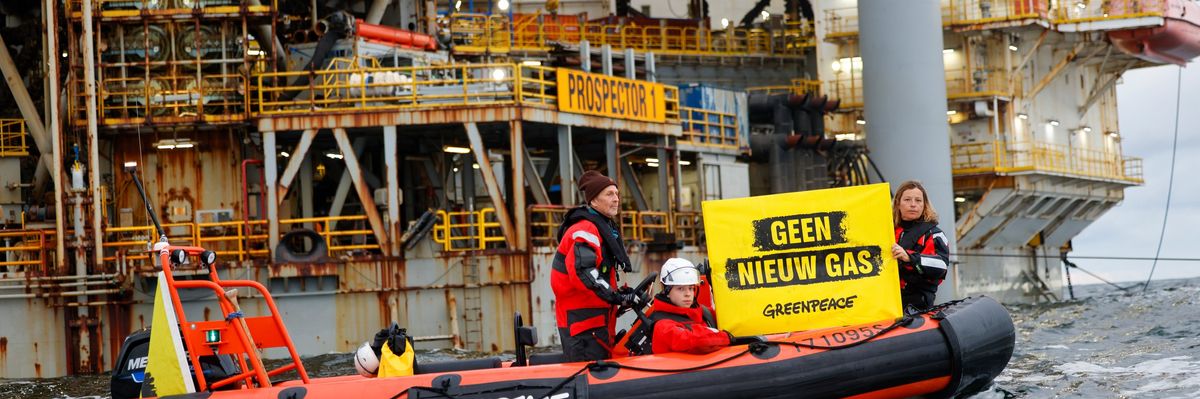
Greenpeace activists from Germany and the Netherlands hold up a “No New Gas” placard next to an gas drilling platform that they occupied on June 4, 2024. 
(Photo: Axel Heimken/Greenpeace)

“Today’s events show that people power works!” a campaigner said. “Whether it is occupying a gas rig or challenging it in court, people will not be silent, we are standing up to the fossil fuel industry.”

A Dutch court on Tuesday ordered a pause to a gas drilling initiative in the North Sea after Greenpeace activists occupied a platform owned by the company behind the project, leading the environmental group to declare “victory” as it pushes for an end to new fossil fuel infrastructure in Europe.

The activists sought to disrupt the work of Dutch energy company ONE-Dyas, which had just received the go-ahead for offshore drilling from the Dutch government last week and quickly sent the drilling platform to the site, which is about 12 miles from the German island of Borkum and straddles Dutch and German waters.

“The science is clear, we must stop digging and drilling for fossil fuels if we are to avoid the worst of climate chaos,” Mira Jaeger, energy expert from Greenpeace Germany, said in a statement released earlier on Tuesday, before the court decision. “We cannot afford any new fossil fuel extraction projects. Not in the North Sea or anywhere else.”

“Today’s events show that people power works!” Jaeger said in another statement following the ruling. “Whether it is occupying a gas rig or challenging it in court, people will not be silent, we are standing up to the fossil fuel industry.”

Greenpeace, an environmental group that engages in nonviolent direct action, has previously occupied oil and gas rigs in the North Sea and elsewhere. Last year, the group’s campaigners occupied a platform contracted by Shell, a multinational oil and gas company, as it made its way to work in U.K. waters.

The planned Borkum drilling project, which Greenpeace has said would threaten rocky reefs and a local nature reserve, has been the subject of a legal and regulatory fight in recent years. Environmental and community groups filed a lawsuit against it in Dutch court, and a judge halted the project for over a year starting in April 2023. However, following court-ordered changes, the Dutch state secretary for economic affairs and climate approved the project last week. On Monday, Offshore Energy, a trade publication, declared that the project, which it said involves an investment of more than $500 million, had “no more legal woes” and would produce gas by the end of the year. A Dutch official noted the importance of a domestic supply of natural gas in approving the project, Offshore Energy reported.

With the company moving quickly, Greenpeace activists aimed to block the installation of the platform on Tuesday. Five of the 21 who went to sea for the action occupied the platform, called Prospector 1, and tied themselves to pillars, according to Greenpeace. The occupation lasted 8 hours, ending when news came of the court ruling.

Tuesday’s ruling suspended the approval granted by the Dutch state secretary for economic affairs, and is to be followed by a hearing on June 12. The decision came at the request of environmental and community groups, which submitted an application on Friday for “provisional relief.” The groups aim to block the drilling initiative entirely, arguing that ONE-Dyas should abandon its “legal tricks” and “accept reality and abandon the project.”

Greenpeace, which was one of the plaintiffs in the application, reiterated its demand on Tuesday that the project be permanently canceled, while calling for the E.U. to abandon all fossil fuel infrastructure projects.

“The Borkum project is just the tip of the iceberg: in Europe, fossil fuel companies are pushing European states into such massive, unnecessary investments just like TotalEnergies’ LNG terminal in France, or OMV’s Neptun Deep gas drilling project in Romania,” the first Greenpeace statement said. “But the European Union can and must put its member states on a path away from fossil fuels, by banning new fossil fuel projects and investing in an energy system based on renewables and energy sufficiency.”

Original article by EDWARD CARVER republished from Common Dreams under Creative Commons (CC BY-NC-ND 3.0). 

Continue Reading‘Victory’: Gas Drilling Project Paused After Greenpeace Occupies Platform in North Sea

Week of Protests Over Equinor’s Media Sponsorship Greenwashing

Spread the love

Original article by Adam BarnettPhoebe Cooke and Ellen Ormesher republished from DeSmog

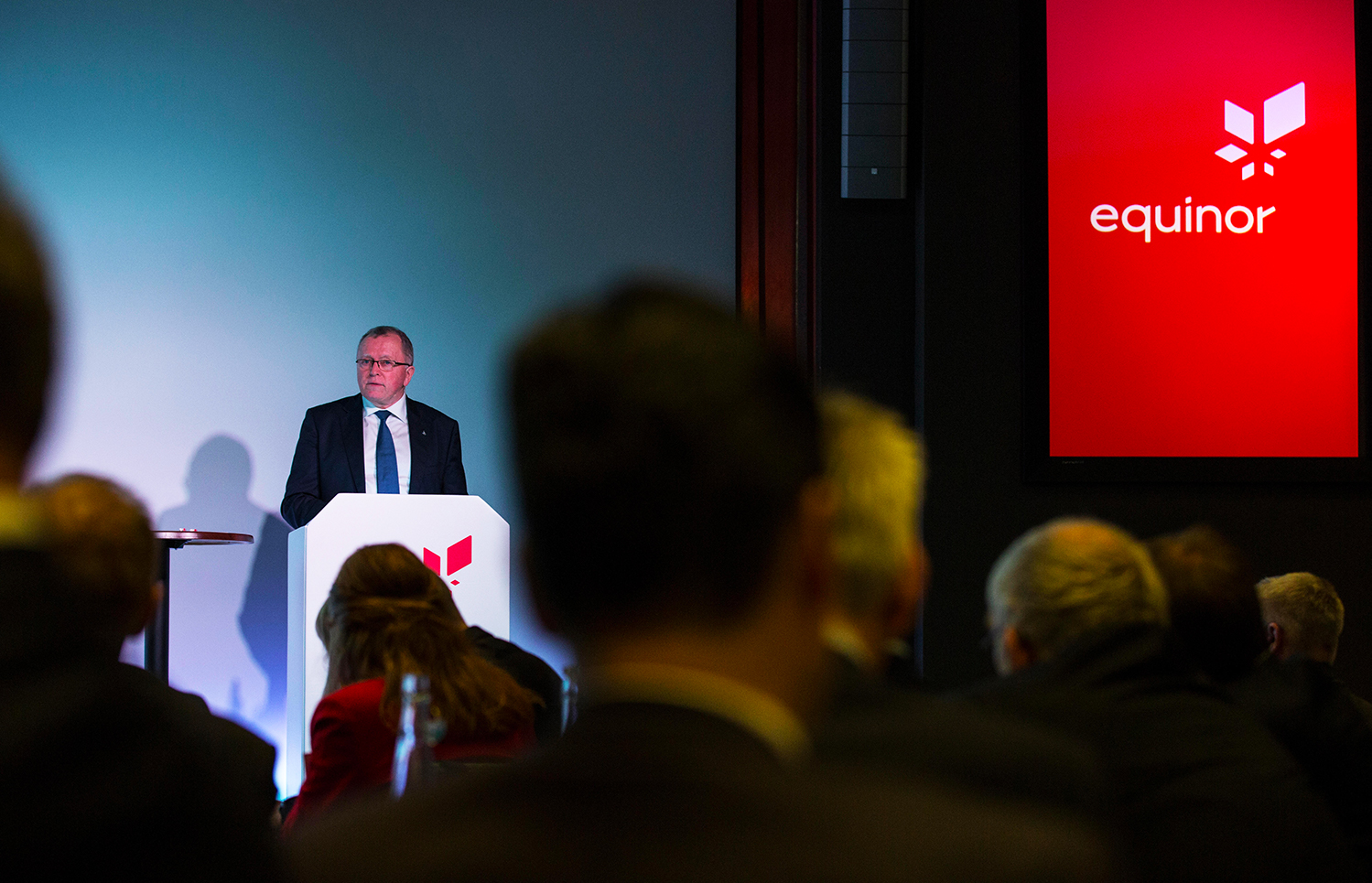
Eldar Saetre, CEO of Equinor. Credit: Jeff Gilbert / Alamy

Campaigners likened the fossil fuel company’s patronage of climate events to letting an “arsonist sponsor a fire safety conference”.

Major media companies have sparked a wave of criticism after allowing a Norwegian oil and gas company behind the UK’s largest new North Sea project to sponsor events on climate change.

Equinor was an official sponsor of two conferences on climate and energy this week, one run by the New Statesman magazine, and one run by Politico. Both saw MPs pull out over the sponsorship, while the first was interrupted by a climate activist. 

The Norwegian state-owned company has a majority stake in the Rosebank North Sea oil field, which has been dubbed a “carbon bomb” by environmental law charity ClientEarth. 

Equinor claims it supplies 27 percent of the UK’s energy from oil and gas, and is currently investing $6 billion (£4.8 billion) a year in fossil fuel exploration and drilling.

“Allowing fossil fuel companies like Equinor to sponsor and speak at climate conferences is as absurd as allowing an arsonist to sponsor and participate in fire safety conferences,” said Carys Boughton of the Fossil Free Parliament campaign. “At this critical time for climate and energy policy-making, we can’t afford this absurdity.”

Equinor’s sponsorship of these events is the latest example of fossil fuel companies using media partnerships to greenwash their polluting activities. 

An investigation by DeSmog and Drilled in December detailed how oil and gas companies are using media deals – including partnerships with Politico, the Economist, the Financial TimesReuters, and the Washington Post – to present a climate-friendly image. 

DeSmog also revealed this week, based on documents released by a powerful U.S. congressional committee, that fossil fuel companies believe these media partnerships help to protect their “social licence to operate”.

Michelle Amazeen, a mass communications researcher at Boston University, said that oil and gas sponsorship is “a strategic move by fossil fuel companies to compromise the integrity of events intended to foster dialogue and action around climate issues”. 

She added that, “While the sponsorship gives the impression of caring about the environment, it’s a veneer that’s like an oil slick obscuring the actual conduct of the fossil fuel industry.”

This week, a cross-party group of 50 MPs, including three Conservatives, wrote to Prime Minister Rishi Sunak urging him to end the licensing of new oil and gas fields, appoint a climate envoy, and back the Beyond Oil and Gas Alliance, an international coalition working to facilitate a global phase-out of oil and gas production.

Alice Baxter, Equinor’s UK spokesperson, said: “At Equinor we believe in openness and the importance of engaging in the complex conversations around the energy transition. We respect everyone’s right to protest and encourage robust debate.”

New Statesman Event 

Equinor was one of the sponsors of the New Statesman’s Energy and Climate Change Conference on 14 May at the Leonardo Royal Hotel in south London.

Green Party MP Caroline Lucas pulled out of the event last week due to Equinor’s sponsorship.

At the event, attended by DeSmog, the second panel discussion featured Equinor’s UK country manager Alex Grant. The session was entitled “How can the UK lead the world in the green transition?”

When it was Grant’s turn to speak, a Fossil Free London activist in the audience stood up and gave a speech criticising Equinor and its sponsorship of the event.

The activist said climate scientists “are warning us that we are headed towards a catastrophic 2.5C of global warming. Yet staggeringly, Equinor, that’s sponsoring this event, is opening the largest undeveloped oil field in the North Sea.” 

Labour MP Meg Hillier, who chairs the Public Accounts Committee and was on the panel, interjected: “Why don’t you let us talk about it, because I’m actually here to be pretty critical of the government, I’d quite like to get my points across.” 

The protester continued her speech, and was removed by security. Her comments received a round of applause from the audience. 

Grant replied by saying that Equinor takes a “pragmatic approach” to the energy transition, as opposed to one that “costs more than it needs to”. He also defended the Rosebank project, saying it would reduce carbon emissions over the long term.

Rosebank could produce around 300 million barrels of oil over its lifetime, emitting 200 million tonnes of carbon dioxide. 

Questions at the New Statesman event were submitted online, rather than asked in person by the audience. 

During the event’s final session with Chris Stark, the former chief executive of the Climate Change Committee, which advises the government on its climate policies, DeSmog submitted a question about Equinor and Rosebank’s impact on the climate. The question was not posed to the panel. 

The latest issue of the New Statesman magazine, which features an interview with climate scientist and author Michael Mann, includes advertorials from biomass company Drax, which is the UK’s largest single source of CO2 emissions, and Calor Gas, one of the UK’s largest suppliers of liquefied petroleum gas.

The New Statesman hosted a number of events at the 2023 Labour Party conference sponsored by fossil fuel companies and lobbying groups, including Cadent, National Gas, and Offshore Energies UK

The New Statesman did not respond to DeSmog’s request for comment. 

Politico Event

On 16 May, Politico held its own Energy and Climate Summit, also sponsored by Equinor. 

Labour MP Alex Sobel, who chairs the All-Party Parliamentary Group on Net Zero, last week pulled out of the event due to Equinor’s sponsorship. 

At the event, attended by DeSmog, a panel on Carbon Capture and Storage (CCS) featured David Cairns, a former British ambassador to Sweden and now Equinor’s vice president of political and public affairs. 

When questioned by the Politico chair, Cairns confirmed that the company had no plans to set targets for phasing out oil and gas.

He also said it was “debatable” whether the oil and gas industry was making large profits. Equinor reported £28 billion in profits in 2023. Cairns added that it was “really misplaced” to think that the oil and gas industry is an “easy business in which it’s easy to make money”.

A Politico spokesperson said: “This multi-sponsored Energy and Climate UK Summit is an extension of Politico’s ongoing and robust coverage of climate policy in the United Kingdom. 

“There is a clear division between Politico’s newsroom and our commercial operations. With critical milestones and a general election on the horizon, we continue to cover climate each day through our dedicated reporting.”

Politico’s influential London Playbook newsletter has this week been sponsored by the oil and gas giant BP. 

Michelle Amazeen said that fossil fuel sponsorship of media companies “has delegitimised their journalistic content, opened their journalists up for attack, and has even led to the resignation of journalists who are trying to write about climate issues”.

Equinor’s AGM 

Equinor also faced further public criticism this week, when on Tuesday the company was confronted by a climate activist at its annual general meeting (AGM).

Lauren MacDonald of the environmental group Uplift delivered a four minute speech about the company’s impact on the planet, and promised that campaigners would not stop opposing Rosebank or the company’s other fossil fuel projects.

At the meeting, shareholders rejected a resolution calling on the company to align its strategy and spending with climate goals.

“We invest in the energy the world needs now. That is oil and gas,” Equinor’s chief executive Anders Opedal said.

Tessa Khan, executive director at Uplift, told DeSmog: “Try as it might, Equinor can no longer ignore the scale of opposition to its climate-wrecking business model – it’s not just campaigners who are calling out its harmful mission, it’s also politicians pulling out of Equinor-sponsored events and shareholders demanding it ditch its plans of endless oil and gas expansion.

“Even if Equinor wants to stay silent, these demands for accountability will only get louder. Governments in the UK and Norway – who can’t afford to ignore this chorus of voices – must reject Equinor’s delay tactics and insist that their activities don’t further endanger our climate. As a first step, this means rejecting new oil and gas fields, and pulling the plug on disastrous projects like Rosebank.”

All-Energy and Dcarbonise

Equinor was not the only fossil fuel company to sponsor climate events this week. 

On Wednesday, climate protesters disrupted the All-Energy and Dcarbonise event in Glasgow, which describes itself as “The meeting place for the renewable and low carbon energy community”, yet featured paid exhibitions from oil and gas majors BP and Shell. 

Protesters from Stop Polluting Politics, and Fuel Poverty Action interrupted a speech by Scotland’s Net Zero and Energy Secretary Màiri McAllan, and a pre-recorded video of UK Energy and Net Zero Secretary Claire Coutinho. Both appeared alongside Louise Kingham, a senior vice president at BP. 

“As the lethal reality of climate breakdown becomes unmissable, the PR strategies of big fossil fuel companies like Equinor and Shell reveal their growing isolation, and an increasingly desperate attempt to buy friends,” said Andrew Simms, a director of the New Weather Institute and a co-founder of the Badvertising campaign.  

“They are the unwelcome guests at the party with everyone waiting for them to leave, but who keep buying rounds for anyone willing to drink with them in order to stay.”

Original article by Adam BarnettPhoebe Cooke and Ellen Ormesher republished from DeSmog

Rishi Sunak on stopping Rosebank says that any chancellor can stop his huge 91% subsidy to build Rosebank, that Keir Starmer is as bad as him for sucking up to Murdoch and other plutocrats and that we (the plebs) need to get organised to elect MPs that will stop Rosebank.
Image of InBedWithBigOil by Not Here To Be Liked + Hex Prints from Just Stop Oil's You May Find Yourself... art auction. Featuring Rishi Sunak, Fossil Fuels and Rupert Murdoch.
Image of InBedWithBigOil by Not Here To Be Liked + Hex Prints from Just Stop Oil’s You May Find Yourself… art auction. Featuring Rishi Sunak, Fossil Fuels and Rupert Murdoch.
Continue ReadingWeek of Protests Over Equinor’s Media Sponsorship Greenwashing

Liz Truss Book Calls for Climate Laws to be Abolished and Boasts of Effort to Cancel UK COP Summit

Spread the love

Original article by Adam Barnett republished from DeSmog.

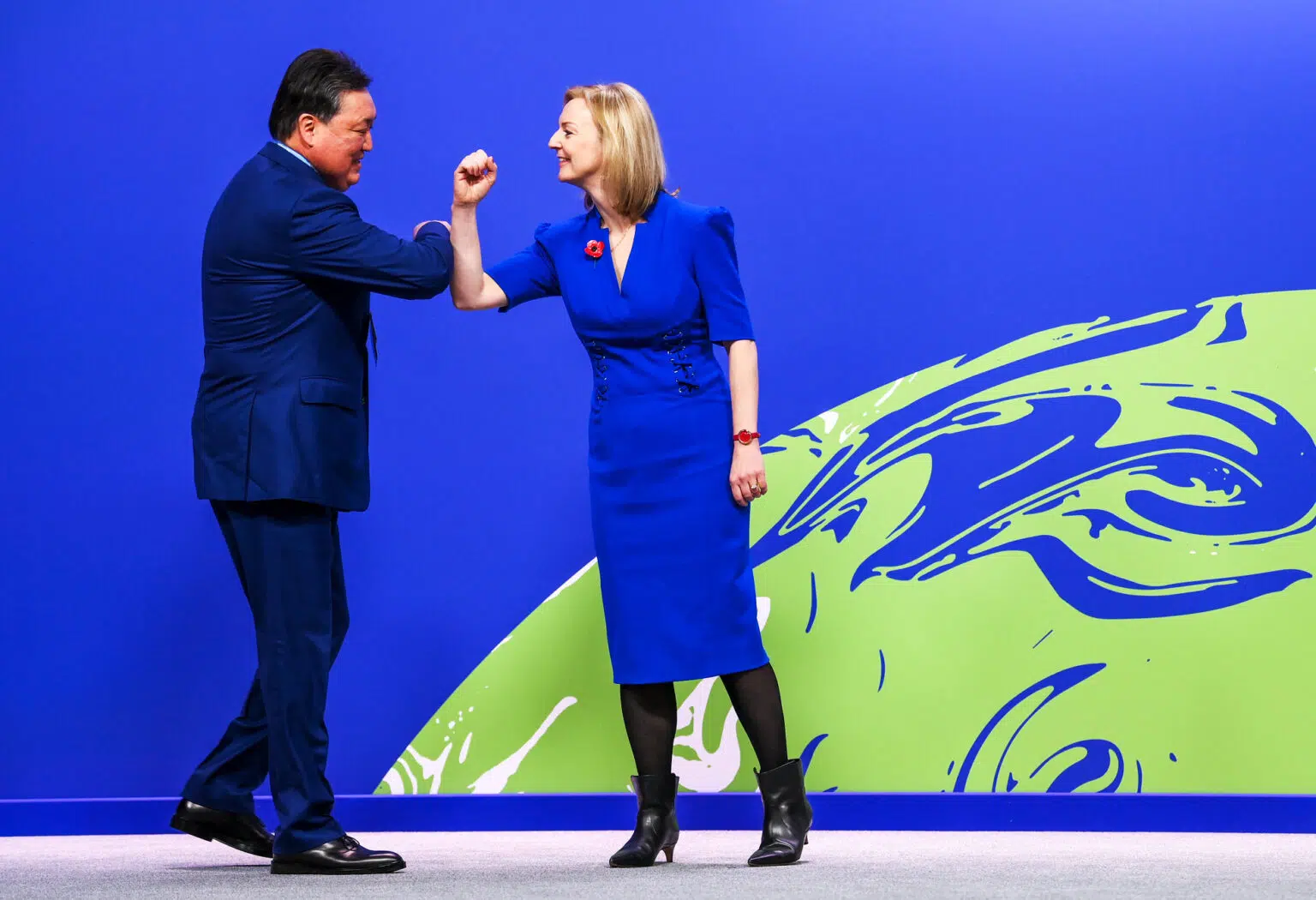
Liz Truss and former Prime Minister of Kazakhstan Asqar Mamin at the COP26 summit in Glasgow. Credit: Karwai Tang/UK Government (CC BY-NC-ND 2.0)

The former prime minister attacks flagship climate deals and makes false claims about electric vehicles, Russia’s influence on energy policies, and net zero.

The new book by former Prime Minister Liz Truss urges the UK, U.S. and EU to drop their landmark climate change laws, spreads falsehoods about green policies, and fondly recalls an attempt to cancel a major climate conference.

Truss, who is the Conservative MP for South West Norfolk, resigned as prime minister in October 2022 after just 49 days in office.

Since leaving 10 Downing Street, Truss has attempted to expose the “deep state” forces that allegedly brought down her premiership, while advocating for “free market” ideas within the Conservative Party, helping to launch the Popular Conservatives group.

In her book, Ten Years to Save the West, which she is promoting widely this week, Truss writes that “the zealous drive to net zero”, the UK’s legally binding 2050 climate target, amounts to “unilateral economic disarmament” and is “a drag on economic growth”. She also claims that, while serving in the Treasury, she attempted to cancel the 2021 COP26 climate summit in Glasgow.

Truss writes: “We should abolish the Climate Change Act and instead adopt a new Climate Freedom Act that enables rather than dictates technology”. She adds that “the U.S. should reverse the Inflation Reduction Act, and the EU should abandon its equivalent measures”.

The Climate Change Act legalised the UK’s commitment to reducing carbon dioxide emissions by at least 80 percent by 2050 from 1990 levels. The Inflation Reduction Act is a $369 billion package of grants and subsidies by the U.S. government to spur green technology investment. 

Scientists at the Intergovernmental Panel on Climate Change (IPCC) have said that without “immediate and deep emissions reductions across all sectors” limiting global heating to 1.5C is beyond reach.

Restricting global temperatures to this threshold – the target agreed by the UK as part of the 2015 Paris Agreement – would prevent the worst and most irreversible effects of climate change, including floods, droughts, heatwaves, and wildfires.

In the book, Truss also attacks climate advocates, writing that “the environmental movement is fundamentally driven by the radical left”, adding: “This ‘watermelon’ tendency is green on the outside, red on the inside – a modern rebranding of socialism. It features the same instincts of collectivism and authoritarianism.”

Truss writes that “we should cancel” the United Nations annual COP climate summit, and falsely claims that electric vehicles are worse for the environment than those powered by fossil fuels.

“In recent years, more radical forms of climate misinformation and disinformation have become mainstreamed”, said Jennie King, director of climate research and policy at the Institute of Strategic Dialogue think tank. “Such content continues to grow in virality and engagement online, but its impacts are vastly increased when platformed in the media or by politicians.”

King said “the normalisation of wild and outlandish claims”, with climate action “being framed through a conspiratorial, tribalist and anti-scientific lens”, can lead to “real-world harm”. 

“When such ideas are conveyed from the very corridors of power, it sets a dangerous precedent”, she added. 

The IPCC warned in 2022 that efforts to tackle climate change were being delayed by “rhetoric and misinformation that undermines climate science and disregards risk and urgency”.

Truss Claims ‘Couldn’t be Further from the Truth’

Truss’s book is published by Biteback Publishing, a company owned by former Conservative deputy chair and major party donor Michael Ashcroft. 

The former prime minister dedicates a chapter to green policies, titled ‘A Hostile Environment’, apparently a play on the term used by the Conservative government about its anti-immigration policies

Truss writes that current environmental policies should be scrapped in favour of a “free market” approach. On energy, she calls for more fossil fuel extraction, advocating a mix of “oil and gas as well as nuclear and renewables”, adding: “The use of North Sea oil and gas is crucial, so there needs to be investment in that too. There also should be fracking in the UK.”

Fracking for shale gas is a controversial practice that risks causing air, water, and noise pollution.

She fails to mention that oil and gas firms receive major subsidies and tax breaks from the government, which would logically be removed in a “free market” energy system. The UK government has given £20 billion more in support to fossil fuel producers than renewables companies since 2015.

Truss’s book also attacks the multilateral UN COP process, which has seen agreements on transitioning away from fossil fuels, and financial support for poorer countries suffering the worst effects of climate change. 

Truss writes that “we should cancel the COP gravy train”. She claims that, in 2018, when she was chief secretary to the Treasury, she made “11th-hour attempts to ditch COP26”, the UN climate summit hosted by the UK in 2021, arguing that it was not a spending priority. 

At COP26, nearly 200 countries agreed to ramp up efforts to cut emissions, also calling on wealthy countries to double their funding to poorer nations that have contributed the least to climate change. More than 40 countries also pledged to quit coal, the dirtiest fossil fuel and the world’s largest source of carbon dioxide emissions.

The book also spreads false claims about climate policies. Truss writes that “in the UK and Europe, Russia has funded anti-fracking campaigns”, a claim which is not supported by any evidence.

Truss claims that policies like “the switch from petrol to diesel in cars or the use of electric vehicles, have either harmed the environment in other ways or empowered our polluting adversaries elsewhere in the world”. 

Colin Walker, head of transport at the Energy and Climate Intelligence Unit think tank, told DeSmog: “The notion that the switch to electric vehicles will have little discernible environmental impact, and make us dependent on imported gas and coal, couldn’t be further from the truth.

“The total lifetime CO2 emissions of an electric vehicle, from being built to being driven, are three times lower than a petrol vehicle – a figure that will only get higher as our grid becomes cleaner. And while older technologies like petrol cars and gas boilers rely on fossil fuels imported from abroad, EVs and heat pumps can be powered by electricity generated by British wind and solar farms.”

Truss also writes of “ludicrous claims that pursuing a net zero agenda … will boost the economy and drive growth”. 

Walker added: “The UK’s net zero economy is now worth £74 billion, and grew by nine percent in 2023.  The wider economy grew just 0.1 percent. Talking down the economic opportunities net zero has to offer the UK is at odds with a growth agenda when the U.S., EU and China are all competing for clean industries.” 

Truss’s Climate Denial Ties

Truss has a long history of opposing climate policies. In the 2022 Conservative Party leadership contest, she attacked solar farms on agricultural land and, during her brief time in 10 Downing Street, she overturned the UK’s ban on fracking. (A policy reversed by her successor, Rishi Sunak.)

As DeSmog reported at the time, Truss’s leadership campaign received £30,000 from a pro-fracking lobby group, £10,000 from a climate denial activist, and £100,000 from the wife of a former BP oil executive. Truss received a further £5,000 from Lord Vinson, a Tory peer who has provided funding to the UK’s leading climate science denial group, the Global Warming Policy Foundation

Since leaving office, Truss has received £250,000 in speaking fees, including £7,600 last April from the Heritage Foundation, a right-wing U.S. think tank that has long promoted climate science denial. Heritage President Kevin Roberts provides a long and glowing blurb for Truss’s book. 

Earlier this year, Truss helped to launch the Popular Conservatives (PopCon), a new initiative run by Truss-ally Mark Littlewood, the former director general of the Institute of Economic Affairs, a think tank which received funding from oil major BP for at least 50 years. 

At the PopCon launch, Truss attacked “net zero zealotry”, claiming voters “don’t like the net zero policies which are making energy more expensive”

.Additional reporting by Sam Bright

Original article by Adam Barnett republished from DeSmog.

Continue ReadingLiz Truss Book Calls for Climate Laws to be Abolished and Boasts of Effort to Cancel UK COP Summit

Prospective GB News Board Member is Fossil Fuel Investor

Spread the love

Original article by Adam Barnett and Sam Bright republished from DeSmog.

Conservative peer and prospective GB News board member Lord Theodore Agnew. Credit: GB News / YouTube

Lord Agnew is a shareholder in Equinor, the Norwegian oil and gas firm behind the ‘carbon bomb’ Rosebank oil field.

A Conservative peer who is expected to join the board of broadcaster GB News has shares in Equinor, the oil and gas multinational behind the Rosebank oil field in the North Sea. 

According to his parliamentary register of interests, Lord Theodore Agnew has shares of at least £100,000 in Equinor, the Norwegian state-owned energy producer. Equinor has a majority stake in the Rosebank North Sea oil field, which has been dubbed a “carbon bomb” by environmental law charity ClientEarth. 

Agnew is set to replace hedge fund millionaire Paul Marshall on the board of GB News’s parent company All Perspectives Ltd, according to Sky News. 

Marshall is one of the key backers of GB News, holding a 45 percent stake in the company. He is reportedly planning to step back from GB News in order to launch a bid for the Telegraph Media Group, which includes The Telegraph newspaper and The Spectator magazine. 

His withdrawal could potentially throw GB News into turmoil. The startup broadcaster has lost £76 million since its launch in 2021 and relies on the resources of Marshall and its other big stakeholder, UAE-based investment firm Legatum, to survive. Sky News reported that GB News is now preparing to make job cuts as part of a “corporate reorganisation”.

This may have implications for how climate change is covered in the UK. An investigation by DeSmog found that one in three GB News presenters had spread climate science denial on air in 2022, while more than half had attacked climate action.

“It comes as no surprise that members of the GB News board have ties to the oil and gas industry, given the way its presenters have championed continued oil and gas expansion,” said Tessa Khan, director of environmental non-profit Uplift. 

Agnew, a former Cabinet Office minister under Boris Johnson, was in October appointed chair of UnHerd Ventures, another Marshall media vehicle. The company runs UnHerd, a publication founded in 2017 to give a platform to marginalised views.

Agnew also has shares in Carbon Plus Capital, a private investment company which specialises in carbon offsetting “based on the protection of forests”. This involves companies paying to plant trees to “offset” their greenhouse gas emissions. 

Carbon offsetting is a controversial idea that has been criticised by climate campaigners as a form of greenwashing. An investigation published last year by newspapers The Guardian, Die Zeit and non-profit SourceMaterial found that 90 percent of rainforest carbon offsets approved by the world’s largest certifier Verra were “largely worthless” and could actually increase global heating. 

Carbon Plus Capital partner Robin Warwick Edwards is a trustee of the Institute of Economic Affairs (IEA) think tank and the chair of its advisory council. The IEA, a free market group that has advocated for more fossil fuel extraction, received funding from BP for at least 50 years. 

Agnew and Edwards declined to comment. GB News did not respond. 

“Climate denial and investment in the fossil fuel industry go hand in hand”, said Carys Boughton of campaign group Fossil Free Parliament. 

“It makes complete sense that an expected new board member of GB News – a channel absolutely committed to attacking climate science and policy at every turn – is invested in Equinor, a company that, according to research by Oil Change International, ranks eighth worst in the world for its commitment to expanding oil and gas production.”

She added: “By spreading disinformation about the climate crisis, GB News is feeding into the fossil fuel industry’s licence to operate and thus helping to line the pockets of the industry’s shareholders.”

GB News in Turmoil

GB News hosts regularly attack climate policies and the science behind them. 

Numerous GB News presenters have also been vocal about their support for policies that would maintain and even extend the UK’s reliance on oil and gas. 

On 9 December 2022, host Mark Dolan praised West Cumbria Mining’s plan to open a new coal mine in Cumbria. He said the UK should “drill, baby, drill” for coal, oil and gas,  adding: “I think the push for net zero here is another element of liberal progressivism which is infecting the West.”

DeSmog revealed in October that Marshall Wace, the hedge fund run by Paul Marshall, had £1.8 billion invested in fossil fuel companies as of June 2023. This included Chevron, Shell, Equinor, and 109 other fossil fuel companies. 

Marshall reportedly invested £10 million in GB News when it first launched two years ago and, in August 2022, joined the Dubai-based investment firm Legatum Group in a £60 million capital injection and buyout of GB News’s other major investor, Discovery. 

If he joins the All Perspectives board, Agnew would become the latest Conservative politician to be adopted by the right-wing broadcaster. GB News hosts include Jacob Rees-Mogg, who was business and energy secretary under Liz TrussLee Anderson, a former Tory deputy chair who defected to anti-net zero party Reform UK last month, as well as Conservative MPs Esther McVey and Philip Davies.  

The All Perspectives board also includes Tory peer Baroness Helena Morrissey and George Farmer, a Reform UK donor and the son of Conservative peer Lord Michael Farmer. 

GB News reported losses of £42 million in the year to May 2023, and £76 million since its launch in 2021. This comes as rival populist channel TalkTV is closing its TV operation and switching to YouTube, having suffered losses of £90 million since it launched in 2022. 

Agnew’s appointment has not been confirmed by Marshall, Agnew or the company. 

“With advertisers steering clear, GB News is haemorrhaging cash – yet they continue to push misleading messages on climate change,” said Richard Wilson, director of the Stop Funding Heat campaign.  

“In the last month alone, GB News commentators have claimed climate change is a ‘social mania’, dismissed climate harms as ‘hypothetical’, and attacked United Nations warnings about the need for urgent climate action as ‘hysteria’.

“Now we learn that a prospective GB News board member has fossil fuel investments”.

He added: “Britain urgently needs a media that supports the public interest – not the interests of a toxic industry that is putting all of our futures at risk”.

Fossil Fuel Projects

Equinor claims it supplies 27 percent of the UK’s energy from oil and gas, and is currently investing $6 billion (£4.8 billion) a year in fossil fuel exploration and drilling. It also says that it powers one million homes in Europe via renewable offshore wind. 

Rosebank is the UK’s largest undeveloped oil and gas field, and could produce around 300 million barrels of oil over its lifetime, emitting 200 million tonnes of carbon dioxide. 

In October, DeSmog revealed that Equinor urged the UK government to help promote the oil and gas industry, and was one of several companies which lobbied to water down the windfall tax on oil and gas company profits following Russia’s invasion of Ukraine. 

The UK government controversially approved the Rosebank project in September, despite the International Energy Agency stating that new oil and gas exploration is incompatible with the ambition to reach net zero emissions by 2050. Green Party MP Caroline Lucas labelled the decision “morally obscene”.

Prime Minister Rishi Sunak used his address at the COP28 climate summit in December to claim that “climate politics is close to breaking point”, while stating that the UK will meet its net zero targets, “but we’ll do it in a more pragmatic way, which doesn’t burden working people”.

However, a 2023 court case found that the government’s plans only added up to 95 percent of the reductions needed to meet its net zero targets. The Conservative government has said it plans to “max out” the UK’s North Sea oil and gas reserves.

Tessa Khan added: “Those pushing for new oil and gas drilling, whether that’s the UK government, GB News or Equinor, are making things worse for the millions struggling with high energy bills and for those now struggling to cope with the impacts of climate change such as UK farmers – and all just to make a few oil and gas companies and their shareholders even richer.”

DeSmog has previously revealed that the Conservative Party received £3.5 million in donations from fossil fuel interests and climate science deniers in 2022, while two-thirds of the directors in charge of the party’s multi-million-pound endowment fund have a financial interest in oil, gas, and highly polluting industries.

Original article by Adam Barnett and Sam Bright republished from DeSmog.

Image of InBedWithBigOil by Not Here To Be Liked + Hex Prints from Just Stop Oil's You May Find Yourself... art auction. Featuring Rishi Sunak, Fossil Fuels and Rupert Murdoch.
Image of InBedWithBigOil by Not Here To Be Liked + Hex Prints from Just Stop Oil’s You May Find Yourself… art auction. Featuring Rishi Sunak, Fossil Fuels and Rupert Murdoch.
Continue ReadingProspective GB News Board Member is Fossil Fuel Investor