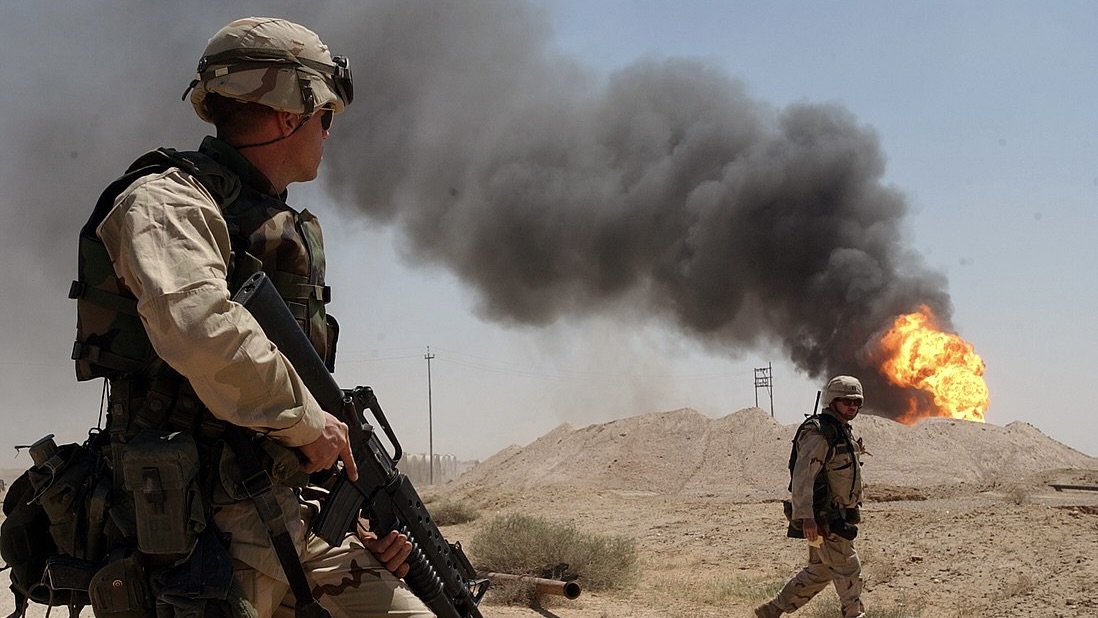
A US Army soldier watching a burning oil well at Rumaila oil field in Iraq in April 2003. Photo: US Navy
With the suspension of dialogue between the US and Venezuela, the sighting of US B-52 bombers in Venezuelan airspace, and the further lethal US strikes in the Caribbean, the US seems to be accelerating its drive towards war with Venezuela
The mood in the Caribbean grows increasingly tense, as the United States intensifies its military threats. Beneath the deceptive shroud of the “war on drugs,” the United States is actively executing a blueprint for military intervention in Venezuela, employing lethal force and projecting power in a manner that legal institutions and regional leaders have condemned as a profound threat to international order. This aggression is not a law enforcement operation; it is the negation of law, a neocolonial revival of the Monroe Doctrine, designed to shatter the sovereignty of Venezuela, seize control of the world’s largest oil reserves, and install a compliant regime.
A license to kill: the precedent of state murder
A chilling adoption of extrajudicial violence has marked the current escalation. The Trump administration has ordered unilateral military strikes against private vessels near the Venezuelan coast, allegedly to stop drug trafficking. To launch these alarming attacks, the US military has deployed a massive naval force of warships, drones, and special operations forces.
These strikes have resulted in the summary execution of at least 27 people as of recent reports. The most recent lethal strike in the Caribbean resulted in the “elimination” of 6 more people. This is not law enforcement; it is extrajudicial murder and a campaign that now stands as part of a war plan against Venezuela. The administration has characterized the victims, without credible proof, as drug traffickers and “terrorists,” a claim that, even if true, provides no legal authority for the US president to execute whomever it decides.
Legal and human rights organizations have been unequivocal in their condemnation of this profound and dangerous policy, which replaces established law enforcement procedures with premeditated lethal force. The New York City Bar Association (NYCBA), a key voice on international legal ethics, has strongly denounced these actions. The NYCBA stated explicitly that “Because the recent attacks on Venezuelan vessels and their crews were unauthorized by US law and in violation of binding international law, they were illegal summary executions – murders.” They further argued that these actions violate the fundamental international principle that “No one shall be arbitrarily deprived of his life” under the International Covenant on Civil and Political Rights.
The US government possesses ample legal authority for the Coast Guard to interdict and search vessels suspected of carrying narcotics, followed by prosecution in US courts according to due process requirements. However, in the case of the Venezuelan vessels, the Coast Guard’s Congressionally authorized police function was bypassed; instead, the crews were simply targeted and executed by overwhelming military force. Regional leaders, including Colombian President Gustavo Petro, have condemned the extrajudicial killings, highlighting the profound anxiety across Latin America over a return to unilateral US military action under the cover of anti-narcotics policy.
Beyond the lethal strikes, the US government has engaged in significant military posturing that amounts to a direct challenge to Venezuelan sovereignty. The sighting of US B-52 bombers in Venezuelan airspace, flying in close range, is a significant escalation. This warmongering has nothing to do with the “war on drugs” and everything to do with regime change to plunder Venezuela’s oil. This reckless push for war is a criminal act of international aggression.
The Trump Administration’s unilateral drone strikes in the Caribbean, combined with the White House’s termination of all negotiations with Venezuela, appear as a precursor for a full-scale regime change operation. This is a critical moment. We must sound the alarm: there is a risk of a new, catastrophic conflict in the region.
The US government’s own officials continue to escalate the crisis with bellicose rhetoric and actions. Secretary of State Marco Rubio, a key architect of the regime-change policy, has consistently refused to rule out a military option, asserting that the Maduro regime has become a “threat to the region and even to the United States.”
Venezuela’s response has been one of principled defense of its sovereignty. Ambassador to the UN, Samuel Moncada has repeatedly sounded the alarm on the global stage, arguing that the US military deployment in the Caribbean is a massive propaganda operation that seeks “excuses to fabricate a conflict” to seize the country’s oil wealth. Moncada affirmed that, “The United States believes that the Caribbean belongs to it because it has been using the expansionist Monroe Doctrine for over 100 years, which is nothing more than a remnant of colonialism.”
President Nicolás Maduro has called on Washington to resume dialogue, stating, “Our diplomacy isn’t the diplomacy of cannons, of threats, because the world cannot be the world of 100 years ago,” while simultaneously mobilizing national defense exercises to ensure the country is prepared for any direct assault. The NYCBA warned that attacks against Venezuelan vessels and reported threats against the Venezuelan government violate the nation’s obligations under the United Nations Charter, with the risk of escalating to open hostilities.
Parallels with the Iraq War: oil, ideology, and deception
The current situation is chillingly reminiscent of the lead-up to the 2003 invasion of Iraq. In that case, the Bush administration justified unilateral action on the basis of “weapons of mass destruction,” but this was a pretext. The true objectives were not limited to oil, but also included achieving profound ideological and political goals – overthrowing a government to reshape Middle Eastern politics and assert dominance.
Washington must learn the lessons of this history. The Bush administration promised a quick victory in Iraq. Instead, the invasions and occupation claimed countless Iraqi lives, resulted in tens of thousands of American soldiers killed or wounded, and destabilized the region. The notion that the US can carry out military invasions into the heart of Latin America without a massive blowback is outlandish.
In the case of Venezuela, the “war on drugs” and the labeling of the government as a “threat” serve as the new rhetorical pretexts. The US interest is multifaceted: it involves securing the world’s largest proven oil reserves and achieving the ideological and political goal of overthrowing a socialist government to assert dominance and reshape Latin American politics. The US seeks to dismantle the Bolivarian Revolution and eliminate a major center of anti-imperialist politics in the hemisphere.
The current escalation is not about law enforcement or counter-narcotics; it is about regime change and plunder. While members of Congress from both Democratic and Republican parties, as well as key voices of public opinion, are increasingly speaking up about the illegality of these strikes and the absence of credible information from the administration, this situation requires much more urgency, once the escalation ladder is climbed, there may be no going back. The international community must recognize this aggressive campaign for what it is: a criminal act of international aggression. The world must stand against this threat of a new, catastrophic conflict.
Manolo De Los Santos is Executive Director of The People’s Forum and a researcher at Tricontinental: Institute for Social Research. His writing appears regularly in Monthly Review, Peoples Dispatch, CounterPunch, La Jornada, and other progressive media. He coedited, most recently, Viviremos: Venezuela vs. Hybrid War (LeftWord, 2020), Comrade of the Revolution: Selected Speeches of Fidel Castro (LeftWord, 2021), and Our Own Path to Socialism: Selected Speeches of Hugo Chávez (LeftWord, 2023).
Donald Fuhrump says that Amerikkka doesn’t bother with crimes or charges anymore, not being 100% Amerikkkan and opposing his real estate intentions is enough.Elon Musk urges you to be a Fascist like him, says that you can ignore facts and reality then.Orcas discuss how Trump was re-elected and him being an obviously insane, xenophobic Fascist.
Carbon capture faces significant skepticism from environmentalists who note that the industry’s past is littered with failed projects, missed targets, and an overall net increase in emissions. Credit: Matt Hrkac (CC BY-NC-ND 2.0)NDLA,
CCS can “no longer be considered an unlimited” climate solution, researchers caution after concluding most storage options are in risky regions
As the Trump administration seeks to wipe away environmental rules covering the oil, gas, and coal industries, fossil fuel producers and sellers are reassuring buyers that carbon capture and storage (CCS) could slash climate-altering emissions from a growing range of fossil-fuel projects — like blue hydrogen, LNG export terminals, and data centers.
“That’s right: data centers,” fossil fuel giant ExxonMobil wrote in December, adding that the need for more data centers for AI could represent a fifth of the world’s demand for carbon capture by 2050.
Now, a study published in the journal Nature calls attention to another issue that could loom in the future if CCS were to really take off — a lack of easy-to-develop locations where captured carbon can be buried underground.
The vast majority of places where you can find the kinds of sedimentary rocks that allow carbon dioxide to be stored underground sit in higher risk zones or in areas like the Arctic that are potentially off-limits for practical or political reasons, the study found.
That has big implications for the energy transition, since once carbon dioxide is put into storage, it’s supposed to stay there for as long as possible. Any storage sites we use today can’t be expected to be available for future generations — not just the children and grandchildren of people alive today but “more than ten generations into the future,” the study notes.
“This study should be a gamechanger for carbon storage,” coauthor Joeri Rogelj, director of research at the Grantham Institute at Imperial College London, said in a statement when the study was announced. “It can no longer be considered an unlimited solution to bring our climate back to a safe level. Instead, geological storage space needs to be thought of as a scarce resource that should be managed responsibly to allow a safe climate future for humanity.”
In fact, there may be only enough practical storage to potentially reverse between 0.4 and 0.7 degrees Celsius of warming — a tiny fraction of the five or six degrees experts previously estimated, the researchers said.
The carbon storage that is available “should be used to halt and reverse global warming,” Rogelj added, “and not be wasted on offsetting on-going and avoidable CO2 pollution from fossil electricity production or outdated combustion engines.”
On Track to ‘Overshoot’
International plans to limit climate change tend to assume that we can “overshoot” on climate pollution, pushing the Earth’s climate into dangerous territory past 1.5 or 2 degrees Celsius of warming. That’s because, the argument goes, carbon capture and storage could come to the rescue if we go too far, letting us draw carbon dioxide levels back down.
The new study calls that assumption into question, highlighting uncertainty about how effective carbon removal will be at curbing climate change, in addition to concerns over difficulties in accessing underground carbon storage.
“With current trends suggesting warming up to 3°C this century, using all of the safe geological storage wouldn’t even get us back to 2°C,” said lead author Matthew Gidden, research professor at the Center for Global Sustainability at the University of Maryland.
Industry estimates, like those from the Oil and Gas Climate Initiative (OGCI), suggest the world has plenty of storage potential to keep 14,000 gigatons of carbon dioxide buried below ground and out of the atmosphere.
That would be “more than enough to meet projected needs for CCUS [carbon capture, use and sequestration] over the coming century,” the OGCI wrote in a 2023 report it called a “playbook for regulators, industrial emitters and hub developers.”
The new study, however, takes a closer look at where that storage is located — and in particular whether it’s in regions at higher risk of earthquakes or groundwater contamination like locations deep in the ocean, or in the Arctic and Antarctic circles. The study concludes that nearly 90 percent of that storage capacity is in less-than-desirable locations.
The researchers estimate there’s just 1,460 gigatons worth of “prudent” storage available worldwide — a tenth of the industry estimates.
Some earlier estimates stretch even higher, suggesting there’s around 40,000 gigatons of CO2 storage capacity worldwide.
“These estimates are also important as they remove all the technical constraints from assessment and assume that cost and engineering challenges will pose no issue in the future,” coauthor Siddharth Joshi, a research scholar at the Integrated Assessment and Climate Change Research Group, told DeSmog, adding that “the shock value of technical potentials is enough to sometimes drive an industry forward.”
At the same time, focusing only on larger capacity estimates can create a “false sense of abundance,” Gidden noted, if policy-makers think the world has more room for overshoot than carbon storage can really offer.
The Nature study raises big questions about how the world’s carbon storage should be used long term.
“As [the study authors] point out, if we act to reduce emissions now, we probably have enough storage, but that ceases to be true really, really soon,” Rob Anex, professor at the University of Wisconsin-Madison who researches carbon capture technology, told Canada’s CBC News. “Global emission rates are so high that the window of time in which geologic storage is practical is shutting really, really fast.”
Trump Backs Carbon Capture Subsidies
Despite the federal government’s retreat from climate action, including Trump’s January executive order withdrawing the U.S. from the Paris Agreement, the Trump administration has moved to protect and expand some federal subsidies for CCS.
Lucrative tax credits for using captured carbon for enhanced oil recovery were expanded this summer as part of Trump’s “One Big Beautiful Bill Act.”
Given this political climate, experts didn’t expect to see a major direct impact from the study for blue hydrogen projects and other proposals aiming to use carbon storage.
“The pragmatist in me says it’s unlikely,” Anika Juhn, energy data analyst for the Institute for Energy Economics and Financial Analysis (IEEFA), told DeSmog. “I don’t see government taking those kinds of steps.”
The Nature study follows a precautionary approach to carbon storage, she noted. “The precautionary principle says if we don’t really know about it, then maybe we shouldn’t be rushing headlong into just applying this technology everywhere as fast as possible,” she said. “I think that’s really where the strength of it is, saying if you are interested in doing it safely, here are some key aspects that you should really focus on.”
“Because their estimate is so prudent, it really doesn’t reflect at all current industry practice,” Juhn noted.
So far, there’s not a lot of carbon storage operating worldwide, with the Nature study pointing out existing projects currently store just 49 megatons per year, with 416 megatons worth “either planned or in construction.” Meanwhile, annual global emissions from fossil fuels topped 37,400 megatons last year, according to the World Meteorological Organization, another record high.
But that small CCS industry has already caused significant safety incidents — including well blowouts and a major 2020 CO2 pipeline leak that hospitalized dozens of people.
Concerns over the potential for groundwater contamination — one of the factors highlighted in the Nature study — have already begun curbing real-world carbon storage availability at the state and local level.
Take, for example, Illinois, home to the nation’s first dedicated carbon storage project, the Archer-Daniels-Midland (ADM) carbon storage site in Decatur, Illinois.
Carbon injections were halted at ADM’s site a year ago, after the company discovered leaks below ground. “Given the extreme depth and the multiple layers of shale and other confining rock up to the surface, at no time was there an impact to the surface or groundwater sources, nor any threat to public health,” ADM said at the end of August, announcing the restart of operations at its Decatur site.
But the incident appears to have hit a nerve in the state, where nearly a million people rely on the Mahomet Aquifer in Champaign, Illinois, as their sole source of drinking water.
This summer, Illinois passed a law banning carbon storage below that aquifer, making roughly 15 percent of the state’s counties off limits for carbon storage. ADM’s leak had reached within about six miles of the Mahomet Aquifer, Taxpayers for Common Sense notes.
The Nature study notes that most of the carbon storage in operation today doesn’t actually offer any net climate benefit — because it’s used for enhanced oil recovery, which, the researchers wrote, “overall results in net-positive CO2 emissions.”
“After decades of bold projections, only around 10 million tons of CO₂ are captured and permanently stored each year (excluding enhanced oil recovery), representing less than 0.03% of annual global fossil fuel emissions,” Kevin Anderson, professor of Energy and Climate Change at the University of Manchester, said in a statement responding to the study. “Rather than serving as a credible mitigation technology, CCS has largely functioned as a rhetorical device to delay robust fossil fuel regulation.”
Donald Trump urges you to be a Climate Science denier like him. He says that he makes millions and millions for destroying the planet, Burn, Baby, Burn and Flood, Baby, Flood.Nigel Farage urges you to ignore facts and reality and be a climate science denier like him. He says that Reform UK has received millions and millions from the fossil fuel industry to promote climate denial and destroy the planet.
The price of eggs has more than doubled in the past eight years, which isn’t great, but at least you can eat eggs. The price of US government subsidies for the fossil-fuel industry has also more than doubled in that time, which is far, far less great. Welfare for an industry that makes billions of dollars in profits and pollutes the climate is worse than useless. It’s self-destructive.
The federal government gives oil, gas and coal producers at least $34.8 billion in subsidies each year, according to a new study by the research and advocacy nonprofit Oil Change International. In 2017, OCI estimated these gifts at $14.7 billion annually. This doubling in federal largesse has taken place under both Democratic and Republican political administrations, highlighting the difficulty of stopping its growth, much less reversing it.
In fact, some of the most recent extensions of federal aid have made it possible for these subsidies to explode in the future, threatening to reach trillions of dollars. When the world needs exponential growth in clean-energy investments to avoid the most catastrophic effects of global heating, the US government will be bankrolling fossil-fuel expansion and stoking the emergency.
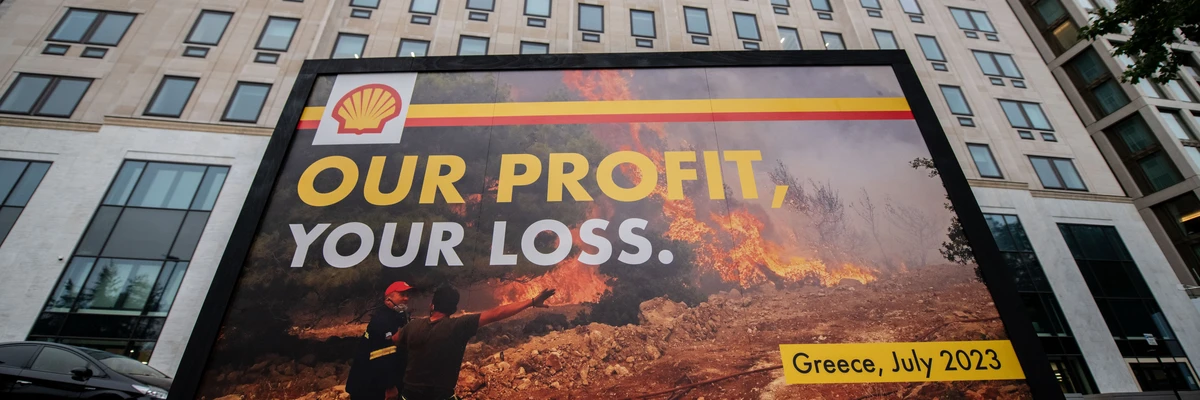
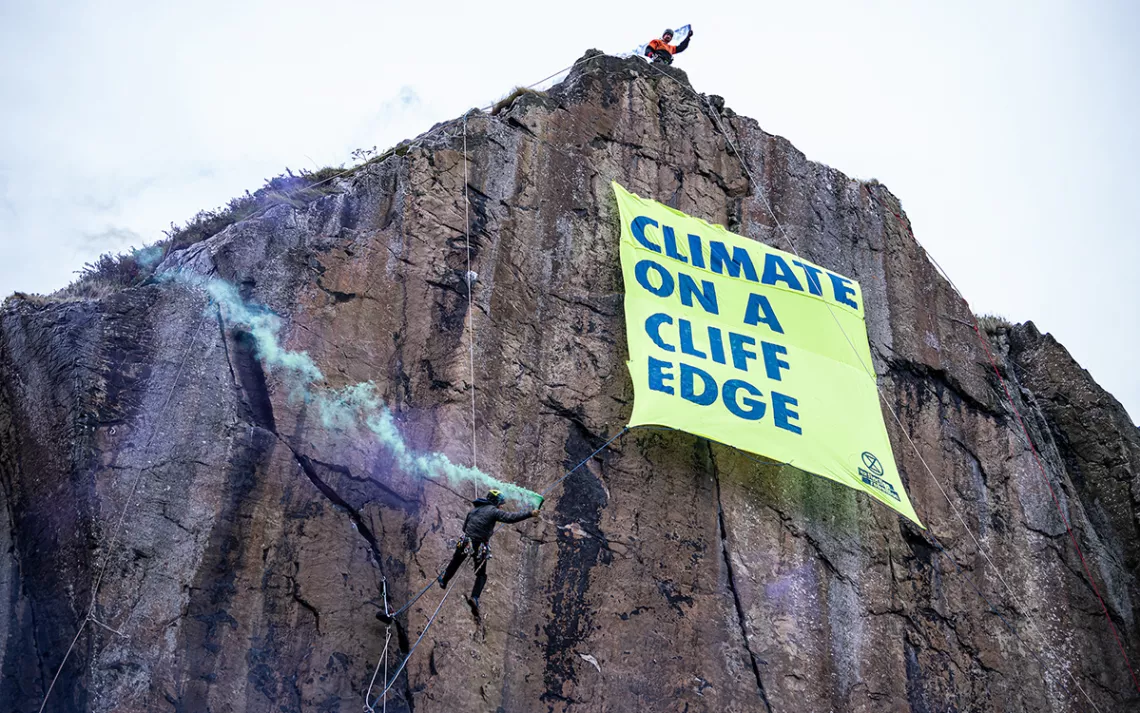
Donald Trump urges you to be a Climate Science denier like him. He says that he makes millions and millions for destroying the planet, Burn, Baby, Burn and Flood, Baby, Flood.Greenpeace activists display a billboard during a protest outside Shell headquarters on July 27, 2023 in London. (Photo: Handout/Chris J. Ratcliffe for Greenpeace via Getty Images)Experienced climbers scale a rock face near the historic Dumbarton castle in Glasgow, releasing a banner that reads “Climate on a Cliff Edge.” One activist, dressed as a globe, symbolically looms near the edge, while another plays the bagpipes on the shores below. | Photo courtesy of Extinction Rebellion and Mark Richards
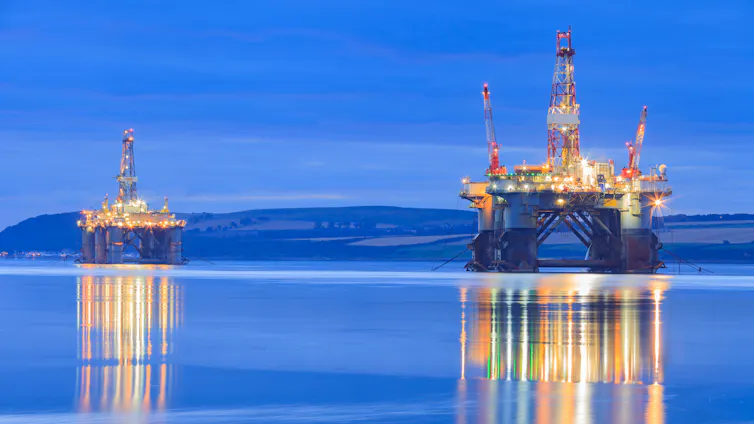
“We are going to get all our oil and gas out of the North Sea”, Conservative Party leader Kemi Badenoch said recently. Her promise to “maximise extraction” sets up a clash between political ambitions, economic reality and geological limits.
Reform UK has also said drilling for more oil and gas in the North Sea would be a “day one” priority. But even if the Conservatives or Reform were to be elected and lifted the current moratorium on new exploration licenses, there might not be the promised prizes of oil and gas under the seabed – or enough appetite from investors – to deliver on that promise.
BP, in those days British Petroleum, first extracted gas from under the North Sea in 1967. It marked the start of what was to become, for decades, one of the most valuable sectors of the UK economy, with more than 400 separate oil and gas fields developed to date.
But production peaked in 1999 and the North Sea now produces less than half as much as in its heyday.
It is now a “mature” basin: most of the biggest and easiest-to-develop fields have already been discovered and depleted. What remains are smaller, sometimes more remote, and often more technically challenging or expensive resources and reserves.
This is typical of ageing oil and gas provinces, where production declines even as operating costs rise. New projects must compete with oil and gas extracted from other parts of the world where it is easier and cheaper and more appealing to investors.
Finding oil and gas
Historically, only one in eight exploration wells in the North Sea led to a field producing oil and gas. That ratio has improved: between 2008 and 2017, a bit more than one in four wells led to a commercial success.
But far fewer wells are being drilled today. Even with the advances in technology, such as improved geophysical imaging which allows us to better define opportunities ahead of drilling, the big discoveries were probably made decades ago.
UK exploration wells vs offshore fields by year:
The number of exploration wells is down hugely from its peak in the 1980s and early 90s. Mark Ireland / NSTA
The UK government’s North Sea Transition Authority estimates there could still be around 3.5 billion barrels of oil equivalent in more than 400 undeveloped prospects. But most of these potential fields are small, isolated or technically complex. Developing them will require high oil and gas prices, fiscal stability, and a lot of investor confidence.
Politics vs geology
Even if a future government relaxes exploration licensing rules, geology will remain the bigger constraint. The North Sea is simply not as cheap as it was, and global fossil fuel giants have many other options. It is currently far cheaper to produce oil and gas in other regions, the Middle East or North Africa for example. Projects in these countries are all competing for the same capital.
Volatility in the energy sector will continue to make investors cautious. The 2015 oil price crash cut activity in the UK sector to its lowest level in decades, and it has never fully recovered. As fossil fuels are sold on the global market, political volatility, international and national, can lead to rapid shifts in investor confidence.
In the UK the introduction of a windfall tax in 2023 and changing requirements for environmental impact assessments are all making decision making on long-term projects riskier. And while the UK still needs considerable volumes of gas in future (and more modest amounts of oil) both are declining as our energy system evolves and renewable energy expand.
The UK’s mix of economic uncertainty, mature geology and smaller discoveries will make it harder to attract major international energy firms.
The future of the North Sea
That doesn’t mean the North Sea has finished as a source of oil and gas. For instance, undeveloped discoveries – where oil or gas has been confirmed but not yet produced – represent a lower-risk opportunity. But returns may be modest as many are relatively small and isolated from existing infrastructure.
New exploration licenses, if issued, might extend production modestly, but they are unlikely to deliver another game-changing discovery.
Some analysts argue that future licensing should be highly strategic, limited to projects with clear economic importance or climate compatibility. That approach could reduce reliance on imported gas, which tends to be more carbon-intensive than gas produced domestically. This would certainly make more sense than restarting fracking. But it would still not recreate the industry’s heyday.
Easy oil is over
The North Sea will still produce oil and gas for years to come, but its role will shrink. Even with friendlier policies, the era of big discoveries and rapid growth isn’t coming back.
Maximising extraction may sound appealing to politicians, but geology, economics and climate commitments all point to the North Sea’s best oil and gas days being behind it. The real challenge now is managing the investment during decline while investing in the cleaner solutions that will replace it.
UK Conservative Party leader Kemi ‘not a genocide’ Badenoch explains her reality that the Earth is flat, the Moon is made of cheese and that she was born from
Unicorn horn dust
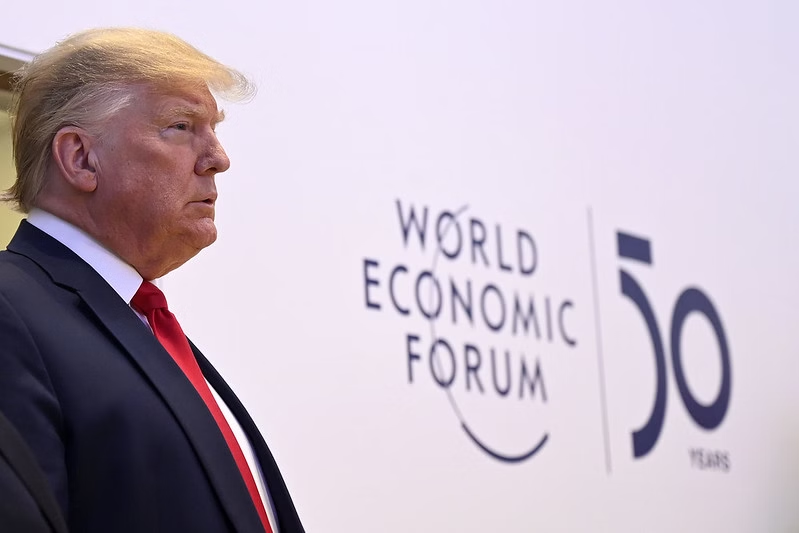
U.S. President Donald Trump and corporate image-crafter the World Economic Forum have perfected the tactic of creating “pseudo-realities” to help avoid accountability for damaging actions. Credit: World Economic Forum/Valeriano Di Domenico .
This week, the EU agreed to 15% tariffs with the United States, half of President Donald Trump’s threatened rate, before the August 1 deadline. With Mexico and Brazil trade deals on the horizon, Trump appears to have the world’s pocketbooks, supply chains, and eyeballs precisely where he wants them: in a state of uncertainty, and focused on him.
“We didn’t believe him,” a Wall Street executive told the Financial Times. “We assumed that someone in the administration that had an economic background would tell him that global tariffs were a bad idea.” Trump seemed surprised by the executives’ surprise: “I said this would exactly be the way it is,” he noted, correctly.
But perhaps CEOs can be forgiven for assuming that the self-proclaimed “Tariff Man” was bluffing. Perhaps it’s understandable that some of the world’s most powerful and highly compensated executives, including fossil fuel leaders, filed Trump’s campaign pledges — “tariffs are the greatest thing ever invented,” he declared last fall — in the category of “things politicians say.”
After all, making high-profile promises on which they have no intention of following through — promises that are based largely on what they want people to think is true, or simply what is convenient to say in the moment — is how corporations operate every day.
Indeed, with the help of well-paid public relations firms, prestigious consultants, and elite conveners like the World Economic Forum, executives and their organizations construct what might be considered “pseudo-realities”: alternative portrayals of the world that serve a company’s interests but have little bearing on how the company actually makes money.
In the digital age, in fact, operating in the space between word and deed, between image and action, between theater and reality, has become the modus operandi of the corporate world, especially fossil fuel companies.
The Big Oil Autocratic Playbook
Big Oil has honed this playbook to near perfection. For decades, the industry has enlisted PR agencies to construct elaborate narratives so polished and pervasive that they’ve managed to stave off meaningful climate action while painting the oil and gas giants as working toward — in what might be a first in the history of modern capitalism — its own obsolescence.
Take Saudi Arabia’s state-backed oil giant Aramco, which is one of the most profitable companies in the world. As DeSmog’s TJ Jordan has pointed out, the company’s relentless advertising constructs a narrative of responsibility and green innovation. Aramco frames its advanced fuels and F1 motorsport sponsorship as a credible pathway to decarbonization — part of a broader Saudi push for a clean energy transition.
That argument omits a key piece of reality: not just that the kingdom is a major fossil fuel producer, but that it has stated its commitment to this extractive business model for years to come. (McCann, Publicis, and Hill+Knowlton, which is now part of Burson, are among the PR firms that have worked for Aramco.)
Or consider DeSmog’s deeply researched investigation into how Edelman, one of the world’s largest PR firms, polished the image of the United Arab Emirates, creating an alternate reality that convinced the public and heads of state that it was a leader on climate action, obscuring its oil-producing legacy.
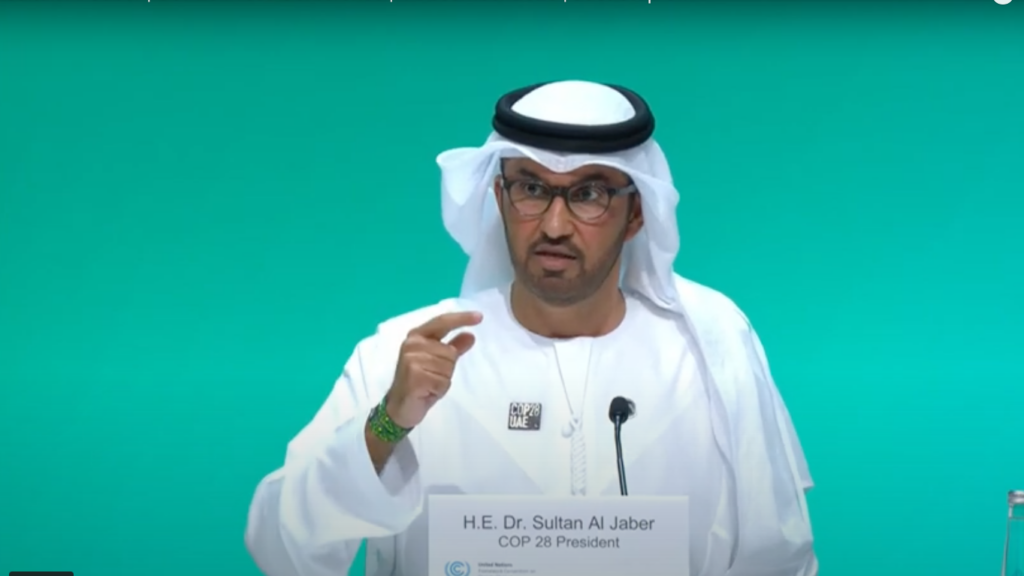
The PR campaign helped propel oil baron Sultan Ahmed Al Jaber to the top levels of climate diplomacy as host of COP28, the UN’s annual climate gathering, even as the UAE was pumping more and more oil — a case study in manifesting an effective pseudo-reality.
Sultan Ahmed Al Jaber addresses a news conference in Dubai, December 4, 2023. Credit: Just Stop Oil YouTube Channel.
Meanwhile, this July, barely a year after Edelman won an “eight-figure” contract with Shell, one of the world’s leading oil and gas producers, the agency signed an agreement to manage PR for the upcoming COP30 climate conference in Brazil.
The goal of campaigns like these does not appear to be to convince everyone, everywhere, forever. Instead, like an authoritarian propagandist (or an aspiring one), these efforts seek to flood society’s information channels with alternate visions of how the world might be.
As long-serving autocrats have discovered, the resultant mixture of true belief, skepticism, and confusion creates doubt that the truth — in this case, about the severity of climate change, and the complicity of those responsible for it — can ever really be known. Such doubt helps prevent the emergence of public consensus and stalls momentum for accountability and change.
A Performative Ally
In pursuit of these efforts, fossil fuel companies have found an ally in an organization that is ostensibly committed to tackling the climate crisis and transitioning the world to clean energy.
Indeed, few organizations demonstrate the performative nature of corporate image-crafting as transparently as the World Economic Forum (WEF), the nonprofit that hosts the annual gathering of corporate and political elites of the same name in Davos, Switzerland, each January.
“The big issues in the world, like climate change, cannot be solved by governments alone,” said WEF’s founder and former CEO Klaus Schwab in 2019. “We need new technologies, so business has a role to play. Civil society has a big role to play. We are all stakeholders in our global future. And the World Economic Forum acts as a kind of catalyst for this process.”
(Earlier this year, Schwab resigned from the WEF following allegations that included misappropriating funds and creating a toxic work environment rife with racial discrimination and sexual harassment.)
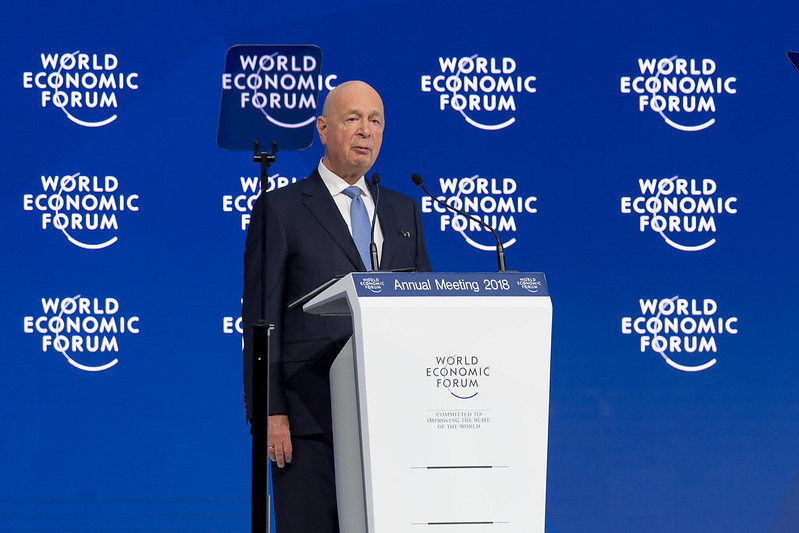
WEF CEO Klaus Schwab speaks at the group’s 2018 annual meeting. Credit: World Economic Forum/Remy Steinegger
The WEF is decidedly inaccessible to the public: Membership can cost companies more than $650,000 a year, with individual attendees paying upwards of $30,000 for top-tier access to the four-day Davos conference. But it is nevertheless a performance for the public. WEF elites want to be seen and think of themselves as “using their powers for good,” as one of my former bosses in the corporate world used to say.
To that end, the organization publishes a steady stream of content, including reports, white papers, articles, podcasts, YouTube videos, and social media posts. Most of this corporate “thought leadership” shares two distinct but related goals: to position the organization that publishes it as an expert in a problem being discussed (such as climate change), and to portray the company — and “business” more generally — as critical to addressing that problem.
The WEF did not respond to an emailed request for comment.
For instance, in a January 2023 paper published with the consulting firm (and WEF “strategic partner”) PwC, the WEF outlined a “business case” for corporations to pursue climate adaptation strategies. One recommendation: “Capitalize on opportunities” created by the climate crisis. “These adaptation efforts will generate demand for products and services and open new markets,” the report noted.
The language in these publications is typically grandiose. “The future of our planet depends on it,” its foreword concluded, referring to the corporations taking action — of which authoring a report is presumably one part.
The business models of, say, a consulting firm like McKinsey & Co. that is determined, in the words of its boss, to continue “[doing] business with greenhouse-gas emitters,” or of a global nonprofit like the WEF, which brought in more than $500 million in revenue last year, much of it from extractive corporations and oil-reliant governments, do not include concrete actions that would make fossil fuel production less lucrative. (McKinsey, Chevron, Aramco, BP, and Rio Tinto are among WEF’s other “strategic partners.”)
‘Organized Lying’
A revealing example of how companies use thought leadership to spin pseudo-realities into existence comes from a PR firm with close ties to Schwab and the WEF.
The late 2010s and early 2020s marked a short-lived era in which executives decided that their workers, customers, and other “stakeholders” — such as politicians and regulators — wanted to hear that businesses were solving global challenges like climate change, inequality, and racism. This self-serving notion was called “stakeholder capitalism,” which also became the title of a 2021 book by Klaus Schwab.
Edelman, one of the largest PR firms in the world, helped drive this corporate reimagining. “CEOs expected to lead on change” was among the findings of the agency’s 2019 “trust barometer,” a survey it releases in Davos every January.
The following year, company CEO Richard Edelman highlighted the “stunning” finding that employees “expect their employer’s CEO to speak up on one or more issues.” In 2021, Richard Edelman proclaimed that “the events of this past year reinforced business’ responsibility to lead on societal issues.” Citing the trust survey, the CEO wrote in a 2023 blog post titled “Companies Must Not Stay Silent,” that, “Business leaders must not only speak out on incidents of injustice and the pressing issues of the day, but they must take action.”
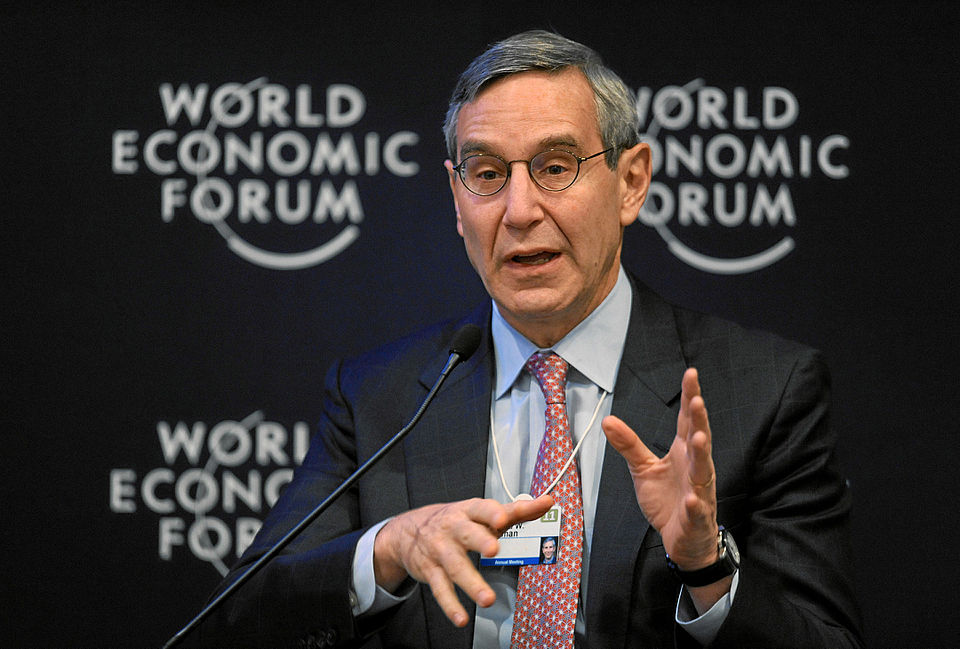
PR firm CEO Richard Edelman writes an annual trust survey that a researcher said “consistently paints the picture that best served the interests” of Edeman and its clients. Credit: Wikimedia Commons
In a 2024 paper, Lee Edwards, a professor of strategic communications and public engagement at the London School of Economics, looked closely at the surveys Edelman published between 2018 and 2022. She studied not only their findings and conclusions, but the entire package — the headlines, the imagery, the tone, the formatting, the branding.
Edwards found that Edelman consistently painted the picture that best served the interests of the firm and its clients: that public trust in governments, nonprofit organizations, and the media was collapsing — meaning, in turn, that businesses had an obligation to step into the breach.
In a nod to Hannah Arendt, the late philosopher and scholar of totalitarianism, Edwards described the trust barometer as an example of “organized lying,” which “reconstitutes … reality on the basis of whatever the organization deems necessary to achieve their goals.” Corporate thought leadership “might be based on deception,” Edwards argued, “but the appearance of truth is what matters most for its value in the production of trust.”
In short, you do not need to convey what is true. You only need convince people to believe that something is true, a tactic that Trump and his Maga movement specialize in.
Corporate Trust Narratives as Alternative Realities
Edwards concluded that “the production of trust narratives by the public relations industry is not a commentary on a pre-existing reality, but a construction of an alternative reality, that in many ways obscures — intentionally or otherwise — many inconvenient but factual truths about the role of business in society.”
Because these alternative realities are driven by what is most useful for companies to portray as the truth at a given moment in time, their conclusions can shift quickly. The rhetorical emergence of stakeholder capitalism was promptly followed by a right-wing backlash that saw furious pundits and political parties in the United States and elsewhere, especially the MAGA movement and its emulators around the world, gain momentum — and sometimes win elections — in part by decrying what they called “woke capitalism.”
In turn, as the cheery narrative that companies would use market forces to fight injustice and solve climate change began to incur reputational and political risks from the right, companies did not hesitate to pivot to a different message — one that, in many ways, appeared incompatible with what they had been touting widely only months before.
“My advice to all of you for your companies is stay out of politics,” Richard Edelman told the WEF in January 2024, less than a year after advising that “this is not the time for CEOs and the companies they lead to remain silent or stand down.”
One organization that appeared to follow Edelman’s change of heart was the WEF itself. In 2024, Semafor reported that Richard Edelman was among the executives counseling the WEF to shift its politics rightward to avoid alienating conservative politicians and governments reliant on oil and gas extraction.
“The Gulf monarchies, whose oil money flows down the [Davos] Promenade and helps underwrite the forum, have also grown weary of criticism of fossil fuels and signaled to the forum that, ‘we can do this elsewhere,’” Semafor wrote. A few months later, in April 2024, WEF hosted a “special meeting” in Riyadh, Saudi Arabia, where a panel about “an equitable energy transition” featured the Saudi energy minister, the CEO of Occidental Petroleum, and the CEO of ExxonMobil.
In an emailed statement, an Edelman spokesperson said: “The guardrails on speaking out have changed because public expectations of business have evolved. The broad permission once granted to business leaders to speak freely has become more selective, requiring careful consideration of when and where to engage. Our recent data shows that there are specific instances where people expect business leaders to engage on a societal issue such as when the issue harms their employees, customers, or communities.”
Boorstin’s ‘Pseudo-events’
In her 2024 book Invisible Rulers: The People Who Turn Lies Into Reality, Georgetown University professor Renée DiResta discusses what the late historian Daniel J. Boorstin called “pseudo-events”: events manufactured specifically for the purpose of generating media coverage. Like a news conference that announces the formation of a task force that will produce a non-binding report, pseudo-events have no significance in and of themselves; they exist to create the illusion of significance.
Once a pseudo-event has been hallucinated into existence — such as an announcement in a news release or, these days, a mention in an Instagram influencer’s story — its significance cascades outward as more news outlets and social media influencers and online scrollers report on it and cite it and share it. This “narrative laundering,” as DiResta calls it, helps transform a pseudo-event into reality — or, at least, pseudo-reality.
“Once a pseudo-event has been hallucinated into existence — such as an announcement in a news release or, these days, a mention in an Instagram influencer’s story — its significance cascades outward as more news outlets and social media influencers and online scrollers report on it and cite it and share it.”
The WEF and its corporate members are master crafters of pseudo-events. Indeed, the gatherings of the WEF high in the Swiss Alps, or at June’s “Summer Davos” in Tianjin, China, are themselves pseudo-events.
They attract legions of wealthy and powerful people, alongside their PR teams and journalists. From behind closed doors emerge plenty of headlines and pledges, endless content and commitments — but no new laws, no binding emissions reductions, no new taxes to help pay for the climate adaptation that “the future of our planet depends on.” And, crucially, their high-profile pronouncements and publications can say whatever they deem most helpful for them to say in that moment.
Out of nothing emerges a pseudo-reality that portrays corporations as they wish to be seen. And in this alternate reality, the real world — in which companies operate as they always have, capitalizing on the sociopathicimperatives of capitalism — is mostly irrelevant.
Trump, Tariffs, and Pseudo-Realities
Of course, what validated, to some extent, the disbelief of the executives and Wall Street analysts on “Liberation Day” is the fact that Trump is a serial fabricator. Over the past decade, no one has been more successful than this president of the United States in spinning up and cashing in on pseudo-realities largely untethered from what he is actually doing.
Shamelessly promising whatever is convenient in the moment, with no intention of following through; profiting off the manipulation of supporters while condescending to them; acquiring power by constructing an alternative narrative of how the world is; performing that pseudo-reality into existence by repeating it over and over again: This is the Trump playbook. But it is also the corporate playbook.
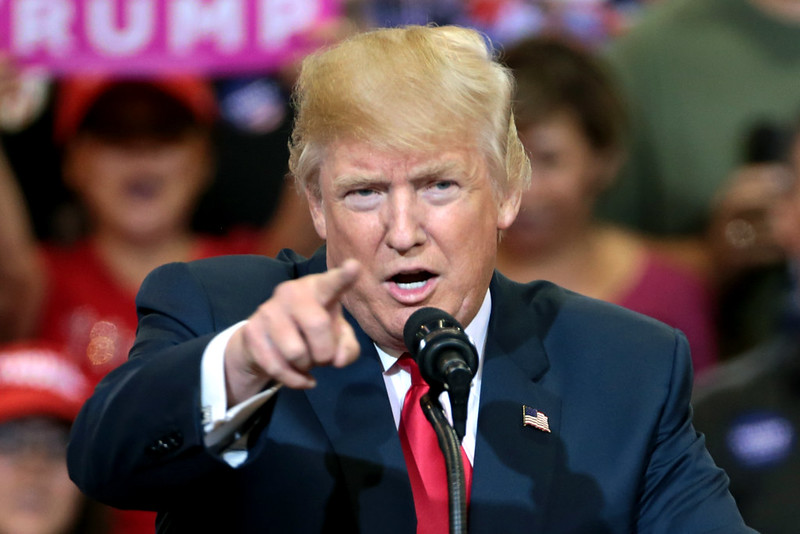
Many say that President Trume aquired power by constructing an alternative narrative of how the world really is. Credit: Public Domain
Despite their initial shock, companies quickly found that there was value in the tariff narrative. Reports are already documenting executives explaining how the expectation of tariff-driven price increases provided an ideal cover for increasing prices — even on products not impacted by tariffs.
In April, asked on CNBC whether corporations were “raising their prices…just because they can,” one oil executive responded, “Exactly. Yes. … It gives them room to move prices up,” as The Lever’s Luke Goldstein noted.
Whether price-gouging under the cover of tariffs, or offering tired-but-effective national security justifications for doubling down on fossil fuels, predicting something and then using your prediction to justify what you already wanted and/or planned to do is a key two-step in what LSE’s Edwards called “organized lying.”
Only in an alternative reality could the PR and influence industry, whose business model includes laundering the reputations of autocrats and creating astroturf front groups to generate the illusion of broad public support, be seen as an authority on public trust. Yet it seems not to matter whether the pseudo-realities they manufacture are genuinely believable — only that they are just believable enough to serve a purpose.
And that purpose is often as simple as preventing the coherence of an alternative narrative, like the fact that corporate profiteering, which rose during the COVID crisis, is exacerbating tariff consequences for consumers. Or that the fossil fuel industry is (still) exploiting public anxieties to preserve its lucrative business model as long as possible, as Amy Westervelt discussed recently for Drilled.
Were narratives like these to cohere, they might generate broad public enthusiasm for new taxes or regulations or consumer protections or unions or even popular movements. As long as a pseudo-reality prevents the truth from cohering, it serves its purpose.
In Invisible Rulers, DiResta notes a consequence of living in a world of pseudo-realities, one in which it becomes difficult for ordinary people to be certain about what is true and what is not (which is also a defining characteristic of authoritarian propaganda states).
“People are simply overwhelmed,” DiResta writes. “The world feels unimaginably complex, and millions believe that they are being manipulated — they’re just not sure by whom and to what end.”
Those millions are often correct.
Donald Trump urges you to be a Climate Science denier like him. He says that he makes millions and millions for destroying the planet, Burn, Baby, Burn and Flood, Baby, Flood.Neo-Fascist Climate Science Denier Donald Trump says Burn, Baby, Burn.