Green Party’s co-leader and Bristol Central MP Carla Denyer on BBC Question Time.
In the wake of unfounded reports that Ed Miliband will announce a ban on new drilling in the North Sea, Green Party co-leader and MP for Bristol Central, Carla Denyer, has urged the energy secretary to do just that, and “send a clear signal to the fossil fuel industry that they have no future in the UK.” Denyer said:
“It didn’t take long for the right wing press to come out waving the banner for the fossil fuel industry together with the usual round of scare stories about a dent to the economy and tax revenues if we don’t continue to burn oil and gas. Those cheerleading for oil and gas corporations must not be allowed to derail us from the path towards a green transition. That is where our future prosperity and thousands of good new jobs lies. We need to seize the opportunities that greening the economy will bring.
“This is a test to see how brave and bold Labour will be and whether they will send a clear signal to the fossil fuel industry that they have no future in the UK. Ed Miliband certainly should ban all future licences for new North Sea oil and gas fields, and do so immediately.
“The Green Party would like to see him go further by revoking the licence for Rosebank which has the potential for producing around 500 million climate-wrecking barrels of oil. We would also like to see a carbon tax on polluters to help drive the transition to cleaner and cheaper renewable sources of energy.”
Environmental activist protest outside CitiBank Headquarters in New York City on April 25, 2023, calling for an end to fossil fuel financing. (Photo by Leonardo Munoz / AFP via Getty Images)
Here’s why we will be using our bodies to shut down Citibank’s global headquarters over and over again, this summer.
This summer, along with dozens of others, I’ll be helping to run the Summer of Heat on Wall Street, a campaign of sustained nonviolent civil disobedience against the banks, investors, and insurance companies financing fossil fuel expansion.
As we have written about here already, our plan is simple: using our bodies, we will continually blockade the New York headquarters of the Wall Street giants bankrolling coal, oil, and gas expansion; week after week, we will disrupt the companies disrupting our climate and our planet.
Since the adoption of the Paris Agreement in 2015, Citi has provided $204.46 billion in financing to the company’s most rapidly developing new coal, oil, and gas fields. Remarkably, Citi has provided more money to those oil and gas companies than even JPMorgan Chase―the bank that climate activists like to call the “Doomsday Bank.”
To be clear, I’m talking here only about the financing Citi has provided for companies developing new oil and gas reserves, not merely investing in infrastructure to keep the oil pumping from existing reserves. When we take into account financing to all fossil fuel companies, Citi has provided a little shy of $400 billion to coal, oil, and gas companies since 2015. But focusing on expansion is important.
Numerous climate experts, from the International Energy Agency to the Intergovernmental Panel on Climate Change, have made it clear that to stave off the worst of climate catastrophe, there must be no investment in new fossil fuel expansion. But last year alone, Citibank provided $14.6 billion to the companies most rapidly expanding their coal, oil, and gas operations.
Citibank’s financing of fossil fuel expansion not only drives climate chaos, it also results in environmental racism. To give just one example, 70% of the air pollution generated by ExxonMobil is dumped on communities of color, contributing to the higher levels of heart disease, strokes, cancer, and other illnesses that are widely associated with living near oil and gas infrastructure.
Citibank’s top fossil fuel client is ExxonMobil. Yet when asked by Congress if she knew what environmental racism was, Citi CEO Jane Fraser replied: “Only vaguely.”
Not content with merely financing fossil fuels, Citi also works to block climate action both from its own investors and the U.S. government.
CEO Jane Fraser is chair of a group called the Financial Services Forum and a board member of the Bank Policy Institute, groups that have fought tooth and nail to weaken climate-financial regulation advanced by the Biden Administration. Citi also donates to several high-profile politicians who work against action on climate, including Congressman Andy Barr who has led the charge in a series of fossil fuel-backed, right-wing attacks designed to prevent the financial industry from taking action on climate.
For the past three years, Citi has faced a shareholder resolution from investors calling for a report on how the bank ensures that the oil, gas, and mining companies it finances respect Indigenous rights and sovereignty. Yet, in spite of Ms. Fraser’s previous claims in 2020 that Citi was committed to being ”an anti-racist institution,” Citi has fought the resolution each year, urging investors to vote against it, even as they remain one of the world’s largest funders of oil and gas in the Amazon rainforest.
Besides its role in the climate crisis and environmental racism, there are plenty other reasons to be angry at Citibank, too. In the early 20th century, Citi actively lobbied the US government to invade and occupy Haiti, which it promptly did, resulting in decades of bloodshed and misery for Haitians. A century later, Citi did as much as any bank to cause the financial crisis of 2008, which led to nearly 3.8 million Americans losing their homes; no bank received a larger bailout from the government than Citi.
And then there’s the fact that Citi is the foreign bank with the largest presence in Israel and a major financier of weapons manufacturers that are currently providing Israel with fighter jets and missiles being used to massacre Palestinians.
All of this is why Citibank is our number one target this summer.
30+ young people, scientists and supporters occupy Science Museum’s new climate gallery in protest over its sponsorship by coal-producing conglomerate Adani
Group announce plan to remain over weekend ahead of the opening to school groups next week
Naturalist Chris Packham says sponsorship deal is “beyond greenwash – it’s grotesque” and attends to support the protesters
Science Museum criticised over ties to conglomerate involved in manufacturing drones for the Israeli military amidst bombardment of Gaza and destructive coal mining operations in India and Australia opposed by Indigenous groups
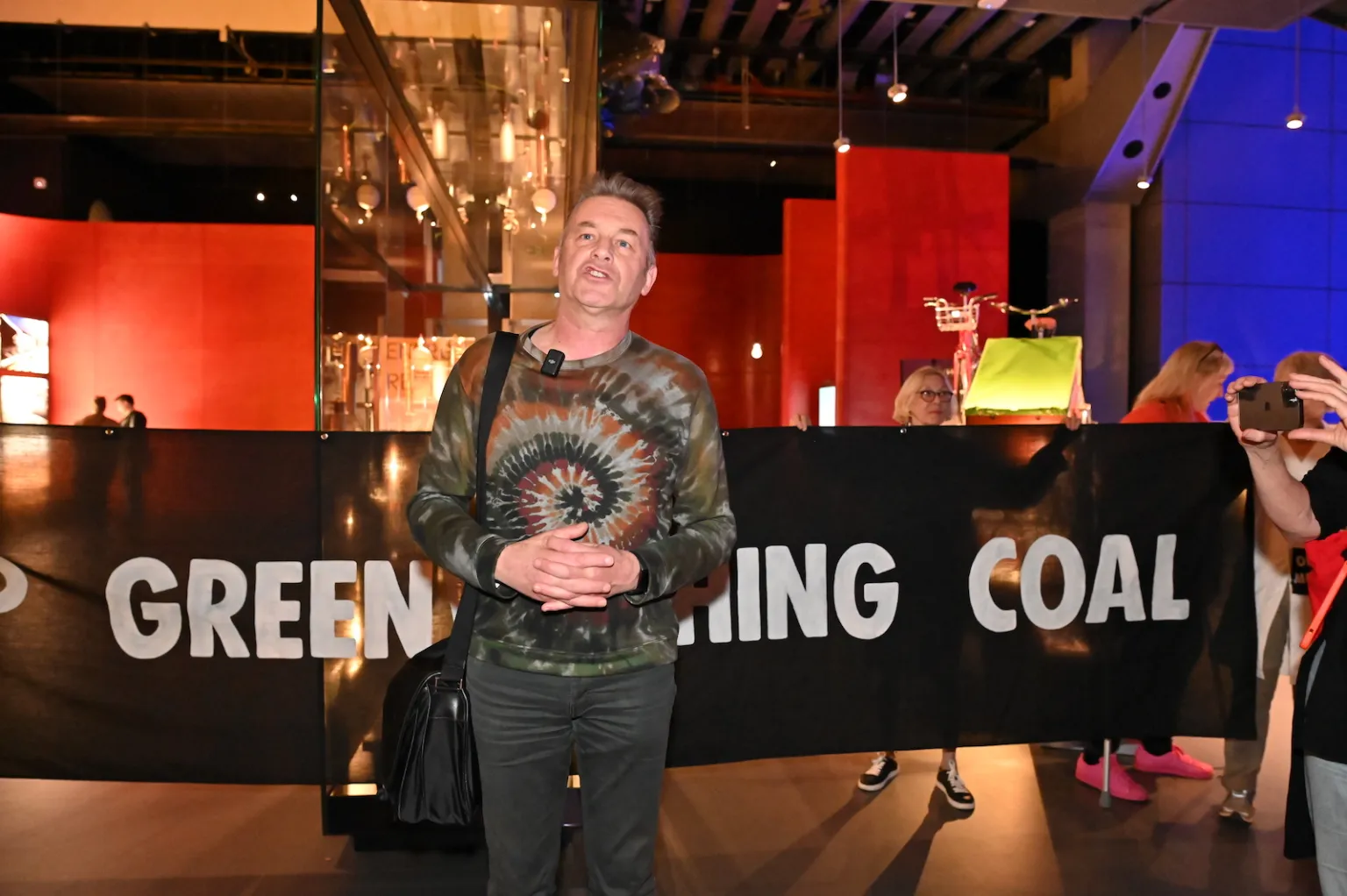
This evening, more than 30 protesters led by young people from Youth Action for Climate Justice and members of Scientists for Extinction Rebellion have occupied the Science Museum’s new climate gallery, Energy Revolution, over its sponsorship by the coal giant and arms manufacturer, Adani. Naturalist and broadcaster Chris Packham joined the group as they began their protest, with scientists and young people now intending to remain in the museum over the weekend, with the first school visits to the gallery beginning on Monday.
Chris Packham, who famously claimed that peacefully breaking the law is the ethically responsible thing to do when it comes to protecting the planet, told the protesters: “For me science is the art of understanding truth and beauty and a lot of that beauty lies in the natural world. Science tells us that the fossil fuel industry is responsible for the accelerating destruction of our natural world. The Science Museum is a place to spark imagination, to provide answers but also to encourage us to ask questions. The question I’m asking today is a big one, “why on earth are we allowing a destructive industry to sponsor an educational exhibition whilst simultaneously setting fire to young peoples futures?” This is beyond greenwash – it’s grotesque. We urgently need an ‘Energy Revolution’ to steer us away from the course of planetary destruction on which we are heading. We need a rapid, just transition to renewables – that revolution means an end to coal, and starts with the young people and scientists occupying this space this evening. Science tells us the truth, and the truth is that we must change.”
Naturalist Chris Packham at the Science Museum occupation 12 April 2024. Image: Extinction Rebellion.
The Energy Revolution gallery opened to the public just a few weeks ago amidst protest, with over 150 people taking part in a day of creative action. A few days earlier, guests arriving for the private VIP launch were greeted by protesters as they arrived, as well as the museum throwing a lavish dinner for the Adani Group’s billionaire chairman, Gautam Adani, with the Adani Group’s logo plastered on screens around the room.
To coincide with today’s protest, activists have released a new video exposing the truth behind the misleading claims made by Gautam Adani during his speech at the opening of the gallery. While he discussed the energy transition from oil and gas, he neglected to mention coal, the industry from which the Adani Group derives 60% of its revenue. The Science Museum has attempted to defend its sponsorship deal by claiming it has only partnered with the Green Energy division, although evidence clearly shows that it is directly linked to Adani’s coal business and that the museum has maintained a relationship with the main Adani Group.
At 2pm on Saturday, the occupiers will invite members of the public to join them for an interactive assembly inside the gallery to discuss alternatives to toxic fossil fuel sponsorship at the Science Museum. The group plans to tell the public the truth about the gallery’s sponsor and the urgency of keeping fossil fuels in the ground for a liveable future. Throughout their occupation, the protesters are also constructing sculptures of fragments of coal as a poignant reminder of Adani’s core polluting business.
Ian McDermott, a Chemistry teacher who will no longer organise school trips to the museum, has said: “For decades I ran a couple of trips to the museum a year, but I just don’t think it’s in the students’ interests to engage with the greenwashing of the companies destroying their futures.”
Protest placard reads Greenwash detected
Adani is the world’s largest private developer of new coal mines and coal-fired power plants, including Australia’s largest, the Carmichael Coal Mine built on Wangan and Jagalingou ancestral land. This ongoing investment in coal mining and power flies in the face of the scientific warning that most fossil fuel reserves cannot be burned and emitted if global warming increase is limited to 1.5°C, or even 2°C above pre industrial levels.
Anya, a young person occupying the gallery said: “To have a coal company sponsoring an exhibition on the future of energy is blatantly deceiving. Through this sponsorship deal, the Science Museum is helping Adani attach itself to the image of a positive and sustainable future when in reality it is a coal giant, weapons manufacturer and genocide supporter. It’s plain wrong for the Science Museum to be deceiving visitors, including young people like me, when it comes to the climate crisis.”
This is not the only instance of the museum welcoming fossil fuel companies to sponsor and influence its science education programmes and galleries. The Museum’s STEM Training Academy, which aims to support teachers in delivering science education, is sponsored by oil and gas giant BP, while the Museum’s interactive children’s gallery is named after Norwegian oil and gas company, Equinor.
Dr. Aaron Thierry, a scientist, who has researched climate impacts in the Arctic, is among those currently occupying the museum: “It’s not just Adani’s brand that the science museum is greenwashing, they’re also allowing the oil and gas giants BP and Equinor to sponsor their exhibits, disregarding the fact that these companies continue to expand fossil fuel production against the warnings of climate scientists. The latest science has shown we must leave the majority of fossil fuels unburned to prevent catastrophic changes to our climate. That an institution like the Science Museum is working with such rouge companies is a disgrace. The museum’s management needs to follow the example of Britain’s other leading cultural institutions and drop all ties to the fossil fuel industry.“
Scientists for Extinction Rebellion and Youth Action for Climate Justice (who have led this action) are members of Fossil Free Science Museum Coalition who are campaigning for the Science Museum to end its sponsorship by fossil fuel companies.
Youth Action for Climate Justice (formerly UKSCN London) is a radical youth organisation mobilising for climate justice. YACJ aims to create a new generation of young activists who are educated about society and the change we need, in order to work with other movements to change the system we live in. The group was previously part of Youth Strike for Climate Movement and coordinated the London youth climate strikes in 2019 and 2020, which brought thousands of young people to the streets of London. Instagram | Twitter
Other groups involved are: International Solidarity for Academic Freedom in India (InSAF India), India Labour Solidarity (UK), Students for Survival; and numerous Extinction Rebellion groups.
Large volumes of mercury, radioactive lead and polonium-210 could be released into the sea if pipelines are left to decay. Photograph: Jane Barlow/PA
Decaying oil and gas pipelines left to fall apart in the North Sea could release large volumes of poisons such as mercury, radioactive lead and polonium-210, notorious for its part in the poisoning of Russian defector Alexander Litvinenko, scientists are warning.
Mercury, an extremely toxic element, occurs naturally in oil and gas. It sticks to the inside of pipelines and builds up over time, being released into the sea when the pipeline corrodes.
Some methylmercury, the most toxic form of the metal, is released by the pipelines although other forms can be converted into it. The international Minamata convention on mercury states that high levels in dolphins, whales and seals can lead to “reproductive failure, behavioural changes and even death”. Seabirds and large predatory fish such as tuna and swordfish are also particularly vulnerable.
Lhiam Paton, a researcher from the Institute for Analytical Chemistry at the University of Graz who has raised the alarm over the mercury pollution, told the Guardian and Watershed Investigations that “even a small increase in mercury levels in the sea will have a dramatic impact on the animals at the top of the food web”.
There are about 27,000km (16,800 miles) of gas pipelines in the North Sea, and scientists predict the amount of the metal in the sea could increase anywhere from 3% up to 160% from existing levels. In some countries, such as Australia, companies are required to remove them when the oil well stops operating. But in the North Sea companies are allowed to leave them to rot away.
BP has scaled back its climate ambitions as it announced that annual profits more than doubled to $28bn (£23bn) in 2022 after a sharp increase in gas prices linked to the Ukraine war boosted its earnings.
In a move that will anger campaigners, the oil and gas giant cut its emissions pledge and plans a greater production of oil and gas over the next seven years compared with previous targets.
The huge annual profit led to renewed calls for a toughened windfall tax, as oil companies reap rewards from higher gas prices while many households and businesses struggle to cope with a sharp rise in energy bills.
…
Kate Blagojevic, Greenpeace UK’s head of climate justice, said: “BP is yet another fossil fuel giant mining gold out of the vast suffering caused by the climate and energy crisis.
“What’s worse, their green plans seem to have been strongly undermined by pressure from investors and governments to make even more dirty money out of oil and gas. This is precisely why we need governments to intervene to change the rules.”