This work by Middle East Monitor is licensed under a Creative Commons Attribution-NonCommercial-ShareAlike 4.0 International License.
People gather during a memorial ceremony held in front of City Theater for students killed in US and Israeli attacks in Minab, Hormozgan province on February 28, in Tehran, Iran on April 6, 2026. [Fatemeh Bahrami – Anadolu Agency]
Iran said Sunday that 942 schools have been damaged in US-Israeli attacks across the country since Feb. 28, Anadolu reports.
Government spokesperson Fatemeh Mohajerani told a press conference that the damaged buildings will need between two and three months to be rebuilt.
The US-Israeli assault also destroyed 125,640 civilian units, including 100,000 homes, 20,500 shops, and 339 health centers, she added.
Mohajerani indicated that rebuilding the damaged civilian units is expected to take between three and 24 months.
She noted that citizens whose homes were damaged in the attacks can take advantage of housing loan opportunities to rebuild their units.
More than 3,000 people have been killed in US-Israeli airstrikes on Iran since Feb. 28. Tehran launched retaliatory strikes on Israel, Iraq, Jordan and Gulf countries hosting US military assets before a two-week ceasefire was announced earlier this week.
Iranian and US delegations concluded 21 hours of talks in Islamabad, Pakistan, early Sunday without reaching an agreement.
This work by Middle East Monitor is licensed under a Creative Commons Attribution-NonCommercial-ShareAlike 4.0 International License.
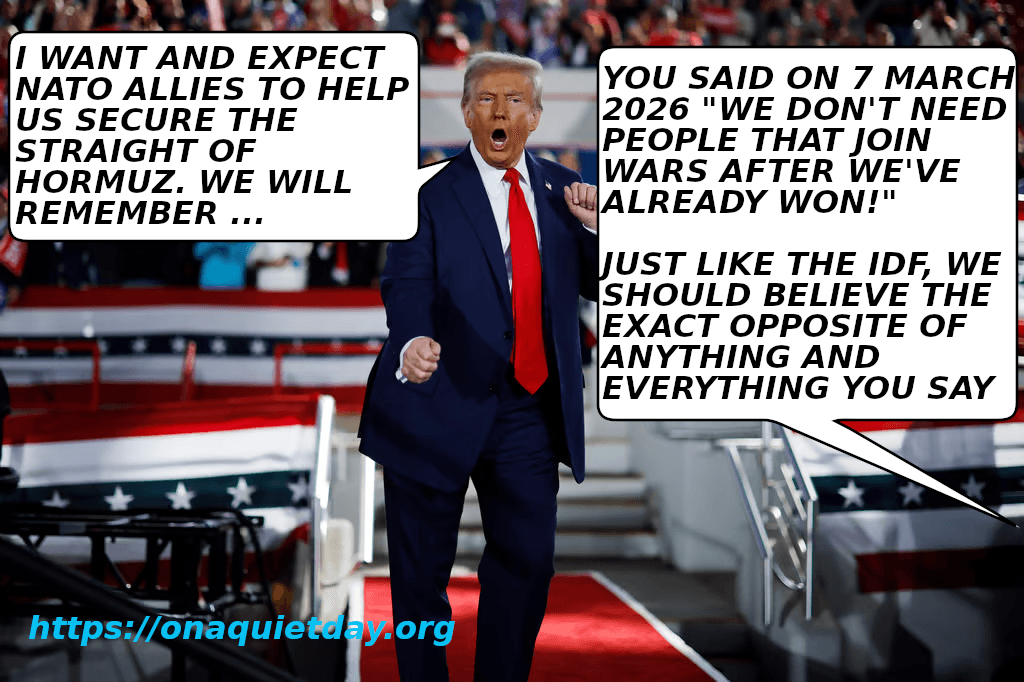
Keir Starmer explains that UK is actively supporting Israel’s genocidal expansion and repeats his previous quotation that he supports Zionism “without qualification”. Keir Starmer said “I said it loud and clear – and meant it – that I support Zionism without qualification.” here: https://www.jewishnews.co.uk/keir-starmer-interview-i-will-work-to-eradicate-antisemitism-from-day-one/Donald Trump calls for help from NATO allies in securing the Straight of Hormuz despite saying on 7 March 2026 that they don’t need people to join wars after they’ve already won. He’s challenged with the claim that he lies as much as the IDF.
Members of the National Education Union (NEU) hold a rally at Old Palace Yard, in Westminster, London, January 29, 2025
…
It is no exaggeration to say, as National Education Union (NEU) leader Daniel Kebede does, that “the classroom has become the front line of every unresolved crisis in our society… hunger walks in with the children. Anxiety takes a seat at the back of the room.”
Schools are community hubs, and their intrinsic links across each community make teachers both receptive to local feeling and persuasive local voices.
So if a union the size of the NEU finds 65 per cent of its members who voted Labour less than two years ago would not do so again, MPs need to take note — especially since every opinion poll confirms this collapse in support for the party is general.
That it also found the most popular party among NEU members is now the Greens is another warning.
The conceit that the working class has nowhere else to go, that Labour can offend every one of its natural constituencies in turn while exclusively courting Tory — and more recently Reform UK — votes, should have died with the Scottish election wipeout of 2015, but remains the default setting of the zombie Blairites — whose long domination of the party has seen a steady decline in its vote, concealed at first by the initial size of the majorities that were shrinking but now threatening its future as a party of government. Peter Mandelson, a key author of that strategy, is gone: can the party escape his influence, and listen again to working-class people instead of the filthy rich?
Keir Starmer says that the Labour Party under his leadership is intensely relaxed about assaulting those least able to defend themselves – the very poorest and most vulnerable.Keir Starmer refuses to be outcnuted by Nigel Farage’s chasing the racist bigot vote.Keir starmer warns against following the https://onaquietday.org blog.
US Rep. Rashida Tlaib (D-Mich.) speaks during a press conference with families of Americans killed by Israeli forces on September 16, 2025, in Washington DC. (Photo by Celal Gunes/Anadolu via Getty Images)
“We are witnessing the same genocidal playbook used against Palestinians in Gaza, now in Lebanon,” Rep. Rashida Tlaib said.
As Israel ramps up its devastating invasion of Lebanon, Rep. Rashida Tlaib has introduced legislation in the US House of Representatives aimed at blocking US support.
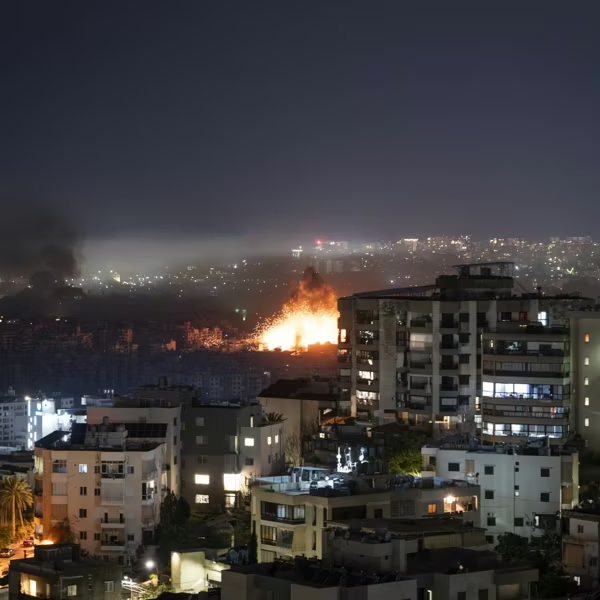
Israel’s latest onslaught against Lebanon, launched after the militant group Hezbollah retaliated against the joint US-Israeli attack against Iran at the end of February, has already killed more than 1,100 people, including at least 121 children, according to the Lebanese Health Ministry.
Many pieces of civilian infrastructure—including hospitals, schools, and residential buildings—have been attacked, and Israel has issued forced evacuation orders that have led more than 1 million people to be displaced from their homes.
“Thousands of families in our district with strong ties to Lebanon are living through immense pain,” said Tlaib, who represents a district that includes parts of Detroit and surrounding suburbs. “Many have lost loved ones, watched their grandparents’ towns and villages be completely destroyed, and seen relatives uprooted from their homes, not knowing if they will ever be able to return.”
Tlaib (D-Mich.), the only Palestinian-American member of Congress, introduced two resolutions on Friday. The first calls on the US to use its leverage to end Israel’s land and air assaults against Lebanese territory, denounce efforts at territorial expansion, and investigate alleged crimes against humanity.
The second, cosponsored by Reps. Delia Ramirez (D-Ill.) and Nydia Velázquez (D-NY), is a war powers resolution that would require President Donald Trump to remove US forces from participation in all military actions in Lebanon that have not been authorized by Congress.
I'm introducing two resolutions standing with the people of Lebanon against the U.S.-backed Israeli invasion. The first resolution calls on the United States to force an end to the Israeli military invasion, reject threats of the illegal occupation of Lebanese territory,… pic.twitter.com/qgrtNhOkxq
— Congresswoman Rashida Tlaib (@RepRashida) March 27, 2026
In recent days, Israel has expanded its ground operation, aiming to control the entire territory south of the Litani River indefinitely. Leaders of the military campaign, such as Defense Minister Israel Katz, have suggested using the genocidal war in Gaza as a “model” for Lebanon, including the full destruction of residential areas.
“We are witnessing the same genocidal playbook used against Palestinians in Gaza, now in Lebanon,” Tlaib said. “Israeli leaders are openly celebrating it. This ethnic cleansing campaign is only possible because of US support, funded by our tax dollars. We must act now to stop these crimes against humanity and illegal invasion of Lebanon.”
Nathan Thompson, a senior analyst at Just Foreign Policy, which advised Tlaib on the legislation, told Common Dreams that although the US military and Israel Defense Forces (IDF) are “deeply operationally integrated, and have only become more so since October 7, 2023,” the extent of direct US involvement in Lebanon has been kept secret from the public.
“Military officials wouldn’t say whether or not they provided targeting assistance for Israel’s airstrikes on Hezbollah in 2024, and that’s exactly the type of action Congress has considered to be unauthorized ‘hostilities’ under the War Powers Act in the past,” Thompson said.
However, he said, “We know that the IDF and the US military are linked at the hip—on weapons sales, missile defense, targeting assistance, everything.”
Tlaib’s resolutions come as another war powers resolution to limit Trump’s ability to launch more attacks against Iran appears to have gained enough support to pass the House, although Democratic leadership has chosen to delay the vote until mid-April despite warnings that Trump may soon dramatically escalate the war, including with US ground troops.
That bill remains viable due to limited Republican support, including from Reps. Thomas Massie (Ky.), Warren Davidson (Ohio), and Nancy Mace (SC). While Massie has been a consistent anti-war vote, it’s unclear whether other Republicans, as well as some pro-Israel Democrats, would similarly sign onto a resolution concerning Lebanon.
Thompson said the Lebanon-related legislation is an “urgently necessary tool to end US complicity” as Israeli officials are “talking about functionally annexing southern Lebanon and recreating Gaza-level destruction there.”
He said, “A war powers vote forces all of Congress to go on the record: Do you want the US to enable this genocide, or not?”
Keir Starmer objects to criticism of the IDF. He asks how could anyone object to them starving people to death, forced marches like the Nazis did, bombing Gaza’s hospitals and universities, mass-murdering journalists, healthworkers and starving people queuing for food, killing and raping prisoners and murdering children. He calls for people to stop obstructing his genocide for Israel.
Smoke is seen billowing skyward during US-Israeli bombing of Tehran, the Iranian capital, on March 1, 2026. (Photo by Fatemeh Bahrami/Anadolu via Getty Images)
“This is carpet-bombing, which has struck everything from playgrounds, to an emergency services HQ, schools, media buildings, and medical facilities,” said one observer.
US and Israeli forces were accused Monday of “seemingly indiscriminate” bombing of Iran as the country’s Red Crescent said that at least 555 people have been killed amid reports of fresh mass casualty attacks across the country.
The Iranian Red Crescent Society said at least 555 people have been killed so far during three days of a US and Israeli war of choice aimed at toppling Iran’s long-ruling Islamist government. US Secretary of State Marco Rubio on Monday continued to insist that the war is not about regime change, but rather enduring yet bogus claims that Iran is close to developing nuclear weapons.
Those killed include many civilians as well as former Iranian Supreme Leader Ayatollah Ali Hosseini Khamenei and dozens of senior government and military officials. Iranian counterattacks have killed half a dozen US troops, 9 Israelis, and a handful of people in Gulf nations allied with the United States.
An attack on the Abbasabad Police Station—where anti-government protesters were allegedly tortured during the recent deadly crackdown—in Niloofar Square in central Tehran killed at least 20 people, local media reported.
“This is carpet-bombing, which has struck everything from playgrounds, to an emergency services HQ, schools, media buildings, and medical facilities,” documentary filmmaker Robert Inlakesh said in a social media post showing the aftermath of the strike.
Local residents said that the site was attacked for the second time in three days. This was part of broader US-Israeli strikes on Tehran, including attacks on the Revolutionary Court, Defense Ministry, other government sites, and civilian infrastructure including at least eight medical facilities and state media outlets.
Carpet bombing in Iran is stark reminder of how air superiority shapes modern warfare. In May 2025, Pakistan faced similar escalation from India—yet credible air defense and a combat-ready air force altered strategic calculus decisively. Invest in air power, instead of proxies! pic.twitter.com/H3rx2tYS7T
Video footage of another attack on central Tehran—this one in Ferdowsi Square—showed devastation from what political analyst Trita Parsi called “seemingly indiscriminate” bombing.
“Increasingly, Israel and the US appear to be following the Gaza playbook, having failed to achieve a quick regime implosion,” Parsi said on social media.
Parsi also shared video of a distraught woman who described an apparent so-called “double-tap” strike, a common tactic used by the US, Israel, and other militaries in which an initial bombing is followed up with a second one in a bid to kill and injure survivors and first responders.
“They killed everyone,” the woman said of the attackers. “They dropped the first bomb, then when people went to help, they dropped another bomb.”
Local and international media reported at least 35 people killed in multiple attacks on targets in the southern Fars province, which neighbors Hormozgan province, where the deadliest massacre of the young war took place on Saturday. Officials said at least 175 people—mostly children—were killed in a strike on the Shajareh Tayyebeh girls’ elementary school in Minab.
Several hours later, a missile strike on a gymnasium in Lamerd, Pars province, where dozens of teenage girls were playing sports reportedly killed at least 18 people.
“Like the destruction of the school in Minab, basic protections to safeguard the lives of civilians in war either failed or were disregarded, leading to catastrophic loss among Iran’s civilian population,” the National Iranian American Council said in a statement Monday.
There is serious evidence of war crimes against the Iranian people in only three days of war, including bombings of protected civilian sites including hospitals and schools.
NIAC demands a full, independent investigation and a halt to this illegal war. https://t.co/zZTSZwxJa5
Iranian Red Crescent chief Pirhossein Kolivand said in a video posted on social media Sunday that “the Minab school incident has no comparison with any other incident, even in Gaza.”
Comparisons with Gaza—where Israel’s genocidal assault has left more than 250,000 Palestinians dead, maimed, or missing since October 2023 and the coastal strip in ruins—have been numerous.
Condemning what it called the “barbarous” and “treacherous” US-Israeli attacks on Iran, Hezbollah, the Lebanon-based resistance group targeted by Israel during the Gaza war, said, “This aggression confirms the full and direct partnership between America and Israel in planning and execution, not only in the war against the Islamic Republic, but also in all the wars and crimes the region is facing, in Gaza, Lebanon, Syria, and Yemen.”
Ori Goldberg, an Israeli political analyst, said that, in Israeli society, “there’s a sense of triumphalism, of having attacked an enemy regime.”
“Not really because we’re greatly invested in the future of the Iranian people, but because, through the genocide on Gaza, we’ve devalued human life,” he added.
Parsi said that “Israel appears to be going Gaza on Iran.”
The renewed US and Israeli attacks on Iran follow last year’s limited war on the country that left thousands of Iranians dead or wounded, including at least 436 civilians killed and over 2,000 others injured, according to officials and activists.
Addressing the Minab school strike, UNESCO—the UN’s educational, scientific, and cultural agency—said that “the killing of pupils in a place dedicated to learning constitutes a grave violation of the protection afforded to schools under international humanitarian law.”
UN Messenger of Peace and Nobel Peace laureate Malala Yousafzai asserted that “all states and parties must uphold their obligations under international law to protect civilians and safeguard schools,” adding that “every child deserves to live and learn in peace.”
In the United States—where Democratic and a handful of Republican lawmakers are reportedly drafting a war powers resolution in a bid to rein in President Donald Trump’s aggression—Rep. Rashida Tlaib (D-Mich.) took to social media to note the “over 555 Iranians already killed by US-Israeli bombs, including at least 165 at a girls’ elementary school.”
“At least four US service members are dead,” she also wrote, before that figure rose to six. “Any member of Congress who votes against the war powers resolution is voting for more of this.”
The Not Above the Law coalition was among the civil society groups urging Congress to pass an Iran war powers resolution.
“President Trump has launched deadly military strikes against Iran without congressional approval, in flagrant violation of the Constitution,” the coalition’s co-chairs said Monday. “Article I, Section 8 is crystal clear: Only Congress can declare war. Yet Trump has secured neither a declaration of war nor congressional authorization for military force.”
“Trump’s reckless unilateral action puts American lives and global security at risk while trampling the foundational principle that no president is above the law,” Not Above the Law added. “Congress must act immediately. Pass war powers resolutions to reject this unconstitutional power grab and reassert its authority over matters of war and peace. The rule of law demands it.”
Orcas discuss Donald Trump and the killer apes’ concept of democracy. Front Orca warns that Trump is crashing his country’s economy and that everything he does he does for the fantastically wealthy.Donald Trump explains why he established his Bored of PeaceOrcas discuss rotting brain. Front Orca says “Wish someone would lock him up”.
This work by Middle East Monitor is licensed under a Creative Commons Attribution-NonCommercial-ShareAlike 4.0 International License.
Gustavo Petro, Colombia’s president, during the United Nations General Assembly (UNGA) in New York, US, on Tuesday, Sept. 23, 2025. [Photographer: Michael Nagle/Bloomberg via Getty Images]
In one of the most daring and controversial political interventions to echo through the halls of the United Nations in decades, Colombian President Gustavo Petro, in his address to the UN General Assembly on 23 September 2025, called for the creation of an international army that transcends the traditional balance of power and whose first mission would be the liberation of Palestine from Israeli occupation and the cessation of the ongoing genocide in Gaza.
The speech drew widespread global attention, opening the door to a complex debate on the future of the international order, the limits of international law, and the possibility of a fundamental transformation toward a new architecture of international relations that moves beyond bipolarity and the centrality of U.S. power.
Petro: The end of words and the beginning of action
In his speech, President Gustavo Petro sharply criticised the current international order, asserting that a world dominated by a single power and complicit in genocide cannot credibly claim to defend democracy or human rights. He emphasised that statements and declarations are no longer sufficient amid the mass killings in Gaza, calling for the creation of an international armed force composed of states that reject genocide, tasked with protecting threatened populations and enforcing international justice. Petro declared: “We need a strong army of nations that do not accept genocide… We must gather weapons and armies. We must liberate Palestine.”
Invoking Simón Bolívar, he added: “We are tired of words… It is time for the sword of liberty or death.”
In later remarks posted on X (formerly Twitter), Petro announced plans to submit a draft resolution to the UN General Assembly to establish a “global army for justice,” with its first mission focused on liberating Palestine,” marking a dramatic call for action over [sic]
Petro’s proposal marks a significant shift in international political discourse. Since the UN’s founding in 1945, international forces have primarily focused on post-conflict peacekeeping, operating under limited mandates and with Security Council approval. Petro, however, envisions a force designed not to maintain the status quo but to actively change it, intervening militarily to prevent genocide and end occupation. This transition from neutrality to action challenges core principles of international law, including state sovereignty and non-intervention, while contesting the Security Council’s monopoly, particularly its five permanent members, over the authorised use of force. Petro suggested that such a force could be established through the General Assembly, referencing the 1950 “Uniting for Peace” resolution, when the Assembly bypassed a deadlocked Security Council to authorize military intervention in Korea, setting a precedent for acting when conventional mechanisms fail.
Enormous political and legal obstacles
Despite Petro’s bold proposal, formidable obstacles make its near-term realization highly unlikely. The UN’s legal framework restricts the use of force to the Security Council, where the US holds veto power and would never allow the creation of a force that could act against Israel, its key Middle Eastern ally. Geopolitical realities also hinder the formation of a global coalition outside the Western security umbrella. Even countries critical of Israeli policies, including EU members and Global South states, may resist joining a force that risks direct confrontation with Israel or the U.S Additionally, there is a significant lack of collective political will: while smaller and medium-sized states often use strong rhetoric, turning such words into military action demands a consensus that is currently absent. Past struggles to reform the Security Council or establish war crimes tribunals underscore how difficult it is to translate ambitious ideas into action within today’s entrenched power structures.
The significance and timing of Petro’s speech
Despite significant practical obstacles, Petro’s speech carries profound symbolic and political weight in shaping global discourse on Palestine and the international order. He reframes the Palestinian issue from a mere “conflict” to an act of “genocide,” shifting the debate from political negotiation to one centered on liberation and international justice. His references to “Bolívar’s sword” and an “army of justice” seek to place Palestine at the core of a broader struggle against double standards and for global legitimacy.
Moreover, Petro’s call sparks renewed debate on reforming the United Nations. Beyond advocating for a force dedicated to Palestine, he highlights the failure of the current system to prevent genocides in Rwanda, Syria, Myanmar, and now Gaza. The proposed army thus symbolizes a deeper demand for rebuilding the international order on fairer, more pluralistic foundations.
Finally, the speech underscores a shift within the Global South. From Colombia to South Africa and Brazil, states on the geopolitical periphery are increasingly using the UN stage to challenge the Global North’s dominance and redefine concepts of legitimacy. Petro’s message aligns with this momentum, adding new strategic depth to the Palestinian cause within emerging international alliances.
President Petro’s speech comes at a critical moment, as Gaza endures one of the most brutal Israeli military campaigns since the Nakba. UN agencies and human rights organizations, including OCHA, Oxfam, and Human Rights Watch, report the killing of tens of thousands of civilians and the widespread destruction of vital infrastructure, including hospitals, schools, and relief centers. The UN has also documented the deaths of hundreds of humanitarian workers, in what international organizations describe as the largest targeting of the humanitarian sector in modern conflict.
In this context, Petro’s speech becomes more than a theoretical proposal, it is a cry against a world that remains silent in the face of genocide. His call to form an “army of justice” is, at its core, an expression of the failure of the international system to fulfill its most fundamental duty: protecting civilians and enforcing international law.
And while the idea may be unattainable at present, it exposes the glaring gap between the UN’s rhetoric and its reality, opening the door to rethinking the mechanisms of collective international action.
Conclusion
President Petro’s project to form an international army to liberate Palestine may seem, in the realpolitik balance, a utopian dream difficult to achieve amid current power dynamics. Yet, in the realm of symbolic and strategic politics, it reflects a profound shift in how international justice, Palestine, and the global order itself are conceived.
The speech will not change the world tomorrow, but it could mark a turning point in a longer trajectory toward reshaping international institutions so that they are capable of confronting genocide and injustice. And just as Simón Bolívar’s words once ignited the liberation of entire continents, President Petro’s speech may, even if only in the long run, be the spark that drives the world to contemplate a global army for justice, one whose first mission would begin in Gaza, if Gaza, as we know it, still exists.
The views expressed in this article belong to the author and do not necessarily reflect the editorial policy of Middle East Monitor.
Genocide denier and Current UK Prime Minister Keir Starmer is quoted that he supports Zionism without qualification. He also confirms that UK air force support has been essential in Israel’s mass-murdering genocide. Includes URLs https://www.declassifieduk.org/keir-starmers-100-spy-flights-over-gaza-in-support-of-israel/ and https://youtu.be/O74hZCKKdpAKeir Starmer objects to criticism of the IDF. He asks how could anyone object to them starving people to death, forced marches like the Nazis did, bombing Gaza’s hospitals and universities, mass-murdering journalists, healthworkers and starving people queuing for food, killing and raping prisoners and murdering children. He calls for people to stop obstructing his genocide for Israel.Vote Labour for Genocide.