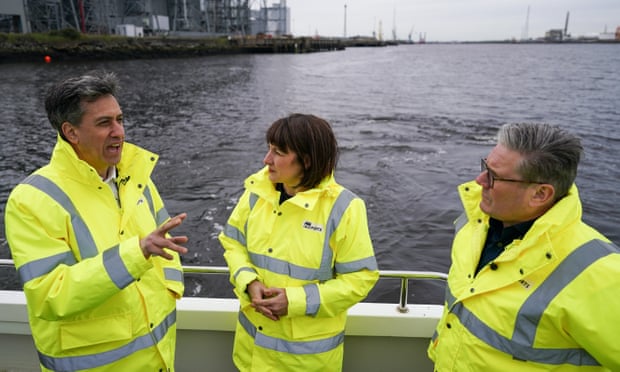
Ed Miliband, Rachel Reeves and Keir Starmer visit Teesside, the location of a proposed multibillion-pound carbon capture and storage project. Photograph: Ian Forsyth/Getty Image
Letter says technologies to produce blue hydrogen and capture CO2 are unproven and could hinder net zero efforts
Leading climate scientists are urging the government to pause plans for a billion pound investment in “green technologies” they say are unproven and would make it harder for the UK to reach its net zero targets.
Labour has promised to invest £1bn in carbon capture, usage and storage (CCUS) to produce blue hydrogen and to capture carbon dioxide from new gas-fired power stations – with a decision on the first tranche of the funding expected imminently.
However, in the letter to the energy security and net zero secretary, Ed Miliband, the scientists argue that the process relies on unproven technology and would result in huge emissions of planet-heating CO2 and methane – gases that are driving the climate crisis.
“We strongly urge you to pause your government’s policy for CCUS-based blue hydrogen and gas power, and delay any investment decision … until all the relevant evidence concerning the whole-life emissions and safety of these technologies has been properly evaluated,” they write.
The letter, which is signed by leading climate scientists from the UK and US as well as campaigners, argues the plans would:
Lock the UK into fossil fuel production for generations to come.
Result in huge upstream emissions from methane leaks, transport and processing of liquefied natural gas (LNG) from the US.
Rely on carbon capture and storage (CCS) during the production of hydrogen – technology they say has been abandoned in the vast majority of similar projects around the world.
Pose a danger to the public if there are any leaks from pipes carrying the captured carbon. At least 45 people had to be taken to hospital after a leak in the US.
Original article by Ed Siddons republished from TBIJ under a Creative Commons Attribution-NonCommercial-NoDerivs 3.0 Unported License.
The number of civil tax avoidance leads looked into by HMRC’s Fraud Investigation Service has fallen by almost half in five years, while the number of civil cases it has formally opened has decreased by more than a quarter.
These figures, obtained by the Bureau of Investigative Journalism (TBIJ) under Freedom of Information laws, raise questions about the tax authority’s performance since the start of the pandemic.
The findings follow revelations by TBIJ and the Observer in September that prosecutions following HMRC investigations plummeted by two thirds in five years. TBIJ then revealed in January that HMRC has not charged a single company under a landmark 2017 law to clamp down on corporate tax evasion.
The new figures suggest that the tax authority’s civil enforcement has also declined alongside its use of criminal powers.
Margaret Hodge MP called on HMRC to “finally crack down on egregious tax avoidance and collect the revenues we desperately need”.
In the tax year of 2018/19, HMRC’s Fraud Investigation Service opened 37,273 “risks”, a term used to describe a preliminary inquiry into suspected error or false declaration. In 2022/23, that figure fell to just 21,338 – a 43% decline in five years.
The number of civil cases that were formally opened fell by 28% in the same period, from 17,424 to 12,585.
“The new revelations that HMRC is failing to make up for [declining numbers of criminal prosecutions] by undertaking more civil investigations is just disgraceful,” said Hodge. “These consecutive failures mean tax dodgers and their enablers can continue getting away scot-free.”
Stephen Daly, senior lecturer in corporate law at King’s College London, said: “[The number of] investigations has fallen off a cliff, and that can’t be good … If you don’t enforce the rules, then you create a culture in which people don’t have to worry about their tax returns later being checked.”
Civil inquiries and investigations declined sharply in 2020, when the Covid-19 pandemic interrupted HMRC’s enforcement activity. But despite a significant rise last year, the number of cases remains well below pre-pandemic levels. “If, in fact, this isn’t explained by Covid, then it’s unacceptable,” said Daly.
A HMRC spokesperson told TBIJ that figures relating to its Fraud Investigation Service “do not take account of our overall compliance activity”, including 300,000 interventions opened in 2022/23. They said the authority has recouped £136bn from compliance interventions since 2018/19.
Easy targets?
As well as the general decline in civil cases opened by HMRC’s fraud unit, the number opened by its team for investigating offshore, corporate and wealthy taxpayers has fallen especially steeply, by 56% in five years.
“Even when [HMRC is] opening civil cases, they appear to be going after the easier, lower value targets,” said Fiona Fernie, a partner at tax advisory firm Blick Rothenberg.
Last year, HMRC reached one of its highest ever tax settlements when former F1 mogul Bernie Ecclestone paid £650m after pleading guilty to tax fraud – but that success was “the exception, not the rule”, said Fernie.
Part of the problem is that the UK has an increasingly complex tax code, which makes enforcement action difficult, she said. “The staff are under considerable pressure, we get an increasingly complicated system every year, [and] it’s very difficult to get anybody to keep up with it.”
Robert Palmer, executive director of Tax Justice UK, said another issue was lack of resources. “We know HMRC is underfunded and resources have been diverted for work on Covid and Brexit,” he said.
HMRC estimates that it collects 95% of all the tax owed in the UK, a proportion it says has remained stable in recent years. However, it estimates that the remaining 5% still accounts for about £36bn.
“Parliamentary research shows that when the government invests in HMRC, the return on investment is significant. Until the department is properly funded, vast sums of money owed, often by the richest people and companies, will go unrecovered,” said Palmer.
The Public Accounts Committee last year found that for every £1 spent on compliance, HMRC recovers £18 in additional tax revenue. “The government is missing the opportunity to recover billions in lost revenue by not resourcing compliance,” it said.
Original article by Ed Siddons republished from TBIJ under a Creative Commons Attribution-NonCommercial-NoDerivs 3.0 Unported License.
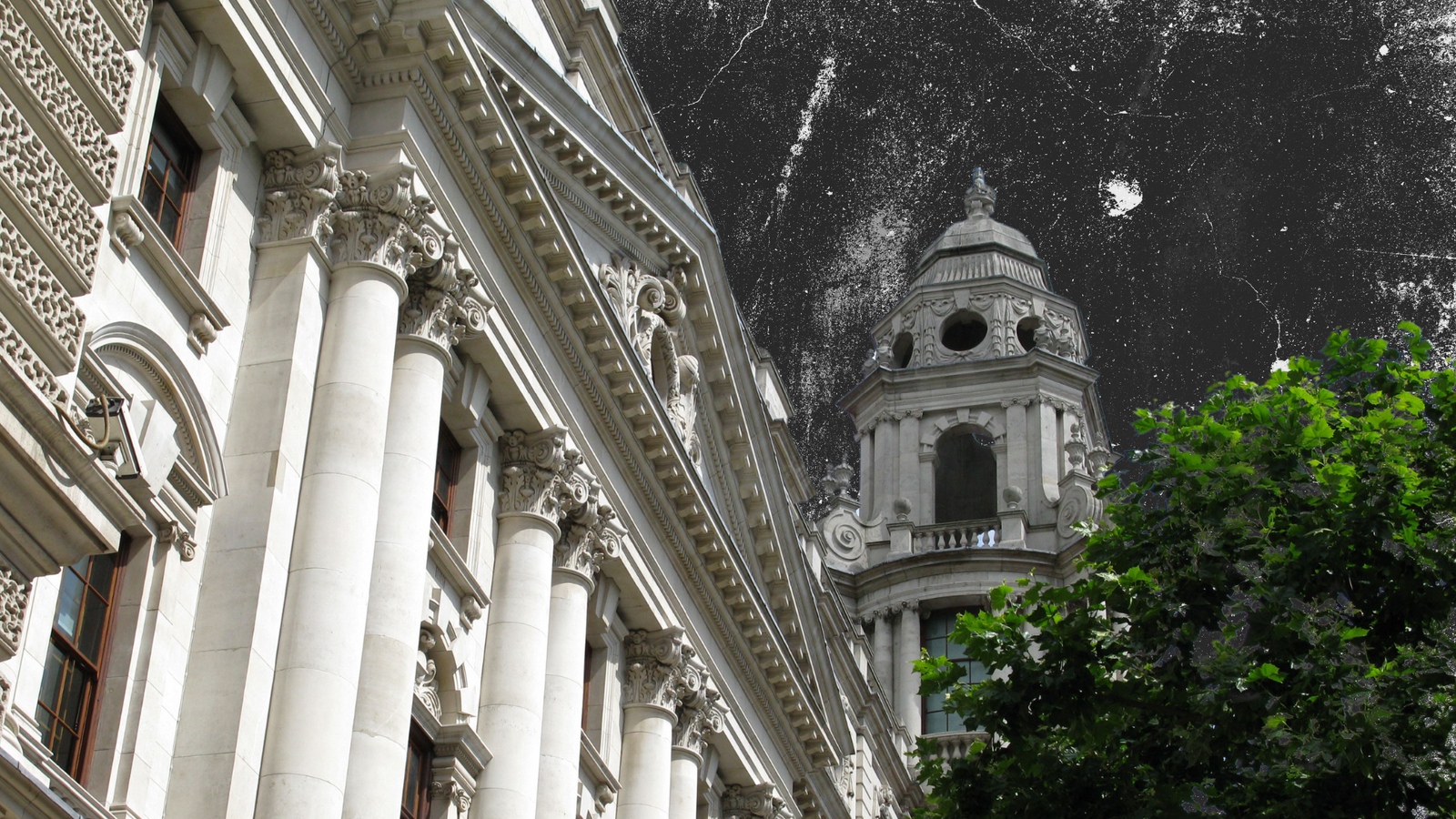
Lead image: Her Majesty’s Revenue and Customs building, London. Credit: Ian Bottle/Alamy Stock Photo
The government has been defeated in court – for a second time – for not doing enough to meet its targets for cutting greenhouse gas emissions.
Environmental campaigners argued that the energy minister signed off the government’s climate plan without evidence it could be achieved.
The High Court ruled on Friday that the government will now be required to redraft the plan again.
In response the government defended its record on climate action.
A Department for Energy Security and Net Zero spokesperson said: “The UK can be hugely proud of its record on climate change. We do not believe a court case about process represents the best way of driving progress towards our shared goal of reaching net zero.”
The legal challenge was brought by environmental groups Friends of the Earth, ClientEarth and The Good Law Project.
Tony Bosworth, lead campaigner at Friends of the Earth, said it was “an embarrassing day for the government”.
Speaking outside the court to BBC News he said: “What we now need to see is a climate plan which is robust, which is comprehensive and which is fair, which makes sure we meet all our climate targets, and which does that in a way which doesn’t leave anybody behind.”
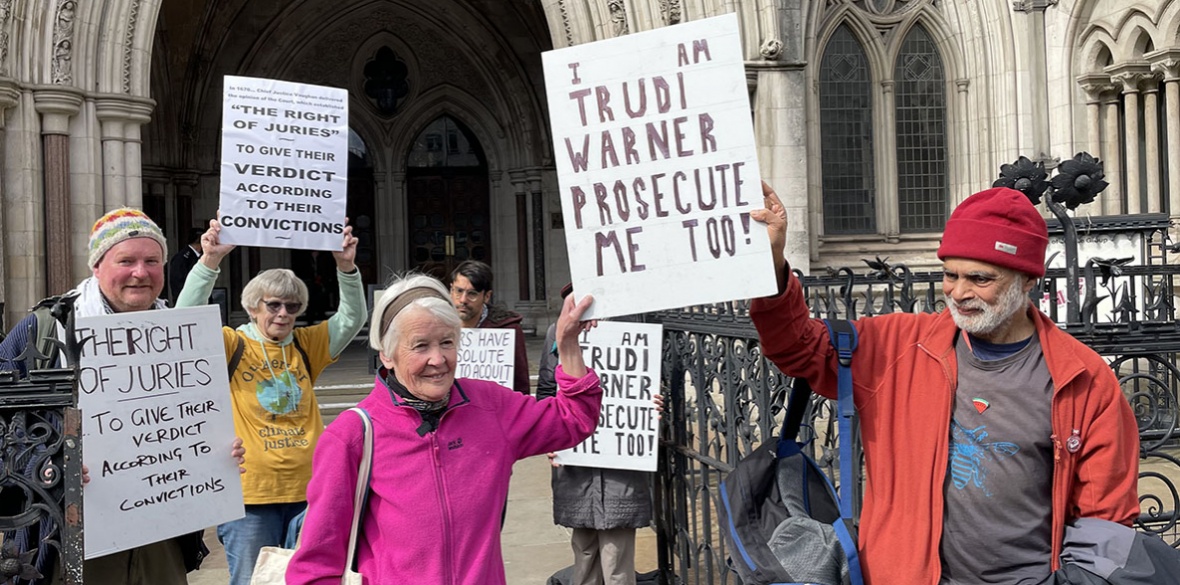
Trudi Warner with supporters outside the Royal Courts of Justice in London, April 18, 2024
A HIGH COURT judge has refused to allow contempt proceedings against a retired social worker who held up a sign outside a court where Insulate Britain activists were due to be tried.
Trudi Warner, from Walthamstow, East London, told of her relief following today’s ruling.
She was arrested on March 27 last year and accused of “deliberately targeting” the jury by holding up a placard outside an entrance used by jurors at Inner London Crown Court.
The sign read: “Jurors you have an absolute right to acquit a defendant according to your conscience.”
Rendering judgement at the Royal Courts of Justice, Mr Justice Saini said he would not give the Solicitor General permission to pursue proceedings against Ms Warner as she had “accurately informed potential prospective jurors about one of their legal powers.”
…
“The proper forum for the Solicitor General to address this concern is Parliament, not by way of contempt proceedings,” he said.
Sir Lindsay Hoyle MP was elected Speaker of the House of Commons in November 2019.
The fact that Westminster is content to play cynical games while Palestinians suffer is beneath contempt writes Lindsey German
The shameful scenes in parliament where Labour manoeuvred to stop a principled motion calling for immediate ceasefire in Gaza are bad enough. But even worse is the justification of many Labour MPs for the coercion of the Speaker: that they were fearful of intimidation and violence from demonstrators over Gaza.
Firstly, this is a lie: the protests that take place at MPs’ offices are overwhelmingly peaceful and no threat to MPs or their staff. They are a longstanding and valid form of expressing disagreement and concern over issues in a democracy. But such is the state of politics in Britain that they are now equated with intimidation of MPs. Perhaps these MPs – highly salaried and privileged in comparison with most of their constituents – should have reflected when they stood for office that being involved in politics of necessity involves disagreement and controversy at certain times.
There is a huge movement in support of the Palestinians across Britain and real anger that politicians have for the most part stood by as we witness a genocide in Gaza. None of these protests would take place if the MPs concerned had taken the very minimal step of backing an immediate ceasefire.
But there is also a second and more important question: why MPs are so self-centred to highlight the minimal inconvenience to them while people are starving in Gaza, while over 12,000 children have been killed and where the population is being ethnically cleansed? And why did the Labour leadership refuse to accept an amendment which talked about the collective punishment of the people of Gaza? The Labour position on Gaza has been a disgrace from the beginning and this is why they are facing a wave of protest.
The fact that they are trying to demonise protestors and to paint them as violent extremists shows their political and moral bankruptcy. The fact that they are content to play their cynical and pathetic games while the Palestinians suffer is beneath contempt.