‘This Is Unprecedented’: Several Horrific Wildfires Ravage Los Angeles

Spread the love

Original article by Jake Johnson republished from Common Dreams under Creative Commons (CC BY-NC-ND 3.0).

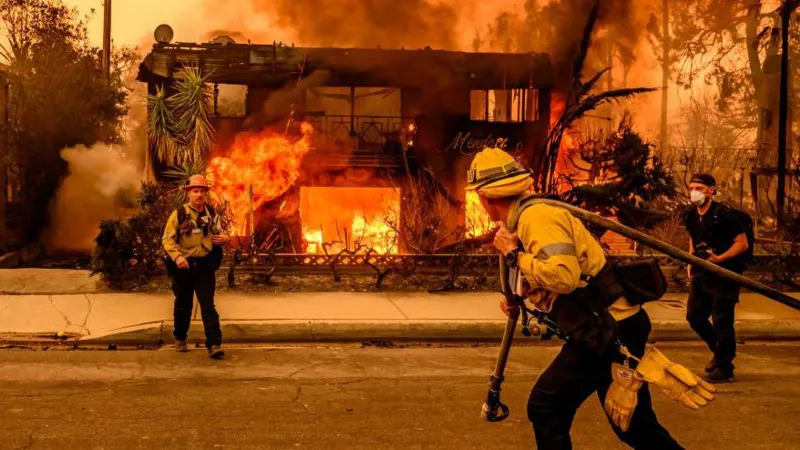
Flames from the Palisades fire burn homes on January 7, 2025 in the Pacific Palisades neighborhood of Los Angeles, California. (Photo: Eric Thayer/Getty Images)

“There is no ‘firefighting’ in these kinds of conditions,” said one meteorologist. “There is only saving as many lives as possible and getting the heck out of the fire’s way.”

Several major wildfires burned out of control in California’s Los Angeles County on Wednesday as roaring winds fueled the rapid spread of the blazes, forcing tens of thousands to evacuate as state, local, and federal officials mobilized resources to confront the emergency.

Los Angeles Mayor Karen Bass wrote on social media late Tuesday that the city is “working aggressively” to stem the wildfires, which scientists and government officials characterized as uniquely devastating.

“Emergency officials, firefighters, and first responders are all hands on deck through the night to do everything possible to protect lives,” California Gov. Gavin Newsom said early Wednesday. The governor noted that more than 1,400 firefighting personnel have been deployed to “combat these unprecedented fires.”

The PalisadesEaton, and Hurst fires broke out on Tuesday. It quickly exploded amid what the National Weather Service described as “extremely critical fire weather,” with wind gusts up to 99 mph propelling the devastating blazes. The extreme winds forced emergency crews to ground aircraft that were working to contain the fires.

“For some context, fire crews are up against near hurricane-force winds occurring mid-winter in rugged terrain during a drought at night,” wrote meteorologist Eric Holthaus. “There is no ‘firefighting’ in these kinds of conditions. There is only saving as many lives as possible and getting the heck out of the fire’s way.”

“The emergence of extreme wintertime wildfires in California presents one of those classic ‘this is climate change’ moments.”

The Eaton fire, which broke out Tuesday evening in the Pasadena area, “spread so rapidly that staff at a senior living center had to push dozens of residents in wheelchairs and hospital beds down the street to a parking lot,” The Los Angeles Times reported.

“The residents waited there in their bedclothes as embers fell around them until ambulances, buses, and even construction vans arrived to take them to safety,” the newspaper added.

The three fires have together burned thousands of acres so far and destroyed or endangered tens of thousands of homes and buildings, according to Newsom’s office. So far, at least 19 school districts have announced complete or partial closures due to the fires.

Video footage posted to social media showed residents watching in horror as flames surrounded their homes:

https://twitter.com/i/status/1876845562328146405

Sorry, this content could not be embedded.
X

Another video shows residents attempting to salvage as many belongings as possible before fleeing:

https://twitter.com/i/status/1876845004745748780

Sorry, this content could not be embedded.
X

“There has been a recent massive increase in wildfires in California but really, a fire this big in January? This is unprecedented,” scientist Hayley Fowler wrote on social media. “One of many extreme events fueled by the climate crisis.”

Holthaus wrote Tuesday that Southern California is “facing a rare and dangerous juxtaposition of extreme winds and midwinter drought,” the meteorologist described as “a worrying example of the state’s expanding wildfire threat as climate change worsens.”

“The National Weather Service defines ‘extremely critical’ fire weather as sustained winds over 30 mph and relative humidity of less than 10% in drought conditions and temperatures warmer than 70 degrees,” Holthaus observed. “This is the first time in history these criteria have been met anywhere in the United States during January.”

“The emergence of extreme wintertime wildfires in California,” he added, “presents one of those classic ‘this is climate change’ moments: A specific set of weather conditions are now occurring in such a way to produce the potential for rare disasters to become much more common.”

Original article by Jake Johnson republished from Common Dreams under Creative Commons (CC BY-NC-ND 3.0).

Continue Reading‘This Is Unprecedented’: Several Horrific Wildfires Ravage Los Angeles

Humanity’s Chance to Reverse Amazon’s Slide Toward Tipping Point Is ‘Shrinking’

Spread the love

Original article by Eloise Goldsmith republished from Common Dreams under Creative Commons (CC BY-NC-ND 3.0).

This aerial view shows Amazon forest degradation in the Menkragnoti Indigenous Territory in Altamira, Pará state, Brazil, on August 28, 2019. (Photo: Joao Laet/AFP/Getty Images)

The world’s largest rainforest showed “ominous indicators,” including wildfires and extreme drought, in 2024.

The Amazon, sometimes called the “lungs of the planet,” this year showed signs of further inching toward a much-feared tipping point, threatening the very existence of the world’s largest rainforest.

Rampant wildfires and extreme drought ravaged large parts of the Amazon in 2024. The fires and dry conditions were fueled by deforestation and the El Niño weather pattern, and also made worse by climate change, according to the World Economic Forum. “The number of fires reached its highest level in 14 years this September,” the group reported in October.

Drought has also impacted the Amazon River, causing one of the river’s main tributaries to drop to its lowest level ever recorded, according to October reporting from The Associated Press. The drop in the river has negatively impacted local economies and food supplies.

Andrew Miller, advocacy director at Amazon Watch, told the AP last week that the fires and droughts experienced across the Amazon in 2024 “could be ominous indicators that we are reaching the long-feared ecological tipping point.”

“Humanity’s window of opportunity to reverse this trend is shrinking, but still open,” he said.

The Amazon plays a vital role in keeping the planet healthy. 150-200 billion tons of carbon are stored in the Amazon, and it also carries 20% of the earth’s fresh water to sea.

According to the World Economic Forum, if the Amazon tipping point is reached, “it will release billions of tonnes of CO2 into the atmosphere through fires and plants dying off. This would further exacerbate climate change and make the 1.5°C goal impossible to achieve. It would also alter weather patterns, which would impact agricultural productivity and global food supplies.”

A paper published in the journal Nature in February indicates that up to half of the rainforest could hit a tipping point by the middle of the century. “We estimate that by 2050, 10% to 47% of Amazonian forests will be exposed to compounding disturbances that may trigger unexpected ecosystem transitions and potentially exacerbate regional climate change,” explained the researchers behind the paper.

However, it wasn’t all bad news out of the Amazon in 2024. According to the AP, the amount of deforestation in Brazil and Colombia declined in this year. In Brazil, which houses the largest chunk of the Amazon, forest loss dropped 30.6% compared to the year prior, bringing it to the lowest level of destruction in nearly a decade.

The improvement is an about-face from a couple of years ago, when the country registered 15-year high of deforestation during the leadership of former far-right President Jair Bolsonaro. Brazil is now led by the left-wing President Luiz Inácio Lula da Silva, who—despite presiding over this drop in deforestation—has also come under scrutiny, as AP noted, by environmentalist for backing projects that they argue could harm the environment.

Original article by Eloise Goldsmith republished from Common Dreams under Creative Commons (CC BY-NC-ND 3.0).

Continue ReadingHumanity’s Chance to Reverse Amazon’s Slide Toward Tipping Point Is ‘Shrinking’

Arctic Tundra Has Turned From ‘Carbon Sink to Carbon Source’ in Dangerous Flip: NOAA

Spread the love

Original article by Julia Conley republished from Common Dreams under Creative Commons (CC BY-NC-ND 3.0).

A view of Brooks Range as seen from the Dalton Highway on May 10, 2024 in North Slope Borough, Alaska. (Photo: Lance King/Getty Images)

“This is yet one more sign, predicted by scientists, of the consequences of inadequately reducing fossil fuel pollution,” said one scientist.

Permafrost in the Arctic has stored carbon dioxide for millennia, but the annual Arctic Report Card released by the National Oceanic and Atmospheric Administration reveals a concerning shift linked to planetary heating and a rising number of wildfires in the icy region: The tundra is now emitting more carbon than it is storing.

The report card revealed that over the last year, the tundra’s temperature rose to its second-highest level on record, causing the frozen soil to melt.

The melting of the permafrost activates microbes in the soil which decompose the trapped carbon, causing it to be released into the atmosphere as planet-heating carbon dioxide and methane.

The release of fossil fuels from the permafrost is also being caused by increased Arctic wildfires, which have emitted an average of 207 million tons of carbon per year since 2003.

“Our observations now show that the Arctic tundra, which is experiencing warming and increased wildfire, is now emitting more carbon than it stores, which will worsen climate change impacts,” said Rick Spinrad, administrator of NOAA. “This is yet one more sign, predicted by scientists, of the consequences of inadequately reducing fossil fuel pollution.”

Sue Natali, a scientist at the Woodwell Climate Research Center in Massachusetts and one of 97 international scientists who contributed to the Arctic Report Card, told NPR that 1.5 trillion tons of carbon are still being stored in the tundra—suggesting that the continued warming of the permafrost could make it a huge source of planet-heating greenhouse gas emissions.

Along with the “Arctic tundra transformation from carbon sink to carbon source,” NOAA reported declines in caribou herds and increasing winter precipitation.

The report card showed that the autumn of 2023 and summer of 2024 saw the second- and third-warmest temperatures on record across the Arctic, and a heatwave in August 2024 set an all-time record for daily temperatures in several communities in northern Alaska and Canada.

The last nine years have been the nine warmest on record in the Arctic region.

“Many of the Arctic’s vital signs that we track are either setting or flirting with record-high or record-low values nearly every year,” said Gerald (J.J.) Frost, a senior scientist with Alaska Biological Research, Inc. and a veteran Arctic Report Card author. “This is an indication that recent extreme years are the result of long-term, persistent changes, and not the result of variability in the climate system.”

Brenda Ekwurzel, a climate scientist at the Union of Concerned Scientists, emphasized that the continuous release of fossil fuel emissions from oil and gas extraction and other pollution has caused the Arctic to warm at a faster rate than the Earth as a whole over the past 11 years.

“These combined changes are contributing to worsening wildfires and thawing permafrost to an extent so historic that it caused the Arctic to be a net carbon source after millennia serving as a net carbon storage region,” said Ekwurzel. “If this becomes a consistent trend, it will further increase climate change globally.”

The Arctic Report Card was released weeks before President-elect Donald Trump is set to take office. Trump has pledged to slash climate regulations introduced by the Biden administration and to increase oil and gas production. He has mused that sea-level rise will create “more oceanfront property” and has called the climate crisis a “hoax,” while his nominee for energy secretary, Chris Wright, the CEO of the fracking company Liberty Energy, has claimed that climate warming is good for the planet.

“These sobering impacts in the Arctic are one more manifestation of how policymakers in the United States and around the world are continuing to prioritize the profits of fossil fuel polluters over the well-being of people and the planet and putting the goals of the Paris climate agreement in peril,” said Ekwurzel. “All countries, but especially wealthy, high-emitting nations, need to drastically reduce heat-trapping emissions at a rapid pace in accord with the latest science and aid in efforts of climate-vulnerable communities to prepare for what’s to come and help lower-resourced countries working to decrease emissions too.”

Original article by Julia Conley republished from Common Dreams under Creative Commons (CC BY-NC-ND 3.0).

Experienced climbers scale a rock face near the historic Dumbarton castle in Glasgow, releasing a banner that reads “Climate on a Cliff Edge.” One activist, dressed as a globe, symbolically looms near the edge, while another plays the bagpipes on the shores below. | Photo courtesy of Extinction Rebellion and Mark Richards
Continue ReadingArctic Tundra Has Turned From ‘Carbon Sink to Carbon Source’ in Dangerous Flip: NOAA

COP29 puts world on course for more extreme weather – and more deaths

Spread the love

Original article by Paul Rogers republished from Open Democracy under a Creative Commons Attribution-NonCommercial 4.0 International licence.

After a disappointing COP29, we should prepare for more extreme weather events like the floods that hit Valencia last month
 | David Ramos/Getty Images

Summit proves change won’t come until floods and wildfires are killing tens of thousands in rich Global North cities

While COP29 in Baku narrowly avoided collapsing, its results were bitterly disappointing for delegations from across the Global South, who ended up with barely a quarter of the annual $1.3trn of support they were seeking by 2035 to respond to climate breakdown.

Quite apart from other factors, more than 1,500 pro-carbon lobbyists worked hard to limit progress and ensure that burning oil, gas and coal at profit continues for as long as possible whatever the global consequences. After all, the world’s fossil fuel industries rake in around a trillion dollars in profits a year.

Meanwhile, more and more examples are emerging of accelerating climate breakdown. The flooding in Valencia is just one, but scarcely noticed in Europe is the thoroughly weird weather being experienced in the eastern United States.

This autumn there have been over five hundred wildfires in New Jersey alone, a 5,000-acre fire has been burning for a week on the New York-New Jersey border prompting a voluntary evacuation, and New York City’s Fire Department was called out to deal with 271 brush fires in the first two weeks of November alone.

As if timed for that and certainly released with COP29 in mind, Carbon Brief, a website covering the latest developments in climate science, climate policy and energy policy, has mapped every published study on ‘impossible’ weather events – record heatwaves or storms that would not have happened without the overall global climate changes.

The first such study came in 2004, the year after weeks of extreme heat hit Europe and killed 70,000 people across the continent over several months. That early example of an ‘impossible’ weather event kick-started a new field of research known as ‘extreme event attribution’, which looks at how climate change has influenced extreme weather.

There are now 600 studies of 750 such extreme events spanning the past 20 years – a tiny fraction of the total number of these kinds of events. Of these 750, Carbon Brief found that scientists and researchers had concluded that 74% were made more likely or more severe because of climate change.

This has added to the growing sense of urgency right across the climate science community coupled with a highly critical view of the whole COP process. Even before the dismaying summit in the Azerbaijani capital, both last year’s COP in Abu Dhabi and the year before in Egypt were notable for their lack of progress even as the urgency of preventing climate breakdown was becoming more and more obvious.

There are other risks to global security including nuclear weapons, pandemics, cyber warfare, AI misuse and the progressive destruction of biodiversity, but climate breakdown is different from all of these. It is not a future risk, it is a current happening, it is accelerating, and we now have very few years left to get on top of it. If we don’t then a worldwide catastrophe with many hundreds of millions dying and societal collapse will become increasingly likely.

Does it have to be like that?

As things stand, in terms of changing attitudes, developments in renewables, resistance of the fossil carbon industries and, of course, Donald Trump’s looming presidency in the US, a reasonable prognosis for the next decade has three elements.

First, the use of renewable energy resources does continue to increase but not at anything like the rate required, so net carbon emissions will continue to rise, not fall, for most of the next ten years. Second, resistance to decarbonisation will continue from many quarters, no doubt now including the White House. Finally, severe weather events will become both more common and more destructive.

Eventually, and it might take more than a decade, the disasters will be so great, including sudden weather events in rich cities in the Global North killing many tens of thousands of people, that public pressure across the world will force governments to respond. There will be no alternative to engage in truly transformative change.

But what that means is that the task ahead by then will be hugely greater than if the transformation starts much sooner, so timescales become crucial, especially what can speed up the process.

There is, though, one thing to remember at a time of widespread pessimism. If nations had got their act together 25 years ago after the Kyoto Protocols, were signed we would be in a far more favourable position worldwide than we are now. We are acting more than two decades late.

But climate breakdown is not happening as a slow, steady process of change, creeping up almost unawares. If that had been the case then with all the reasons not to act, especially the global fossil carbon lobby, we would have been in an even worse position now. Instead, it is happening at variable rates in two respects, some parts of the world – such as the polar regions – are warming up much faster than others and extreme weather events are happening much more often.

We are therefore getting a foretaste of what will affect everyone a few years before it does, and this gives us just a little more time to act. It means that the next ten years, and perhaps even the five years to 2030, will be the key time for us to come to terms with the transformation in society that is essential for global well-being. That is possible, just.

Original article by Paul Rogers republished from Open Democracy under a Creative Commons Attribution-NonCommercial 4.0 International licence.

Continue ReadingCOP29 puts world on course for more extreme weather – and more deaths

Eight times more children will face extreme heatwaves by 2050s, Unicef says

Spread the love
Experienced climbers scale a rock face near the historic Dumbarton castle in Glasgow, releasing a banner that reads “Climate on a Cliff Edge.” One activist, dressed as a globe, symbolically looms near the edge, while another plays the bagpipes on the shores below. | Photo courtesy of Extinction Rebellion and Mark Richards

https://www.theguardian.com/global-development/2024/nov/20/children-extreme-heatwaves-2050s-un

Without action on climate crisis, far greater numbers will also experience floods, wildfires and droughts, according to report

Eight times as many children around the world will be exposed to extreme heatwaves in the 2050s, and three times as many will face river floods compared with the 2000s if current trends continue, according to the UN.

Nearly twice as many children are also expected to face wildfires, with many more living through droughts and tropical cyclones, according to the annual state of the world’s children report.

The report, released on Wednesday, World Children’s Day, forecasts how the climate crisis, demographic shifts (sub-Saharan Africa and south Asia are projected to have the largest child populations in the 2050s) and breakthrough technologies will affect children’s lives in the future.

The report said technologies such as artificial intelligence (AI) will bring benefits and risks to children, who are already interacting with AI embedded in apps, games and learning software. The digital divide remains stark, however. In 2024, almost 95% of people in high-income countries are connected to the internet, compared with about 25% in low-income countries.

“Children are experiencing a myriad of crises, from climate shocks to online dangers, and these are set to intensify in the years to come,” said Catherine Russell, Unicef’s executive director. “The decisions world leaders make today – or fail to make – define the world children will inherit … Decades of progress, particularly for girls, are under threat.”

Much of the emphasis of the report is on the impact of the climate crisis on children, nearly half of whom (approximately 1 billion) live in countries that face a high risk of environmental disasters. Even before they take their first breath, children’s brains, lungs and immune systems are susceptible to pollution, disease and extreme weather. As they grow, their education, nutrition, safety, security and mental health are shaped by the climate and environment.

https://www.theguardian.com/global-development/2024/nov/20/children-extreme-heatwaves-2050s-un

Greenpeace activists display a billboard during a protest outside Shell headquarters on July 27, 2023 in London.
Greenpeace activists display a billboard during a protest outside Shell headquarters on July 27, 2023 in London. (Photo: Handout/Chris J. Ratcliffe for Greenpeace via Getty Images)

Continue ReadingEight times more children will face extreme heatwaves by 2050s, Unicef says