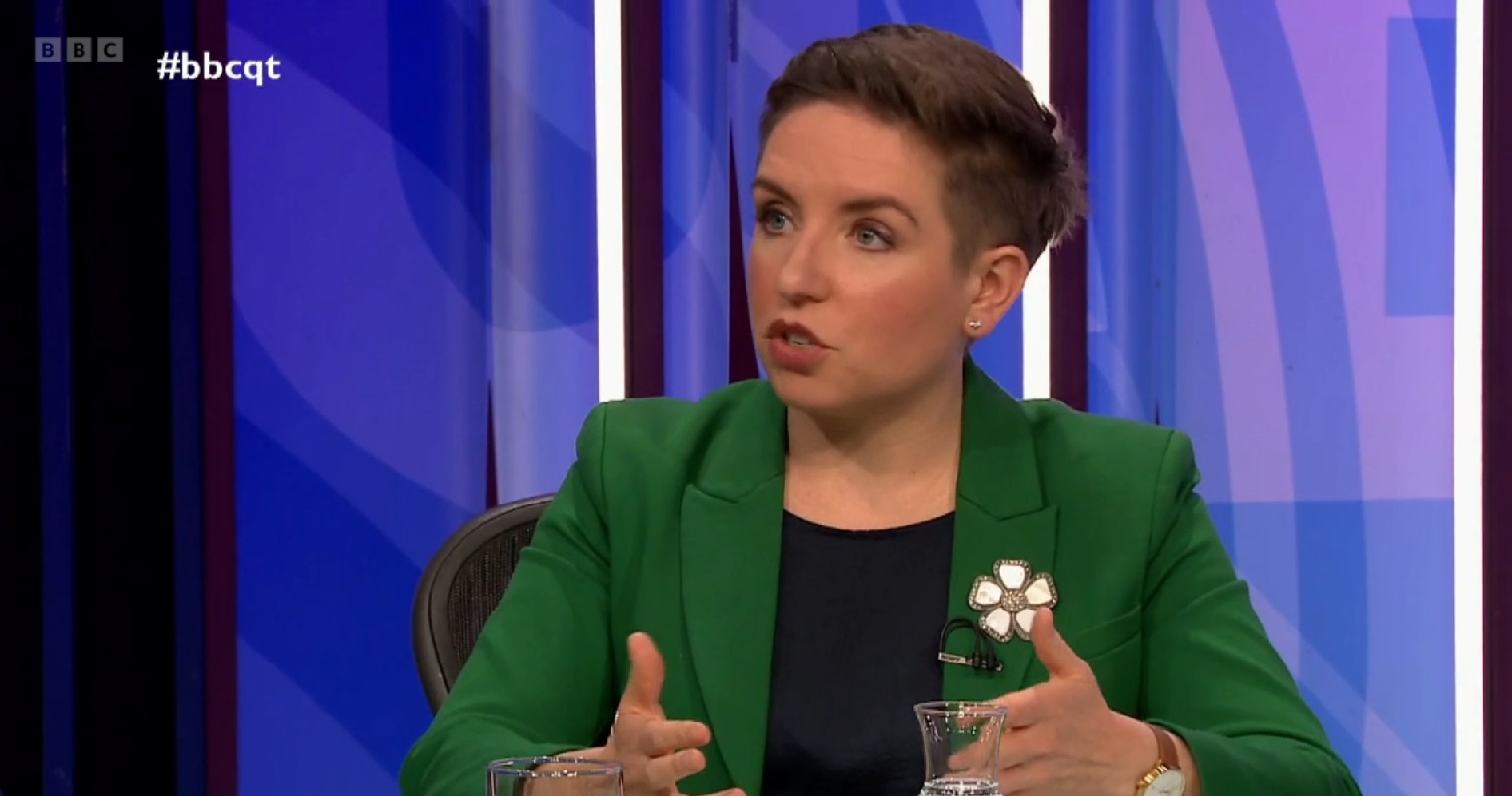
Image of the Green Party’s Carla Denyer on BBC Question Time.
Responding to new data from the Copernicus Climate Change Service showing that the average temperature in 2024 was 1.6C above preindustrial levels, Green Party co-leader Carla Denyer MP said:
“This news comes as uncontrollable wildfires rage in Los Angeles, and just months after unprecedented flooding in Spain killed over 200 people.
“The target of limiting warming to below 1.5 degrees was an attempt to prevent the deadliest effects of the climate crisis. Breaching that limit is catastrophic for humanity – and yet our leaders are sleepwalking into this deadly new future.
“We need to massively speed up the transition away from fossil fuels – that is the bottom line. In a world of 1.5 degree warming it’s unconscionable that the government is still letting some new North Sea oil and gas drilling go ahead – Starmer must revoke those consents and licenses immediately.
“But we also need to start thinking about how we make our communities more resilient in the face of the extreme weather that is now unavoidable. From flooding to extreme heat, our homes and neighbourhoods need to be fit for the future.”
October to April is normally considered to be the wet season in California, yet this January, the region is experiencing some of the most devastating fires it’s ever seen.
As of January 10, five major fires in and around Los Angeles have burned over 29,053 acres, leading to the evacuation of more than 180,000 people, the destruction of over 2,000 buildings (mainly homes), and an estimated damage cost of at least US$52 billion (£42.5 billion). Ten lives have been lost, and these numbers are expected to rise as the fires continue to burn.
The exact causes of each fire are still under investigation. However, several factors have contributed to their rapid spread and intensity.
The seasonal Santa Ana winds are particularly strong this year, bringing low humidity, dry air and high wind speeds. Southern California has received less than 10% of its average rainfall since October 2024, creating dry conditions that make the area highly vulnerable to fire.
Unusually wet winters in both 2022-23 and 2023-24 led to increased vegetation growth, providing more fuel for the fires. This cycle of wet and dry extremes, known as “hydroclimate whiplash”, is part of the increasingly intense climate cycles caused by climate change.
Hydroclimate whiplash can occur virtually anywhere. These cycles can cause extreme wildfires, such as those in California, where rapid vegetation growth is followed by drying. They can also exacerbate flooding when unusually heavy rains hit the dry-baked ground, then run off over the land rather than seeping in, leading to flash flooding.
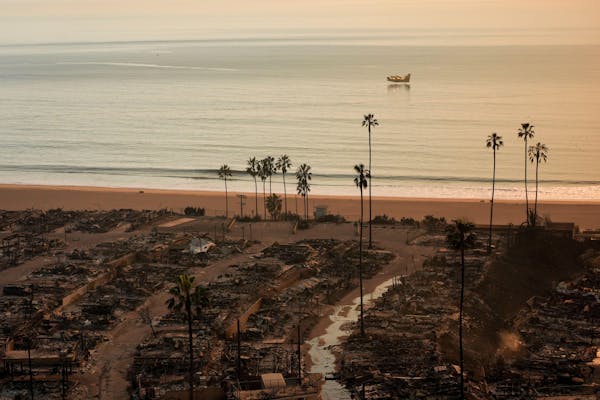
In Los Angeles, some neighbourhoods have been almost entirely destroyed. Jae C. Hong / Alamy
The human impact of hydroclimate whiplash
Rapid transitions between extreme wet and dry conditions have significant and wide-ranging impacts on people, a focus of my academic research, affecting everything from public health to economic stability and social equity.
As we have seen in California, there is the immediate impact of loss of life, property and livelihoods. We have also seen this during whiplash-induced floods and landslides, such as those experienced across California in 2023 and east Africa in 2024, when years of drought were followed by weeks of rain.
Fires exacerbate respiratory and cardiovascular diseases through their polluting smoke. Flooding creates conditions for waterborne illnesses such as cholera, leptospirosis or norovirus to rip through populations. Extreme swings in temperature can also create more heat-related illnesses, as human bodies struggle to adapt quickly. It is estimated that the health-related impacts of climate change will cost US$1.1 trillion by 2050.
And these impacts are not evenly distributed. While this month’s wildfires are affecting some of the richest communities in the US, it is generally low-income communities and vulnerable populations that are disproportionately affected, with limited resources to prepare for or recover from extreme events. Across the world, poorer populations are experiencing a 24%-48% increase in drought-to-downpour events, exacerbating their vulnerability and widening the health equity gap.
All these events and concerns also lead to mental health issues such as anxiety, depression and post-traumatic stress disorder (PTSD), resulting from displacement and trauma. Such human impacts are harder to measure, and often under-reported.
Adaptation and resilience
As climate change intensifies hydroclimate whiplash events, the human impacts are expected to grow more severe. Addressing these challenges will require coordinated efforts across multiple sectors, with a focus on both mitigation and adaptation strategies to protect human health, economic stability and social equity.
Governments and local authorities will need to implement co-management approaches for both drought and flood risks, alongside developing more flexible water management systems and infrastructure. Investing in natural infrastructure to enhance biodiversity and ecosystems will reduce risks to humans, both by restricting the effects of climate change and lowering the risks of fire and flooding.
As individuals we can often feel powerless, but environmental campaigns and movements have been highly successful in changing government policies. In the UK, the 2008 Climate Change Act and the net zero by 2050 legislation were the direct result of citizen lobbying and action, and the same can be said for numerous renewable energy transition policies around the world.
In California, we have seen the devastating effect of hydroclimate whiplash – and this won’t be the last we see. By calling on our governments to produce adaptation and resilience strategies that recognise climate change as a long-term human and economic risk factor, we can be more prepared for these events.
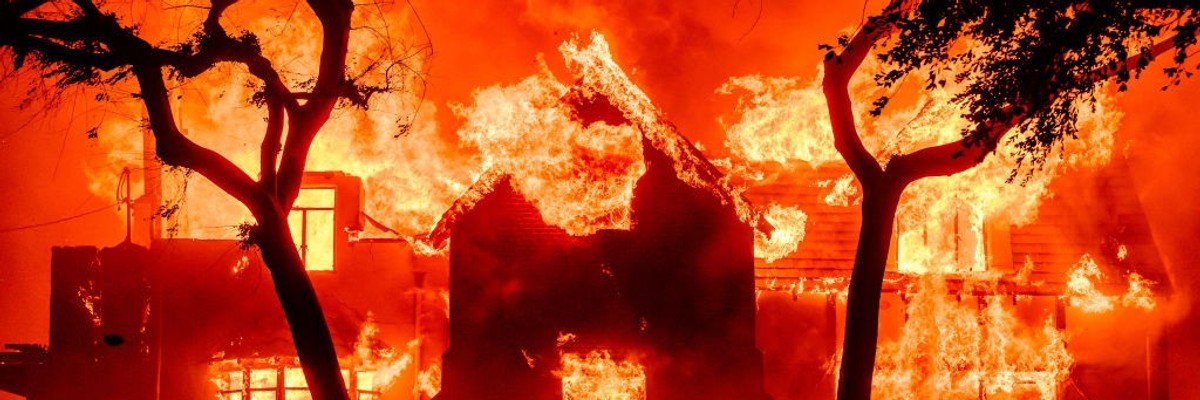
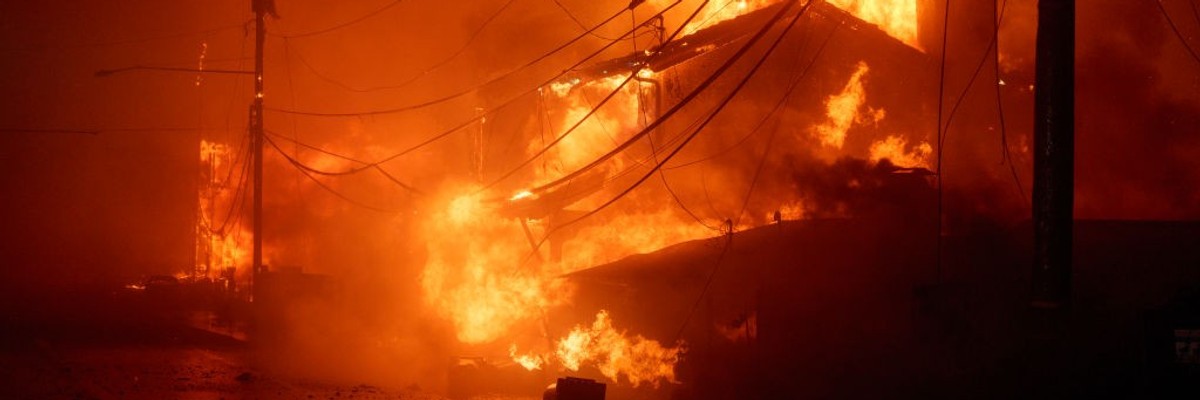
A home is engulfed in flames during the Eaton fire in the Altadena area of Los Angeles County, California on January 8, 2025. (Photo: Josh Edelson/AFP via Getty Images)
“The fires in Los Angeles aren’t just a tragedy, they’re a crime.”
As massive wildfires continued ripping through Los Angeles on Thursday, leaving utter devastation in their wake, climate campaigners said blame for the infernos ultimately lies with the mega-profitable oil and gas giants that have spent decades knowingly fueling the crisis that made the emergency in southern California possible.
“Los Angeles is burning. Entire neighborhoods have been wiped off the map. We are devastatingly unprepared for the climate that fossil fuel greed is creating,” the youth-led Sunrise Movement wrote on social media as several mostly uncontained fires wreaked havoc, supercharged by roaring winds and abnormally dry conditions.
“Oil and gas CEOs know they’re responsible for these disasters,” the group added. “But still, they choose to fight investments in renewable energy, spread propaganda, and bribe politicians into supporting $757 BILLION in fossil fuel subsidies.”
With appalling speed, the Los Angeles fires have so far scorched tens of thousands of acres, destroyed thousands of homes, and killed at least five people—a death toll that’s expected to rise.
“It’s like Armageddon,” said one resident, a sentiment echoed by a CNN reporter in Los Angeles.
“Everyone keeps saying ‘apocalyptic,’” said CNN‘s Leigh Waldman. “But that doesn’t begin to cover it.”
The Palisades fire, the largest of five blazes currently ravaging Los Angeles County, has already been deemed the most destructive in LA history.
Early estimates indicate the total economic damage of the Los Angeles fires could exceed $50 billion.
With a Thursday social media post featuring footage of the raging fires and damage in Los Angeles, Warren Gunnels, staff director for Sen. Bernie Sanders (I-Vt.), wrote: “They say the Green New Deal is expensive. Compared to what?”
Ben Jealous, executive director of the Sierra Club, said in a statement Wednesday that “these fires have taken lives and destroyed homes, livelihoods, and landscapes.”
“We are holding those affected by this disaster close in our hearts and appreciate the first responders who are bravely working to contain the fires. It is essential that federal and state authorities continue to provide these communities with all the resources and support they need to recover and heal,” said Jealous. “Barely a week into the new year, and fire season is here. This is not normal.”
“Time and again, we are witnessing fossil fuel-driven climate change heighten extreme weather, making wildfires increasingly common and increasingly destructive,” he continued. “We cannot be passive. We cannot elevate misinformation about what is needed to confront the worsening crisis. Leaders must take the action necessary to fund and support the home-hardening efforts that make our communities resilient.”
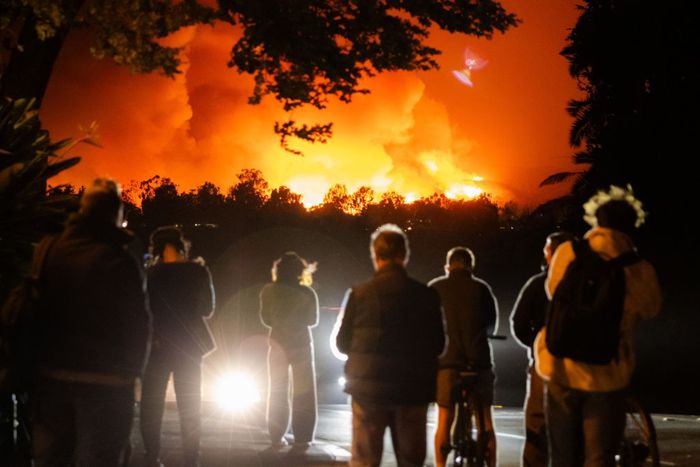
People watch smoke and flames from the Palisades Fire on January 7, 2025 in Los Angeles, California. (Photo: Tiffany Rose/Getty Images)
The Los Angeles fires come as states and localities across the United States are suing oil and gas companies for climate damages as extreme weather becomes increasingly frequent and destructive on a warming planet.
According to the Center for Climate Integrity, more than one in four Americans currently live in a community taking legal action against Big Oil, “underscoring the rapidly growing wave of calls to hold the oil and gas industry accountable for its decades-long climate deception and the harms it has caused.”
Aaron Regunberg, an attorney who is helping build a legal case against the fossil fuel industry, wrote Wednesday that the Los Angeles crisis “didn’t just happen.”
“A recent study found that nearly all of the observed increase in wildfire-burned area in California over the past half-century is attributable to anthropogenic climate change,” Regunberg, senior policy counsel with Public Citizen’s Climate Program, wrote on social media. “This devastation is the direct result of Big Oil’s conduct.”
Did you know that California has a law that makes it a crime to "recklessly cause a fire," as well as a victim restitution statute requiring those conficted of crimes to pay their victims for their economic losses?Big Oil did this. Prosecute them and make them pay.
Jamie Henn, director of Fossil Free Media, offered a similar assessment, writing that “the fires in Los Angeles aren’t just a tragedy, they’re a crime.”
“This is exactly the sort of disaster that Exxon’s own scientists predicted more than 50 years ago, but they spent billions to keep us hooked on fossil fuels,” Henn added. “It’s time to make polluters pay.”
Flames from the Palisades fire burn homes on January 7, 2025 in the Pacific Palisades neighborhood of Los Angeles, California. (Photo: Eric Thayer/Getty Images)
“There is no ‘firefighting’ in these kinds of conditions,” said one meteorologist. “There is only saving as many lives as possible and getting the heck out of the fire’s way.”
Several major wildfires burned out of control in California’s Los Angeles County on Wednesday as roaring winds fueled the rapid spread of the blazes, forcing tens of thousands to evacuate as state, local, and federal officials mobilized resources to confront the emergency.
Los Angeles Mayor Karen Bass wrote on social media late Tuesday that the city is “working aggressively” to stem the wildfires, which scientists and government officials characterized as uniquely devastating.
“Emergency officials, firefighters, and first responders are all hands on deck through the night to do everything possible to protect lives,” California Gov. Gavin Newsom said early Wednesday. The governor noted that more than 1,400 firefighting personnel have been deployed to “combat these unprecedented fires.”
The Palisades, Eaton, and Hurst fires broke out on Tuesday. It quickly exploded amid what the National Weather Service described as “extremely critical fire weather,” with wind gusts up to 99 mph propelling the devastating blazes. The extreme winds forced emergency crews to ground aircraft that were working to contain the fires.
“For some context, fire crews are up against near hurricane-force winds occurring mid-winter in rugged terrain during a drought at night,” wrote meteorologist Eric Holthaus. “There is no ‘firefighting’ in these kinds of conditions. There is only saving as many lives as possible and getting the heck out of the fire’s way.”
“The emergence of extreme wintertime wildfires in California presents one of those classic ‘this is climate change’ moments.”
The Eaton fire, which broke out Tuesday evening in the Pasadena area, “spread so rapidly that staff at a senior living center had to push dozens of residents in wheelchairs and hospital beds down the street to a parking lot,” The Los Angeles Times reported.
“The residents waited there in their bedclothes as embers fell around them until ambulances, buses, and even construction vans arrived to take them to safety,” the newspaper added.
The three fires have together burned thousands of acres so far and destroyed or endangered tens of thousands of homes and buildings, according to Newsom’s office. So far, at least 19 school districts have announced complete or partial closures due to the fires.
Video footage posted to social media showed residents watching in horror as flames surrounded their homes:
“There has been a recent massive increase in wildfires in California but really, a fire this big in January? This is unprecedented,” scientist Hayley Fowler wrote on social media. “One of many extreme events fueled by the climate crisis.”
Holthaus wrote Tuesday that Southern California is “facing a rare and dangerous juxtaposition of extreme winds and midwinter drought,” the meteorologist described as “a worrying example of the state’s expanding wildfire threat as climate change worsens.”
“The National Weather Service defines ‘extremely critical’ fire weather as sustained winds over 30 mph and relative humidity of less than 10% in drought conditions and temperatures warmer than 70 degrees,” Holthaus observed. “This is the first time in history these criteria have been met anywhere in the United States during January.”
“The emergence of extreme wintertime wildfires in California,” he added, “presents one of those classic ‘this is climate change’ moments: A specific set of weather conditions are now occurring in such a way to produce the potential for rare disasters to become much more common.”
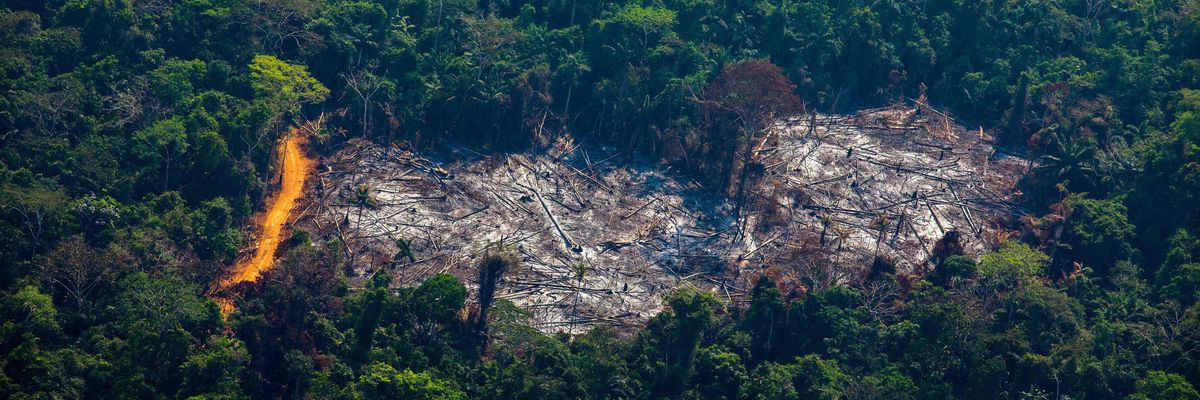
This aerial view shows Amazon forest degradation in the Menkragnoti Indigenous Territory in Altamira, Pará state, Brazil, on August 28, 2019. (Photo: Joao Laet/AFP/Getty Images)
The world’s largest rainforest showed “ominous indicators,” including wildfires and extreme drought, in 2024.
The Amazon, sometimes called the “lungs of the planet,” this year showed signs of further inching toward a much-feared tipping point, threatening the very existence of the world’s largest rainforest.
Rampant wildfires and extreme drought ravaged large parts of the Amazon in 2024. The fires and dry conditions were fueled by deforestation and the El Niño weather pattern, and also made worse by climate change, according to the World Economic Forum. “The number of fires reached its highest level in 14 years this September,” the group reported in October.
Drought has also impacted the Amazon River, causing one of the river’s main tributaries to drop to its lowest level ever recorded, according to October reporting from The Associated Press. The drop in the river has negatively impacted local economies and food supplies.
Andrew Miller, advocacy director at Amazon Watch, told the AP last week that the fires and droughts experienced across the Amazon in 2024 “could be ominous indicators that we are reaching the long-feared ecological tipping point.”
“Humanity’s window of opportunity to reverse this trend is shrinking, but still open,” he said.
The Amazon plays a vital role in keeping the planet healthy. 150-200 billion tons of carbon are stored in the Amazon, and it also carries 20% of the earth’s fresh water to sea.
According to the World Economic Forum, if the Amazon tipping point is reached, “it will release billions of tonnes of CO2 into the atmosphere through fires and plants dying off. This would further exacerbate climate change and make the 1.5°C goal impossible to achieve. It would also alter weather patterns, which would impact agricultural productivity and global food supplies.”
A paper published in the journal Nature in February indicates that up to half of the rainforest could hit a tipping point by the middle of the century. “We estimate that by 2050, 10% to 47% of Amazonian forests will be exposed to compounding disturbances that may trigger unexpected ecosystem transitions and potentially exacerbate regional climate change,” explained the researchers behind the paper.
However, it wasn’t all bad news out of the Amazon in 2024. According to the AP, the amount of deforestation in Brazil and Colombia declined in this year. In Brazil, which houses the largest chunk of the Amazon, forest loss dropped 30.6% compared to the year prior, bringing it to the lowest level of destruction in nearly a decade.
The improvement is an about-face from a couple of years ago, when the country registered 15-year high of deforestation during the leadership of former far-right President Jair Bolsonaro. Brazil is now led by the left-wing President Luiz Inácio Lula da Silva, who—despite presiding over this drop in deforestation—has also come under scrutiny, as AP noted, by environmentalist for backing projects that they argue could harm the environment.