Climate activist Greta Thunberg stands near a Palestinian flag after boarding the Madleen boat and before setting sail for Gaza along with activists of the Freedom Flotilla Coalition, departing from the Sicilian port of Catania, Italy, June 1, 2025
ISRAEL’S far-right defence minister vowed today to prevent an aid boat carrying Greta Thunberg and other activists from reaching the Gaza Strip.
The remarks by Israel Katz comes as the Israelis continue to carry out their attacks on Palestinians desperately seeking aid in Gaza.
Mr Katz said today that Israel wouldn’t allow anyone to break its naval blockade of the Palestinian territory, which he said was aimed at preventing Hamas from importing arms.
“To the anti-semitic Greta and her fellow Hamas propagandists — I will say this clearly: You should turn back, because you will not make it to Gaza,” he said in a statement.
Ms Thunberg, a climate campaigner, is among 12 activists aboard the Madleen, which is operated by the Freedom Flotilla Coalition. The vessel departed Sicily last Sunday on a mission that aims to break the sea blockade of Gaza and deliver humanitarian aid to the Palestinian enclave.
The vessel was expected to reach Gaza’s territorial waters this evening.
After a three-month total blockade aimed at pressuring Hamas, Israel started allowing some basic aid into Gaza last month, but humanitarian workers have warned of famine unless the blockade [is lifted] and the war end[s].
Genocide denier and Current UK Prime Minister Keir Starmer is quoted that he supports Zionism without qualification. He also confirms that UK air force support has been essential in Israel’s mass-murdering genocide. Includes URLs https://www.declassifieduk.org/keir-starmers-100-spy-flights-over-gaza-in-support-of-israel/ and https://youtu.be/O74hZCKKdpAUK Labour Party government ministers Keir Starmer, Angela Rayner and Rachel Reeves explain that they are partners complicit in Israel’s Gaza genocide. The UK has provided Israel with arms, military and air force support. They explain that they don’t do gas chambers but do do forced marches, starvation, destroy hospitals, mass-murders of journalists and healthcare workers.
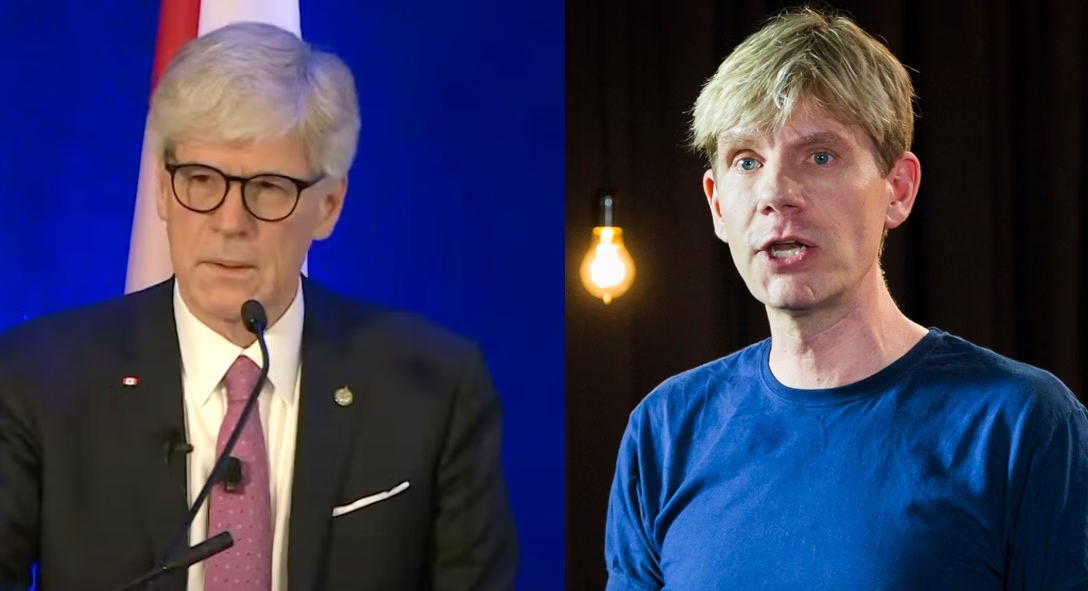
Canada Energy Minister Tim Hodgson (left) and climate crisis denier Bjorn Lomborg (right). Credit: Dan Lofton (CC BY-NC 2.0) and CPAC / YouTube
In audio obtained by DeSmog, Bjorn Lomborg told a Fraser Institute event in Vancouver that the technology is way too expensive to be viable.
Bjorn Lomborg has for years promoted the idea that fossil fuels are crucial for humankind through syndicated newspaper columns, best-selling books and appearances on TV shows including HBO’s Real Time with Bill Maher.
Yet the Danish political scientist — who acknowledges that climate change is real but denies that it’s a serious crisis — has a dim view of the oil and gas industry’s preferred solution to climate change: carbon capture and storage.
That technology is favored by Alberta premier Danielle Smith and Liberal energy minister Tim Hodgson, both of whom recently floated the idea of a “grand bargain” where Canada’s oil and gas industry gets approval for new pipelines in exchange for moving forward with a $16.5 billion carbon capture project.
It might seem that a prominent fossil fuel advocate like Lomborg would support technology loudly touted by major oil and gas producers and their political allies. But speaking at a private event last week in Vancouver, exclusive audio of which was obtained by DeSmog, Lomborg argued that “carbon capture will always be a net cost” to oil and gas producers and the taxpayers that subsidize it.
“In realistic terms, I don’t think it’s ever going to happen,” he added, referring to the prospect of prices for the technology coming down low enough that it can be rapidly and cost-efficiently deployed worldwide.
On that point Lomborg might actually be in agreement with climate policy experts who are also critical of carbon capture. “There’s a lot of federal money and provincial money that could be thrown at this thing,” Dave Sawyer, principal economist at the Canadian Climate Institute, recently told DeSmog. “We’ve been looking at this option for almost 20 years and it hasn’t happened.”
Speaking at the Fraser Institute
Lomborg was in the west coast Canadian city to speak at a private luncheon hosted by the Fraser Institute, a free-market organization with a long history of disputing the scientific reality of climate change that has received funding from the likes of Exxon and the charitable foundation of oil and gas billionaire Charles Koch.
It’s a leading member of Atlas Network, an influential coalition of more than 500 groups worldwide that promote free-market policies and whose partners in Canada have developed political strategies for fossil fuel expansion.
“Yes, global warming is real. It’s man-made, but it’s often also vastly exaggerated,” Lomborg claimed at the Fraser Institute luncheon, the same day that the United Nations warned that global temperatures were likely to breach the crucial warming threshold of 1.5 degrees within the next five years.
During the event he was asked for this thoughts about carbon capture, a technology that Canada’s largest oil and gas companies have for years argued is crucial for achieving “net zero” emissions in their operations.
Those companies, via an industry group called Pathways Alliance, are currently in talks with the federal and Alberta governments to build a multi-billion dollar carbon capture project in the heart of the Canadian oil sands which could be subsidized heavily by taxpayers.
“The problem is you need to store it underground,” Lomborg said, referring to the carbon dioxide captured by the technology. And to do that on a meaningful scale worldwide, he argued, “you have to build at least an infrastructure equivalent to the infrastructure that we built in the last hundred years for oil and gas. And remember back then, we did it because it was incredibly profitable. This time we would just have to pay for it.”
Current costs in Canada could be as high as $150 per tonne of CO2. Lomborg noted that for direct air capture projects — which Pathways Alliance is also proposing and involve sucking carbon emissions from the atmosphere — the costs could be as high as $600 per tonne. At those price points, widespread deployment is “not going to happen,” he said.
Growing rightwing backlash to CCS
Climate experts such as University of Pennsylvania scientist Michael Mann have for years argued that carbon capture and storage is a false solution to the climate crisis that allows oil and gas companies to suck up huge amounts of public money while continuing to pump fossil fuels. “It’s not a meaningful climate solution and it displaces meaningful climate solutions like clean energy, renewable energy,” he told a U.S. House panel in 2022.
But recently there has been growing backlash to the technology from conservatives and fossil fuel advocates, some of whom see it as an egregious government waste.
“We might as well take tax money at gunpoint and burn it,” Peterson, the conservative podcaster, wrote last year on X in response to a CCS project in Wyoming.
At Peterson’s ARC conference in London this February, the climate crisis denier Robert Bryce told DeSmog that carbon capture “will never work at scale.” He added, “Once you get that CO2 super-compressed and you’re pushing it down underground, there are very few places where you can actually sequester it. So it’s a lot of money wasted.”
That skepticism is now translating into federal U.S. policy, with Wright’s Department of Energy recently canceling $3.7 billion in decarbonization awards for carbon capture projects from Exxon and other fossil fuel producers.
Canada is still pushing ahead, however. Recently appointed Liberal energy minister Hodgson, a previous board member of oil and producer MEG Energy, said during a speech in Calgary in May that “All of us, governments and industry, need to get the Pathways [carbon capture] project done.”
During his Vancouver talk, Lomborg argued that the main reason oil and gas companies are pursuing such prohibitively expensive climate projects is so they can be generously supported by governments.
“What you can do is you can get a lot of subsidies,” he said.
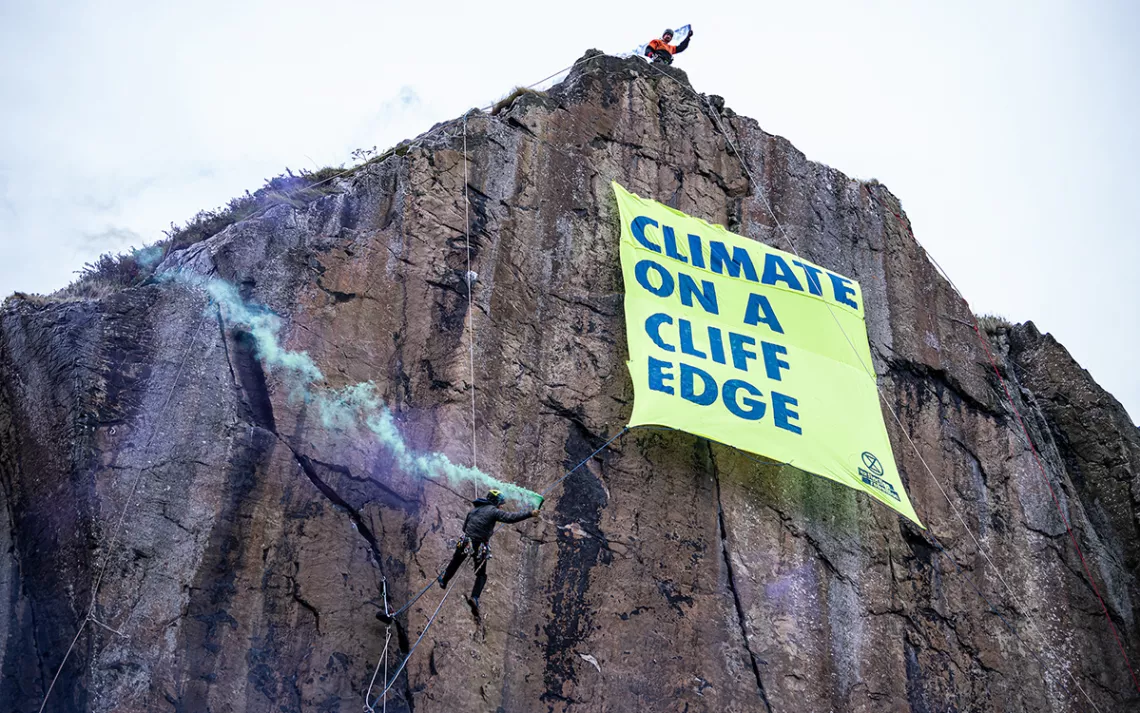
Experienced climbers scale a rock face near the historic Dumbarton castle in Glasgow, releasing a banner that reads “Climate on a Cliff Edge.” One activist, dressed as a globe, symbolically looms near the edge, while another plays the bagpipes on the shores below. | Photo courtesy of Extinction Rebellion and Mark RichardsOrcas comment on killer apes destroying the planet by continuing to burn fossil fuels.
The online game is targeted at pupils as young as seven
Equinor, the company looking to develop the Rosebank oil field in the North Sea, has funded a computer game aimed at UK school children, promoting the idea that fossil fuels are part of a green energy mix.
In an unusually frank admission of lobbying children, a web page promoting the game stated that it “aligns with our work to build future talent pipelines and secure permission to operate at a time of sensitivity around fossil fuels, particularly in light of . . . the Rosebank development”. The story was first revealed by the Norwegian news publication E24.
Rosebank – the UK’s largest untapped oilfield – was greenlit by the Conservative government in 2023, prompting condemnation from climate campaigners. That decision was ruled unlawful by the courts in January this year because it had not taken into account the carbon emissions created by burning any oil and gas produced. Equinor, Norway’s state energy company, continues preparation work on the site under its joint venture with Shell. [*1]
The game lets players choose between renewable energy or fossil fuels to power their city.
Marketing agency We Are Futures, which describes itself as “the go-to partner for building advocacy for brands amongst young people”, developed Equinor’s schools-based, curriculum-linked education programme, Wonderverse. It also received support from the Association for Science Education (ASE), a UK membership organisation for science teachers and technicians.
The game was promoted on ASE’s School Science website, which also stated: “With over two-thirds of teens believing the oil and gas industry causes more problems than it solves, Wonderverse helps lay misconceptions to rest by exploring some of the challenges involved in a just energy transition.”
The ASE web page, which has been taken down since the story first broke, said the programme, aimed at 7–14 year olds, is “designed to spark wonder for science and the future of energy”. It includes a game, in which players attempt to build a city that survives until the year 2050, and in-school education materials to “showcase how modern cities use energy resources and the ways the energy transition can be managed”.
While players are encouraged to invest in research into renewable energy, TBIJ successfully ran a city powered by oil and some renewables until 2050. Meanwhile, scientists say there must be huge declines in the use of coal, oil and gas to reach net zero emissions by 2050 and avoid further catastrophic climate change.
Screenshot from Game Over screen of Energy Town
Charlotte Howell, who leads the climate campaign group Parents for Future, was shocked that Equinor was behind an energy-themed game aimed at UK schoolchildren. She told E24: “We want to know how this can be allowed. I’m horrified that Equinor, as a partly state-owned company, is working against UK ambitions on climate. They are lobbying directly against our children.”
Tessa Khan, executive director at climate campaign group Uplift, said it was “morally indefensible” to pretend that the UK needed Rosebank for energy security when in reality it would accelerate the climate crisis.
Khan told TBIJ: “It’s one thing for Equinor to mislead the public about the benefits of new oil fields like Rosebank, but it is quite another to target children with blatant fossil fuel propaganda disguised as ‘education’. This so-called ‘computer game’ is not about learning – it’s about teaching the next generation to see oil and gas as inevitable, when the climate science could not be clearer that we need to leave new fossil fuels in the ground.”
Equinor told TBIJ it was not aware of the promotional material associated with the game until notified by media, and denied that rolling out the school game is part of a lobbying campaign to promote developing Rosebank.
A spokesperson said: “The overall intention and aim for Wonderverse and Energy Town is to provide schools and teachers with a suite of high-quality resources to help students learn more about where energy comes from, whilst building … the employability skills needed to successfully enter employment. The learning resources have been awarded a green tick by the Association for Science Education, assuring the programme’s quality for use in schools.” They also said the game was developed using data from the International Energy Agency.
ASE’s School Science website provides free online science resources for teachers and students. The site was sponsored by partners including ExxonMobil, which ASE describes as “the world’s leading nongovernmental energy company aiming to meet world energy demand in an economically, environmentally and socially responsible manner”. ExxonMobil is the world’s third most polluting company, according to Carbon Majors, a database of historical fossil fuel production data.
A spokesperson for ASE said the promotional text was provided via briefing materials from We Are Futures. They said the School Science website was no longer actively maintained and will be decommissioned, and that ExxonMobil is no longer a partner of ASE.
We Are Futures, which also works for the UK government and BP, did not respond to a request for comment.
After the court ruling in January, Equinor is set to reapply to the UK government for approval to develop Rosebank. This time it must include information about the emissions that will be produced by burning the oil extracted from Rosebank. According to Uplift, those emissions could be more than the combined annual CO2 emissions of all 28 lowest-income countries in the world, including Uganda, Ethiopia, and Mozambique. Equinor is reportedly “confident” that the project will go ahead and expects it to start up in 2026 or 2027.
Khan said: “If Equinor is serious about supporting the next generation, it should start by walking away from Rosebank and using its power and influence to focus solely on renewable energy. That’s the only way to really protect our children’s future.”
Reporter: Josephine Moulds Environment editor: Rob Soutar Deputy editor: Chrissie Giles Editor: Franz Wild Fact checker: Frankie Goodway Production editor: Sasha Baker
TBIJ has a number of funders, a full list of which can be found here. None of our funders have any influence over editorial decisions or output.
*1 by dizzy. Equinor is attempting to develop the Rosebank oil field in partnership with Ithaca Energy, not Shell.
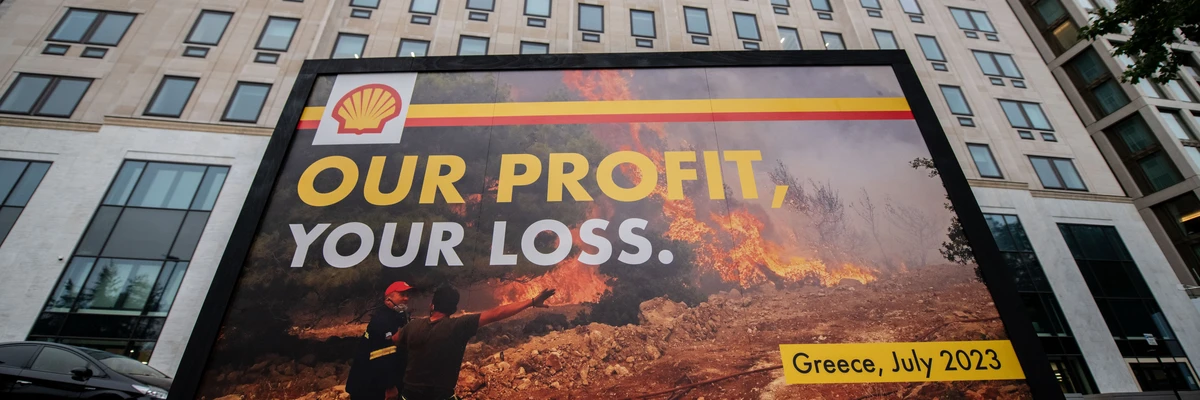
Campaigners take part in a Stop Rosebank emergency protest outside the U.K. Government building in Edinburgh, after the controversial Equinor Rosebank North Sea oil field was given the go-ahead Wednesday, September 27, 2023. (Photo: Jane Barlow/PA Images via Getty Images)Experienced climbers scale a rock face near the historic Dumbarton castle in Glasgow, releasing a banner that reads “Climate on a Cliff Edge.” One activist, dressed as a globe, symbolically looms near the edge, while another plays the bagpipes on the shores below. | Photo courtesy of Extinction Rebellion and Mark RichardsGreenpeace activists display a billboard during a protest outside Shell headquarters on July 27, 2023 in London. (Photo: Handout/Chris J. Ratcliffe for Greenpeace via Getty Images)
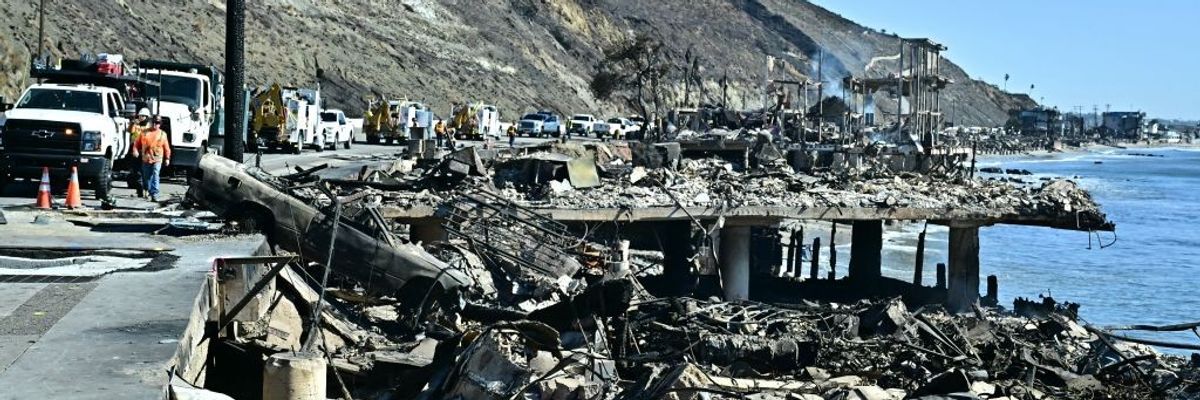
Gas company employees work in Malibu, California, after the Palisades Fire destroyed beach homes on January 12, 2025. (Photo: Frederic J. Brown/AFP via Getty Images)
A new report “shows a 50% GDP contraction between 2070 and 2090 unless an alternative course is chartered,” said the lead author.
U.K. actuaries and University of Exeter climate scientists on Thursday warned that “the risk of planetary insolvency looms unless we act decisively” and urged policymakers to “implement realistic and effective approaches to global risk management.”
Actuaries have developed techniques that “underpin the functioning of the global pension market with $55 trillion of assets, and the global insurance market, collecting $8 trillion of premiums annually, to help us manage risk,” Tim Lenton, University of Exeter’s climate change and Earth system science chair, noted in the foreword of a report released Thursday.
Planetary Solvency—Finding Our Balance With Nature is the fourth report for which the Institute and Faculty of Actuaries (IFoA) has collaborated with climate scientists. In financial terms, solvency is the ability of people or companies to pay their long-term debts. Co-authors of one of the previous publications coined the phrase planetary solvency, “setting out the idea that financial risk management techniques could be adapted to help society manage climate change and other risks.”
Three IFoA leaders—Kalpana Shah, Paul Sweeting, and Kartina Tahir Thomson—explained in their introduction to the latest report how “planetary solvency applies these techniques to the Earth system,” writing:
The essentials that support our society and economy all flow from the Earth system, commodities such as food, water, energy, and raw materials. The Earth system regulates the climate and provides a breathable atmosphere, it is the foundation that underpins our society and economy. Planetary solvency assesses the Earth system’s ability to continue supporting us, informed by planetary boundaries, tipping points in the Earth system, and other scientific discoveries to assess risks to this foundation—and thus to our society and the economy.
Our illustrative assessment of planetary solvency in this report shows a more fundamental, policy-led change of direction is required. Our current market-led approach to mitigating climate and nature risks is not delivering. There is an increasing risk of severe societal disruption (planetary insolvency), as our economic system drives further global warming and nature degradation.
“Impacts are already severe with unprecedented fires, floods, heatwaves, storms, and droughts,” the document points out, emphasizing that human activity—particularly burning fossil fuels—drives climate change and biodiversity loss. “If unchecked they could become catastrophic, including loss of capacity to grow major staple crops, multimeter sea-level rise, altered climate patterns, and a further acceleration of global warming.”
The report was released as wildfires ravage California and shortly after scientific bodies around the world concluded that 2024 was the hottest year on record and the first in which the average global temperature exceeded a key goal of the Paris agreement: 1.5°C above preindustrial levels. In the United States, experts identified 27 disasters with losses exceeding $1 billion.
“We risk triggering tipping points such as Greenland ice sheet melt, coral reef loss, Amazon forest dieback, and major ocean current disruption,” the new publication warns, adding that “tipping points can trigger each other,” and if multiple are triggered, “there may be a point of no return, after which it may be impossible to stabilize the climate.”
Food system shocks and more frequent and devastating disasters increase the risk of mass mortality for humanity—including due to hunger and infectious diseases—along with mass migration and conflict, the report highlights.
The conversation around the climate crisis isn’t to change or not to change – change is coming for us whether we’re ready or not. Time for leaders to take their heads out of the sand – we need to decarbonise, fast, and make our communities resilient. https://t.co/akb9IhErON
“Climate change risk assessment methodologies understate economic impact, as they often exclude many of the most severe risks that are expected and do not recognize there is a risk of ruin,” the document stresses. “They are precisely wrong, rather than being roughly right.”
Specifically, lead author and IFoA council member Sandy Trust said in a statement, “widely used but deeply flawed assessments of the economic impact of climate change show a negligible impact” on gross domestic product (GDP).
However, Trust continued, “the risk-led methodology, set out in the report, shows a 50% GDP contraction between 2070 and 2090 unless an alternative course is chartered.”
To mitigate the risk of planetary insolvency, the co-authors called on policymakers around the world to implement independent, annual assessments; set limits and thresholds that respect the planet’s boundaries; enhance governance structures to support planetary solvency; and “enhance policymaker understanding of ecological interdependencies, tipping points, and systemic risks so they understand why these changes are needed.”
They also underscored the need to limit global warming and avoid triggering tipping points with actions such as accelerating decarbonization, removing greenhouse gases from the atmosphere, restoring damaged ecosystems, and building resilience.
“You can’t have an economy without a society, and a society needs somewhere to live,” said Trust. “Nature is our foundation… Threats to the stability of this foundation are risks to future human prosperity which we must take action to avoid.”
Orcas discuss Donald Trump and the killer apes’ concept of democracy. Front Orca warns that Trump is crashing his country’s economy and that everything he does he does for the fantastically wealthy.Neo-Fascist Climate Science Denier Donald Trump says Burn, Baby, Burn.Elon Musk urges you to be a Fascist like him, says that you can ignore facts and reality then.
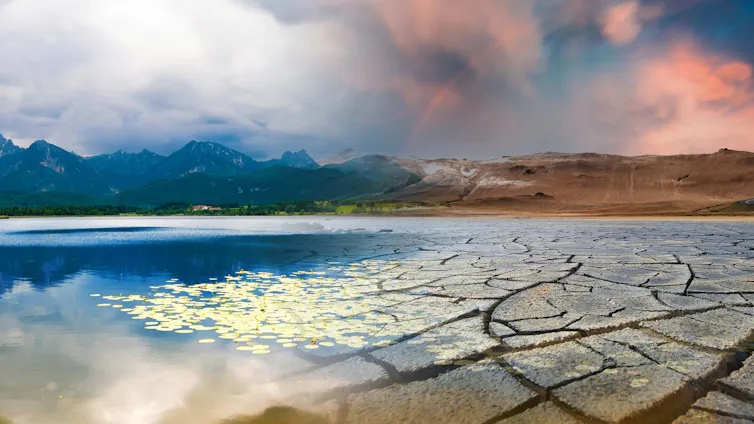
Droughts are becoming more severe and widespread across the globe. But it’s not just changing rainfall patterns that are to blame. The atmosphere is also getting thirstier.
In a new study published in Nature, my colleagues and I show that this rising “atmospheric thirst” – also known as atmospheric evaporative demand (AED) – is responsible for about 40% of the increase in drought severity over the last four decades (1981-2022).
Imagine rainfall as income and AED as spending. Even if your income (rainfall) stays the same, your balance goes into deficit if your spending (AED) increases. That’s exactly what’s happening with drought: the atmosphere is demanding more water than the land can afford to lose.
As the planet warms, this demand grows – drawing more moisture from soils, rivers, lakes, and even plants. With this growing thirst, droughts are getting more severe even where rain hasn’t significantly declined.
Get your news from actual experts, straight to your inbox.Sign up to our daily newsletter to receive all The Conversation UK’s latest coverage of news and research, from politics and business to the arts and sciences.
The process of AED describes how much water the atmosphere wants from the surface. The hotter, sunnier, windier and drier the air is, the more water it requires – even if there isn’t less rain.
So even in places where rainfall hasn’t changed much, we’re still seeing worsening droughts. This thirstier atmosphere is drying things out faster and more intensely and introducing more stress when this water is not available.
Our new analysis reveals that AED doesn’t just make existing droughts worse – it expands the areas affected by drought. From 2018 to 2022, the global land area experiencing drought rose by 74%, and 58% of that expansion was due to increased AED.
Our study highlights that the year 2022 stood out as the most drought-stricken year in over four decades. More than 30% of the world’s land experienced moderate to extreme drought conditions. In both Europe and east Africa, the drought was especially severe in 2022 – this was driven largely by a sharp increase in AED, which intensified drying even where rainfall hadn’t dropped significantly.
In Europe alone, widespread drying had major consequences: reduced river flows hindered hydropower generation, crop yields suffered due to water stress, plus many cities faced water shortages. This put unprecedented pressure on water supply, agriculture and energy sectors, threatening livelihoods and economic stability.
My team’s new research brings clarity to the dynamics of drought. We used high-quality global climate data, including temperature, wind speed, humidity and solar radiation – these are the key meteorological variables that influence how much water the atmosphere can draw from the land and vegetation. The team combined all these ingredients to measure AED – essentially, how “thirsty” the air is.
Then, using a widely recognised drought index that includes both rainfall and this atmospheric thirst, we could track when, where and why droughts are getting more severe. With this metric, we can calculate how much of that worsening is due to the atmosphere’s growing thirst.
The future implications of this increasing atmospheric thirst are huge, especially for regions already vulnerable to drought such as western and eastern Africa, western and south Australia, and the southwestern US where AED was responsible for more than 60% of drought severity over the past two decades.
Without factoring in AED during drought monitoring and planning, governments and communities may underestimate the true risk they face. With global temperatures expected to rise further, we can expect even more frequent and severe droughts. We need to prepare. That involves understanding and planning for this growing atmospheric thirst.
Driving drought
Knowing what is causing droughts in each specific location enables smarter climate adaptation. AED must be a central part of how we monitor, model and plan for drought.
Identifying the specific drivers of drought is essential for tailoring effective ways to cope with drought. If droughts are mainly due to declining rainfall, then the focus should be on water storage and conservation. But if AED is the main driver – as it is in many places now – then strategies must address evaporative loss (i.e. the amount of water lost from the surface and plants to the atmosphere) and plant water stress. This might involve planting drought-resistant crops, constructing irrigation systems that use water more efficiently, improving soil health or restoring habitats to keep moisture in the land.
As our research shows, rising AED – driven by global warming – is intensifying drought severity even where rainfall hasn’t declined. Ignoring it means underestimating risk.

 Climate activist Greta Thunberg stands near a Palestinian flag after boarding the Madleen boat and before setting sail for Gaza along with activists of the Freedom Flotilla Coalition, departing from the Sicilian port of Catania, Italy, June 1, 2025



 The game lets players choose between renewable energy or fossil fuels to power their city.
 Screenshot from Game Over screen of Energy Town