What REALLY Happened at Glastonbury


This work by Middle East Monitor is licensed under a Creative Commons Attribution-NonCommercial-ShareAlike 4.0 International License.

by Adnan Hmidan
More than 77 years since the Zionist project was planted at the heart of the Arab and Islamic world, and despite enjoying unprecedented military, political and financial support from the West, particularly the United States, Israel remains a fragile entity. For all the rhetoric portraying it as a military and technological powerhouse, its survival still hinges on foreign intervention.
Since 1948, Western powers have mobilised every instrument available, politics, capital, science, and brute military force, to uphold this settler-colonial project. Thousands of Jewish experts and professionals were brought in from Europe, America and the former Soviet Union, while billions were poured into building a state on the ruins of an indigenous population, denied basic rights simply because Palestinians weren’t considered “white enough” to deserve them.
Over the decades, Israel has amassed a formidable arsenal: unregulated nuclear weapons, the Iron Dome missile defence system, and surveillance technologies exported to repressive regimes around the world. Its intelligence services have trained authoritarian states from Latin America to Africa, turning the occupation into a global model for control.
Yet the illusion is wearing thin.
Since the launch of the Al-Aqsa Flood operation in October 2023, Israel’s vulnerability has been laid bare. This is not a self-reliant regional power, it is an entirely dependent project. It cannot endure prolonged resistance without American military support, European political cover, and consistent Western economic backing.
During its latest assault on Gaza, Israel relied heavily on US ammunition, airlifts, and naval deployment. Against Iran, it proved unable to act independently, requiring Washington to step in on its behalf. Just this week, the United States bombed Iranian nuclear sites, including the Fordow facility, in what appeared to be a direct request from Tel Aviv; a dangerous escalation that threatens to ignite a wider regional war.
One is forced to question: What kind of “regional power” needs a global superpower to fight its battles? What kind of sovereignty is that?
READ: Gaza will not be defeated as long as there are people who refuse to stay silent
Meanwhile, in the occupied West Bank, Israel continues a policy of violent erasure; assassinations, home demolitions, mass arrests, and the systematic punishment of prisoners and their families. In Gaza, we are witnessing a genocide: famine, siege, and the total destruction of life and infrastructure.
Even the sanctity of Al-Aqsa Mosque has been violated. The compound has seen unprecedented closures, its prayer halls raided by night, copies of the Quran desecrated, and its guards detained, while much of the international community remains silent, if not complicit.
But what Israel fails to grasp is this: resistance is not confined to rockets. It is an idea, rooted, growing, and passed down through generations. From Gaza to the West Bank, and from Sana’a to Tehran, new alliances are taking shape. Palestine’s voice now echoes from Chicago to Cape Town.
Yes, Israel has a missile defence system, but it has no moral shield. Yes, it can carry out precision airstrikes, but it cannot destroy the idea of freedom that lives in the hearts of millions.
Seventy-seven years on, Israel still behaves like a spoilt, unruly child, forever looking to its powerful patron for protection. It lacks true independence, genuine sovereignty, and any sense of lasting security.
It is a heavily armed entity with a hollow centre. A state upheld not by legitimacy or justice, but by coercion and propaganda.
And that is why it will fall. Because ideas do not die. Because justice delayed is not justice denied. And because Palestine lives, in the ruins, in the camps, in memory, and in the future.
So the “state” that never matured will fall. And Palestine will endure, because it is the wound that never dried, and the truth that never fades.
The views expressed in this article belong to the author and do not necessarily reflect the editorial policy of Middle East Monitor.
This work by Middle East Monitor is licensed under a Creative Commons Attribution-NonCommercial-ShareAlike 4.0 International License.


 Zarah Sultana speaking after a march organised by the Palestine Solidarity Campaign, from Russell Square to Whitehall in central London, June 21, 2025
ZARAH SULTANA has warned that Labour aping right-wing slogans will only see what has happened in the US, Brazil and India happen in Britain.
The Independent MP told the “confronting the rise of the far-right” panel at Glastonbury festival’s Left Field stage on Saturday warned that the next election will be a fight between “socialism and barbarism.”
“We have to ensure that we defeat Nigel Farage or any kind of fascist incarnation we have at the time,” she said.
…
“It’s a politics that punches down and not up, a politics that scapegoats the most marginalised people.”
She added: “The answer to the politics of hate is the politics of solidarity.
“We have to fight in every possible way — electorally, in our communities, through our trade unions.”


John Curtice, National Centre for Social Research
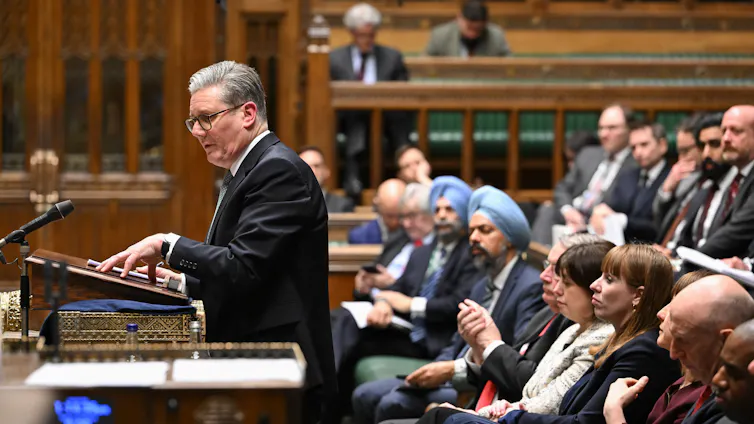
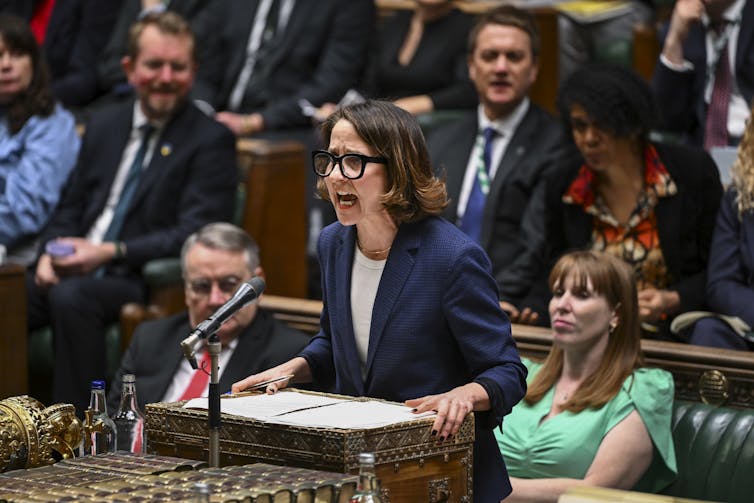
Keir Starmer has been dealing with his most serious parliamentary challenge since he became prime minister. More than a hundred Labour MPs backed a motion to stop in its tracks the government’s attempt to reduce the welfare bill, including by raising the threshold at which someone can claim disability benefit.
This issue has divided the parliamentary Labour party. But what does the public think?
Although there are signs people recognise that spending on disability benefits is now relatively high, the latest annual British Social Attitudes (BSA) report reveals that it is far from clear that they are supportive of cutbacks. And, unfortunately for the government this is especially true of those who voted Labour last year.
Ever since the late 1990s, BSA has regularly asked its respondents whether they would like “to see more or less government spending than now on benefits for disabled people who cannot work”. In 1998, 78% indicated they would like to see more spending. By 2011, that figure had fallen to 53%, and it was still no more than 56% in 2021.

Now, though, only 45% would like to see more money spent on disability benefits. For the first time, less than half the country backs giving those with a disability more help.
However, that does not mean most voters would like to see actual cutbacks. Only 11% say the government should spend less on disability benefits. The rest are content with the status quo.
Meanwhile, just 5% of those who voted Labour last year back less spending. Over half (53%) are in favour of an increase.
The government’s central argument is that it has become too easy to claim disability benefits and that this is discouraging people from getting back into employment.
There is some support for this view. Among the public in general, 29% say it is “too easy” to claim disability benefit. The trouble is, just as many, 29%, take the opposite view and say it is “too difficult”. The most popular response, given by 35%, is that it is “neither too easy nor too difficult”.
Meanwhile, among Labour voters, the balance of opinion is clearly tilted towards the view that claiming disability benefit is “too difficult”. As many as 39% say so, while only 20% feel it is “too easy”.
Similarly, most voters (62%) feel the requirement for people on disability benefits to take “active measures to find appropriate work” is “about right”. Just 11% feel it is “too weak”, while more than twice as many (23%) believe it is “too tough”. Only 6% of Labour voters believe it is “too weak”.
Want more politics coverage from academic experts? Every week, we bring you informed analysis of developments in government and fact check the claims being made.
Sign up for our weekly politics newsletter, delivered every Friday.
These figures help explain why the government has seemingly been struggling to head off the rebellion. Already burned by voters’ reaction to last year’s cutback to the winter fuel allowance, and with their party trailing Reform in the polls, Labour MPs now find themselves presented with another cut that threatens to be unpopular with many of those who put them into Westminster. Little wonder there are now signs the government is having to bend to their view.
.
John Curtice, Professor of Politics, University of Strathclyde and Senior Research Fellow, National Centre for Social Research
This article is republished from The Conversation under a Creative Commons license. Read the original article.

The Labour whip who resigned in protest against disability benefit cuts has said Keir Starmer’s concessions do not yet go far enough to win her over, as No 10 launched a fresh attempt to stem the revolt against its welfare bill.
Vicky Foxcroft, who quit her frontbench role over the welfare bill a little more than a week ago, urged the government to work jointly on the changes with disabled people and to publish the review of the system before bringing in cuts.
In an interview with the Guardian, Foxcroft said she had not made up her mind how to vote on Tuesday but would need assurances about further improvements.
“I would hope that actually we start to ensure we listen to disabled people and their organisations right across government. This isn’t just about warm words. This is about making sure we get policy right,” she said.
…
Article continues at https://www.theguardian.com/politics/2025/jun/29/starmers-disability-benefit-concessions-are-not-enough-says-rebel-labour-whip
