Protests against the Rosebank oilfield in Edinburgh in 2024. Labour pledged in its manifesto to halt new North Sea licensing, but Rosebank was awaiting final approval when the party won the general election. Photograph: Murdo MacLeod/The Guardian
Lobbyists argued it was unfair for their industry to be treated the same as others as end product – oil and gas – inevitably produced emissions
Experts have accused the fossil fuel industry of seeking special treatment after lobbyists argued greenhouse gas emissions from oilfields should be treated differently to those from other industries.
The government is embroiled in a row over whether to allow a massive new oilfield, Rosebank, to go ahead, with some cabinet members arguing it could boost growth and others concerned it could make the goal of reaching net zero emissions by 2050 impossible to reach. Labour made a manifesto commitment to halt new North Sea licensing, but Rosebank and some other projects had already been licensed and were awaiting final approval when the party won the general election.
Documents seen by the Guardian show the industry group Offshore Energies UK (OEUK) asking for Rosebank and other oilfields’ “scope three emissions” – those caused by the burning of extracted oil and gas – to be treated differently because that was the point of their business.
A court case recently found the licence granted to Rosebank by the previous government was unlawful as it failed to take these emissions into account.
The UK chancellor, Rachel Reeves, has described so-called sustainable aviation fuel (SAF) as a “game changer”. As she announced government support for a series of airport expansions, she said that the fuel “can reduce carbon emissions from flying by 70%”.
This number is misleading. Optimistic estimates do suggest that fully replacing fossil jet fuel with its sustainable alternative could lead to total savings of around 70%. But it will be hard to produce enough SAF to make a difference on that sort of scale. Even if the UK meets its ambitious targets, an annual saving of 7% by 2030 is more plausible.
SAF is synthetic liquid fuel derived from something other than fossil fuels. These inputs have to be processed into a liquid that can be burned safely while also storing a lot of energy for its weight, since minimising weight is crucial. This is why long-haul electric battery-powered planes are unlikely to take off any time soon.
The UK classifies three major pathways for creating sustainable aviation fuel. It can be derived from oils or fats, including used cooking oil or tallow. It can come from other sorts of material, such as municipal solid waste, agricultural residues, or sewage. Or it can be made from hydrogen and captured carbon using renewable electricity.
SAF can also be produced from bioenergy crops, and products such as palm oil. However the UK won’t certify it as sustainable, due to concerns about land use and impacts on wildlife.
Emissions that would have occurred anyway
Burning SAF actually emits a similar amount of CO₂ to fossil jet fuel. Instead, most savings come from how we account for the waste and renewable energy that is used to produce it.
Waste emits greenhouse gases anyway, sustainable fuel supporters argue. So why not have those emissions do something useful, like power a plane? Jenya Smyk/shutterstock
SAF fundamentally relies on assumptions that if waste or energy crops were not used to make this fuel, they would be incinerated, would degrade, or would in some way release their embodied carbon anyway. In the case of fuel derived from renewable energy and captured carbon, it assumes that carbon came from the atmosphere in the first place. This allows these emissions to be deducted from the total impact of SAF, leading to lower emissions than conventional aviation fuel.
Is sustainable aviation fuel even sustainable?
Estimates of how much greenhouse gas SAF could cut vary greatly due to the many different ways it can be produced, and the complexities of accounting for emissions across the entire life cycle from waste, to fuel production, to plane engine. A 2023 review by the Royal Society illustrates this nicely. It found SAF could at best produce effectively negative emissions (a 111% reduction), while at worst it could be more carbon intensive than fossil kerosene jet fuel (a 69% increase).
While policy incentives are likely to encourage increased production, there remain serious concerns that will need to be addressed before SAF can become a serious competitor for conventional jet fuel. There are hard limits to the amount of used cooking oil available for instance, and the use of other feedstocks is still in its infancy.
Meanwhile any renewable energy used to make the fuel will have to compete with growing demand from electric vehicles, AI data centres and more. And there are big worries the industry simply won’t be profitable enough to attract initial capital investment, let alone take on its well-established rival.
UK SAF production
Coming into effect in January, the UK’s SAF mandate sets legal obligations for aviation fuel suppliers in the UK to progressively increase proportions of sustainable fuel, from 2% of total jet fuel in 2025 to 10% in 2030, and 22% in 2040.
As of 2023, 97% of the UK’s supply is derived from used cooking oil, with the rest from food waste. Only 8% of this cooking oil is sourced from the UK, with most being imported from China and Malaysia. The UK also comprises 16% of the global SAF market, despite representing only 1% of total passengers.
Let us assume that Rachel Reeves’ 70% saving is deliverable if fossil jet fuel was fully replaced with SAF. That’s optimistic in itself, but not beyond the realms of possibility.
Getting hold of that much sustainable fuel is less plausible, however – the total demand for jet fuel in the UK is more than ten times the current global production of SAF. But let’s assume that the rocky global market can deliver the UK’s ambitious demand of 10% SAF use by 2030.
Reeves’ figure then becomes an optimistic value of 7% savings across the UK industry. If we then correct for anticipated growth of passenger numbers, assuming plans for airport expansion, those savings are likely to vanish.
While SAF has a role to play in decarbonisation, growth sits in clear opposition to its impacts and potential. If the UK has any hope of meeting its climate targets, it should instead be seeking alternatives to flying where possible.
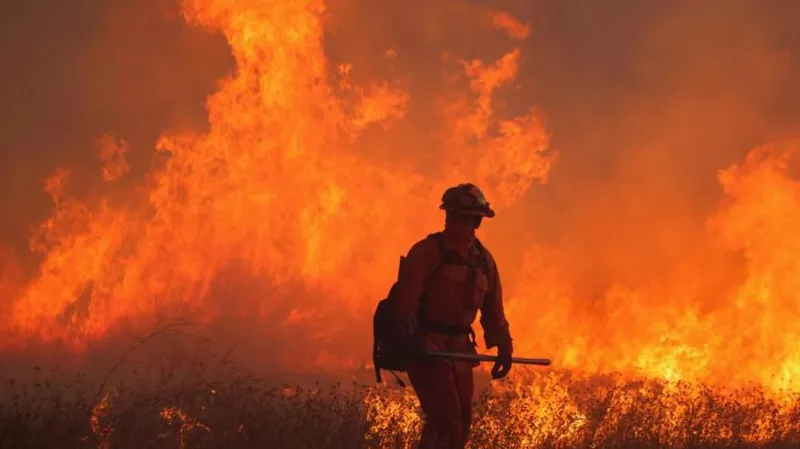
Last month’s Los Angeles fires were one of the costliest disasters in US history
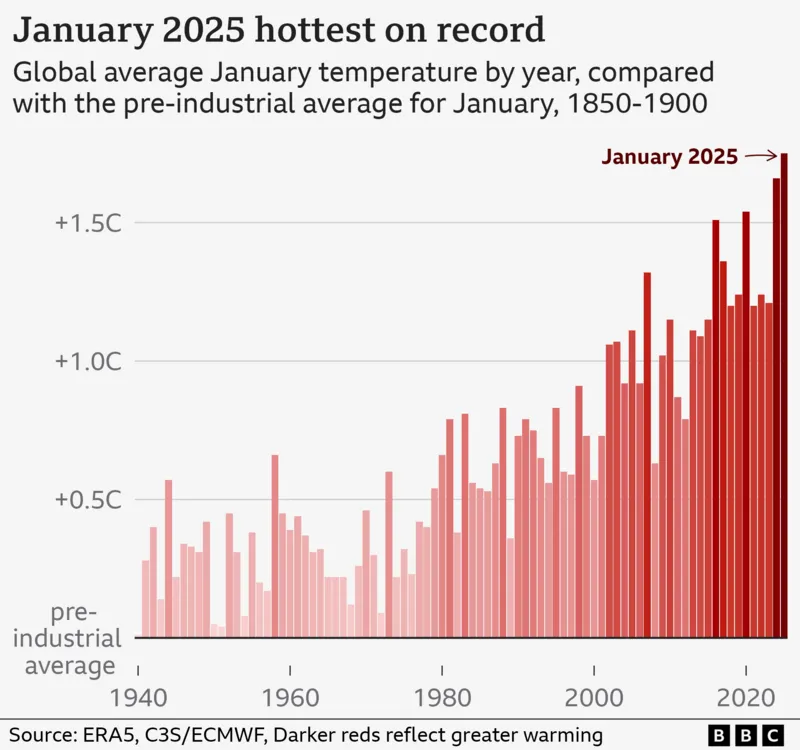
Last month was the world’s warmest January on record raising further questions about the pace of climate change, scientists say.
January 2025 had been expected to be slightly cooler than January 2024 because of a shift away from a natural weather pattern in the Pacific known as El Niño.
But instead, last month broke the January 2024 record by nearly 0.1C, according to the European Copernicus climate service.
The world’s warming is due to emissions of planet-heating gases from human activities – mainly the burning of fossil fuels – but scientists say they cannot fully explain why last month was particularly hot.
It continues a series of surprisingly large temperature records since mid-2023, with temperatures around 0.2C above what had been expected.
“The basic reason we’re having records being broken, and we’ve had this decades-long warming trend, is because we’re increasing the amount of greenhouse gases in the atmosphere,” Gavin Schmidt, director of Nasa’s Goddard Institute for Space Studies, told BBC News.
Climate Science Denier Donald Trump says Burn, Baby, Burn.Elon Musk urges you to be a Fascist like him, says that you can ignore facts
and reality then.
Planes queuing for takeoff at Heathrow airport in Britain. Credit: david pearson / Alamy Stock Photo
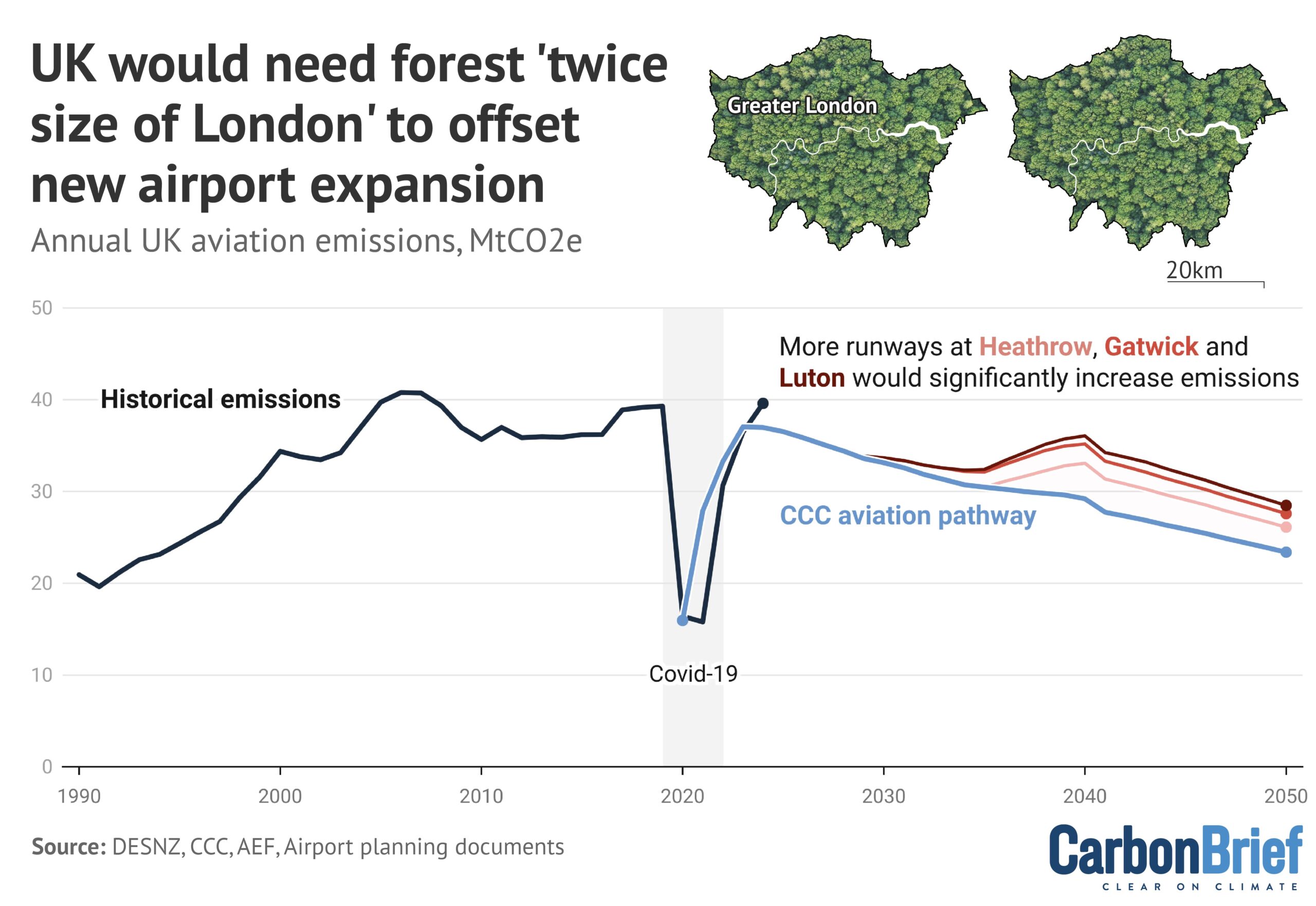
A forest twice the size of Greater London would need to be planted in the UK to cancel out the extra emissions from the expansion of Heathrow, Gatwick and Luton airports, Carbon Brief analysis reveals.
New runaways at these airports surrounding London would result in cumulative emissions of around 92m tonnes of extra carbon dioxide equivalent (CO2e) by 2050, if the number of flights increases in line with their operating company targets.
If the UK is to remain on track for net-zero, it would need to cut emissions further in other sectors of the economy or remove an equivalent amount from the atmosphere.
For example, offsetting these emissions would require more than 300,000 hectares of trees to be planted within just a few years. This equates to all the trees planted in the UK since 2000.
The Labour government is set to back all three airport expansions, according to mediareporting ahead of a speech by chancellor Rachel Reeves this week.
This is in spite of opposition from within the Labour party and the government’s climate advisors recommending against airport expansion.
Reeves has stressed that “sustainable aviation fuels” (SAFs) and electric planes could help to offset these emissions.
However, such technologies are still in the early stages of deployment and previous Carbon Brief analysis suggests the role of SAFs in achieving net-zero may be limited.
Two Londons
Reeves is expected to reveal plans for a third runway at Heathrow in a speech on Wednesday.
This, alongside suggestions she will also announce her support for the expansion of Gatwick and Luton airports, has prompted days of political debate over the friction between the government’s climate and economic plans.
Reeves sees the expansion of airports as a key part of the government’s “growth strategy”. However, senior Labour politicians, notably energy secretary Ed Miliband, have previously opposed such expansions on environmental grounds.
For her part, the chancellor told BBC News that she thought “sustainable aviation and economic growth go hand in hand”.
Carbon Brief has used estimates of passenger numbers from the airports’ planning applications, combined with assumptions used by UK government advisors the Climate Change Committee (CCC), to calculate emissions from the three expansions.
As the chart below shows, the CCC assumes aviation emissions fall in the coming years due to technological and efficiency improvements.
However, the expansion of Heathrow, Gatwick and Luton would drive an uptick in emissions around 2040 as the projects are completed, if the expected number of extra flights take off and if there are no additional improvements in aircraft efficiency.
This would amount to an additional 92MtCO2e being emitted cumulatively by 2050.
In order to remain on track for the UK’s net-zero target, these emissions would need to be avoided by additional technological innovations in the aviation sector, balanced by faster cuts in other parts of the economy – or removed from the atmosphere after being emitted.
Annual UK aviation emissions, MtCO2e. The blue line indicates the trajectory for emissions set out by the CCC. The three red lines indicate the additional emissions that would result from the expansion of Heathrow, Gatwick and Luton airports, plus the resulting flights. The airport expansions are assumed to follow approximate timelines based on their respective planning applications, with some dates assumed based on the views of AEF. The Heathrow expansion is assumed to be in operation in 2035 and at full capacity by 2040. The Gatwick expansion is assumed to be operational in 2028 and at full capacity by 2038. The Luton expansion is assumed to be operational in 2033 and at full capacity by 2043. Sources: DESNZ, CCC, AEF, airport planning documents.
Aviation is generally viewed as a difficult sector to decarbonise, due to the lack of cheap and effective technologies to cut emissions from planes.
This is why campaigners and researchers frequently stress demand reduction as the most effective way to cut aviation emissions.
The UK’s net-zero plans already allow for aviation to be one of the final sectors producing sizable volumes of emissions in 2050, when most of the economy has decarbonised.
One strategy to remove the excess emissions from the additional Heathrow, Gatwick and Luton flights would be to plant more trees. However, this would be a significant undertaking, as Carbon Brief analysis shows.
It would require planting around 301,000 hectares of new forest by around 2028 so that the trees are large enough by the middle of the century to absorb significant amounts of CO2.
This is equivalent to around twice the size of Greater London, which covers 157,000 hectares. It is 10 times higher than the UK’s most recent annual tree-planting target and equates to all of the trees planted in the past 24 years across the country.
More passengers
Government advisors at the CCC have recommended that there should be no more than a 25% growth in the number of air passengers from 2018 levels, in order to meet the UK’s net-zero goal by 2050.
This amounts to an increase from 292 million passengers to 365 million by 2050. The number of UK flights collapsed during Covid-19 lockdowns and has been slow to recover to pre-pandemic levels, but the number of air passengers in 2023 reached 273 million.
The CCC has consistentlystressed that there should be “no net increase” in airport capacity if the UK is to reach net-zero by the middle of the century, meaning any expansion is “balanced by reductions in capacity elsewhere”. It has also stated there should be no airport expansion without a UK-wide framework for managing capacity.
The committee criticised the previous Conservative government for setting “no plans” to limit growth in passenger numbers in its “jet-zero” strategy, which envisaged demand for flying increasing by 70% out to 2050.
Airport expansion at Heathrow, Gatwick and Luton would help bring the total number of passengers at these three sites up to 243 million in 2050, according to the airports’ own planning applications, compiled by the Aviation Environment Federation (AEF).
This amounts to an additional 100m passengers passing through these airports, compared to 2018 levels. This would bring the total number of UK passengers to 392 million – equivalent to a 34% increase in UK airport traffic – meaning that growth at Heathrow, Gatwick and Luton alone would be enough to breach the CCC’s guidance.
(In reality, more than 20 UK airports have plans for more capacity and some already have unused capacity, so it is unlikely that expansion would be limited to three airports around London.)
SAF concerns
The CCC leaves some flexibility in its advice to the government, allowing for future capacity growth, if “the carbon intensity of aviation is outperforming the government’s emissions reduction pathway”.
Essentially, if clean technologies slash aviation emissions faster than expected, then there will be space for more flights within a pathway to net-zero by 2050.
This has been alluded to by Reeves in recent days. She has stated that a “lot has changed in terms of aviation” and reportedly based an internal proposal to expand Heathrow on the use of “sustainable aviation fuels” (SAFs).
In reality, there has been very limited progress in developing SAFs or any other technologies to decarbonise planes in the UK. In 2023, the CCC chastised the Conservative government for “rel[ying] heavily on nascent technologies”.
Government modelling has shown SAFs will have a limited impact on cutting UK aviation emissions. Experts have pointed to the issues with the supply of materials for making SAFs and noted that none of the five SAF plants originally pegged to start construction in the UK this year are being built yet.
Methodology
This analysis is based on the CCC’s sixth carbon budget “balanced pathway” for the aviation sector, combined with data obtained from AEF on the expected increase in passenger numbers from the expansion of Heathrow, Gatwick and Luton airports.
The CCC pathway assumes that the emissions per passenger fall from 0.14 tCO2 in 2020 to 0.06tCO2 in 2050, accounting for the rollout of SAF and more efficient aircraft. It also assumes that no net expansion of airport capacity occurs.
Therefore, in this analysis, the three airport expansions are considered additional to the emissions included within the CCC pathway.
To calculate the additional emissions from the expansion of the three airports, the additional passenger numbers this would facilitate are multiplied by the emissions intensity per passenger in each year of the CCC pathway.
The additional passenger numbers from each airport are added to a Department for Transport pathway that assumes no further expansion. Each airport expansion is assumed to ramp up linearly from the year of operation to the year of operation at full additional capacity.
Based on the airport planning applications and AEF, it is assumed that:
The Heathrow expansion will be operational by 2035 and operating at full capacity by 2040.
The Gatwick expansion will be operational by 2028 and operating at full capacity by 2038.
The Luton expansion will be operational by 2033 and operating at full capacity by 2043.
The calculated CO2 removals from planting trees are based on assumptions used by the CCC’s sixth carbon budget “balanced pathway”, in which there is a 2:1 ratio of conifers to broadleaves planted across the country.
The CO2 removals per hectare for conifers and broadleaves are taken from the UK Centre for Ecology and Hydrology (CEH), whose numbers are also used by the CCC.
Based on these numbers, the cumulative emissions removed per hectare of forest after 22 years – from the start of airport expansion in 2028 to 2050 – is 304tCO2. Dividing this value by the total additional cumulative emissions from the airport expansion (92 MtCO2), gives a total area required of 301,000ha. Given that Greater London is 157,200ha, this corresponds to approximately two (1.91) times the area of Greater London.
Historical UK aviation emissions are taken from the Department of Energy Security and Net Zero (DESNZ) up to 2022. For 2023 and 2024, the emissions are estimated based on percentage annual changes in UK jet fuel use, which are then applied to the emissions from 2022.
The UK government is set to back plans for a third runway at Heathrow, the country’s busiest airport, and to expand two other airports near London: Gatwick and Luton. The move is designed to support the government’s “mission” to grow the economy.
Air transport is notoriously hard to decarbonise. Unlike the energy system, or even road transport, there is no renewable alternative to switch to immediately. If electric or hydrogen planes become reality, it won’t be for many years yet. Therefore it’s not clear this airport expansion can fit within the UK’s legal and arguably moral requirement to cut emissions and remain within its carbon budget.
It certainly goes against what the government’s official advisory body the Committee on Climate Change (CCC) recommends. The CCC’s 2023 report to parliament stated that: “No airport expansions should proceed until a UK-wide capacity management framework is in place to annually assess and, if required, control sector GHG [greenhouse gas] emissions and non-CO₂ effects.”
Those non-CO₂ effects of aviation include water vapour, soot and other gases like nitrous oxides and sulfur dioxide, all released directly into the high atmosphere where they help form heat-trapping clouds. Estimates suggest they could triple the greenhouse impact of aviation.
In 2019, the last year of available data pre-COVID, domestic and international aviation accounted for around 8% of the UK’s total emissions. The non-CO₂ effects makes aviation a larger contributor to climate change than that number suggests.
The sector itself struggles to build a coherent decarbonisation roadmap based solely on “supply-side” improvements to things like fuel efficiency or, in a recent example from EasyJet, thinner paint. The demand side – taking fewer flights, frequent flyer levies, or restrictions on domestic flights as have been introduced in France – is rarely mentioned.
Unfortunately aviation is a prime example of the Jevons effect where any improvement in efficiency has been wiped out by increased demand. With a growing global middle class pursuing a higher consumption lifestyle, aviation emissions continue to grow even while other sectors have shows some efforts to reduce their own.
A third runway at Heathrow was first proposed back in the 2000s. This photo is from a 2016 protest. Dinendra Haria / shutterstock
The UK has mandated that synthetic aviation fuel (SAF), a more sustainable alternative to regular jet fuel, must make up 10% of aviation fuel by 2030. But only 1.2% of aviation fuel is currently SAF and the industry has not published any plans to show it can scale up in time. Indeed, the sector’s own plans for growth will outstrip efforts to decarbonise through synthetic fuel, delivering a neutral effect at best.
The consumer-facing airport sector has also been accused of greenwash. For instance, Luton Airport recently published adverts making the claim that its own expansion would be stopped if it did not meet stringent environmental targets. However, the Advertising Standards Authority found that consumers would naturally believe that would include air traffic and not just terminal operations (a terminal’s heating or lighting is, of course, largely irrelevant when its core business is as emissions-intensive as flying).
The difficulty of decarbonising aviation while the sector still grows is exemplified by the government’s recently launched consultation on adopting the Corsia carbon offsetting scheme for international flights and how it might work with existing cap and trade schemes. All of which encourage or excuse excess emissions through a charging mechanism.
Growing pains
“Kickstarting economy growth” and “Make Britain a clean energy superpower” are two of the UK government’s six “missions”. However, by expanding airports in support of the former, it risks failing the latter.
A new report by thinktank the New Economics Foundation shows that airport expansion could balance out all of the emissions saved by the government’s clean power plans by 2050.
There is evidence that airport expansion can bring some of the economic benefit that government needs. However, another New Economics Foundation report has found that air travel is no longer a catalyst for productivity growth. So the economic benefits of a new runway are really confined to the airport operation itself – projects for engineers and builders, service jobs for people living near Heathrow, and so on.
Aviation is the privilege of the richer part of society, both globally and within the UK. Figures from Our World in Data shows the richest 50% of the global population produces 90% of the aviation emissions.
While many more UK residents have experienced flying than in the past, most flights are still taken by a small, wealthy subset of the population, which will typically capture the largest share of any new capacity. Each year, around half of British residents do not fly at all.
The focus on London airports for the largest scale expansions will shift the balance of the economy further towards south-east England, and increase inequality within the UK economy. And while these plans might bring some of the GDP gains the government is desperate to deliver, all the evidence shows they will be at the expense of its environmental targets.