The mega-rich are using private jets like taxis, warn climate scientists who tracked flights to calculate the planet-warming gases they release.
The scientists worked out that the carbon dioxide emissions, which contribute to climate change, rose by 46% between 2019 and 2023.
Researchers traced all private flights globally, including summer weekend trips to Ibiza, Spain and travel to the Fifa World Cup and the UN climate conference in Dubai.
Flying in a private jet for a single hour can release more carbon dioxide into the atmosphere than the average person produces in a year, according to the research team.
“There are a lot of people using these aircraft as taxis, where you cover whatever distance by aircraft simply because it’s more convenient,” Professor Stefan Gossling, from Sweden’s Linnaeus University, who led the research, said.
“If somebody’s flight emits in one hour as much as an average human being emits in a year – just to watch a soccer game – then perhaps it shows those people think they are outside the standards that we have as a global community.”
The ability of governments to implement climate policies effectively is the “most important” factor in the feasibility of limiting global warming to 1.5C, a new study says.
The future warming pathways used by the Intergovernmental Panel on Climate Change (IPCC) suggest that holding warming to 1.5C is unlikely, but still possible, when considering the technological feasibility and project-level economic costs of reaching net-zero emissions.
However, the new study, published in Nature Climate Change, warns that adding in political and institutional constraints on mitigation make limiting warming to 1.5C even more challenging.
They find that the most ambitious climate mitigation trajectories give the world a 50% chance of limiting peak global warming to below 1.6C above pre-industrial temperatures. However, adding ”feasibility constraints” – particularly those involving the effectiveness of governments – reduces this likelihood to 5-45%.
The study shows that, thanks to advances such as solar, wind or electric vehicles, “the technological feasibility of climate-neutrality is no longer the most crucial issue”, according to an author on the study.
Instead, he says, “it is much more about how fast climate policy ambition can be ramped up by governments”.
Emissions scenarios
In 2015, almost every country in the world signed the Paris Agreement – with the aim to limit global warming to “well below” 2C above pre-industrial levels, with a preference for keeping warming below 1.5C.
Since then, most countries have set net-zero targets and many are making progress towards achieving them. However, as the planet continues to warm, some scientists are questioning whether it is still possible to limit warming to 1.5C, the new study says.
The IPCC’s special report on 1.5C, published in 2018, included a cross chapter box on the “feasibility” of this temperature limit. The report says there are six components of feasibility that could inhibit the world’s ability to limit warming to 1.5C, as shown in the image below.
The six components of feasibility that could inhibit the world’s ability to limit warming to 1.5C, according to the IPCC”s special report on 1.5C. Source: IPCC SR1.5, cross chapter box 3.
The IPCC’s working group three report from its sixth assessment cycle explores thousands of different future warming scenarios. These scenarios are mainly generated by integrated assessment models (IAMs) that examine the energy technologies, energy use choices, land-use changes and societal trends that cause – or prevent – greenhouse gas emissions.
Fewer than 100 of these scenarios result in warming of below 1.5C with limited or no overshoot, defined as more than a 50% chance of seeing a peak temperature below 1.6C. These are known as the “C1 scenarios”. However, these scenarios do not consider all of the feasibility constraints outlined by the IPCC.
(Furthermore, these scenarios – which run from 2019 – assume that rapid decarbonisation began almost immediately. However, in reality, emissions have continued to rise since 2020, eating into the remaining “carbon budget” for warming to be limited to 1.5C more quickly than the models assume.)
The new study investigates five constraints. The first two – geophysical and technological – focus on the constraints presented by technologies, such as the growth of carbon capture and storage, nuclear power and solar generation, and the Earth’s total geological carbon storage capacity.
For sociocultural constraints, the study explores behavioural changes that can accelerate decarbonisation, such as reduced energy demand. The authors refer to these as “enablers”. And the “economic constraint” focuses on carbon prices.
However, the authors say the “key innovation” of their study is the inclusion of “institutional constraints”, which measure a government’s ability to “effectively implement climate mitigation policies”.
Policy constraints
All countries have different “institutional capabilities” to enforce policies. Some countries are able to quickly and successfully implement policies, such as taxation changes or environmental regulation. Other countries – which are often less wealthy – have lower levels of governance, making it harder to implement these measures.
The indicator is based on the speed and success with which they have achieved their past “environmental goals” – for example, reductions in the sulphur emissions of power plants – he explains. Countries that were successful in achieving these targets in the past are given higher governance scores.
She tells Carbon Brief that the indicator is originally from the Worldwide Governance Indicators published by the World Bank. (See more on the indicators in the guest post Andrijevic and her co-authors wrote for Carbon Brief.)
The graph below, taken from the new study, shows how governance is expected to improve over the 21st century for countries with a population of more than 25 million in 2020, according to this indicator. Each colour indicates a different world region. The grey lines indicate a “pessimistic” scenario in which governance remains frozen at 2020 levels.
Expected increases in governance over the 21st century. Only countries with a population of more than 25 million in 2020 are shown. Each colour indicates a different world region. Source: Bertram et al (2024).
The authors use global average carbon prices as a “proxy” for the overall strength of a country’s climate policy, assuming that countries with higher levels of governance will implement higher carbon prices.
They develop a range of scenarios. In their optimistic scenario, carbon prices vary, but this does not explicitly constrain emissions reductions. In the “default” scenario, both carbon prices and emissions reductions are constrained.
In the pessimistic scenario, governance indicator values are “frozen” at their 2020 levels, meaning that governments’ ability to implement new climate mitigation policies does not improve over the 21st century.
Bertram tells Carbon Brief that the measure is “not perfect”, but says that it gives a good approximation of “how fast decarbonisation can happen in different countries”.
Is 1.5C ‘feasible’?
The authors used existing literature to quantify how much each of the five constraints might affect the world’s ability to limit global warming. They then produced a set of different “feasibility scenarios” and assessed their future CO2 emissions using eight IAMs.
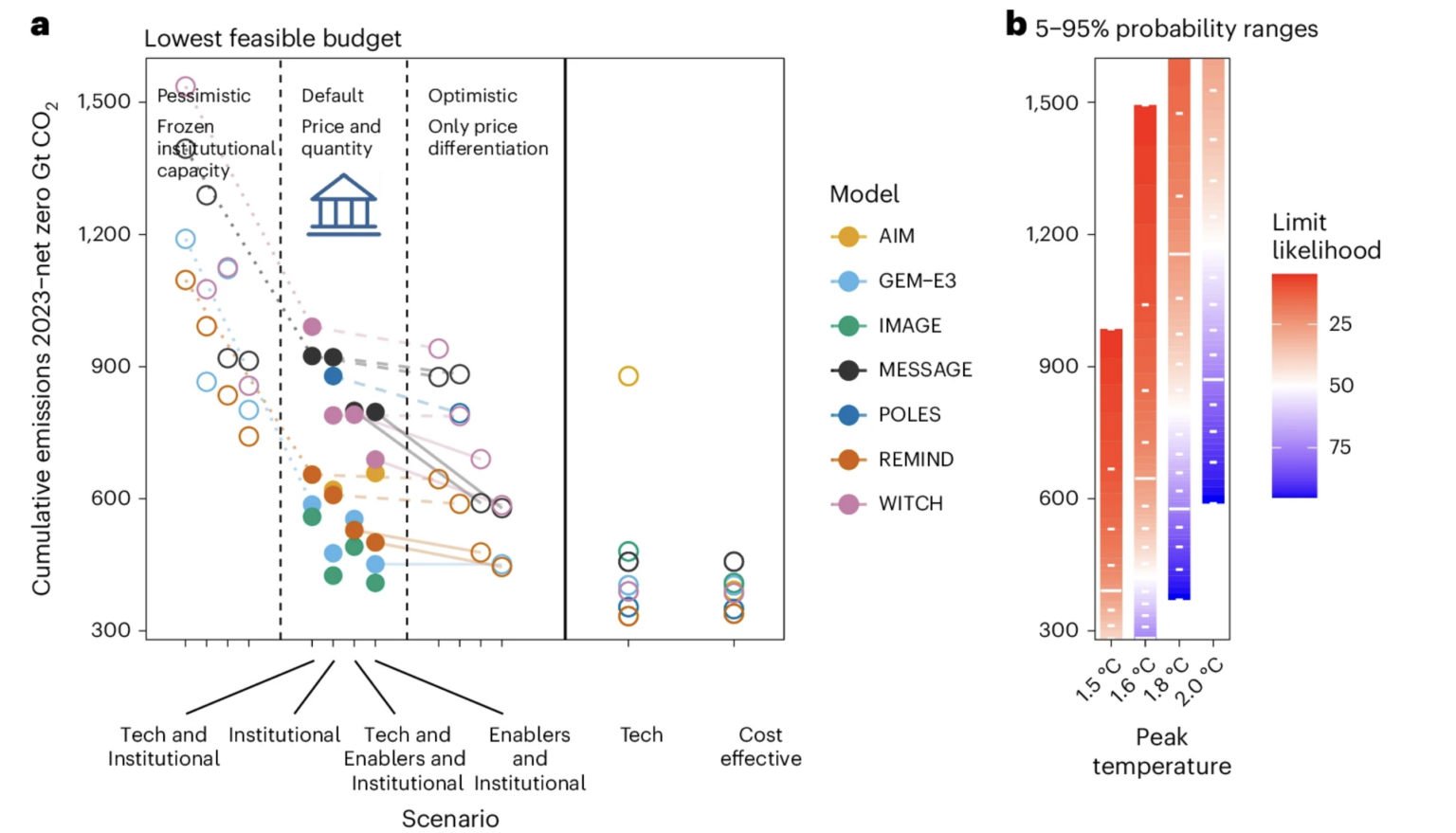
The plot below shows the minimum total global CO2 emissions that could be produced between 2023 and the date that net-zero CO2 is reached for these scenarios. In the panel “a”, on the left, each dot indicates a model result.
The column on the far left is a “pessimistic” institutional feasibility scenario, in which governance indicators do not improve beyond 2020 levels. Cumulative global CO2 emissions before net-zero here are the highest of any scenario explored.
The next column is the “default” assumption of carbon prices and emissions-reduction quantities, under four different combinations of constraints.
From left to right within this column, the combinations cover technological and institutional constraints, only institutional constraints, technological and institutional constraints with enablers and then institutional constraints with enablers.
The enablers include measures such as reduced energy demand in high income countries and increased electrification. This helps to “create more flexibility on the supply side and thus further improve the feasibility of implementation”, according to the paper.
The final column shows “optimistic” scenarios, divided between a scenario with technological constraints (left) and a “cost-effective” scenario, as used in the IPCC (right).
Panel “b” shows the likelihood, based on the 14 feasibility scenarios in panel a, of staying below 1.5C, 1.6C, 1.8C and 2.0C peak temperatures. Each bar indicates a different peak temperature. Red indicates a high likelihood of meeting the temperature target, given the level of emissions, and purple indicates a low likelihood.
Minimum achievable carbon budget from 2023 until net-zero CO2, across 14 different feasibility scenarios. Source: Bertram et al (2024).
In scenarios without any institutional constraints, nearly all models are able to produce scenarios which line up with the IPCC’s C1 scenarios, which have more than a 50% chance of seeing a peak temperature below 1.6C.
However, adding institutional constraints reduces this likelihood to 5-45%.
(A peak temperature of 1.6C would not necessarily breach the long-term goal of the Paris agreement, as long as temperatures were brought back down below the 1.5C threshold by the end of the century. However, there are risks associated with overshoot – such as crossing tipping points – and it relies more heavily on large-scale implementation of negative emissions technologies.)
Under the “pessimistic” institutional constraints, the ability of countries to cut emissions is “sharply curtailed”, the authors say, resulting in only a 30-50% chance of limiting warming even to 2C above pre-industrial levels.
The study shows that “technological constraints are not a crucial impediment to a fast transition to net-zero anymore,” Bertran tells Carbon Brief.
“Thanks to the latest advances in low-carbon technology deployment, such as solar, wind or electric vehicles, the technological feasibility of climate-neutrality is no longer the most crucial issue,” Prof Gunnar Luderer – a study author and lead of the energy systems group at the PIK – added in a press release.
Instead, he said, “it is much more about how fast climate policy ambition can be ramped up by governments”.
Future warming
The findings of this study have implications for meeting the Paris Agreement 1.5C limit. “Our study does not imply that the 1.5C target needs to be abandoned,” the study says. However, it adds:
“The world needs to be prepared for the possibility of an overshoot of the 1.5C limit by at least one and probably multiple tenths of a degree even under the highest possible ambition.”
“The 1.5C target was always something that, while theoretically possible, was very unlikely given the real-world technical, institutional, economic and political setting that determines climate policy,” says Prof Frances Moore from the department of environmental science and policy at UC Davis, who was not involved in the study.
However, she tells Carbon Brief, the finding that humanity could still limit warming to 2C is “a signal of the progress countries have made in committing to climate action”.
However, he says the results “need to be interpreted very cautiously”. For example, he notes that the study only considers CO2 emissions and not other greenhouse gases, such as methane.
In addition, he notes that “institutional capacities affect climate action in a myriad of different ways that are not easily representable in the modelling world”. As a result, the study authors had to “settle” on an approach that “may only be partly representative of ‘real world’ dynamics and is very sensitive to modelling assumptions”.
Moore says this is a “valuable initial study”, but makes a similar point, noting that the “implementation of institutional constraints and demand-side effects is somewhat arbitrary and ad-hoc”, such as using carbon prices as a governance indicator.
Dr William Lamb is a researcher at the Mercator Research Institute and was also not involved in the study. He tells Carbon Brief that the study results are “sobering” and says that “we need to start focusing research, policy and advocacy on the underlying institutions and politics that shape climate action”.
He adds that there are other aspects of feasibility that could be considered:
“We know that incumbent fossil fuel interests are politically powerful in many countries and are able to obstruct the implementation of climate policies, or even reverse those that are already in place. In other words, some governments may be capable, but do not want to implement ambitious climate action.”
Global efforts to slow a runaway climate catastrophe may have reached a critical milestone in the last year with the peak of global carbon emissions from energy use, according to experts.
A growing number of climate analysts believe that 2023 may be recorded as the year in which annual emissions reached a pinnacle before the global fossil fuel economy begins a terminal decline.
The milestone is considered a crucial tipping point in the race to drive emissions to net zero. But for many climate experts it’s an inflexion point that was due years ago and which, although encouraging, falls far short of the rapid reduction the world needs.
The world’s leading climate scientists have consistently warned that the buildup of carbon dioxide in the Earth’s atmosphere means it is critical to drive down emissions before 2030 if leaders hope to keep global heating to a maximum of 1.5C above pre-industrialised levels. The rate at which emissions would need to be reduced will require, most experts agree, global transformation on a scale not yet in the pipeline.
“We can take a small pause to celebrate this tipping point,” said Dave Jones, a director at the climate thinktank Ember. “But in a way it’s worrying that we are still talking about when emissions might peak. The reality of the situation is that we need deep and fast reductions in emissions if we hope to stay within the vanishingly small budget for carbon which remains.”
The International Energy Agency (IEA) raised hopes earlier this year of an end to the fossil fuel era when it predicted for the first time that the consumption of oil, gas and coal would peak before 2030 and begin to fall as climate policies took effect.
“It’s not a question of ‘if’, it’s just a matter of ‘how soon’ – and the sooner the better for all of us,” said Fatih Birol, the head of the IEA.
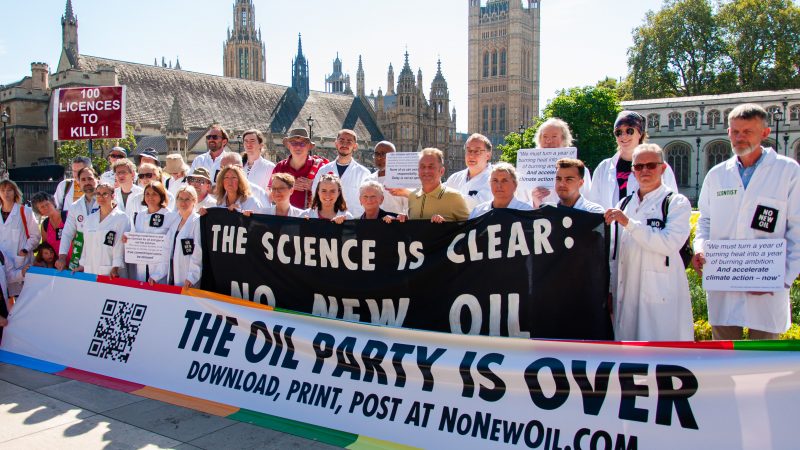
Scientists protest at UK Parliament 5 September 2023.
dizzy: I’m expecting huge disinvestment and consequent disempowerment of the fossil fuel sector. The longer investors stay in fossil fuels, the larger their lossses will be. later elaboration: Plutocrats are losing control of the narrative, activists are aware of and highlighting huge fossil fuel subsidies and fossil fuel lies like CCS, renewables becoming much cheaper, court cases, greater acceptance and recognition of role of fossil fuels in destroying the planet, green parties achieving much higher vote share, it’ll hit the fan. later still elaboration: All the increasingly extreme and more often weather events that we’re experiencing attributed to fossil fuels caused climate crisis.
“These carbon credits are essentially predicting whether someone will chop down a tree, and selling that prediction,” said one study author. “If you exaggerate or get it wrong, intentionally or not, you are selling hot air.”
Most carbon offset schemes significantly overestimate their impact on reducing deforestation, with many of the carbon credits purchased by polluting corporations amounting to little more than “hot air,” according to a researcher behind a study released Thursday that could portend billions of dollars in losses for speculators.
“Reducing emissions from deforestation and forest degradation (REDD) projects are intended to decrease carbon emissions from forests to offset other carbon emissions and are often claimed as credits to be used in calculating carbon emission budgets,” explains the study, which was published in the journal Science.
However, according to the study:
We examined the effects of 26 such project sites in six countries on three continents using synthetic control methods for causal inference. We found that most projects have not significantly reduced deforestation. For projects that did, reductions were substantially lower than claimed…
Methodologies used to construct deforestation baselines for carbon offset interventions need urgent revisions to correctly attribute reduced deforestation to the projects, thus maintaining both incentives for forest conservation and the integrity of global carbon accounting.
“Carbon credits provide major polluters with some semblance of climate credentials. Yet we can see that claims of saving vast swathes of forest from the chainsaw to balance emissions are overblown,” study co-author Andreas Kontoleon, from the University of Cambridge’s Department of Land Economy, said in a statement.
“These carbon credits are essentially predicting whether someone will chop down a tree, and selling that prediction,” he added. “If you exaggerate or get it wrong, intentionally or not, you are selling hot air.”
A new analysis in Science reveals that emission reductions from forest conservation projects—sometimes used to “offset” carbon emissions from other sources—have been overestimated.
Kontoleon added that overestimations of forest preservation have driven an increase in the number of carbon credits on the market, resulting in artificial price suppression.
“Potential buyers benefit from consistently low prices created by the flood of credits,” he said. “It means that companies can tick their net-zero box at the lowest possible cost.”
This could mean that carbon speculators stand to lose billions of dollars in the future as offsets become stranded assets.
“It’s currently a buyer’s market and buyers are, rightly, prioritizing quality. There are over a billion tons of issued but not retired credits in the market—this suggests lots of credits can be written off, and there will remain a large supply for buyers to tap into,” Anton Root, head of research at AlliedOffsets, toldThe Guardian Thursday.
“A correction like that could help to orient the market toward fundamental supply-demand dynamics, which we don’t currently tend to see, and drive up the price for credits that are deemed to be above the quality threshold,” he added.
“Carbon credit speculators could lose billions as scientific evidence shows many offsets they have bought have no environmental worth and have become stranded assets.” https://t.co/gnx6fZy8yS
The new research follows other scientific research and journalistic investigations, including a January study by The Guardian, Die Zeit, and SourceMaterial that concluded that over 90% of the rainforest carbon offsets sold by Verra, the nonprofit organization that sets the world’s leading sustainability standard, “are largely worthless and could make global heating worse.”
While some scientists argue that CO2 extraction, either via natural or technological means, is needed in order to meet the goals of the Paris climate agreement, opponents call the technology a “false climate solution.”
“Carbon offset markets are widely discredited,” Food & Water Watch policy director Jim Walsh said earlier this year. “Their only benefit lies in enriching the middlemen charged with selling the lie.”
Despite this, the Biden administration is pushing ahead with a plan to invest $2.5 billion in a pair of major carbon capture and storage projects, which it claims will “significantly reduce carbon dioxide emissions from electricity generation and hard-to-abate industrial operations” as part of the “effort critical to addressing the climate crisis and meeting the president’s goal of a net-zero emissions economy by 2050.”
“Instead of providing desperately needed clean energy, they feed us greenwashing garbage.”
A new analysis of the activities of twelve major fossil fuel giants shows that the companies are misleading the public about their emission-reduction commitments while raking in record profits from fossil fuels, which are driving catastrophic extreme weather events across the globe.
In a report published Wednesday, Greenpeace Central and Eastern Europe examines the decarbonization pledges, investments, and profits of six global fossil fuel giants—including Shell, BP, and TotalEnergies—and six European oil companies.
The results indicate that, in 2022, close to 93% of the oil giants’ investments on average went to keeping the companies on the “fossil oil and gas path” while just 7.3% were aimed at promoting “low-carbon solutions” and sustainable production.
“Although most of the sample companies are committed to ‘net zero’ by 2050, a closer look shows that none of them has developed a coherent strategy to achieve this,” the report notes, adding that the examined companies are in fact “scaling back their ambitions” even as their polluting activities wreak havoc worldwide. Shell and BP recently announced they are ditching previous plans to curb oil production and emissions.
The report shows that BP, Equinor, Wintershall and TotalEnergies cut their investments in renewable products last year—a fact that, according to Greenpeace, bolsters the case for “compulsory investment in genuinely green infrastructure” and other government regulations.
Kuba Gogolewski, a finance campaigner at Greenpeace CEE, said Wednesday that “as the world endures unprecedented heat waves, deadly floods, and escalating storms, Big Oil clings to its destructive business model and continues to fuel the climate crisis.”
“Instead of providing desperately needed clean energy, they feed us greenwashing garbage,” Gogolewski added. “Big Oil’s unwillingness to implement real change is a crime against the climate and future generations. Governments need to stop enabling fossil fuel companies, heavily regulate them, and plan our fossil fuel phase-out now. They will never change on their own.”
“Fossil fuel companies like Shell, TotalEnergies, BP Equinor, and ENI have shown the public they are incapable of self-regulation.”
The new report offers several examples of companies offering misleading data in an apparent attempt to convince investors and the public of their commitment to the renewable energy transition.
“Shell reports a ‘renewable capacity’ of 6.4 gigawatts for the 2022 financial year,” the analysis observes. “Only in the footnote… does one learn that this figure also includes plants that are still under construction or committed for sale. The actual capacity at the end of 2022 was only 2.2 gigawatts, as the group admits in another place in its reporting.”
In the case of BP’s 2022 financial disclosures, the report notes, “there is no number that would show the amount of wind and solar power” the company generated last year.
“This lapse is only an indication that no major oil company can show a comprehensible plan for a ‘net zero’ in 2050,” the report states.
“Fossil fuel companies like Shell, TotalEnergies, BP Equinor, and ENI have shown the public they are incapable of self-regulation after scaling back their climate ambitions, despite being heavily responsible for the climate crisis,” said Gogolewski. “That’s why Greenpeace is calling for European governments to strictly regulate the industry and begin its rapid economic and political downsizing.”
🔴NEW REPORT🔴
🏭Fossil fuel companies have NO MEANINGFUL PLANS to reduce their carbon emissions or switch to renewables.
🤥 Yet they continue with their GREENWASHING talking about greener investments and net zero trajectories.
The new analysis comes in the wake of devastating fires in Maui, Hawaii that were fueled by climate change, which contributed to the severely dry conditions that allowed the fires to spread rapidly.
Maui County is currently suing Shell, BP, and other fossil fuel giants, accusing them of engaging in a “coordinated, multi-front effort to conceal and deny their own knowledge” about the climate threat and profiting “from a massive increase in the extraction and consumption of oil, coal, and natural gas, which has in turn caused an enormous, foreseeable, and avoidable increase in global greenhouse gas pollution and a concordant increase in the concentration of greenhouse gases.”
The Maui lawsuit states that “wildfires are becoming more frequent, intense, and destructive in the county” as the planet warms due to ever-rising carbon emissions.