[T}he very concept of net zero is deeply flawed. It is based on the idea that all we need to do to prevent dangerous levels of warming is eliminate carbon pollution to the point where our remaining emissions are matched by the removal of carbon dioxide from the atmosphere by plants, soils and other natural carbon sinks, as well as – should they ever exist – novel carbon removal technologies. But this focus on emissions is misguided, because it is not how much we emit every year that ultimately counts.
What matters is the concentrations of greenhouse gasses in the atmosphere and these, as the planetary catastrophe unfolding around us testifies, are already far too high.
Atmospheric concentrations of the most significant greenhouse gas, carbon dioxide, are now around 420 parts per million, up from 280 ppm in the 18th Century and 336 ppm when I was born in 1979.
The safe level is generally considered to be no more than 350 ppm, yet net zero aims to stabilise concentrations at whatever level they reach when we finally reach carbon neutrality – and that may be as high as 470 ppm even if we meet our commitments globally. Given what we’re already experiencing at 420 ppm, stabilising the climate at such levels should be unthinkable – and that means we need to rethink net zero.
Rather than slowly applying the brakes with the aim of stopping by 2050, we should be slamming on the brakes immediately and then shifting into reverse. Simply reducing emissions to net zero is not enough, we should be aiming for net negative so that we can start reducing atmospheric concentrations back down to safe levels.
“Without policies such as regulations or taxes on very polluting investments, it’s unlikely that wealthy individuals making a lot of money from fossil fuel investments will stop investing in them,” says one economist.
The richest tenth of U.S. households are responsible for 40% of all the nation’s greenhouse gas emissions, a study published Thursday revealed, underscoring what progressives say is the need for regulations and taxes on carbon-intensive investments.
Published in PLOS Climate, the study—which was led by University of Massachusetts, Amherst sustainability scientist Jared Starr—analyzed 30 years of U.S. household income data and the greenhouse gas emissions generated in creating that income.
“We find significant and growing emissions inequality that cuts across economic and racial lines,” the paper notes. “In 2019, fully 40% of total U.S. emissions were associated with income flows to the highest earning 10% of households.”
“Among the highest-earning 1% of households (whose income is linked to 15-17% of national emissions), investment holdings account for 38-43% of their emissions,” the publication continues. “Even when allowing for a considerable range of investment strategies, passive income accruing to this group is a major factor shaping the U.S. emissions distribution.”
“It just seems morally and politically problematic to have one group of people reaping so much benefit from emissions while the poorer groups in society are asked to disproportionately deal with the harms of those emissions.”
The study’s findings are consistent with research published in 2021 by the Institute for European Environmental Policy and the Stockholm Environment Institute that estimated the wealthiest 1% of humanity was on track to produce 16% of all global CO2 emissions by 2030. Additionally, a 2022 Oxfam report found that a single billionaire produces a million times more carbon emissions than the average person.
Starr toldThe Washington Post that “as you move up the income ladder, an increasing share of emissions is associated with investments.”
New research by @jaredmstarr and colleagues finds that in 2019, 40% of total U.S. greenhouse gas emissions were associated with income flows to the highest earning 10% of householdshttps://t.co/ypZGWH5MDD
Then there were “super-emitters” with extremely high overall greenhouse gas emissions, corresponding to about the top 0.1% of households. About 15 days of emissions from a super-emitter was equal to a lifetime of emissions for someone in the poorest 10% in America.
The team found that the highest emissions linked to income came from white, non-Hispanic homes, and the lowest came from Black households. Emissions peaked until age 45 to 54, and then declined.
“It just seems morally and politically problematic to have one group of people reaping so much benefit from emissions while the poorer groups in society are asked to disproportionately deal with the harms of those emissions,” said Starr.
The study asserts that “results suggest an alternative income or shareholder-based carbon tax, focused on investments, may have equity advantages over traditional consumer-facing cap-and-trade or carbon tax options and be a useful policy tool to encourage decarbonization while raising revenue for climate finance.”
Lucas Chancel, a French economist who was not part of the study, told the Post that “all Americans contribute to climate change, but clearly not in the same way.”
“Without policies such as regulations or taxes on very polluting investments,” he stressed, “it’s unlikely that wealthy individuals making a lot of money from fossil fuel investments will stop investing in them.”
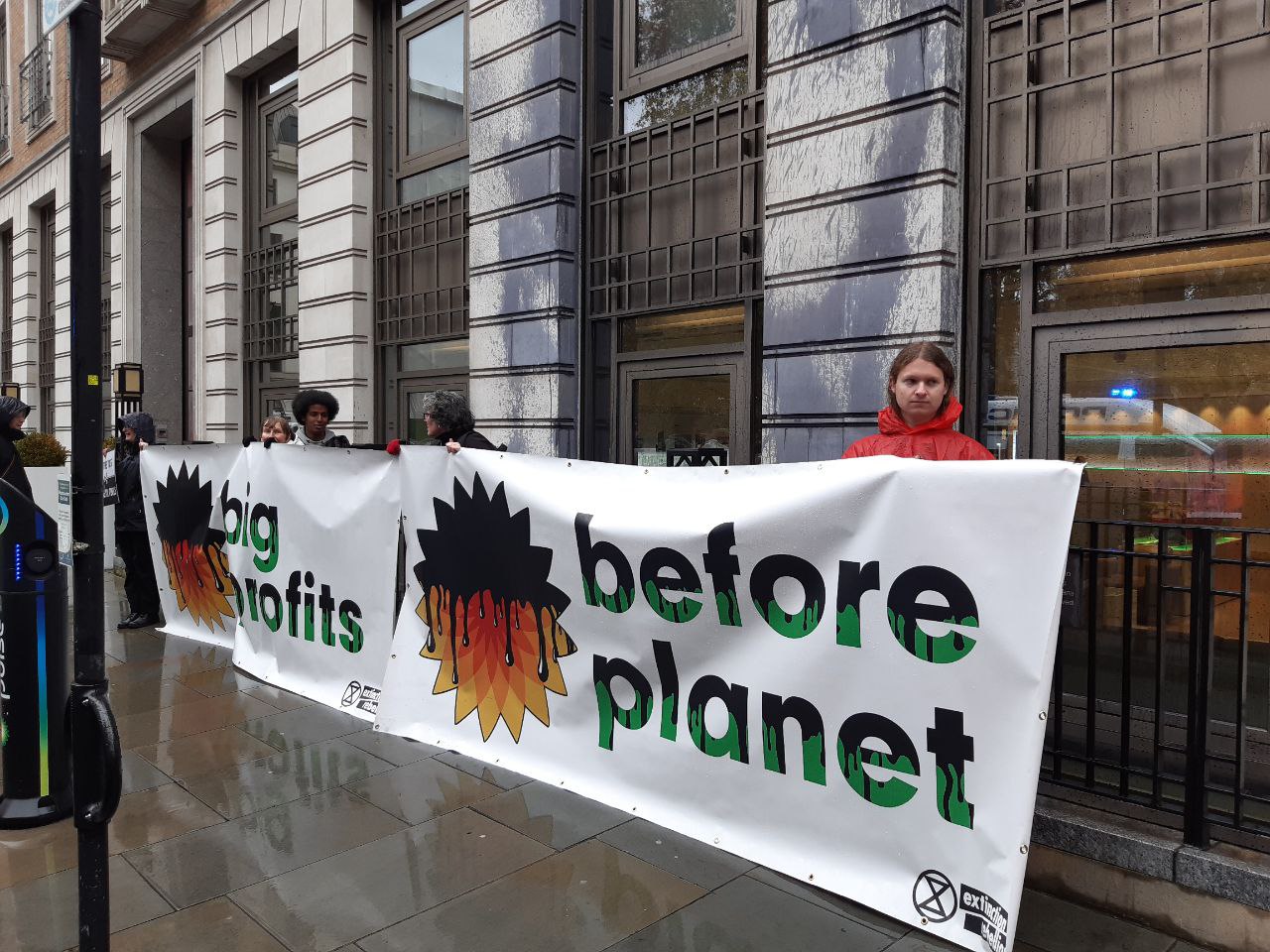
LONDON, Feb 10 (Reuters) – Some climate-focused investors in BP (BP.L) voiced concern this week about the company’s announcement that it has scaled back climate targets and now plans to produce more oil and gas for longer, yet the company’s share price continued to surge on Friday.
Chief Executive Bernard Looney’s strategy revision on Tuesday included a cut to BP’s 2030 emissions reduction target. Three years ago, he took the helm with a vow to re-invent the oil and gas company.
…
Bruce Duguid, head of stewardship at Federated Hermes, which co-leads negotiations with BP over its energy transition on behalf of a large group of institutional investors called Climate Action 100+, voiced concern over Looney’s pivot.
“In the context of a very strong financial outcome, those investors with net-zero goals, including many of our clients, will be concerned at such a material change to BP’s 2030 absolute emissions reduction target,” Duguid said in a statement to Reuters.
Any climate commitment from a bank that is still financing fossil fuel expansion is greenwashing, pure and simple,” said a Stop the Money Pipeline campaigner.
Taking aim at Wall Street banks financing the oil, gas, and coal extraction fueling the climate crisis, a coalition of institutional investors on Tuesday announced the filing of climate-related shareholder resolutions in an effort to force “more climate-friendly policies that better align with” the firms’ public commitments to combating the planetary emergency.
In the resolutions, members of the Interfaith Center on Corporate Responsibility (ICCR) and Harrington Investments asked six banks—Bank of America, Goldman Sachs, JPMorgan Chase, Morgan Stanley, Citigroup, and Wells Fargo—to enact policies phasing out fossil fuel finance, disclose plans for aligning their financing with their stated near-term emissions reduction goals, and to set absolute end-of-decade emissions reduction targets for their energy sector financing.
Shareholders also filed climate resolutions at four companies—Chubb, Travelers, The Hartford, and Berkshire Hathaway—that insure fossil fuel projects.
“Each of the major banks has publicly committed to aligning its financing with the goals of the Paris agreement to achieve net-zero emissions by 2050, a target widely considered imperative to avoid catastrophic climate impacts and financial losses,” ICCR said in a statement. “Scientific consensus shows that new fossil fuel expansion is incompatible with achieving net-zero by 2050, yet these banks continue to invest billions of dollars each year in new fossil fuel development—a fact corroborated by a new Reclaim Finance report released last week.”
As Stop the Money Pipeline—a coalition of over 200 groups seeking to hold “financial backers of climate chaos accountable”—noted:
A slate of resolutions calling for policies to phase out financing for fossil fuel expansion was filed by the same investors at U.S. banks in 2022. They received between 9% and 13% support, which was a significant milestone for these first-of-their-kind proposals. This year’s fossil fuel financing proposals have been updated to encourage banks to finance clients’ low-carbon transition so long as those plans are credible and verified. The previous resolutions were supported by many major institutional investors, including the New York State and New York City Common Retirement Funds.
New in 2023 are the resolutions on absolute emissions reduction targets for energy sector financing filed by the New York City and New York State comptrollers, and the resolutions calling for disclosure of climate transition plans filed by As You Sow. The day before the resolutions were filed, Denmark’s largest bank, Danske, announced a phaseout of corporate financing for companies engaged in new coal, oil and, gas development.
“Any climate commitment from a bank that is still financing fossil fuel expansion is greenwashing, pure and simple,” Arielle Swernoff, U.S. banks campaign manager at Stop the Money Pipeline, said in a statement. “By supporting these resolutions, shareholders can hold banks accountable to their own climate commitments, effectively manage risk, and protect people and the planet.”
NEW! Investors have filed climate shareholder resolutions at major US and Canadian banks.
Dan Chu, executive director of the Sierra Club Foundation—which led the filing at JPMorgan Chase—lamented that “all major U.S. banks continue to finance billions of dollars for new coal, oil, and gas projects every year. Such financing undermines the banks’ net-zero commitments and exposes investors to material risks.”
“These shareholder resolutions simply ask banks to align their promises with their actions and to adopt policies to phase out the financing of new fossil fuel development,” Chu added.
Referring to a warning from the International Energy Agency, Kate Monahan of Trillium Asset Management—which spearheaded the Bank of America filing—said that “we will not be able to achieve the Paris agreement’s goal of limiting warming to 1.5°C if banks continue to finance new fossil fuel exploration and development.”
“Bank of America has publicly committed to the Paris agreement but continues to finance fossil fuel expansion with no phaseout plan, exposing itself to accusations of greenwashing and reputational damage,” Monahan contended. ” By continuing to fund new fossil fuels, Bank of America and others are taking actions with potentially catastrophic consequences.”
Our work is licensed under Creative Commons (CC BY-NC-ND 3.0). Feel free to republish and share widely.
The new coalmine in Cumbria is likely to prevent the UK from meeting its internationally agreed commitment to reduce emissions of the powerful greenhouse gas methane, analysis has suggested.
The Whitehaven colliery, controversially approved by ministers shortly before Christmas, will release about 17,500 tonnes of methane every year, according to estimates from the Green Alliance thinktank.
That is about the same as 120,000 cattle, or about half the beef herd in Cumbria at present, and could put the UK’s methane-cutting targets out of reach.
The analysis comes as campaigners also raise concerns about the filing of more than 100 oil and gas drilling licence applications.