Original article republished from Open Democracy under a Creative Commons Attribution-NonCommercial 4.0 International licence.
Lobbyists for private health corporations were among those tasked with shaping proposals for NHS recovery plan
Adam Bychawski 19 January 2023, 3.31pm
| No 10 Downing Street
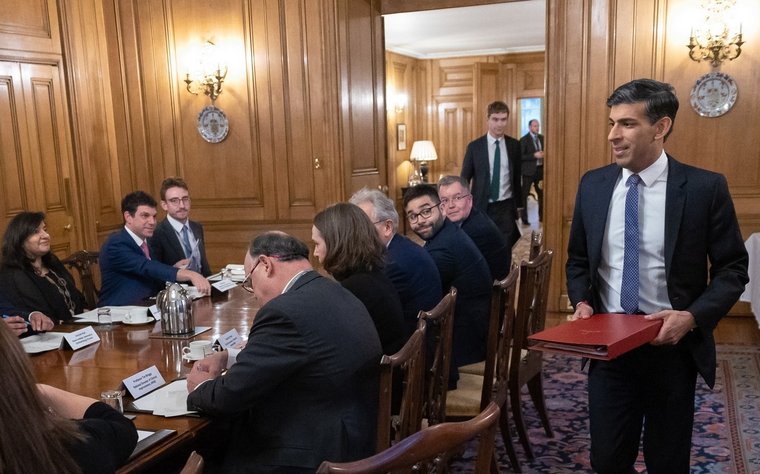
Rishi Sunak hosted a meeting with seven bosses from the UK’s biggest private health companies to discuss how to tackle the NHS backlog, openDemocracy can reveal.
Campaigners have raised concerns that the close involvement of private healthcare corporations in the government’s response to the NHS crisis will benefit shareholders at the expense of public investment.
The government announced the creation of the Elective Recovery Taskforce in December to provide advice on how to “turbocharge NHS recovery from the pandemic, reduce waiting times for patients and eliminate waits for routine care of over a year by 2025”.
At the time, the Department of Health and Social Care (DHSC) refused to give openDemocracy details of the group’s members, or say who had attended its launch at Number 10 led by the PM and health secretary Steve Barclay in December.
A guestlist for the event, obtained by openDemocracy through a Freedom of Information request, reveals that half a dozen CEOs from private health firms were in attendance.
Guests included the chief execs of the UK’s two largest private hospital operators: Paolo Pieri, the chief exec of Circle Health Group, and Justin Ash, who heads up Spire Healthcare. Also present was Jim Easton, the chief executive of Practice Plus Group, the NHS’s top private healthcare provider.
They were joined by David Hare, the chief executive of Independent Healthcare Provider Network, a lobby group that represents for-profit and not-for-profit private health organisations including Bupa and HCA, one of the biggest healthcare facility companies in the US.
Related story
Revealed: Conservatives took more than £800,000 from private health firms
Private health tycoons have wined and dined senior ministers while cashing in on NHS contracts
The private healthcare executives, which also included CEOs from Horder Healthcare, Newmedica, InHealth and Medefer, outnumbered the five NHS England directors invited to the event.
DHSC said it could not provide openDemocracy with minutes from the meeting because none were taken, and refused to share any papers handed out to attendees.
Separately, the government quietly published a list of members of the Elective Recovery Taskforce on Monday. The 16-person group includes DHSC ministers, six NHS bosses, and Hare.
Other members include Bill Morgan, a private healthcare lobbyist whose past clients included Virgin Care, who was appointed a Number 10 adviser in November, and Paul Manning, an NHS consultant surgeon who is also chief medical officer for Circle Healthcare.
The government said the role of the task force would be to “shape proposals for how the healthcare system can make use of all resources at its disposal, further tackling the backlog caused by the Covid-19 pandemic”. It will conclude its work in March.
Last week, the prime minister said he had signed up to an NHS GP after the Guardian reported that he had registered with a private clinic in west London that charges £250 for a consultation.
The British Medical Association warned last year that the government’s NHS recovery plan would significantly increase the outsourcing of services to private providers and that it “threatens the clinical and financial viability and sustainability of the NHS”.
Tony O’Sullivan, a retired consultant paediatrician and co-chair of Keep Our NHS Public, told openDemocracy: “The head parasites are at the table to maximise future extraction of NHS funds.”
He added: “This is an important disclosure extracted from the government proving the direction of travel – to continue disinvesting in the NHS and increase its enforced dependence on private health care.
“The private sector was bailed out during Covid, has a lucrative four-year £10bn deal ongoing and is also in a position to earn massive profits from patients forced to go privately to avoid NHS queues of 7.2 million.”
openDemocracy has no paywall and relies on the backing of thousands of our readers to make stories like this freely available to everyone. You can support our work by making a donation here.
Original article republished from Open Democracy under a Creative Commons Attribution-NonCommercial 4.0 International licence.