The use of military force in Iran could backfire for Washington

Spread the love
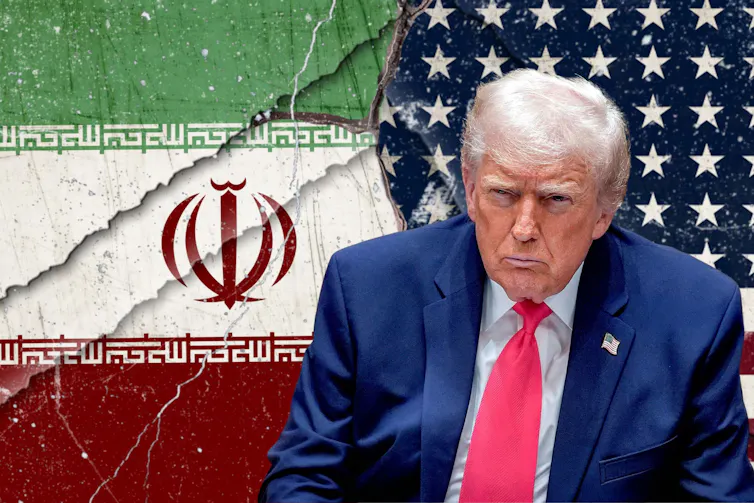
Tehran has said it is ‘ready for war’ after Trump’s threats of US military action. Lucas Parker / Mr Changezi / Shutterstock / Canva

Bamo Nouri, City St George’s, University of London

Donald Trump is weighing military action in Iran over the state’s crackdown on protesters. Reports suggest that more than 600 people have been killed since the protests began in late December, with the US president saying the US military is now “looking at some very strong options”.

Trump has not yet elaborated on what these options are and has said that Iranian officials, keen to avoid a war with the US, had called him “to negotiate”. But he added that the US “may have to act before a meeting” if the deadly crackdown continues.

There is a wide spectrum of measures available to Washington should it decide to intervene in Iran. These range from diplomatic condemnation and an expanded sanctions regime, to cyber operations and military strikes. However, history weighs heavily against every move the US government may be considering.

Targeted sanctions and diplomatic pressure, which includes the 25% tariff rate recently introduced by Trump on any country that does business with Iran, remain the least escalatory tools. They allow the US to coordinate with its allies and signal moral support for protesters in Iran without triggering direct confrontation. Yet decades of experience show the limits of this approach.

Iran’s leadership has mastered how to absorb economic pressure, shift costs on to society and frame longstanding western sanctions as collective punishment imposed by hostile outsiders. The government in Tehran has adapted over time by developing alternative markets and expanding informal and non-dollar trade.

It has also boosted its economic resilience through regional networks, particularly in Iraq where political, financial and security ties help sustain revenue flows and cushion the impact of sanctions on the state.

There are other, more covert tools at Washington’s disposal, including cyber disruption and efforts to assist independent media or help protesters bypass internet shutdowns. These measures can help protesters stay visible internationally and complicate the state’s capacity to ramp up repression.

However, even here expectations should be modest. These tools may create friction within the Iranian elite by raising the costs of, and imposing technical difficulties on, surveillance and repression. But they do not change the core calculus of a regime that prioritises survival above all else.

At the most extreme end of the spectrum are military strikes. The rationale behind strikes would be to undermine the regime’s repression efforts. But in reality, they risk doing the opposite. Iran’s ruling system, and particularly the powerful Islamic Revolutionary Guard Corps branch of the armed forces, has historically relied on external threats to consolidate power domestically.

A preemptive US strike would almost certainly hand Iran’s security apparatus the very narrative it seeks: an existential battle for national survival. This framing is already explicit in the discourse of the Iranian elite.

Mohammad Bagher Ghalibaf, the hardline speaker of the Iranian parliament, warned in a recent speech that any attack on Iran would make Israel and all US military bases and assets in the region “legitimate targets”. Iranian state media then showed large crowds of regime supporters rallying in Tehran and other cities, chanting “Death to America” and “Death to Israel.”

Military escalation is especially dangerous given the character of the current protest movement. Women have been at the forefront, challenging the ideological foundations of the state, while regions populated largely by ethnic Kurds have endured disproportionate levels of violence at the hands of the authorities.

These protests are civic, decentralised and rooted in social grievances. US military strikes would allow the Iranian state to overwrite that reality, recasting a diverse domestic movement as a foreign-backed security threat. In doing so, it would legitimise a far harsher crackdown than anything seen so far.

Shadow of 1953

Many ordinary Iranians are also cautious of direct US interference. This stems from a CIA-backed coup in 1953 that ousted Iran’s elected prime minister, Mohammad Mosaddeq, and restored the monarchy under Shah Mohammad Reza Pahlavi. The coup was followed by nearly two decades of repression, political policing and authoritarian rule closely aligned with western interests.

This experience is not distant history; it is a foundational trauma that continues to shape Iranian political consciousness. As a result, recent suggestions by Trump that the collapse of Iran’s theocratic system would naturally make way for a democratic transition cannot be disentangled from the memory of an external intervention that produced dictatorship rather than self-rule.

It also explains why many people inside Iran are sceptical of figures such as Reza Pahlavi, the son of country’s last shah who has often been promoted in the west as a possible future leader of Iran. Pahlavi remains symbolically tied to a system associated with oppression and foreign backing. This leaves him without the broad domestic legitimacy required for any credible democratic transition, regardless of his messaging.

The scepticism of Iranians is reinforced by recent regional experiences. In Iraq, foreign intervention hollowed out the state, leaving a weak system that has been co-opted by external powers and militias.

And in Syria, the collapse of central authority paved the way for a former al-Qaeda leader, Ahmed al-Sharaa, to take power. He has been rebranded by western powers, including Trump, into a credible political figure despite his jihadist past.

These cases reinforce a belief across the Middle East that western intervention tends not to empower democratic forces. It instead appears to elevate the most organised and militarised parties to power, producing long-term instability rather than renewal.

Without a credible, homegrown transition, Iran risks fragmenting and sliding into chaos. For Washington, the most difficult reality may be that the wisest path is not bold intervention, but restraint combined with sustained support for Iranian society.

Genuine change in Iran cannot be engineered from the outside, especially at the point of a missile.

Bamo Nouri, Honorary Research Fellow, Department of International Politics, City St George’s, University of London

This article is republished from The Conversation under a Creative Commons license. Read the original article.

Elon Musk urges you to be a Fascist like him, says that you can ignore facts and reality then.
Donald Fuhrump says that Amerikkka doesn't bother with crimes or charges anymore, not being 100% Amerikkkan and opposing his real estate intentions is enough.
Donald Fuhrump says that Amerikkka doesn’t bother with crimes or charges anymore, not being 100% Amerikkkan and opposing his real estate intentions is enough.
Orcas discuss how Trump was re-elected and him being an obviously insane, xenophobic Fascist.

Continue ReadingThe use of military force in Iran could backfire for Washington

Asylum is not illegal migration – why the UK government shouldn’t conflate the two

Spread the love
Ajdin Kamber/Shutterstock

Nando Sigona, University of Birmingham

The UK government’s latest proposals on asylum rest on an incorrect premise. In announcing them, home secretary Shabana Mahmood argued that “illegal migration is tearing our country apart”. But asylum-seeking is not illegal migration.

Asylum is a form of protection granted by a country to a non-citizen who faces persecution in their home country. The right to seek asylum is enshrined in international law, and applies irrespective of how the person travelled to the place where they are seeking protection.

Yet the policies being rolled out collapse two distinct categories into a single threat, to be addressed through deterrence and control. In effect, the category of the asylum seeker is equated to that of “illegal migrant”. Both are discussed as “abusing the system”, “flouting the rules” and “undermining communities”.

The underlying implication is that all asylum seekers are “illegal migrants”. Any system that follows will therefore be built on a distortion. Its consequences will fall not on the minority who try to game the system, but on the overwhelming majority who have legitimate claims for protection.

In 2024, 84,200 applications for asylum were made in the UK, relating to 108,100 individuals. More than 36,500 asylum appeals were lodged against negative decisions, with 48% of them allowed. Recent data show that in the months to March 2025, 47% of initial decisions resulted in the applicant being granted refugee status.

The new asylum measures promise faster decisions on asylum applications, tougher thresholds to be granted status, and expanded detention and removals. In continuity with the previous Conservative government, the rhetoric of “restoring control” makes the direction clear: restrict access to protection, harden the conditions for claiming it, and speed up refusals.

Labour is not hiding its reasoning for this approach. The government explicitly argues that firmer control is needed to prevent “darker forces” from coming into power. This is presented not as a concession to the far right, but as a public rationale for tightening the system. The message is clear: these policies are needed to keep politics steady, not because they improve the asylum system.

The issue is not simply that the proposals are harsh, unethical or likely to be ineffective. They represent a deeper shift: redefining protection as a discretionary favour rather than a legal obligation. Control becomes the primary focus, leaving less space for discussing refugee rights, protection and international obligations.

If asylum is framed as illegality, and settlement is reshaped into a privilege that must be endlessly earned, then our understanding of equal membership – the idea that those lawfully in the UK should enjoy stability and a clear path to full inclusion – is fundamentally altered.

A lifetime review

One of the key proposals is to extend the length of time it takes for a refugee to achieve settlement from five to 20 years. Until recently, settlement – the immigration status that allows a non-UK citizen to live, work and study in the UK without time restrictions – was the expected outcome for anyone granted refugee status. It is also a prerequisite for applying for British citizenship.

The new proposals transform settlement into something that must be continually earned. The path has become longer, more conditional and far more easily disrupted.

This aligns closely with other recent announcements on policies relating to migrants more generally. Higher salary thresholds, more enforcement, extended probationary periods and more complex routes to settlement have all been tabled.

These changes would build a structural disadvantage into the migration system. Non-citizens can live, work and contribute, but their belonging remains conditional. They become long-term residents on a form of probation, their status always open to review. This is more than an administrative change. It creates a hierarchy of membership that shapes lives, futures and families.

For a refugee family, this can mean years of uncertainty: parents unable to plan long-term careers or mortgages; partners and children living with the fear that a change in income, a missed renewal deadline or a shift in political priorities could jeopardise their right to remain.

It can also mean delays or barriers to family reunification, with spouses or children abroad left in limbo while the principal applicant waits to demonstrate continuous compliance. In practice, what should be a path to stability becomes a prolonged period of vulnerability, in which everyday life is overshadowed by the possibility of losing one’s status.

Nando Sigona, Professor of International Migration and Forced Displacement and Director of the Institute for Research into International Migration and Superdiversity, University of Birmingham

This article is republished from The Conversation under a Creative Commons license. Read the original article.

Keir Starmer refuses to be outcnuted by Nigel Farage's chasing the racist bigot vote.
Keir Starmer refuses to be outcnuted by Nigel Farage’s chasing the racist bigot vote.
Continue ReadingAsylum is not illegal migration – why the UK government shouldn’t conflate the two

‘No kings’: America’s oldest political slogan is drawing millions out onto the streets

Spread the love
Michael Nigro/Pacific Press via ZUMA Press Wire

Tom F. Wright, University of Sussex

Every few decades, Americans rediscover that their republic was built on a rejection – the rejection of being ruled by a monarch. Now, in one of the largest protest movements in many years, the phrase “No kings” is everywhere: on placards, online memes, and in chants aimed at a president who seems to want to rule rather than serve.

Yet the words are hardly new. They are the first note in the American political scale, the country’s founding slogan before it even had a flag.

Long before it echoed through the colonies, the slogan “No king but Jesus” rang out in the English civil war, where it was used to declare that divine authority, not royal prerogative, should rule the conscience.

When it crossed the Atlantic, colonial Americans inherited a phrase, a stance and an image that could turn theology into politics and rebellion into virtue.

As Thomas Paine put it in his 1776 pamphlet, Common Sense: “Of more worth is one honest man than all the crowned ruffians that ever lived.” Republican speech was invented by rejecting monarchy.

When independence was achieved, America’s experiment rested on a paradox: it needed strong leadership but feared the aura of command. “No kings” was a self-diagnosis of a nervous republic. A way of keeping the charisma of a leader on a leash.

That allergy to grandeur shaped the early republic. In the 1790s when John Adams proposed that the president be addressed as “His Highness”, he was swiftly mocked as “His Rotundity”. The laughter mattered. It expressed the conviction that democracy could not survive reverence.

By the 1830s, this suspicion of pomp had become visual. Critics of the seventh president, Andrew Jackson, issued a famous broadside “King Andrew the First” showing him crowned and trampling the constitution. It wasn’t just partisan art – it was an act of democratic hygiene.

Image from cover of 1864 pamphlet depicting Abraham Lincoln as a king.
Abraham LIncoln depicted as a king in 1864. Lincoln Financial Foundation Collection

A generation later, Abraham Lincoln faced the same charge. During the American civil war, a notorious 1864 pamphlet Abraham Africanus I accused him of seeking to become a “hereditary ruler of the United States”. His sweeping wartime powers fed old fears that emergency rule would harden into monarchy.

Sometimes, the charge is justified. When Puck magazine in 1904 depicted Theodore Roosevelt crowning himself Louis XIV (or perhaps Napoleon), it captured the public’s mixture of thrill and alarm at his trust-busting, canal-building, imperial swagger. Citizens wanted vitality in office, but not vanity.

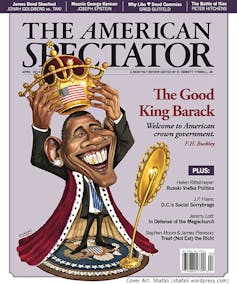
Image from cocver of American Spectgator 2014 showing a caricature of Barack Obama crowning himself king.
How the American Spectator depicted Barack Obama in 2014. American Spectator

Other times, the imagery seemed to speak more to American paternal longings. Take images of Dwight Eisenhower as “King Ike” in the 1950s, a genial ruler among smiling courtiers, soothing cold war nerves.

In our own century, the crown returns in sharper form. The American Spectator’s 2014 cover, “The Good King Barack” showed Obama beaming beneath a red velvet crown.

When Donald Trump triumphed in 2016, crown memes returned as America’s simplest moral shorthand for power that has gone too far.

It fell to his successor Joe Biden to officially declare, in response to the July 2024 Supreme Court ruling that Trump was not immune from prosecution: “This nation was founded on the principle that there are no kings in America.”

Why the crown keeps returning

The crown is both insult and safety valve at once. It’s an instantly legible piece of political folk art reminding citizens that authority is temporary, fallible and – like its wearer – mortal.

When protesters revive “No kings”, they aren’t just quoting the revolution. They’re translating an older language of civic republican virtue into an accent everyone can understand. No person above the law, no office above criticism, no citizen beneath respect.

The slogan reawakens the moral reflex that freedom depends on vigilance, and that dignity belongs to the governed as much as the governors.

And here’s the irony: both parties were founded on that same cry. Democrats and Republicans trace their roots to the anti-monarchical Democratic-Republicans of Thomas Jefferson and James Madison, who defined their movement against the spectre of kingly power. That party later fractured, giving rise to both modern traditions.

In that sense, “No kings” was the nation’s first party platform, the point of agreement from which every later disagreement grew.

Can it still work?

In today’s fractured America, “No kings” offers something rare: a language of protest that feels constitutional rather than ideological. It has the potential to speak to conservatives alarmed by executive overreach, to progressives wary of authoritarian drift, and to independents nostalgic for civic balance.

That gives it unusual rhetorical strength. Unlike most modern slogans – “Drill baby, drill”, “Make America great again” (Maga), or “Defund the police” – it doesn’t divide, it recalls a principle. “No kings” reminds Americans that what unites them is the rejection of tyranny.

The phrase also appeals to exhaustion as much as outrage. After years of political spectacle, “No kings” gestures toward humility, order and self-restraint: the virtues both parties claim to miss.

The movement may go nowhere. But if this moment does turn out to be an inflection point, it is a fitting way to frame it.

To chant “No kings” now is not nostalgia but muscle memory. That is how a republic tests its pulse: by mocking grandeur, refusing awe and rediscovering equality in the act of saying no.

Tom F. Wright, Reader in Rhetoric, University of Sussex

This article is republished from The Conversation under a Creative Commons license. Read the original article.

Orcas discuss how Trump was re-elected and him being an obviously insane, xenophobic Fascist.
Donald Trump urges you to be a Climate Science denier like him. He says that he makes millions and millions for destroying the planet, Burn, Baby, Burn and Flood, Baby, Flood.
Orcas discuss Donald Trump and the killer apes' concept of democracy. Front Orca warns that Trump is crashing his country's economy and that everything he does he does for the fantastically wealthy.
Orcas discuss Donald Trump and the killer apes’ concept of democracy. Front Orca warns that Trump is crashing his country’s economy and that everything he does he does for the fantastically wealthy.
Continue Reading‘No kings’: America’s oldest political slogan is drawing millions out onto the streets

No wonder England’s water needs cleaning up – most sewage discharges aren’t even classified as pollution incidents

Spread the love
oneSHUTTER oneMEMORY/Shutterstock

Alex Ford, University of Portsmouth

England’s privatised water industry may one day be considered a textbook case study of failed corporate responsibility, regulation and governance. The Cunliffe review, the recent report into England’s privatised water industry, concluded that the financial regulator, OfWat, needs to be disbanded and a new water regulator will be introduced.

For that to work effectively, better pollution monitoring and more clearly defined pollution incident criteria are essential. While politicians and water companies have claimed to be reducing pollution incidences, they might not strictly be tackling sources of pollution, so communications must be carefully scrutinised for disinformation.

The UK’s environment minister Steve Reed MP has described the water industry as “broken”. The public have rising water bills. Water companies owe over £60 billion in debts and have left the country with uncertain water security in the face of climate change.

The Environment Agency (EA) in England recently announced that serious pollution incidents in 2024 rose by 60% to 75 from 47 in the previous year. The EA classifies pollution incidents using a four-point scale called the common incident classification scheme. Trained EA officers consider the evidence reported via their incident hotline to assess its credibility and severity.


Get your news from actual experts, straight to your inbox. Sign up to our daily newsletter to receive all The Conversation UK’s latest coverage of news and research, from politics and business to the arts and sciences.


Category 1 is for major incidents, 2 for significant, 3 for minor incidents and 4 for no impact. Category 1 and 2 typically involve visible signs of dead fish floating. For salmon, if more than 10 adult or 100 young fish are dead, this is category 1. With fewer than ten adult and 100 young fish dead, it’s category 2.

No dead fish, no serious problem? The EA can also record damage on protected habitats as “pollution incidents” but these are harder to substantiate without investigative research that takes time and money.

Last year, more than 450,000 sewage discharges were recorded by event duration monitors. These are devices fitted to the end of overflow pipes that indicate when and for how long they have been discharging.

These discharges represent 3.6 million hours of untreated sewage going into our rivers and coasts. These contain chemical contaminants including pharmaceuticals, detergents and human pathogens. Only 75 incidents were recorded as serious or significant in 2024. Another 2,726 were classed as minor.

So lots of sewage discharges are not being classified as pollution incidents, despite containing pollutants. The EA advises its investigating officers to “record substantiated incidents that result in no environmental impact, or where the impact cannot be confirmed, as a category 4”.

The EA has been criticised for turning up late to 74% of category 1 and 2 pollution incidents and for being pressured to ignore low-level pollution – all claims that they have denied. However, they admit they are constrained by finances. Any new regulator must be adequately resourced and independent.

pollution from pipe out into environment
Pollution isn’t always classified as an official pollution incident. YueStock/Shutterstock

In their recent report into pollution incidences, the EA states that they respond to all category 1 and 2 (serious and significant) water industry incidents and will be increasing their attendance at category 3 (minor) incidents. They highlight that more inspections will identify more issues. This shows some acceptance that the more incidents they attend, the more would be substantiated or recorded appropriately.

Most sewage discharges would not have been reported to, or recorded by, the EA as pollution incidents because they were permitted discharges from combined stormwater overflows. Water companies are allowed to discharge untreated wastewater under exceptional rainfall or snowfall conditions to prevent sewage backing up through the pipes.

Extra water flow in rivers from rainfall is meant to dilute chemical contaminants in wastewater. However, some discharges can last days or weeks. The EA is currently investigating whether water companies have been breaching their permits and discharging untreated wastewater when there is low or even no rainfall.

What counts as pollution?

The UN classifies pollution as “presence of substances and energy (for example, light and heat) in environmental media (air, water, land) whose nature, location, or quantity produces undesirable environmental effects”. This definition differs markedly from the EA’s working definition of pollution incidents.

Many sewage discharges containing low concentrations of pollutants won’t kill fish but might still be harmful to fish larvae or small insects, for example.

However, the broad picture from EA data is that invertebrate communities at least are in a better state than they were three decades ago before wastewater treatment plants were upgraded following the EU’s Urban Wastewater Directive.

Some pollutants bioaccumulate through the food chain, so they become concentrated in top predators such as orcas. Some chemicals mimic reproductive hormones even in low concentrations and can feminise fish, for example. High levels of nutrients from agriculture and sewage in rivers can cause fungal diseases in seagrass meadows.

Other families of chemicals build up in wildlife and people, such as persistent “forever chemicals”, much of which comes from wastewater discharges. Continued discharges of antibiotics into waterways might not be classified as pollution incidents but still pose a substantial risk to human and ecosystem health through bacteria developing antibiotic resistance.

The government has just committed to cut sewage pollution by 50% by December 2029 based on 2024 data. But it’s not yet clear whether these involve cutting the frequency of discharges, the duration or both.

This data could also be manipulated so that a large number of small discharges can be consolidated into one official discharge event. Currently, the volume of discharges from stormwater overflows isn’t known. Without this vital data we can’t ascertain the risk posed by their contaminants.


Don’t have time to read about climate change as much as you’d like?
Get a weekly roundup in your inbox instead. Every Wednesday, The Conversation’s environment editor writes Imagine, a short email that goes a little deeper into just one climate issue. Join the 45,000+ readers who’ve subscribed so far.


Alex Ford, Professor of Biology, University of Portsmouth

This article is republished from The Conversation under a Creative Commons license. Read the original article.

Continue ReadingNo wonder England’s water needs cleaning up – most sewage discharges aren’t even classified as pollution incidents

Subsidising e-bikes instead of cars could really kick the electric vehicle transition into high gear

Spread the love
Lime bikes are a popular e-bike rental service in London. EPA/Tolga Akmen

Noel Flay Cass, University of Leeds

If you’re thinking of buying a new electric car worth up to £37,000, the UK government has offered to knock up to £3,750 off the price. The measure adds up to £650 million in grants for people to buy EVs (electric vehicles), but as a researcher who studies transport policy and climate change, I think this money would be better spent subsidising e-bikes.

Numerous questions surround the new government policy. Might people who can afford a new car buy one anyway, without the 10% discount? Might car dealers simply reduce the discounts they offer by a similar amount? Given the 20% VAT on an EV, doesn’t a sale actually result in a 200% immediate return for the government? And isn’t this mainly a bung to car manufacturers and company fleets?

The grants come on top of financial assistance for replacing cars, vans, taxis and motorbikes with electric options, announced in February – £120 million in total, including £500 grants for e-motorbikes. But almost no subsidies are available for two-wheeled, pedal-assisted EVs: e-bikes and e-cargo bikes.

The main financial help for buying e-bikes is the cycle to work salary-sacrifice scheme. The employer buys the bike and then instalments are deducted from a participant’s pay before tax, but the scheme’s eligibility is limited to employees on standard payroll tax (PAYE workers) whose sacrifices don’t drop their pay below minimum wage.

This also excludes those who are out of work, the low-paid, the self-employed and retired, arguably people who might benefit most from an e-bike.

Benefits beyond carbon savings

We know that e-bike owners replace lots of trips and miles driven by cars. We also know the upfront cost of around £2,000-£3,000 is a barrier to more people owning one, despite e-bikes being much cheaper than cars.

Estimates of annual carbon savings from e-bikers avoiding car trips vary, from as little as 87kg CO₂ in a 2016 study to 394kg in research published the following year. Estimates published in 2020 and 2023 put the annual climate dividend at 225kg and 168kg of CO₂ respectively – roughly in line with emissions for one person making a return short-haul flight.

A senior woman on an e-bike surrounded in a park.
E-bikes provide extra propulsion to make long or arduous journeys easier for more riders. Umomos/Shutterstock

These might seem small savings compared to the tonnes of CO₂ that an EV can save. However, e-bike incentives would have two big advantages.

First, policies that encourage active travel, including cycling, have been assessed by the government multiple times to determine the payoff from investment. It turns out that they have huge benefit to cost ratios – 9:1 on average (internationally it’s 6:1).

Conservatively, policies to encourage cycling pay back £5.50 in social benefits for every £1 invested. These benefits are largely savings for the healthcare system. In a project I worked on, in which we lent e-cargo bikes for free to 49 households in Leeds, Brighton and Oxford for several months, e-cargo bike users cycled up to three times more than non-users in our surveys.

E-cargo bike borrowers also reported mental-health benefits on top of satisfaction at being able to combine fitness with functional everyday trips, which were longer than they would attempt on a conventional bike. The cargo bikes especially helped with combining trips – commutes with shopping and school runs, for instance – meaning that more than 50% of trips and miles replaced car usage.

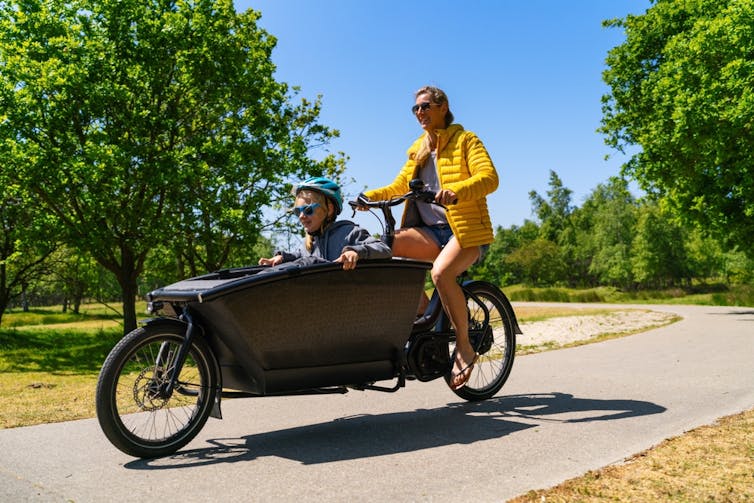
A woman riding a bike with a large cargo hold on the front which a child is sitting in.
Precious cargo. R.Classen/Shutterstock

Second, e-bike incentives can be designed to appeal especially to the lower-paid, who have been found to use their e-bikes more than wealthier buyers, which would also replace more car trips. The highest of a sliding scale of means-tested incentives in a Canadian study attracted poorer first-time e-bike buyers with existing high car-use.

This reaped average annual carbon savings of 1,456kg for those in receipt of the maximum CAN$1,600 (£868). As the authors suggest, these incentives may have helped low-income households realise their preferences for less dependence on cars.

E-bike grants could get more people out of cars

But how many drivers want to drive less? According to research that groups people into camps based on travel preferences, up to 50% of travellers in the UK are “malcontented motorists” and “active aspirers” (to travel differently).

A man in a suit and helmet attending his e-bike.
Research has shown great potential for wider e-bike ridership. Halfpoint/Shutterstock

Our research also found that guilt, or trying to minimise car use, was a major motivator for nearly all of our participants. While the government has funded free e-(cargo) bike trials like ours, the main cycling organisations we talked to pointed out that use would “fall off a cliff” when the trial ends because of the cost barrier. Those who would struggle to buy one were back in the same position as before.

A government evaluation of free e-bike loans concluded they were poor value for money, but it tracked purchases made soon after with a tiny response rate. Our project followed up after a year and found 20% of our borrowers had bought an e-cargo bike. Trial loans and grants together might achieve even more.

The new EV grant money could provide nearly 750,000 e-bike or e-cargo bike purchase-incentives the size of the Canadian ones, which could lead to annual carbon savings of 1.125 million tonnes of CO₂, according to the weekly average savings they found in that group.

Given the conservative benefit to cost ratio of 5.5:1 from such a UK scheme, this investment could also reap more than £3.6 billion in social benefits – especially from a fitter car-dependent population. There would potentially be a massive boost to the struggling UK e-bike and e-cargo bike market as well.


Don’t have time to read about climate change as much as you’d like?
Get a weekly roundup in your inbox instead. Every Wednesday, The Conversation’s environment editor writes Imagine, a short email that goes a little deeper into just one climate issue. Join the 45,000+ readers who’ve subscribed so far.


Noel Flay Cass, Research Fellow in Energy Demand Behaviour, University of Leeds

This article is republished from The Conversation under a Creative Commons license. Read the original article.

Continue ReadingSubsidising e-bikes instead of cars could really kick the electric vehicle transition into high gear