Orcas comment on killer apes destroying the planet by continuing to burn fossil fuels.
UK Chancellor Rachel Reeves has today announced the expansion of Heathrow airport. The climate cannot tolerate that. We have a Burn, baby Burn pyromaniac in the States and seriously intellectually challenged politicians worldwide.
10.20pm GMT Correction: Rachel Reeves announced that the government would support the expansion of Heathrow and other airports.
Commenting ahead of the Chancellor’s speech on growth when she is expected to signal government backing for airport expansion in the South East, including a third runway at Heathrow, Greenpeace UK’s chief scientist Dr Doug Parr said:
“The third runway at Heathrow is bad economics. There’s little evidence that airport expansion in the southeast will boost the economy – the only things that will grow for sure are noise, air pollution and climate emissions. The last thing our economy needs is more billions in damage from storms and floods.
“Fewer and fewer business people choose air travel – the vast majority of flights are taken by a wealthy elite of frequent leisure flyers. Most of the benefits of airport expansion will go to jet-setters, airlines and airport bosses, leaving taxpayers and holidaymakers to pay billions for new infrastructure and transport links.
“Chasing growth for growth’s sake is not an economic strategy. Instead of picking up any old polluting project from the discard pile, the Chancellor should focus on green industries that can attract investment and bring economic and social benefits for years to come, like secure jobs, affordable energy bills and cheaper, better transport.”
Orcas comment on killer apes destroying the planet by continuing to burn fossil fuels.
Planes queuing for takeoff at Heathrow airport in Britain. Credit: david pearson / Alamy Stock Photo
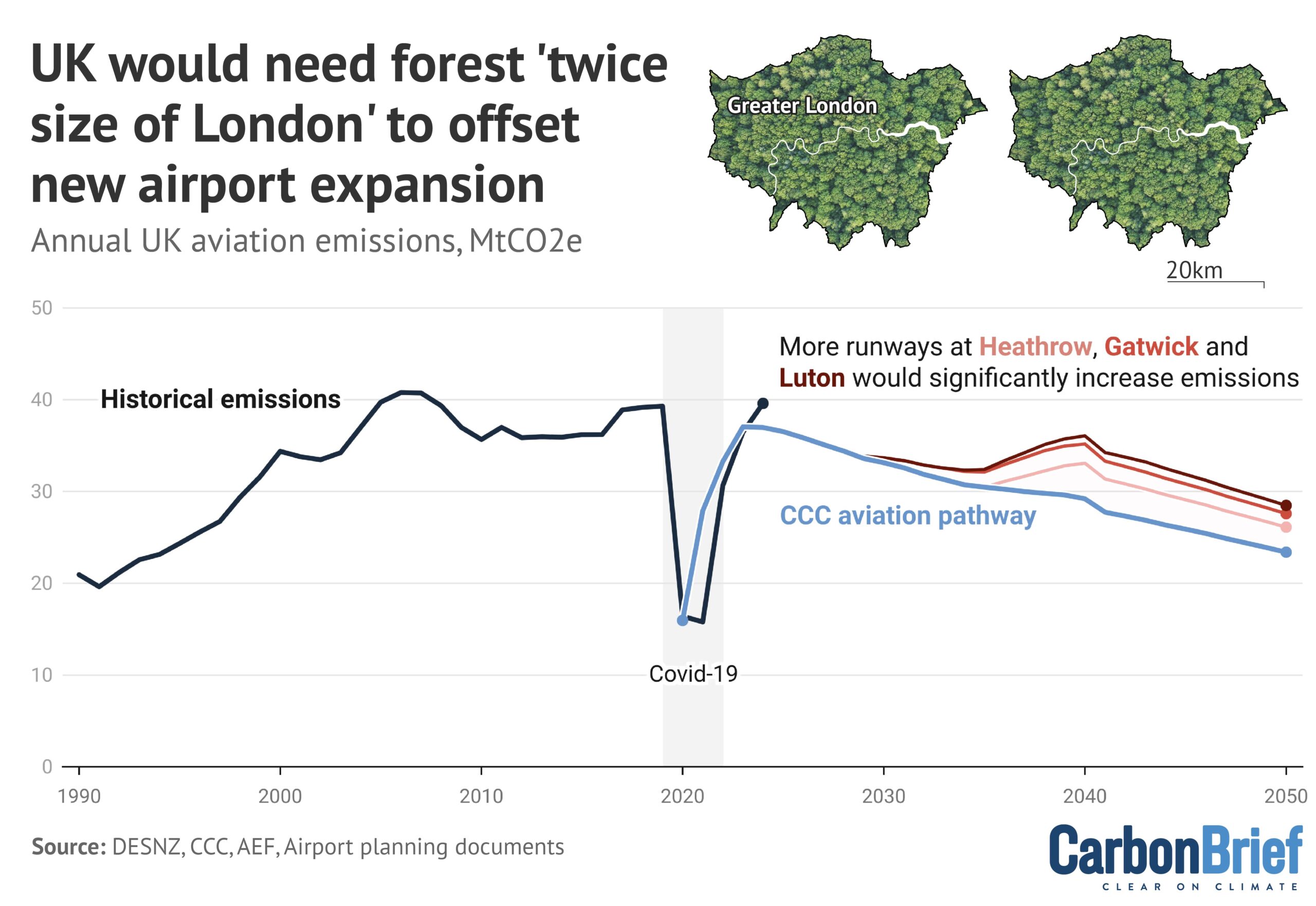
A forest twice the size of Greater London would need to be planted in the UK to cancel out the extra emissions from the expansion of Heathrow, Gatwick and Luton airports, Carbon Brief analysis reveals.
New runaways at these airports surrounding London would result in cumulative emissions of around 92m tonnes of extra carbon dioxide equivalent (CO2e) by 2050, if the number of flights increases in line with their operating company targets.
If the UK is to remain on track for net-zero, it would need to cut emissions further in other sectors of the economy or remove an equivalent amount from the atmosphere.
For example, offsetting these emissions would require more than 300,000 hectares of trees to be planted within just a few years. This equates to all the trees planted in the UK since 2000.
The Labour government is set to back all three airport expansions, according to mediareporting ahead of a speech by chancellor Rachel Reeves this week.
This is in spite of opposition from within the Labour party and the government’s climate advisors recommending against airport expansion.
Reeves has stressed that “sustainable aviation fuels” (SAFs) and electric planes could help to offset these emissions.
However, such technologies are still in the early stages of deployment and previous Carbon Brief analysis suggests the role of SAFs in achieving net-zero may be limited.
Two Londons
Reeves is expected to reveal plans for a third runway at Heathrow in a speech on Wednesday.
This, alongside suggestions she will also announce her support for the expansion of Gatwick and Luton airports, has prompted days of political debate over the friction between the government’s climate and economic plans.
Reeves sees the expansion of airports as a key part of the government’s “growth strategy”. However, senior Labour politicians, notably energy secretary Ed Miliband, have previously opposed such expansions on environmental grounds.
For her part, the chancellor told BBC News that she thought “sustainable aviation and economic growth go hand in hand”.
Carbon Brief has used estimates of passenger numbers from the airports’ planning applications, combined with assumptions used by UK government advisors the Climate Change Committee (CCC), to calculate emissions from the three expansions.
As the chart below shows, the CCC assumes aviation emissions fall in the coming years due to technological and efficiency improvements.
However, the expansion of Heathrow, Gatwick and Luton would drive an uptick in emissions around 2040 as the projects are completed, if the expected number of extra flights take off and if there are no additional improvements in aircraft efficiency.
This would amount to an additional 92MtCO2e being emitted cumulatively by 2050.
In order to remain on track for the UK’s net-zero target, these emissions would need to be avoided by additional technological innovations in the aviation sector, balanced by faster cuts in other parts of the economy – or removed from the atmosphere after being emitted.
Annual UK aviation emissions, MtCO2e. The blue line indicates the trajectory for emissions set out by the CCC. The three red lines indicate the additional emissions that would result from the expansion of Heathrow, Gatwick and Luton airports, plus the resulting flights. The airport expansions are assumed to follow approximate timelines based on their respective planning applications, with some dates assumed based on the views of AEF. The Heathrow expansion is assumed to be in operation in 2035 and at full capacity by 2040. The Gatwick expansion is assumed to be operational in 2028 and at full capacity by 2038. The Luton expansion is assumed to be operational in 2033 and at full capacity by 2043. Sources: DESNZ, CCC, AEF, airport planning documents.
Aviation is generally viewed as a difficult sector to decarbonise, due to the lack of cheap and effective technologies to cut emissions from planes.
This is why campaigners and researchers frequently stress demand reduction as the most effective way to cut aviation emissions.
The UK’s net-zero plans already allow for aviation to be one of the final sectors producing sizable volumes of emissions in 2050, when most of the economy has decarbonised.
One strategy to remove the excess emissions from the additional Heathrow, Gatwick and Luton flights would be to plant more trees. However, this would be a significant undertaking, as Carbon Brief analysis shows.
It would require planting around 301,000 hectares of new forest by around 2028 so that the trees are large enough by the middle of the century to absorb significant amounts of CO2.
This is equivalent to around twice the size of Greater London, which covers 157,000 hectares. It is 10 times higher than the UK’s most recent annual tree-planting target and equates to all of the trees planted in the past 24 years across the country.
More passengers
Government advisors at the CCC have recommended that there should be no more than a 25% growth in the number of air passengers from 2018 levels, in order to meet the UK’s net-zero goal by 2050.
This amounts to an increase from 292 million passengers to 365 million by 2050. The number of UK flights collapsed during Covid-19 lockdowns and has been slow to recover to pre-pandemic levels, but the number of air passengers in 2023 reached 273 million.
The CCC has consistentlystressed that there should be “no net increase” in airport capacity if the UK is to reach net-zero by the middle of the century, meaning any expansion is “balanced by reductions in capacity elsewhere”. It has also stated there should be no airport expansion without a UK-wide framework for managing capacity.
The committee criticised the previous Conservative government for setting “no plans” to limit growth in passenger numbers in its “jet-zero” strategy, which envisaged demand for flying increasing by 70% out to 2050.
Airport expansion at Heathrow, Gatwick and Luton would help bring the total number of passengers at these three sites up to 243 million in 2050, according to the airports’ own planning applications, compiled by the Aviation Environment Federation (AEF).
This amounts to an additional 100m passengers passing through these airports, compared to 2018 levels. This would bring the total number of UK passengers to 392 million – equivalent to a 34% increase in UK airport traffic – meaning that growth at Heathrow, Gatwick and Luton alone would be enough to breach the CCC’s guidance.
(In reality, more than 20 UK airports have plans for more capacity and some already have unused capacity, so it is unlikely that expansion would be limited to three airports around London.)
SAF concerns
The CCC leaves some flexibility in its advice to the government, allowing for future capacity growth, if “the carbon intensity of aviation is outperforming the government’s emissions reduction pathway”.
Essentially, if clean technologies slash aviation emissions faster than expected, then there will be space for more flights within a pathway to net-zero by 2050.
This has been alluded to by Reeves in recent days. She has stated that a “lot has changed in terms of aviation” and reportedly based an internal proposal to expand Heathrow on the use of “sustainable aviation fuels” (SAFs).
In reality, there has been very limited progress in developing SAFs or any other technologies to decarbonise planes in the UK. In 2023, the CCC chastised the Conservative government for “rel[ying] heavily on nascent technologies”.
Government modelling has shown SAFs will have a limited impact on cutting UK aviation emissions. Experts have pointed to the issues with the supply of materials for making SAFs and noted that none of the five SAF plants originally pegged to start construction in the UK this year are being built yet.
Methodology
This analysis is based on the CCC’s sixth carbon budget “balanced pathway” for the aviation sector, combined with data obtained from AEF on the expected increase in passenger numbers from the expansion of Heathrow, Gatwick and Luton airports.
The CCC pathway assumes that the emissions per passenger fall from 0.14 tCO2 in 2020 to 0.06tCO2 in 2050, accounting for the rollout of SAF and more efficient aircraft. It also assumes that no net expansion of airport capacity occurs.
Therefore, in this analysis, the three airport expansions are considered additional to the emissions included within the CCC pathway.
To calculate the additional emissions from the expansion of the three airports, the additional passenger numbers this would facilitate are multiplied by the emissions intensity per passenger in each year of the CCC pathway.
The additional passenger numbers from each airport are added to a Department for Transport pathway that assumes no further expansion. Each airport expansion is assumed to ramp up linearly from the year of operation to the year of operation at full additional capacity.
Based on the airport planning applications and AEF, it is assumed that:
The Heathrow expansion will be operational by 2035 and operating at full capacity by 2040.
The Gatwick expansion will be operational by 2028 and operating at full capacity by 2038.
The Luton expansion will be operational by 2033 and operating at full capacity by 2043.
The calculated CO2 removals from planting trees are based on assumptions used by the CCC’s sixth carbon budget “balanced pathway”, in which there is a 2:1 ratio of conifers to broadleaves planted across the country.
The CO2 removals per hectare for conifers and broadleaves are taken from the UK Centre for Ecology and Hydrology (CEH), whose numbers are also used by the CCC.
Based on these numbers, the cumulative emissions removed per hectare of forest after 22 years – from the start of airport expansion in 2028 to 2050 – is 304tCO2. Dividing this value by the total additional cumulative emissions from the airport expansion (92 MtCO2), gives a total area required of 301,000ha. Given that Greater London is 157,200ha, this corresponds to approximately two (1.91) times the area of Greater London.
Historical UK aviation emissions are taken from the Department of Energy Security and Net Zero (DESNZ) up to 2022. For 2023 and 2024, the emissions are estimated based on percentage annual changes in UK jet fuel use, which are then applied to the emissions from 2022.
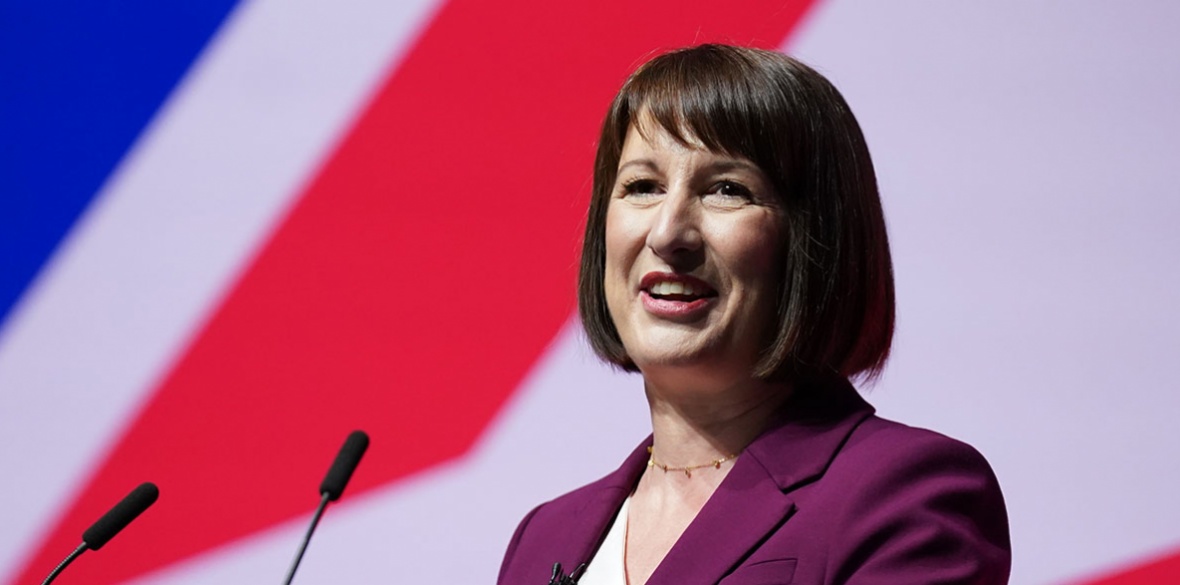
Chancellor of the Exchequer Rachel Reeves at the Labour Party Conference at the ACC Liverpool, September 23, 2024
…
One of Labour’s few redistributive policies attempting to tap the immense wealth of the filthy rich — a crackdown on the abuse of non-dom status to avoid tax — is to be softened, Chancellor Rachel Reeves says, because she has been “listening to the concerns” raised by the non-dom “community.”
She won’t listen to concerns over children trapped in poverty by the discriminatory two-child benefit cap.
Or over the impact of restricting winter fuel payments when energy prices are twice what they were a couple of years ago, even when those concerns convince her own party to vote against the policy at its conference, and prompt Labour’s biggest affiliate Unite to challenge the government in court.
Keir Starmer says pensioners can freeze to death and poor children can starve and be condemned to failure and misery all their lives.
Or even over the U-turn on compensating the Waspi women, despite leading Labour politicians having championed their cause for years.
Reeves’s selective approach to people’s concerns applies to the environment too, even as yet another severe storm closes schools and transport systems, and despite years of worsening floods and failing crops. Sod the science, says Reeves, growth trumps net zero.
Orcas comment on killer apes destroying the planet by continuing to burn fossil fuels.
Limiting action on the accelerating climate catastrophe to measures which don’t affect corporate profits is one reason the world continues to warm uncontrollably.
…
Labour’s growth policies across the board simply turn government into a doormat for big business. Rather than publicly fund infrastructure projects in the public interest, Labour will scrap regulations to weaken rights to object to construction by the private sector.
Keir Starmer, Angela Rayner and Rachel Reeves wear the uniform of the rich and powerful. They have all had clothes bought for them by multi-millionaire Labour donor Lord Alli. CORRECTION: It appears that Rachel Reeves clothing was provided by Juliet Rosenfeld.
The same deference to the right of construction firms to do as they please applies to housing. But it is not over-regulation which stymies house-building in Britain but land-banking aimed at keeping prices high. Urban development in major cities like London and Manchester is blighted by developers’ lack of accountability to communities, as working-class neighbourhoods are driven out by construction of luxury flats designed to accumulate value, not house locals.
Keir Starmer confirms that his government is cnutier than Suella Braverman on killing the right to protest.
The question of the day is democracy versus capitalism. Defending our communities and rights as citizens means building resistance through any means we can: trades councils, People’s Assembly branches, even Morning Star supporters’ groups can be hubs to bring activists together. The future is looking ugly if we cannot unite to do that.
“We must ask who these decisions would be made for and why. Whose advice is the Government listening to, when record-high wealth inequality is causing harm to the economy and society in many different ways, while frequent flying is the preserve of the super-rich?
“The aviation lobby is loud and well-funded, but the Government should instead be listening to scientists and its own Climate Change Committee, which has already urged a halt to overall airport expansion. The previous Labour government’s poor record on airport expansion doesn’t have to continue.
“If Ed Miliband is serious in his role as Net-Zero Minister, he will work to prevent the Chancellor and Transport Secretaries making a huge mistake, and advise the Chancellor to not make any dangerous new decisions until they have heard and listened to the new advice from the Climate Change Committee which is due in February.”
Orcas comment on killer apes destroying the planet by continuing to burn fossil fuels.